
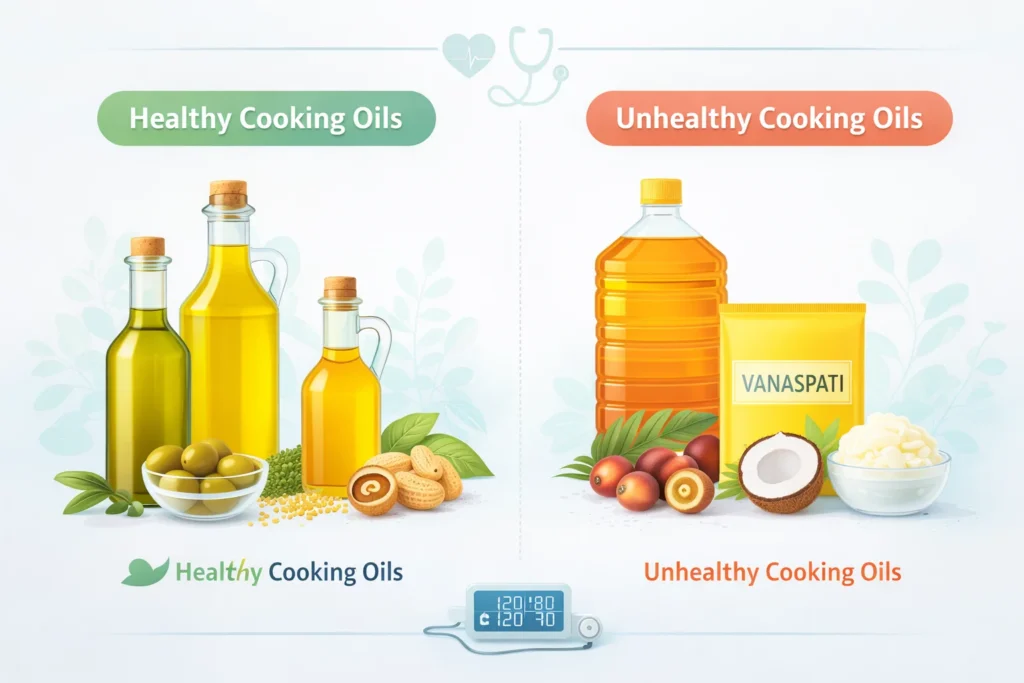
Walk down the cooking oil aisle and you’re met with dozens of choices — olive, avocado, canola, coconut, sunflower, palm, and more. Add social media claims calling some oils “toxic” and others “superfoods,” and the confusion becomes overwhelming.
To separate evidence from internet noise, cardiologists, clinical dietitians, and nutrition researchers consistently return to one principle:
Heart health depends on the type of fat — and how the oil is used.
Let’s break it down clearly.
The Science in 60 Seconds
The most heart-protective oils are rich in:
- Monounsaturated fats (MUFA)
- Polyunsaturated fats (PUFA)
These fats help:
- Lower LDL (“bad”) cholesterol
- Improve HDL cholesterol
- Reduce inflammation
- Decrease risk of atherosclerosis
Oils to limit are:
- High in saturated fats
- Repeatedly heated or over-processed
Now, here’s how 12 common oils rank.
The Heart-Healthy All-Stars
1. Extra Virgin Olive Oil (EVOO)
The gold standard.
EVOO is rich in oleic acid (MUFA) and loaded with polyphenols, which reduce oxidative stress and vascular inflammation. Strong evidence links regular olive oil intake with lower cardiovascular mortality.
Best use: Salad dressings, drizzling over food, light sautéing.
Avoid overheating to preserve antioxidants.
2. Avocado Oil
Nutritionally similar to olive oil but more heat stable.
High in oleic acid, vitamin E, and lutein. Its smoke point (~520°F / 270°C) makes it excellent for high-heat cooking without rapid breakdown.
Best use: Searing, grilling, stir-frying.
3. Canola Oil
Despite online controversy, evidence supports canola oil as heart-friendly.
It contains:
- Low saturated fat
- MUFAs
- Alpha-linolenic acid (ALA), a plant omega-3
Large cohort studies show replacing saturated fat with canola oil improves lipid profiles.
Best use: Baking, sautéing, everyday cooking.
4. Soybean Oil
Often criticized, but data show it reduces heart disease risk when replacing saturated fats.
High in polyunsaturated fats. Concerns about omega-6–induced inflammation are not supported by controlled human studies.
Best use: Moderate-heat cooking, dressings.
Avoid heavily processed fast-food versions.
5. Sunflower Oil
Rich in vitamin E and unsaturated fats.
Stable when not overheated and supports cardiovascular health when used in moderation.
Best use: Roasting, sautéing.
6. Safflower Oil
High in polyunsaturated fats and relatively neutral in flavor.
Improves cholesterol balance when replacing saturated fats.
Best use: Frying, baking, high-heat cooking.
7. Sesame Oil
Contains unique antioxidants: sesamin and sesamolin, which may support cholesterol regulation.
Primarily a flavor oil.
Best use: Stir-fries, marinades, finishing oil.
8. Peanut Oil
High smoke point and rich in monounsaturated fats.
Commonly recommended for high-heat cooking due to stability.
Best use: Deep-frying, wok cooking.
9. Mustard Oil
Popular in Indian cuisine. Contains monounsaturated fats and small amounts of omega-3 fatty acids.
Should be used in moderation due to its strong flavor.
Best use: Traditional sautéing and pickling.
The Oils to Rethink
10. Coconut Oil
Marketed as a health food — but clinically controversial.
It is approximately 90% saturated fat, which can raise LDL cholesterol in many individuals.
While it contains some medium-chain triglycerides (MCTs), cardiology guidelines generally recommend limiting routine use.
Verdict: Not a heart superfood. Use sparingly.
11. Palm Oil
High in saturated fat and particularly problematic when repeatedly heated.
Research shows reheated palm oil increases oxidative stress and inflammatory markers.
Verdict: Avoid frequent use, especially for frying.
12. The Real Silent Culprit: Reheated Oil
This is where doctors raise the strongest warning.
When any oil — even healthy ones — is repeatedly heated:
- Unsaturated fats oxidize
- Toxic byproducts form (e.g., lipid peroxidation compounds)
- Inflammation increases
- Vascular damage risk rises
This is common in:
- Fast food
- Street vendors
- Deep fryers where oil is reused all day
The issue isn’t just the fries — it’s the degraded oil.
Verdict: Never reuse oil repeatedly. Minimize deep-fried restaurant foods.
Practical Guidance: How to Choose Smartly
✔ Prioritize
Olive oil, avocado oil, canola oil, safflower oil.
✔ Use high smoke-point oils for high heat
Avocado, peanut, safflower.
✔ Limit
Coconut oil, palm oil, butter.
✔ Avoid
Repeatedly reheated oils.
The Bottom Line
Your heart health isn’t determined by one bottle of oil. It’s shaped by:
- Fat type
- Cooking temperature
- Oil reuse
- Overall dietary pattern
Replace saturated fats with unsaturated plant oils. Avoid repeatedly heated oils. Focus on minimally processed foods.
When chosen and used correctly, cooking oils can shift from silent harm to powerful cardiovascular protection.

Dr. Mohammed Abdul Azeem Siddiqui, MBBS, M.Tech (Biomedical Engineering – VIT, Vellore)
Registered Medical Practitioner – Reg. No. 39739
Physician • Clinical Engineer • Preventive Diagnostics Specialist
Dr. Mohammed Abdul Azeem Siddiqui is a physician–engineer with over 30 years of dedicated clinical and biomedical engineering experience, committed to transforming modern healthcare from late-stage disease treatment to early detection, preventive intelligence, and affordable medical care.
He holds an MBBS degree in Medicine and an M.Tech in Biomedical Engineering from VIT University, Vellore, equipping him with rare dual expertise in clinical medicine, laboratory diagnostics, and medical device engineering. This allows him to translate complex laboratory data into precise, actionable preventive strategies.
Clinical Mission
Dr. Siddiqui’s professional mission centers on three core pillars:
Early Disease Detection
Identifying hidden biomarker abnormalities that signal chronic disease years before symptoms appear — reducing complications, hospitalizations, and long-term disability.
Preventive Healthcare
Guiding individuals and families toward longer, healthier lives through structured screenings, lifestyle intervention frameworks, and predictive diagnostic interpretation.
Affordable Evidence-Based Treatment
Delivering cost-effective, scientifically validated care accessible to people from all socioeconomic backgrounds.
Clinical & Technical Expertise
Across three decades of continuous practice, Dr. Siddiqui has worked extensively with:
Advanced laboratory analyzers and automation platforms
• Cardiac, metabolic, renal, hepatic, endocrine, and inflammatory biomarker systems
• Preventive screening and early organ damage detection frameworks
• Clinical escalation pathways and diagnostic decision-support models
• Medical device validation, calibration, compliance, and patient safety standards
He is recognized for identifying subclinical biomarker shifts that predict cardiovascular disease, diabetes, fatty liver, kidney disease, autoimmune inflammation, neurodegeneration, and accelerated biological aging long before conventional diagnosis.
Role at IntelliNewz
At IntelliNewz, Dr. Siddiqui serves as Founder, Chief Medical Editor, and Lead Clinical Validator. Every article published is:
Evidence-based
• Clinically verified
• Technology-grounded
• Free from commercial bias
• Designed for real-world patient and physician decision-making
Through his writing, Dr. Siddiqui shares practical health intelligence, early warning signs, and preventive strategies that readers can trust — grounded in decades of frontline medical practice.
Contact:
powerofprevention@outlook.com
📌 Disclaimer: The content on IntelliNewz is intended for educational purposes only and does not replace personalized medical consultation. For individual health concerns, please consult your physician.