
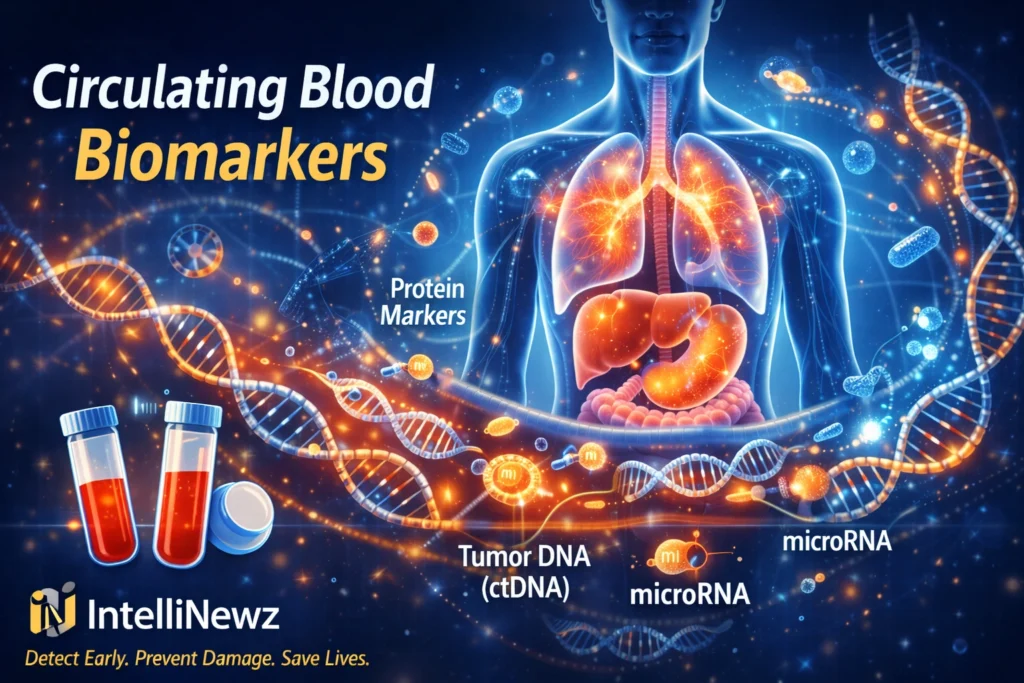

The Power of Blood in Predictive Medicine
The bloodstream is more than just a transport system — it is a liquid archive of your health.
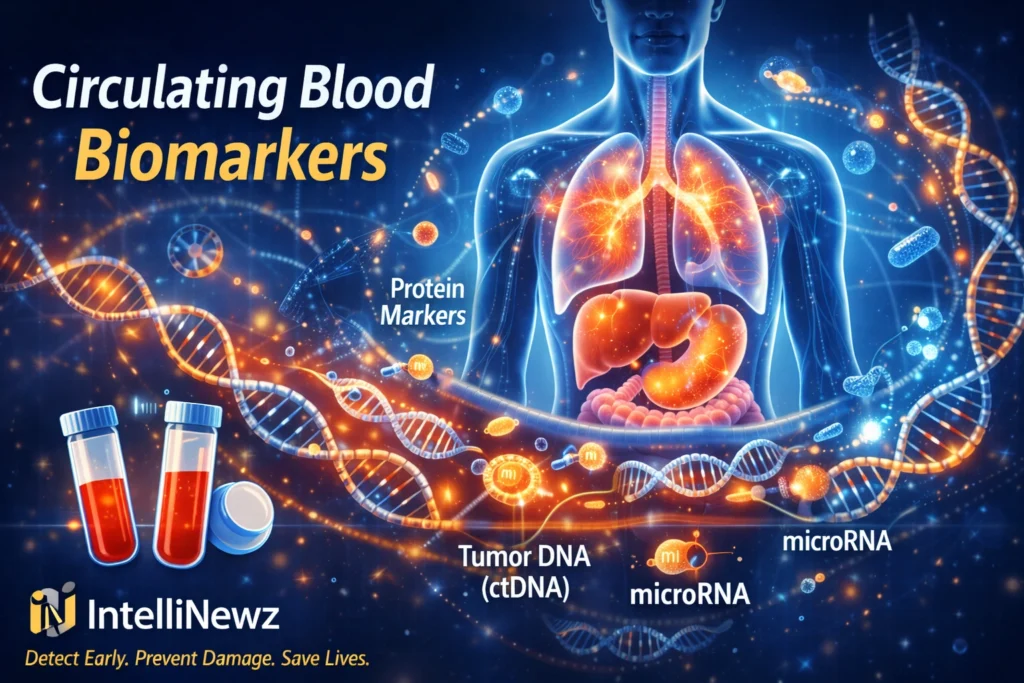
Circulating blood biomarkers are measurable molecules, proteins, DNA fragments, or metabolites in the blood that reveal organ stress, early disease, and even silent cancer long before symptoms appear.
Preventive medicine is shifting its focus from treating illness to decoding blood signals for early intervention.
What Are Circulating Blood Biomarkers?
A circulating blood biomarker is any substance in the blood that provides measurable evidence of biological or pathological processes.
These biomarkers can indicate:
- Early organ damage (heart, kidney, liver)
- Inflammation or immune system activation
- Metabolic disturbances
- Cancer presence or progression
- Genetic or epigenetic risk
Examples: PSA for prostate cancer, CA-125 for ovarian cancer, hs-CRP for inflammation, and ctDNA for hidden tumors.
Major Categories of Circulating Blood Biomarkers
1. Protein Biomarkers
Proteins in blood that reflect organ damage or cancer presence.
| Biomarker | Clinical Use |
|---|---|
| PSA | Early prostate cancer detection |
| CA-125 | Ovarian cancer screening |
| CEA | Colon cancer monitoring |
| AFP | Liver cancer |
| hs-CRP | Inflammation & cardiovascular risk |
| Troponin | Early heart damage detection |
2. Circulating Tumor DNA (ctDNA)
- Fragments of tumor DNA released into blood by dying cancer cells.
- Detects cancers years before symptoms appear.
- Guides treatment monitoring and recurrence prediction.
Example: A patient with elevated ctDNA levels but normal imaging can have early-stage colon or lung cancer detected through liquid biopsy.
3. Metabolic Biomarkers
Blood metabolites that reflect organ function or metabolic stress.
| Biomarker | Clinical Use |
|---|---|
| Glucose & HbA1c | Diabetes risk & progression |
| Lipid profile (LDL, HDL, triglycerides) | Cardiovascular risk |
| Amino acid profiles | Cancer risk & muscle metabolism |
| Hormones (Insulin, Leptin, Adiponectin) | Obesity and metabolic syndrome risk |
4. Inflammatory Biomarkers
Early indicators of tissue stress or chronic low-grade inflammation.
| Biomarker | Clinical Use |
|---|---|
| hs-CRP | Cardiovascular disease & cancer risk |
| IL-6, TNF-α | Chronic inflammatory conditions |
| ESR | Autoimmune and systemic inflammation |
5. Circulating microRNAs (miRNAs)
- Small RNA molecules regulating gene expression.
- Detect early cancer, cardiovascular disease, and neurodegeneration.
Example: miR-21 is often elevated in breast and colorectal cancers, serving as an early warning signal.
Advantages of Circulating Blood Biomarkers
- Early Detection: Identify diseases years before symptoms.
- Minimally Invasive: Require only a blood draw.
- Monitoring: Track treatment response or recurrence.
- Personalized Medicine: Guide preventive or therapeutic interventions.
Who Should Consider Circulating Biomarker Screening?
- Individuals with family history of cancer or cardiovascular disease
- Patients with obesity, diabetes, or chronic inflammation
- Adults 35+ seeking longevity and preventive health monitoring
- Anyone interested in precision preventive medicine
Future Trends: AI + Liquid Biopsy
AI algorithms now analyze hundreds of circulating biomarkers simultaneously, predicting:
- Cancer development
- Organ damage risk
- Therapy response
- Disease progression
This is the era of truly predictive medicine — blood is the window into your future health.
Conclusion
Circulating blood biomarkers have transformed preventive medicine. They turn your blood into a predictive health dashboard, detecting disease before it strikes, guiding early interventions, and saving lives.
At IntelliNewz, we decode these complex blood signals into actionable, physician-guided preventive intelligence, empowering you to detect, prevent, and reverse disease early.
INTELLINEWZ — CIRCULATING BLOOD BIOMARKER MASTER Q&A
1. What is the single most under-recognized blood biomarker that predicts early mortality?
Chronic low-grade systemic inflammatory activation is the most under-recognized early mortality predictor. It precedes cardiovascular disease, cancer initiation, metabolic failure, neurodegeneration, and immune collapse by years.
2. Which biomarker signals irreversible organ damage earliest?
Endothelial and microvascular injury biomarkers signal irreversible organ damage earlier than organ-specific enzymes.
3. What percentage of “normal” lab reports hide silent pathology?
A significant proportion of asymptomatic adults with “normal” laboratory reports carry silent inflammatory, metabolic, or vascular injury that later evolves into chronic disease.
4.Which routine lab tests are most misleading?
4. Which routine lab tests are most misleading?
Fasting glucose, standard lipid profile, and serum creatinine when interpreted without inflammatory, vascular, and metabolic context.
5. Which circulating marker is most reliable for ultra-early cancer detection?
Circulating tumor genetic material detected by liquid biopsy platforms.
6. Should ctDNA be part of routine screening?
Yes. Liquid biopsy screening is becoming foundational in predictive oncology.
7. Which marker combinations best predict colon cancer before imaging?
Tumor-associated proteins combined with circulating tumor DNA and inflammatory clustering.
8. Which markers suggest pan-organ malignant tendency?
Persistent inflammatory–genomic convergence patterns.
9. Which cancers are most easily detected early by blood?
Colon, prostate, liver, ovarian, lung, and hematologic malignancies.
10. Which biomarker best predicts silent myocardial injury?
High-sensitivity myocardial injury biomarkers and vascular fibrosis markers.
11. Is NT-proBNP useful in asymptomatic individuals?
Yes. It identifies silent ventricular stress before symptomatic heart failure develops.
12. Which marker predicts sudden cardiac death earliest?
Vascular fibrosis and myocardial stress biomarkers.
13. Which lipid-related biomarker is more predictive than LDL?
Atherogenic particle concentration and lipoprotein inflammatory burden are more predictive than LDL alone.
14. Which biomarker reveals kidney injury before creatinine rises?
Tubular micro-injury biomarkers and early albumin leakage patterns.
15. What is the role of Cystatin-C in risk detection?
It reveals early decline in renal filtration long before creatinine becomes abnormal.
16. Which metabolic biomarker predicts diabetic organ failure earliest?
Insulin resistance and adipose hormonal dysregulation markers.
17. Which marker predicts fatty liver turning malignant?
Liver stress biomarkers combined with insulin resistance and inflammatory clustering.
18. Which blood biomarker best detects early Alzheimer’s disease?
Neurofilament and phosphorylated tau family biomarkers.
19. Is plasma p-Tau clinically valuable?
Yes. It enables pre-symptomatic detection of neurodegenerative pathology.
20. Which biomarker indicates silent brain inflammation?
Glial activation and neuro-inflammatory markers.
21. What hs-CRP levels are dangerous even if considered “normal”?
Any persistent elevation reflecting chronic low-grade inflammation is clinically significant.
22. Which cytokine predicts immune exhaustion earliest?
Chronic IL-6 and TNF-α activation patterns.
23. Which inflammatory marker is most linked to cancer initiation?
Persistent systemic inflammatory dominance patterns.
24. Which biomarker best predicts biological age?
Composite inflammatory-metabolic-vascular biomarker panels.
25. Which blood marker predicts lifespan reduction earliest?
Persistent systemic inflammatory activation combined with metabolic stress markers.
26. Which three biomarkers would you screen annually in every adult?
- Ultra-sensitive inflammatory dominance panel
- Insulin-resistance and metabolic stress markers
- Endothelial / vascular injury markers