
I. How the Device Works
1. Can The Temple really measure brain blood flow in real time?
Yes, The Temple uses near-infrared spectroscopy (NIRS) and optical sensors to detect cerebral hemoglobin oxygenation changes. These signals indirectly reflect cerebral blood flow (CBF). However, it is important to note that it does not directly measure volumetric blood flow like an MRI or PET scan—the device infers flow from changes in oxygenation and light absorption.
2. How accurate are its ageing predictions?
Ageing predictions are based on trends in cerebral perfusion and vascular dynamics. While correlations exist between reduced CBF and age-related cognitive decline, current data is preliminary, and it cannot provide exact “brain age” numbers with full clinical accuracy.
3. How frequently does it sample data? Continuous or intermittent?
The device samples multiple times per second (high-frequency sampling), giving near-continuous monitoring, but data is often averaged for trend analysis to reduce noise.
4. How does it compensate for motion or signal noise?
Advanced signal processing algorithms filter out artifacts caused by head movement, blinking, or ambient light. Still, intense movement may reduce accuracy, so it’s more reliable at rest or during low-movement activities.
5. Does it integrate other physiological signals?
Yes, modern versions integrate heart rate, oxygen saturation, and accelerometer data to contextualize CBF changes.
6. Depth of measurement: cortical vs subcortical?
NIRS-based devices primarily measure superficial cortical layers, up to 2–3 cm deep. Subcortical perfusion is not directly measurable with this wearable.
II. Validation & Scientific Basis
7. Has it been validated in clinical trials?
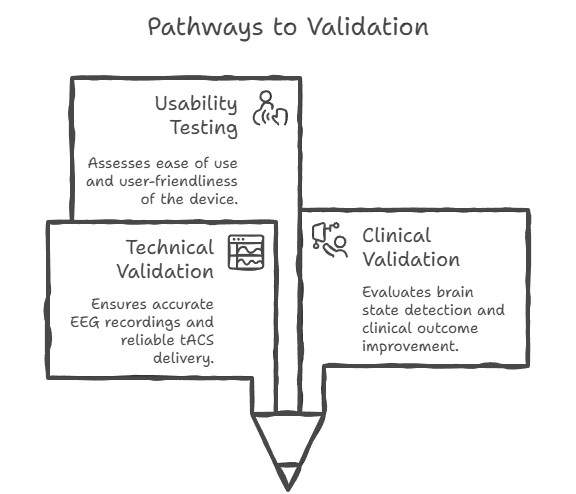
Some pilot studies and laboratory validations exist, but large-scale, peer-reviewed clinical trials are still pending. Current claims rely on preliminary experimental data.
8. How does it compare to fMRI, PET, or Doppler?
Compared to these gold-standard techniques, The Temple offers convenience and portability but lower spatial resolution and precision. It is better suited for trends and relative changes rather than absolute quantitative measurements.
9. Can it detect subtle changes in cerebral perfusion related to ageing?
Yes, changes in cerebral oxygenation and perfusion correlate with vascular ageing, but results should be interpreted cautiously. It is not a diagnostic tool for neurodegenerative diseases yet.
10. How sensitive is it to daily fluctuations?
CBF fluctuates naturally with posture, stress, and activity. The device uses baseline normalization to identify significant deviations rather than daily minor variations.
III. Health & Ageing Claims
11. How does gravity affect brain ageing?
Gravity influences blood distribution, intracranial pressure, and cerebrovascular dynamics. Prolonged upright posture or impaired venous drainage can subtly affect perfusion over time. While intriguing, this is a theoretical concept; conclusive evidence linking gravity to accelerated ageing is limited.
12. Can it predict risk of Alzheimer’s or cognitive decline?
Not yet. Reduced cortical perfusion correlates with cognitive decline, but The Temple cannot diagnose or predict neurodegenerative diseases—it only tracks trends.
13. How does it define “ageing” physiologically?
Ageing here is assessed via cerebral perfusion trends, vascular elasticity, and oxygenation patterns. These are proxies, not definitive age markers.
IV. Safety & Risks
14. Are there risks from prolonged use?
The device is non-invasive and low-power, so direct harm is minimal. Minor skin irritation or discomfort from headbands may occur.
15. Could continuous monitoring trigger anxiety?
Yes. Users may over-interpret small fluctuations, leading to unnecessary stress or health anxiety.
16. Could false readings cause harm?
Potentially, if users replace medical advice with device data. This is why clinical validation and physician interpretation are crucial.
17. Are there contraindications?
People with cranial implants, severe skin conditions, or certain neurological disorders should consult a physician before use.
V. Data, Privacy, and Integration
18. How is the data processed?
Processing can be on-device for immediate feedback or cloud-based for deeper trend analysis. Machine learning algorithms help identify patterns in CBF over time.
19. How secure is personal data?
Security depends on device encryption and cloud policies. HIPAA-compliant storage is recommended, but privacy concerns remain.
20. Can clinicians use the data?
Currently, it is mostly for personal insights, though trends could complement clinical evaluations if validated.
21. Can it integrate with other health platforms?
Yes, integration with EMRs, fitness trackers, and research platforms is possible for longitudinal monitoring.
VI. Usability & Practicality
22. Form factor and comfort?
It is usually a lightweight headband or temple patch, designed for comfort during daily wear.
23. Battery life?
Ranges from 8–12 hours continuous use, depending on sampling frequency and connectivity.
24. Environmental robustness?
Works under normal indoor conditions; excessive sunlight or high humidity may affect optical sensors.
25. Can it be worn during exercise or sleep?
Yes, but motion artifacts increase during high-intensity activity. Sleep tracking is feasible for perfusion trends.
VII. Limitations & Future Directions
26. Can it detect deep brain perfusion or microvascular changes?
No, current NIRS-based wearables cannot reliably measure deep brain or microvascular flow.
27. Could it replace lab imaging?
Not yet. It is complementary, not a replacement for MRI, PET, or Doppler imaging.
28. Will AI improve predictions?
Yes. Machine learning models could use longitudinal CBF data to identify early vascular changes or ageing patterns.
29. Could this technology monitor other organs?
Potentially. NIRS and optical sensors could track muscle perfusion, cardiac output, or peripheral circulation in future versions.
VIII. Shocking Truths & Consumer Concerns
30. Is it exaggerating its abilities?
Partially. While it measures trends reliably, absolute cerebral blood flow and ageing predictions are still experimental.
31. Could your wearable “lie” about brain health?
Yes, if users misinterpret minor fluctuations as clinically significant changes.
32. Is continuous monitoring necessary for healthy adults?
Probably not. For healthy individuals, occasional monitoring may suffice; continuous tracking is more useful in research or high-risk populations.
✅ Summary
The Temple wearable is an exciting experimental device offering insights into cerebral blood flow trends and potential markers of ageing. However:
- It cannot replace clinical imaging or diagnosis.
- Continuous monitoring may cause anxiety if misinterpreted.
- Its accuracy for deep brain or age prediction is limited.
- Data security, calibration, and professional interpretation are essential.
When used responsibly, it is a powerful tool for personal health trends and research rather than a medical diagnostic device.