

The Temple Wearable: Functionality, Science, Safety, Validation, Clinical Relevance, and Future Implications
This document provides a comprehensive overview of the Temple wearable, exploring its functionality, underlying scientific principles, safety considerations, validation studies, clinical relevance, and potential future implications. It aims to provide a balanced perspective on the device’s capabilities and limitations, highlighting its potential benefits while acknowledging areas requiring further research and development.
Functionality
The Temple wearable is a non-invasive device designed to monitor and potentially modulate brain activity. Its core functionality revolves around two key aspects:
- Electroencephalography (EEG) Recording: The device utilizes dry or gel-based electrodes to detect electrical activity on the scalp. This EEG data is then processed and analyzed to provide insights into various brain states, such as sleep stages, cognitive workload, and emotional responses. The number of channels and sampling rate of the EEG recording vary depending on the specific model and intended application.
- Transcranial Alternating Current Stimulation (tACS): Some Temple wearable models incorporate tACS capabilities. This involves delivering a weak alternating current to specific brain regions through the electrodes. The aim is to modulate neuronal excitability and potentially influence cognitive functions or alleviate symptoms of neurological or psychiatric disorders. The stimulation parameters, including frequency, intensity, and duration, are carefully controlled and adjusted based on individual needs and research protocols.
Beyond these core functionalities, the Temple wearable often includes additional features such as:
- Data Logging and Storage: The device typically stores EEG data and stimulation parameters internally or transmits them wirelessly to a connected device (e.g., smartphone, computer) for further analysis and storage.
- Real-time Feedback: Some models provide real-time feedback to the user based on the EEG data, allowing for biofeedback training or adaptive stimulation protocols.
- Connectivity: Wireless connectivity (e.g., Bluetooth) enables seamless integration with other devices and platforms, facilitating data sharing and remote monitoring.
Science
The Temple wearable’s functionality is grounded in established scientific principles:
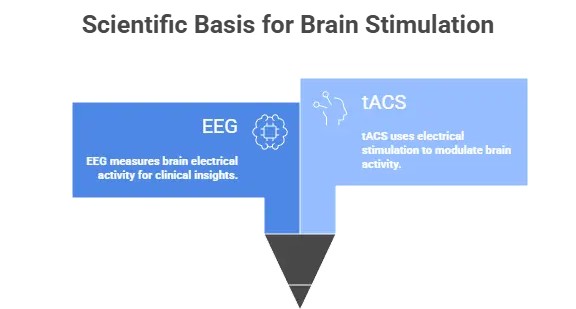
- EEG: EEG measures the summed electrical activity of large populations of neurons in the brain. Different brain states and cognitive processes are associated with distinct EEG patterns, characterized by specific frequencies (e.g., alpha, beta, theta, delta) and amplitudes.
- tACS: tACS is believed to modulate neuronal excitability by influencing the resting membrane potential of neurons. The alternating current can either depolarize or hyperpolarize neurons, making them more or less likely to fire. The effects of tACS depend on several factors, including the stimulation frequency, intensity, duration, and the targeted brain region. The exact mechanisms of action of tACS are still under investigation, but it is thought to involve changes in synaptic plasticity and network connectivity.
The scientific basis for using EEG and tACS to address specific clinical conditions is an area of ongoing research. While promising results have been reported in some studies, further investigation is needed to fully understand the efficacy and mechanisms of action of these techniques.
Safety
Safety is a paramount concern in the development and application of the Temple wearable. Key safety considerations include:
- Electrode Placement: Proper electrode placement is crucial to ensure accurate EEG recording and targeted tACS delivery. Incorrect placement can lead to inaccurate data or unintended stimulation effects.
- Stimulation Parameters: The intensity, frequency, and duration of tACS must be carefully controlled to avoid adverse effects such as skin irritation, headaches, or, in rare cases, seizures.
- Individual Variability: Individuals may respond differently to tACS due to variations in brain anatomy, physiology, and medication use. It is important to screen individuals for contraindications and to monitor them closely during stimulation.
- Device Malfunction: The device should be designed with safety features to prevent malfunction and ensure that stimulation is automatically terminated in case of any technical issues.
Rigorous safety testing and adherence to established safety guidelines are essential to minimize the risks associated with the Temple wearable.
Validation
Validation studies are crucial to demonstrate the accuracy, reliability, and efficacy of the Temple wearable. These studies typically involve:
- Technical Validation: Assessing the accuracy and reliability of EEG recordings and tACS delivery. This may involve comparing the device’s performance to that of established EEG systems and stimulation devices.
- Clinical Validation: Evaluating the device’s ability to detect and monitor specific brain states or to improve clinical outcomes in target populations. This may involve conducting randomized controlled trials to compare the device’s effectiveness to that of sham stimulation or standard treatments.
- Usability Testing: Assessing the ease of use and user-friendliness of the device. This may involve gathering feedback from users on the device’s design, functionality, and overall experience.
The results of validation studies are essential to inform clinical decision-making and to guide the development of future iterations of the Temple wearable.
Clinical Relevance
The Temple wearable has the potential to be clinically relevant in a variety of applications, including:
- Sleep Monitoring and Treatment: The device can be used to monitor sleep stages and to provide personalized feedback or stimulation to improve sleep quality.
- Cognitive Enhancement: tACS may be used to enhance cognitive functions such as attention, memory, and learning.
- Treatment of Neurological and Psychiatric Disorders: The device may be used to alleviate symptoms of depression, anxiety, chronic pain, and other conditions.
- Brain-Computer Interfaces (BCIs): The EEG data from the device can be used to control external devices, such as computers or prosthetic limbs.
However, it is important to note that the clinical efficacy of the Temple wearable is still under investigation for many of these applications. Further research is needed to determine the optimal stimulation parameters and to identify the individuals who are most likely to benefit from the device.
Future Implications
The Temple wearable has the potential to revolutionize the way we monitor and modulate brain activity. Future implications include:
- Personalized Medicine: The device can be used to tailor treatments to individual needs based on their unique brain activity patterns.
- Remote Monitoring and Telehealth: The device can be used to remotely monitor patients’ brain activity and to provide telehealth interventions.
- Preventive Healthcare: The device can be used to identify individuals at risk for developing neurological or psychiatric disorders and to provide early interventions.
- Brain-Computer Interfaces for Everyday Use: The device can be used to develop BCIs that allow individuals to control everyday devices with their thoughts.
The Temple wearable represents a significant advancement in the field of neurotechnology. As research continues and the technology matures, it has the potential to transform the way we understand and treat brain disorders. However, careful consideration must be given to ethical and societal implications as the technology becomes more widely adopted.