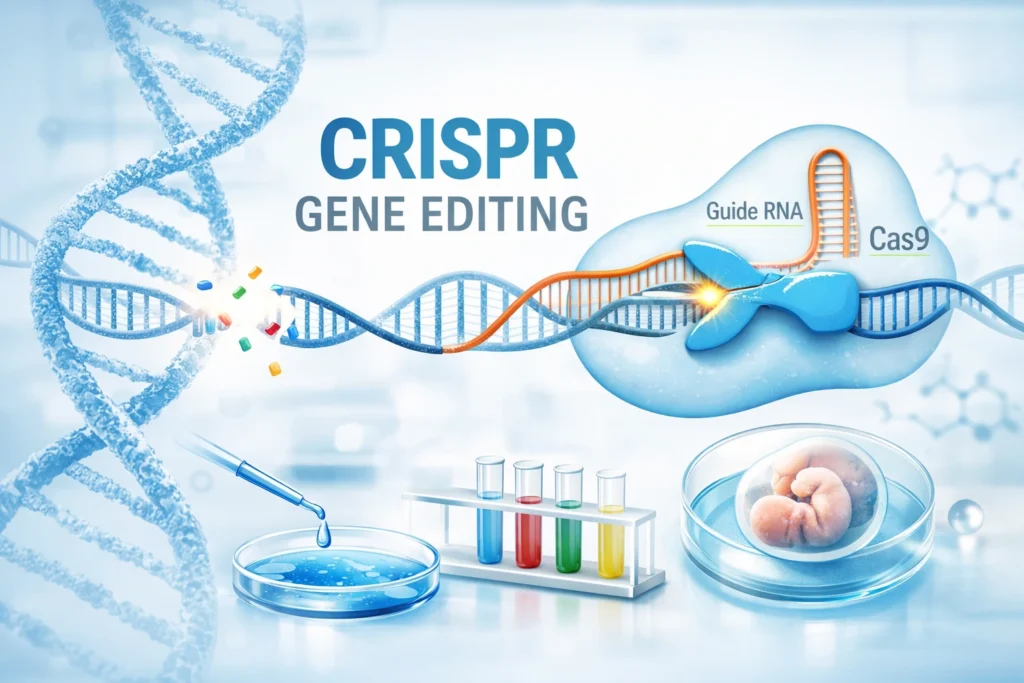

CRISPR-Cas9, often shortened to CRISPR, represents a revolutionary gene-editing technology with the potential to transform medicine and various other fields.
CRISPR stands for
Clustered Regularly Interspaced Short Palindromic Repeats.
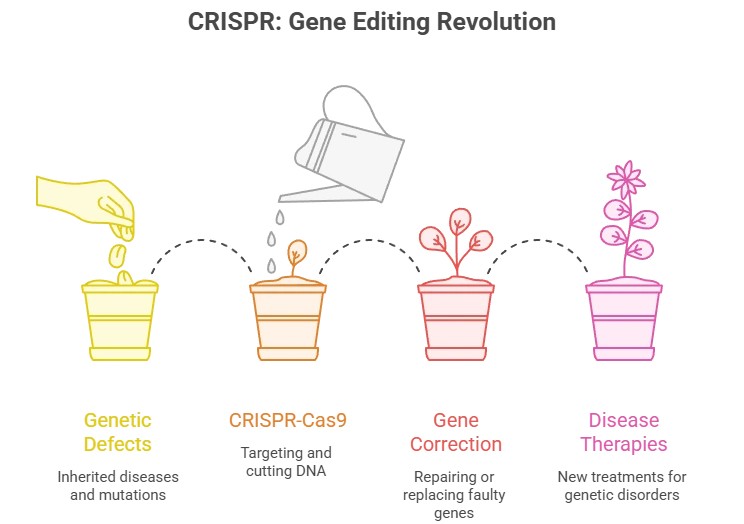
CRISPR is one of the most powerful scientific discoveries of the 21st century. It allows scientists to edit DNA with incredible precision, making it possible to fix genetic diseases, fight cancer, and even prevent inherited disorders before a baby is born.
This document aims to provide a comprehensive overview of CRISPR, explaining its underlying mechanisms, its applications, its advantages, and the ethical considerations surrounding its use. From correcting genetic defects to developing new disease therapies, CRISPR holds immense promise, but also raises important questions about the future of genetic engineering.
CRISPR stands for Clustered Regularly Interspaced Short Palindromic Repeats. It is a naturally occurring defense mechanism found in bacteria and archaea, used to protect themselves from viral infections. Scientists have adapted this system into a powerful gene-editing tool that can be used to precisely alter DNA sequences in a wide range of organisms, including humans.
At its core, CRISPR consists of two key components:
Cas9 enzyme: This is a protein that acts like molecular scissors, capable of cutting DNA at a specific location.
Guide RNA (gRNA): This is a short RNA sequence that is designed to match the specific DNA sequence you want to edit. The gRNA guides the Cas9 enzyme to the correct location in the genome.
How Does CRISPR Work?CRISPR is a biological tool that lets scientists cut and change DNA inside living cells.
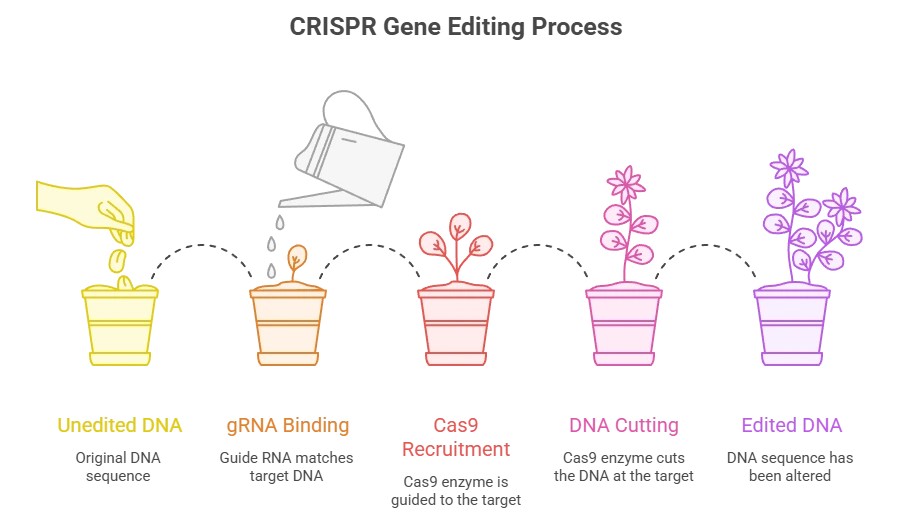
Think of DNA as the instruction manual for the human body. CRISPR works like a “find and replace” function in a word document—it can locate a specific sentence (a gene) and edit or remove it.
The CRISPR-Cas9 system works through a relatively straightforward process:
Design the gRNA: Researchers design a gRNA that is complementary to the target DNA sequence they want to edit. This gRNA is typically about 20 nucleotides long.
Deliver the CRISPR-Cas9 complex: The gRNA and Cas9 enzyme are introduced into the cell. This can be done using various methods, such as viral vectors or direct injection.
Targeting and Cutting: The gRNA guides the Cas9 enzyme to the target DNA sequence. The Cas9 enzyme then cuts both strands of the DNA at the specified location.
DNA Repair: Once the DNA is cut, the cell’s natural DNA repair mechanisms kick in. There are two main pathways for DNA repair:
- Non-homologous end joining (NHEJ): This is a quick and dirty repair mechanism that often introduces small insertions or deletions (indels) at the cut site. This can disrupt the gene, effectively knocking it out.
Homology-directed repair (HDR): If a DNA template with the desired sequence is provided along with the CRISPR-Cas9 complex, the cell can use this template to repair the break. This allows researchers to precisely edit the DNA sequence.
Where Did CRISPR Come From?
CRISPR was not invented in a lab—it was discovered in bacteria.
Bacteria use CRISPR as a defense system. When viruses attack them, bacteria store pieces of viral DNA and use CRISPR to recognize and destroy future invaders.
Scientists realized this natural system could be adapted to edit any DNA, including human genes.
How Does CRISPR Work?
CRISPR has two main parts:
- Guide RNA – This is like a GPS. It tells CRISPR where to go in the DNA.
- Cas9 enzyme – This is the scissors that cut the DNA.
Here’s what happens:
- The guide RNA finds the exact gene that needs editing
- Cas9 cuts the DNA at that location
- The cell repairs the DNA
- Scientists can insert, delete, or correct a gene during this repair
This allows scientists to:
- Turn genes off
- Fix broken genes
- Add new genetic instructions
Why Is CRISPR So Important?
CRISPR is revolutionary because it is:
- Precise – It targets only specific genes
- Fast – Edits can be made in days instead of years
- Affordable – Much cheaper than older gene-editing tools
This makes it practical for real medical use.
How CRISPR Is Being Used in Medicine
CRISPR is already being used or tested in:
1. Cancer Treatment
CRISPR can modify immune cells to better attack tumors. This is being tested in leukemia, breast cancer, and ovarian cancer.
2. Genetic Diseases
CRISPR is being used to correct diseases caused by a single faulty gene, such as:
- Sickle cell disease
- Cystic fibrosis
- Muscular dystrophy
Some patients have already been functionally cured in clinical trials.
3. Women’s Health
CRISPR is being developed to:
- Detect cervical and ovarian cancer early
- Identify genetic risks for breast cancer
- Study infertility and pregnancy complications
4. Infectious Diseases
CRISPR-based tests can detect:
- COVID-19
- HPV
- HIV
- Zika
These tests are faster and cheaper than traditional lab tests.
Can CRISPR Prevent Disease Before Birth?
In the future, CRISPR may allow doctors to fix genetic defects in embryos, preventing inherited diseases before a baby is born.
This raises ethical questions, but it also offers hope for families with severe genetic disorders.
Is CRISPR Safe?
CRISPR is powerful, but scientists are careful.
Major concerns include:
- Off-target gene changes
- Long-term effects
- Ethical use
That’s why CRISPR treatments must go through strict clinical trials before being approved.
The Future of CRISPR
CRISPR is moving medicine from treating symptoms to fixing the root cause of disease.
In the next decade, CRISPR could:
- Cure inherited disorders
- Stop cancer from forming
- Make personalized medicine routine
It is not science fiction—it is already happening.
Applications of CRISPR
CRISPR has a wide range of potential applications in various fields, including:
- Medicine:
- Gene therapy: Correcting genetic defects that cause diseases like cystic fibrosis, sickle cell anemia, and Huntington’s disease.
- Cancer therapy: Developing new cancer treatments by targeting and destroying cancer cells or enhancing the immune system’s ability to fight cancer.
- Infectious diseases: Developing new therapies for viral infections like HIV and hepatitis B.
- Agriculture:
- Crop improvement: Developing crops that are more resistant to pests, diseases, and environmental stresses.
- Increased yield: Enhancing crop yields to meet the growing global demand for food.
- Basic research:
- Understanding gene function: Studying the function of genes by knocking them out or modifying them.
- Developing new disease models: Creating animal models of human diseases to study their mechanisms and develop new treatments.
Can CRISPR Prevent Disease Before Birth?
In the future, CRISPR may allow doctors to fix genetic defects in embryos, preventing inherited diseases before a baby is born.
This raises ethical questions, but it also offers hope for families with severe genetic disorders.
Is CRISPR Safe?
CRISPR is powerful, but scientists are careful.
Major concerns include:
- Off-target gene changes
- Long-term effects
- Ethical use
That’s why CRISPR treatments must go through strict clinical trials before being approved.
Final Thoughts
CRISPR is more than a lab tool. It is a medical revolution.
By allowing doctors to edit the very code of life, CRISPR is opening the door to a future where many diseases are not just treated—but eliminated.
If DNA is the software of life,
CRISPR is the ultimate code editor. 🧬
Ethical Considerations
While CRISPR holds immense promise, it also raises important ethical considerations:
- Germline editing: Editing the genes in sperm, eggs, or embryos, which would result in heritable changes that would be passed down to future generations. This raises concerns about unintended consequences and the potential for eugenics.
- Off-target effects: The possibility that CRISPR may edit DNA at unintended locations, leading to unforeseen health problems.
- Accessibility: Ensuring that CRISPR technology is accessible to all who need it, regardless of their socioeconomic status.
- Regulation: Developing appropriate regulations to govern the use of CRISPR technology and prevent its misuse.
- Informed consent: Ensuring that individuals who undergo CRISPR-based therapies are fully informed about the risks and benefits.
The Future of CRISPR
CRISPR is a rapidly evolving technology with the potential to revolutionize medicine and other fields. Ongoing research is focused on improving the accuracy and efficiency of CRISPR, reducing off-target effects, and developing new applications for the technology. As CRISPR technology continues to advance, it is essential to address the ethical considerations surrounding its use and ensure that it is used responsibly for the benefit of humanity. The potential benefits of CRISPR are enormous, but careful consideration and responsible development are crucial to realizing its full potential while mitigating potential risks.
“CRISPR.” Britannica, Encyclopædia Britannica, Inc., 2026, www.britannica.com/technology/CRISPR. Accessed 27 Jan. 2026.
“Gene Editing.” Britannica, Encyclopædia Britannica, Inc., 2026, www.britannica.com/science/gene-editing. Accessed 27 Jan. 2026.
“CRISPR Gene Editing.” Wikipedia, Wikimedia Foundation, n.d., en.wikipedia.org/wiki/CRISPR_gene_editing. Accessed 27 Jan. 2026.
Library of Congress. “Advanced Gene Editing: CRISPR‑Cas9.” Congress.gov, U.S. Government, congress.gov/crs-product/R44824. Accessed 27 Jan. 2026.
Mdpi Editors. “CRISPR‑Cas Systems: Prospects for Use in Medicine.” Applied Sciences, MDPI, 2019, www.mdpi.com/2076-3417/10/24/9001. Accessed 27 Jan. 2026.
Mdpi Authors. “Applications of CRISPR‑Cas9 as an Advanced Genome Editing System in Life Sciences.” Biotechnology, MDPI, 2020, www.mdpi.com/article/10.3390/biotech10030014. Accessed 27 Jan. 2026.
“Therapeutic Applications of CRISPR‑Cas9 Gene Editing.” Preprints.org, 2025, www.preprints.org/manuscript/202510.0771. Accessed 27 Jan. 2026.
Temple, James. “The First CRISPR Gene Therapy Just Got Approved.” Wired, 2023, www.wired.com/story/crispr-gene-therapy-approved-sickle-cell-casgevy. Accessed 27 Jan. 2026.
He Jiankui and Gene‑Edited Babies Controversy. The Guardian, 2024, www.theguardian.com/science/2024/apr/01/crispr-cas9-he-jiankui-genome-gene-editing-babies-scientist-back-in-lab. Accessed 27 Jan. 2026.
Frequently Asked Questions about CRISPR Gene Editing
What is CRISPR and how does it work?
CRISPR (Clustered Regularly Interspaced Short Palindromic Repeats) is a gene-editing tool derived from bacteria. It works by using a guide RNA (gRNA) to locate a specific DNA sequence and the Cas9 enzyme to cut it. The cell then repairs the DNA, allowing scientists to edit, remove, or replace genes precisely, like a “find and replace” function for DNA.
What does CRISPR-Cas9 stand for and why is it important?
CRISPR-Cas9 combines CRISPR, the bacterial defense system, with Cas9, the enzyme that cuts DNA. This system is revolutionary because it is precise, fast, and cost-effective, enabling researchers to target specific genes in humans and other organisms, paving the way for breakthroughs in cancer therapy, genetic disease correction, and medical research.
Has CRISPR been used in humans?
Yes, CRISPR is currently being tested in humans through clinical trials. It is used to correct genetic disorders like sickle cell disease and beta-thalassemia, modify immune cells to fight cancers, and develop rapid diagnostic tests for viral infections. While promising, it is carefully regulated to ensure safety and ethical compliance.
What are the future applications and ethical considerations of CRISPR?
CRISPR has the potential to prevent genetic diseases before birth, cure inherited disorders, and create personalized medicine. However, ethical concerns include germline editing, unintended off-target effects, accessibility, and responsible use. Scientists and regulators are working to balance innovation with safety and ethics.
Medical Disclaimer & Contact
Disclaimer: The information provided on this website is for educational and informational purposes only and is **not intended as medical advice**. Always consult with a qualified healthcare professional before making decisions related to your health, genetic testing, or treatments.
If you have questions or need further information, you can reach us at: powerofprevention@outlook.com