
The Crimson Enigma: Adrenochrome Between Fact, Fiction, and Fear
A brief overview of the latest expert insights on this controversial public interest topic.
Expert: Dr. Mohammed Abdul Azeem Siddiqui – Cosmo General Hospital
Read Full ResponseIn the modern pantheon of conspiracy lore, few substances hold a candle to the infamous, crimson-hued specter of adrenochrome. It is simultaneously depicted as a psychoactive drug of unparalleled potency, an anti-aging elixir for a hidden elite, and a sacrament born from unspeakable terror. To trace its path from an obscure chemical footnote to a digital-age demon is to map the very mechanics of how modern myths are born, where the lines between real biochemistry, psychiatric speculation, and digital folklore blur into a dangerous new reality.
Adrenochrome: Facts vs Fiction
Dr. Mohammed Abdul Azeem Siddiqui
Senior Clinician | 30+ Years Experience | Cosmo General Hospital
Presented by Dr. Mohammed Abdul Azeem Siddiqui. For educational purposes. Always consult doctors for medical concerns. Adrenochrome has no medical use.
Medical Investigation: Adrenochrome
Separate facts from fiction in this interactive investigation.
Science Facts
Real Chemical, No Medical Use
Adrenochrome (C₉H₉NO₃): Forms when adrenaline oxidizes.
Medical Status: Research chemical only. No therapeutic use.
Biological Reality
• Human adrenal glands: 4-5g each
• Contains trace adrenaline only
• Harvesting claim: Impossible
Media & Fiction
1971: Fear and Loathing in Las Vegas
Fictional description, not medical fact.
1977: Film “Suspiria”
Used in horror film, linked to occult themes.
False Medical Claims
🚨 Claim: “Harvested from humans”
Fact: Biologically impossible
🚨 Claim: “Therapeutic effects”
Fact: No medical evidence
⚠️ Misinformation Alert
You accepted claims without evidence.
Final Check
How does this myth spread?
✅ Investigation Complete
You distinguished facts from fiction.
Key Learnings:
1. Adrenochrome: Real chemical, no medical use
2. Harvesting claims: Impossible
3. Myths spread through social media
4. Always verify medical claims
Dr. Mohammed Abdul Azeem Siddiqui
Senior Clinician | 30+ Years Experience
Cosmo General Hospital
Educational content only. Not medical advice.
Our story begins, mundanely, in a laboratory. Adrenochrome is, in fact, a real organic compound, first identified in the 1930s as an oxidation product of the hormone epinephrine (adrenaline) (Hoffer et al., 1954). It is neither rare nor mystical; it can be synthesized easily and is pharmacologically noted for mild, unremarkable effects, a far cry from the transcendent power ascribed to it in myth. The core claim of the modern conspiracy theory—that it is harvested from human adrenal glands—collapses under scientific scrutiny. The yield would be pharmacologically negligible and unstable, rendering the concept a scientific fraud (Passie & Hartmann, 2005).
So how did this bland molecule become a monster? The first twist came from mid-century psychiatry. Researchers Abram Hoffer and Humphry Osmond hypothesized that adrenochrome might be an endogenous hallucinogen contributing to schizophrenia, dubbing this the "adrenochrome hypothesis" (Hoffer & Osmond, 1959). Though this theory was ultimately debunked and abandoned by mainstream science, it planted a critical seed in the modern imagination: the idea of adrenochrome as a mind-altering substance born from within the human body itself.
This seed was then catapulted into popular culture by the engine of pulp fiction. Hunter S. Thompson’s 1971 classic, Fear and Loathing in Las Vegas, provided the indelible, grotesque imagery. His narrator describes sourcing it from a living donor’s adrenal gland, claiming, “It makes pure mescaline seem like ginger beer” (Thompson, 1971, p. 177). This fictional, hyperbolic portrayal became a primary source text for the legend. Cinema further cemented its Gothic aura, with films like Suspiria (1977) linking it to occult witchcraft. The molecule was now forever severed from its real biochemistry and reborn as a powerful narrative symbol.
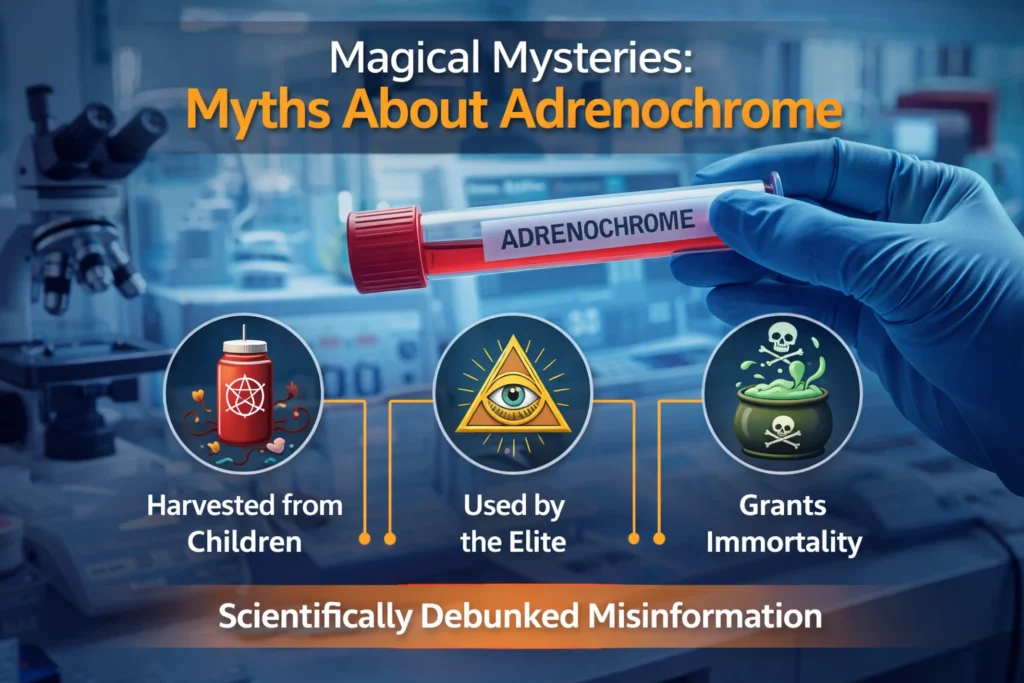
The final, transformative act occurred in the cauldron of the internet. Online forums and, most significantly, the QAnon movement, performed a dark alchemy. They wove the speculative and fictional threads into a grand, unifying conspiracy theory. Here, adrenochrome became the ultimate secret: a literal elixir of life consumed by a cabal of satanic, wealthy and powerful elites who torture children to extract this fear-born sacrament. This narrative did not emerge from pharmacology, but is a direct, repackaged descendant of the ancient "blood libel" trope, a classic case of social contagion amplified by algorithmic disinformation networks (Beran, 2023).
The question of elixir or illusion is therefore easily settled by science. As a potion of power or youth, adrenochrome is pure illusion. Yet, its persistence reveals a profound truth. The adrenochrome mythos is a grotesque tapestry that projects our deepest societal anxieties—about inequality, corruption, and unseen evil—onto a tangible, if fictional, substance. The real toxin is the narrative itself, a corrosive conspiracy theory harvested not from glands, but from the fertile, fearful soil of our collective psyche. In the end, the journey through this myth exposes not a pharmacological marvel, but a blueprint for how 21st-century disinformation turns obscure science into a viral nightmare.
References
Beran, O. (2023). The Blood Libel Legend in the Digital Age: QAnon and Modern Mythmaking. Journal of Contemporary Folklore Studies.
Hoffer, A., & Osmond, H. (1959). The Adrenochrome Model and Schizophrenia. The Journal of Nervous and Mental Disease.
Hoffer, A., Osmond, H., & Smythies, J. (1954). Schizophrenia: A New Approach. II. Result of a Year's Research. Journal of Mental Science.
Passie, T., & Hartmann, U. (2005). The Adrenochrome Hypothesis: A Reappraisal. Pharmacopsychiatry.
⚠️ MEDICAL DISCLAIMER
Presented by Dr. Mohammed Abdul Azeem Siddiqui, Medical Director, Cosmo General Hospital.
This educational content is for informational purposes only. NOT medical advice.
Always consult healthcare professionals for medical concerns.
Adrenochrome has no approved medical applications.
Claims about its therapeutic use are scientifically unfounded.