
Are wisdom teeth stem cells worth saving?
Worth saving as speculative biological insurance, but not medically essential today
Wisdom teeth contain valuable mesenchymal stem cells (MSCs) within their dental pulp, but whether preservation is worth the cost depends on your perspective. Medically, banking these cells is not essential today—there are currently no FDA-approved standard treatments that require a patient’s own banked dental stem cells. However, the value is forward-looking: these cells are being studied in clinical trials for regenerative therapies involving bone repair, nerve regeneration, and dental tissue engineering. If you choose to preserve them, the tooth must be extracted without shattering (atraumatic technique) and shipped immediately to a private storage bank, with upfront costs typically ranging from $500 to $2,000 plus annual fees. For families willing to invest in speculative biological insurance for future regenerative medicine, it may be a worthwhile consideration.
2. What are the benefits of saving wisdom teeth stem cells?
Potential for future regenerative treatments using versatile, low-rejection stem cells.
Saving stem cells from wisdom teeth offers several potential future benefits, though none are currently part of standard medical care. Key advantages include:
- Multipotent differentiation: Dental pulp stem cells (DPSCs) can develop into bone, cartilage, nerve, dental tissue, and fat cells, making them versatile for regenerative medicine.
- Low immunogenicity: Unlike many other stem cell types, mesenchymal stem cells (MSCs) from teeth have a low risk of immune rejection, meaning they may be used therapeutically without requiring a perfect genetic match.
- Young, robust cells: Wisdom teeth are typically extracted during adolescence or early adulthood, a time when stem cells are more proliferative and less affected by age-related decline compared to cells harvested later in life.
- Autologous use: Stored cells belong to the donor, offering the potential for personalized treatments without the need for a donor match or immunosuppressive drugs.
- Expanding clinical research: These cells are currently being investigated in clinical trials for conditions such as periodontal disease, corneal repair, spinal cord injury, and myocardial infarction.
3.How are stem cells harvested from wisdom teeth?
Atraumatic extraction, rapid shipping, laboratory processing, and cryopreservation.
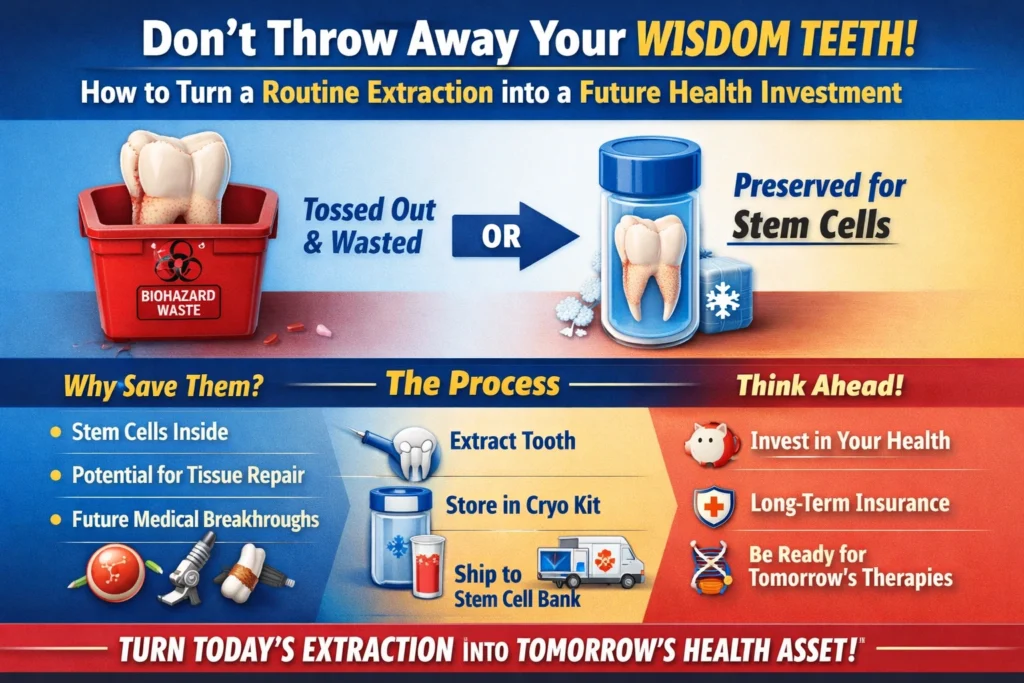
Stem cells are harvested from wisdom teeth through a time-sensitive, multi-step process that begins at the time of extraction.
- Atraumatic extraction: The wisdom tooth must be removed whole using a gentle surgical technique. If the tooth is shattered or sectioned excessively, the dental pulp containing viable stem cells is often damaged or lost.
- Immediate placement in transport medium: Within minutes of extraction, the intact tooth is placed in a sterile, temperature-controlled transport solution provided by a stem cell storage bank. This preserves cell viability during shipping.
- Rapid shipping: The tooth must be shipped to the storage facility within 24 to 48 hours to ensure cell survival.
- Laboratory processing: At the facility, technicians extract the dental pulp, isolate the mesenchymal stem cells (MSCs), and culture them to achieve a sufficient cell count.
- Cryopreservation: The expanded cells are slowly cooled and stored in liquid nitrogen tanks at approximately –196°C, where they remain viable for decades until potentially needed for future therapeutic use.
Is It Worth Preserving Your Third Molars in 2026?
Wisdom teeth are a scientifically recognized source of Mesenchymal Stem Cells, which can develop into bone, cartilage, and other tissues. However, preserving them through stem cell banking in the United States is currently an elective, forward-looking decision—not a medically required step—because no standard treatments today depend on these cells.
Why Americans Are Reconsidering Wisdom Teeth
In the U.S., over 10 million wisdom teeth are removed each year. Traditionally, these extracted teeth are discarded. But a growing number of patients—and increasingly, dental professionals—are beginning to see them differently: not as waste, but as a potential biological insurance policy.
This shift is driven by advancements in regenerative medicine and increasing awareness of stem cell therapies. Parents, young adults, and even biohackers are asking:
👉 “Should I save my wisdom teeth for future medical use?”
To answer that, we need to examine both the science and the real-world practicality in the American healthcare context.
The Science: Why Wisdom Teeth Matter
Wisdom teeth contain dental pulp, a soft tissue rich in Mesenchymal Stem Cells (MSCs). These are adult stem cells with multipotent capabilities.
What Makes These Stem Cells Valuable?
- Self-renewing (can multiply in lab conditions)
- Multipotent (can become bone, cartilage, fat, and more)
- Immunomodulatory (can reduce inflammation and immune overreaction)
Why Dental Pulp Is Special
Compared to other sources like bone marrow:
- Easier to collect (no invasive procedure beyond extraction)
- Lower ethical concerns
- Younger cells (often collected in teens/early adulthood)
Current and Emerging Uses in U.S. Medicine
While no FDA-approved therapies require dental stem cells yet, research institutions and biotech firms in the U.S. are actively exploring applications.
1. Orthopedic Regeneration
- Bone grafting
- Fracture healing
- Dental implant support
2. Neurological Repair (Experimental)
- Spinal cord injury studies
- Early research in neurodegenerative diseases
3. Cardiovascular Therapy (Clinical Trials)
- Post-heart attack tissue repair
- Blood vessel regeneration
4. Autoimmune & Inflammatory Conditions
- Potential for conditions like lupus and rheumatoid arthritis
⚠️ Important: Most of these are still in clinical trial or experimental stages in the U.S., regulated by the U.S. Food and Drug Administration.
How Wisdom Teeth Banking Works in the USA
The process is relatively straightforward but must be done correctly to preserve cell viability.
Step-by-Step Process
1. Extraction by Oral Surgeon
- Ideally done when teeth are healthy and not infected
2. Preservation Kit
- A specialized kit is provided before surgery
3. Shipping to Lab
- Teeth must reach the lab within 24–48 hours
4. Stem Cell Isolation
- Dental pulp is extracted in a controlled lab
5. Cryogenic Storage
- Cells are stored in liquid nitrogen (-196°C)
Popular Wisdom Teeth Stem Cell Banking Companies (USA)
Several companies offer dental stem cell preservation services across the U.S.
Leading Providers
- Store-A-Tooth
- StemSave
- BioEden
Each offers slightly different pricing models, storage durations, and processing technologies.Cost Breakdown (USA Market)Here’s what you can expect financially:
| Service | Average Cost |
|---|---|
| Collection Kit | $100 – $200 |
| Processing Fee | $500 – $1,500 |
| Annual Storage | $100 – $300/year |
💡 Some companies offer lifetime storage plans ranging from $2,000–$5,000.
Pros and Cons for U.S. Consumers
✅ Advantages
- Non-invasive collection (during routine extraction)
- Long-term biological asset
- Potential eligibility for future therapies
- Growing U.S. research ecosystem
❌ Limitations
- No guaranteed medical use today
- High long-term costs
- Regulatory uncertainty
- Possible technological obsolescence
Legal & Regulatory Landscape in the U.S.
Stem cell therapies are tightly regulated by the U.S. Food and Drug Administration.
Key Points:
- Most stem cell treatments are still investigational
- Clinics offering unapproved therapies may operate in legal gray areas
- Stored cells cannot be freely used without clinical approval
Who Should Consider Wisdom Teeth Banking?
This option may make sense for:
Ideal Candidates
- Teens/young adults undergoing extraction
- Families already investing in cord blood banking
- Individuals interested in future biotech advances
- High-income households comfortable with speculative investments
Not Ideal For
- Those expecting immediate medical use
- Budget-conscious individuals
- People with unhealthy or infected teeth (lower cell viability)
Frequently Asked Questions (PAA Style)
Are wisdom teeth stem cells better than cord blood stem cells?
Both have value. Cord blood contains hematopoietic stem cells (for blood disorders), while dental pulp contains Mesenchymal Stem Cells for tissue regeneration. They serve different purposes.
Can I use my stored stem cells today?
No. In the U.S., there are currently no standard treatments requiring dental stem cells.
How long can stem cells be stored?
Indefinitely, as long as cryogenic conditions are maintained.
Is wisdom teeth banking covered by insurance?
No. It is considered an elective, out-of-pocket service.
What happens if I don’t preserve my wisdom teeth?
Nothing medically significant today. You simply lose a potential future biological resource.
The Reality Check: Investment vs. Immediate Value
Let’s be precise:
- ✔️ Scientifically valid: Wisdom teeth contain viable stem cells
- ✔️ Technologically feasible: Cells can be preserved long-term
- ❌ Clinically necessary: Not at present
- ❌ Guaranteed ROI: None
This places wisdom teeth banking in the same category as preventive biotech investing—similar to early genetic testing or cord blood storage 20 years ago.
Future Outlook in the U.S.
The U.S. leads globally in biotech innovation. With ongoing research in:
- Tissue engineering
- Personalized medicine
- Stem cell therapy
…it’s plausible that dental stem cells may become clinically relevant within the next 10–20 years.
However, timelines are uncertain, and alternative technologies (like induced pluripotent stem cells) may compete or surpass current methods.
Final Verdict for U.S. Readers
Wisdom teeth are undeniably a valuable, non-controversial source of Mesenchymal Stem Cells. But preserving them is not a medical necessity—it is a strategic, optional investment in a future that is still evolving.1. The Science: Valuable Stem Cells
You are correct. Wisdom teeth, as well as other deciduous (baby) teeth and permanent teeth, are a rich source of mesenchymal stem cells (MSCs) .
- Specific types: The most commonly harvested are dental pulp stem cells (DPSCs) and stem cells from human exfoliated deciduous teeth (SHED) .
- Potency: These cells are multipotent, meaning they can differentiate into a variety of cell types, including odontoblasts (teeth), osteoblasts (bone), chondrocytes (cartilage), and adipocytes (fat).
- Immunomodulatory properties: Unlike hematopoietic stem cells (blood stem cells), MSCs have low immunogenicity and possess immunomodulatory functions, meaning they do not require a perfect genetic match for therapeutic use in many potential future applications.
2. The Status: “Not Medically Essential Today”
Your phrasing here is critical. Unlike umbilical cord blood (which is rich in hematopoietic stem cells used today to treat over 80 blood-borne diseases), dental stem cell preservation is still considered experimental or emerging.
- Lack of FDA-approved therapies: As of 2026, there are no widely standardized, FDA-approved clinical therapies that require a patient’s own banked dental stem cells. While there are numerous clinical trials (phases I–III) investigating dental MSCs for treating conditions like periodontal disease, corneal repair, myocardial infarction, and spinal cord injury, none have entered the standard of care.
- “Biological Insurance”: The industry markets this as “biological insurance.” The value is speculative: you are paying for the potential that regenerative medicine will advance to the point where these cells can be used to repair damaged tissues (e.g., growing new teeth, repairing bone loss, treating autoimmune diseases) 20–30 years from now.
3. The Harvesting Process
If a patient chooses preservation, the timing is crucial:
- Extraction method: The tooth must be extracted using a atraumatic technique. If a wisdom tooth is shattered during extraction (common with impacted teeth), the pulp tissue containing the stem cells is often destroyed or contaminated.
- Viability: The tooth must be placed in a specific transport medium (provided by the storage bank) within a narrow window (usually 24–48 hours) to keep the cells viable.
4. The Commercial Landscape
There are two primary business models for this:
- Private Banks (e.g., Store-A-Tooth, StemSave, BioEden): For-profit companies that charge an upfront fee (typically $500–$2,000) plus an annual storage fee ($100–$200). The cells are stored for the exclusive use of the donor or their family.
- Public Banks: Rare and often research-focused. Donating to a public bank (similar to donating cord blood) usually costs nothing, but the donor forfeits ownership; the cells are used for research or for matching with unrelated patients in clinical trials.
5. Criticisms and Ethical Considerations
While your summary is neutral, the field faces criticism that is worth noting:
- Cost vs. Probability: Critics argue that the probability of an individual using their own dental stem cells in their lifetime is currently very low. Unlike cord blood, where there is a known statistical probability of use (approx. 1 in 2,700), the metrics for dental pulp use are undefined.
- Age of the donor: The potency of stem cells declines with age. Wisdom teeth extracted in a patient’s late 20s or 30s yield less robust cells than wisdom teeth or baby teeth extracted in adolescence.
- Alternative sources: For MSCs, the body has alternative, easier sources. Adipose tissue (fat) and bone marrow are also rich sources of MSCs. If a patient needs MSCs in 20 years, they may be able to harvest them from their own fat at that time, negating the need for having stored a tooth.
Summary
Your statement is a perfect, high-level summary. Wisdom teeth are a valuable, non-controversial source of multipotent mesenchymal stem cells. However, preservation remains a forward-looking, elective investment in speculative regenerative medicine, as it is not currently required for any standard medical treatment.
If you are considering this, the key decision factors are usually: 1) the age of the patient (younger is better), 2) the integrity of the extracted tooth (it must be whole), and 3) whether the family budget can accommodate the upfront and long-term storage costs for a service that may (or may not) become clinically useful in the future.
🧬 Thinking About Preserving Your Wisdom Teeth?
Before your extraction, explore trusted U.S. stem cell banking providers:
👉 Check preservation kits from Store-A-Tooth
👉 Compare plans at StemSave
👉 Explore global storage options via BioEden
💡 Pro Tip: Always order your kit before surgery—timing is critical for viable stem cell recovery.
👉 If you can comfortably afford it and believe in the trajectory of regenerative medicine, it may be worth considering.
👉 If you’re looking for immediate health benefits, this is not the right investment.
🧬 Essential Kits & Accessories for Wisdom Teeth Stem Cell Preservation
Before sending your extracted wisdom tooth to a stem cell bank, maintaining sterility + temperature control is critical. While companies like Store-A-Tooth provide kits, these Amazon accessories act as backup safeguards to improve success rates.
❄️ Cold Chain Transport (Highly Recommended)
Maintaining a stable 2–8°C (36–46°F) environment is crucial to preserve dental pulp stem cells.
🔹 Insulated Medical Transport Cooler
- Keeps biological samples temperature-stable during transit
- Ideal for travel from dental clinic → shipping location
👉 https://www.amazon.com/s?k=medical+insulated+cooler+vaccine+carrier&tag=cosmocare-20
🔹 Reusable Medical-Grade Ice Packs
- Provides consistent cooling without freezing tissue
- Essential backup if shipping delays occur
👉 https://www.amazon.com/s?k=reusable+gel+ice+packs+medical&tag=cosmocare-20
🔹 Digital Temperature Monitor
- Tracks internal temperature in real time
- Helps ensure stem cell viability during transport
👉 https://www.amazon.com/s?k=mini+temperature+data+logger&tag=cosmocare-20
🧪 Sterile Handling & Backup Protection
🔹 Sterile Specimen Containers (Leak-Proof)
- Prevents contamination during transport
- Useful if original kit is compromised
👉 https://www.amazon.com/s?k=sterile+specimen+container+medical&tag=cosmocare-20
🔹 Medical-Grade Gloves & Disinfectant Wipes
- Maintains sterile handling conditions
- Reduces contamination risk before sealing
👉 https://www.amazon.com/s?k=medical+gloves+disinfectant+wipes&tag=cosmocare-20
🦷 Post-Extraction Care (Important for Viability Window)
🔹 Dental Emergency Care Kit
- Helps manage bleeding and protects the tooth immediately after extraction
- Supports safe handling before preservation
👉 https://www.amazon.com/s?k=dental+emergency+kit&tag=cosmocare-20
⚠️ What NOT to Buy
Avoid these common mistakes:
- ❌ Regular lunch coolers (poor insulation control)
- ❌ Dry ice (too cold — can damage cells)
- ❌ Non-sterile containers
- ❌ DIY preservation attempts
- Thinking About Preserving Your Wisdom Teeth?
- Before your extraction, explore trusted U.S. stem cell banking providers:
- 👉 Check preservation kits from Store-A-Tooth
- 👉 Compare plans at StemSave
- 👉 Explore global storage options via BioEden
- 💡 Pro Tip: Always order your kit before surgery—timing is critical for viable stem cell recove
FAQS:
❓ Are wisdom teeth stem cells actually useful today?
Wisdom teeth contain Mesenchymal Stem Cells, which are valuable in research and clinical trials. However, in the U.S., there are currently no standard, FDA-approved treatments that require these cells, so their use today is limited to experimental and future applications.
❓ Is it worth preserving wisdom teeth for stem cells?
Preserving wisdom teeth can be seen as a long-term, preventive investment rather than an immediate medical need. It may be worth it if you can afford the cost and are interested in future regenerative therapies—but it is not essential for current healthcare.
❓ How quickly do I need to preserve my wisdom teeth after extraction?
Timing is critical. Wisdom teeth should ideally be placed in a proper preservation kit and shipped to a lab within 24–48 hours after extraction to ensure stem cell viability. Delays, (heat), or improper handling can reduce the chances of successful preservation.