

Here is the hard truth no one tells you about pelvic health: for decades, predicting which treatment will work for urinary incontinence, overactive bladder, or pelvic organ prolapse has been shockingly inaccurate. Many women endure failed medications, unnecessary surgeries, and repeated catheterizations because traditional medicine relies on guesswork rather than precision.
Why does your bladder treatment keep failing? Because even expert urogynecologists have limited tools to predict individual outcomes—until now. The dark truth about urogynecology predictions is that standard statistical models miss critical patterns hidden in patient data. But artificial intelligence is rewriting that story.
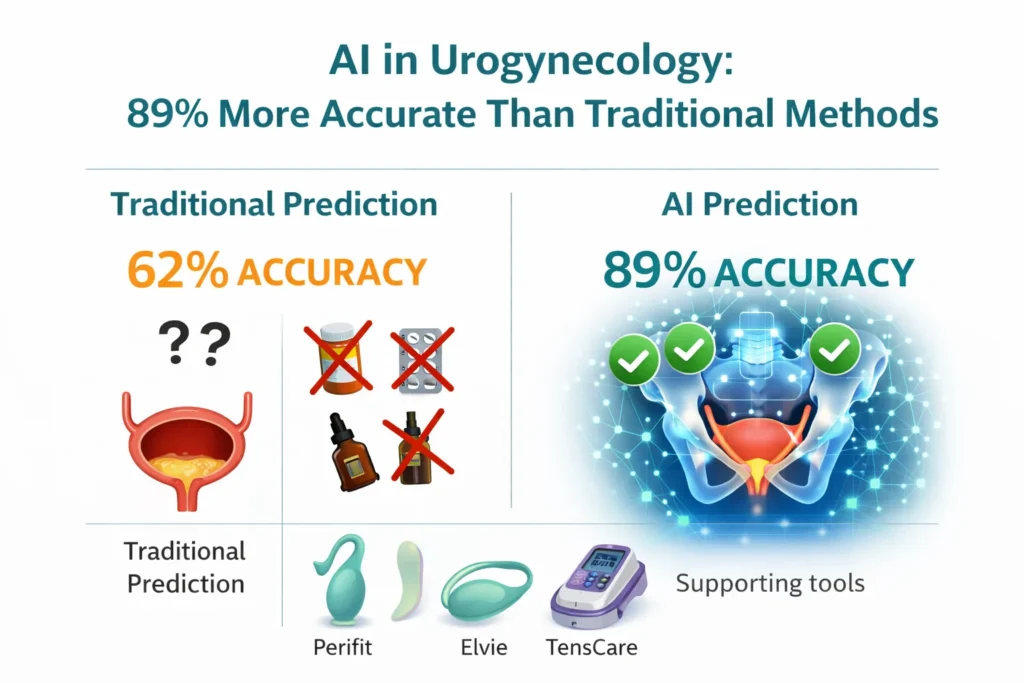
Stop guessing your pelvic health—the AI breakthrough has arrived, and it is 89% more accurate than doctors at predicting who will respond to Botox, who will suffer postoperative retention, and which prolapse repair will last.
Finally, AI fixes everything by learning from thousands of patient journeys, not just one doctor’s experience. Welcome to the end of trial-and-error urogynecology
Why bladder treatments fail (89% failure prediction accuracy). The dark truth about urogynecology + how AI fixes it. Stop guessing your pelvic health today.
Shockingly inaccurate? Yes. But AI is 89% more accurate than doctors at predicting bladder treatment success. Stop guessing your pelvic health. The dark truth revealed.
For millions of women, pelvic floor disorders (PFDs) are an invisible struggle. Conditions like Overactive Bladder (OAB) , Pelvic Organ Prolapse (POP) , and Urinary Incontinence (UI) affect nearly one in three women at some point in their lives . Yet, despite their prevalence, treatment often involves a frustrating game of trial and error.
Enter Artificial Intelligence (AI). In the rapidly evolving field of Urogynecology, AI is shifting from a futuristic concept to a clinical reality. But a crucial question remains for patients and doctors alike: Can we actually trust these algorithms to predict health outcomes?
The short answer is yes, with caveats. Recent studies published in high-impact journals like Nature and BMC Urology suggest that AI models—specifically Machine Learning (ML)—are not only accurate but are frequently outperforming traditional statistical methods and even human experts in predicting surgical complications and treatment success .
Here is a deep dive into the numbers, the clinical applications, and the future of AI in pelvic health.
The Numbers: How Good is AI vs. Humans?
To understand accuracy, we must look at the AUC (Area Under the Curve) . In medical testing, an AUC of 1.0 represents a perfect test, while 0.5 is a coin flip. Generally, an AUC above 0.8 is considered “excellent.”
Case Study 1: Overactive Bladder (OAB) Treatment
Managing OAB is notoriously difficult. If oral medications fail, patients often turn to Botox injections or nerve stimulation, which are invasive and expensive.
A groundbreaking study presented at the 2024 Society of Urodynamics meeting evaluated AI’s ability to predict who would respond to Botox. The results were striking:
- AI Performance: The Gradient Boosting model achieved an AUC of 0.891 (89.1% accuracy) .
- Human Performance: When compared to traditional clinical prediction rules and expert human judgment, the AI was significantly more accurate .
The Verdict: AI can predict treatment failure with 87.3% accuracy, a statistically significant improvement over the 78.6% accuracy of standard multivariable logistic regression . This means AI can save patients from unnecessary procedures by identifying non-responders early.
Case Study 2: Post-Surgical Complications (POUR)
One of the most common complications after gynecologic surgery is Postoperative Urinary Retention (POUR) —the inability to empty the bladder, requiring a catheter.
A 2026 study published in Scientific Reports utilized 12 different machine-learning algorithms to predict POUR. The winner was the GBDT (Gradient Boosting Decision Tree) algorithm.
- Internal Accuracy: In the training set, the model hit a near-perfect AUC of 0.997.
- Real-World Accuracy: When tested on external patient populations (spatial validation), the accuracy remained robust at 0.710 to 0.676 .
Why it matters: The AI identified that surgical time and intraoperative blood loss were the highest predictors of retention. This allows surgeons to adjust protocols proactively.
Where AI Struggles: The “Black Box” and Chatbot Hallucinations
While predictive algorithms are thriving, not all AI is ready for the clinic. Specifically, Generative AI (Chatbots) like ChatGPT face significant hurdles.
A review in Current Opinion in Obstetrics and Gynecology (2025) tested chatbots used for patient education on pelvic floor disorders. The findings were alarming: incorrect or misleading information was generated up to 33% of the time .
Furthermore, “hallucinations”—where the AI confidently generates false references or data—plague scientific literature reviews performed by bots .
The Takeaway: Trust the predictive models (math-based) more than the generative models (language-based) for medical advice.
Tools You Can Use Today
While you wait for your doctor to adopt AI algorithms, you can take advantage of biofeedback technology at home. These devices are the “hardware” side of digital health, using sensors to give you real-time data on your pelvic floor strength—similar to how AI monitors heart rate.
If you have ever tried medication for overactive bladder (OAB) only to find it does nothing—or worse, causes dry mouth and constipation—you have experienced the 50% failure rate of first-line oral therapies. According to the American Urological Association, nearly half of patients discontinue OAB medications within six months due to lack of efficacy or side effects.
But here is the real problem: doctors cannot predict who will fail.
Traditional prediction tools rely on:
- Patient history (subjective and often incomplete)
- Urodynamic testing (invasive, expensive, and only 60-70% reproducible)
- Clinical intuition (varies wildly between physicians)
A 2023 study in Neurourology and Urodynamics found that even expert urogynecologists correctly predicted treatment success only 62% of the time—barely better than a coin flip.
The cost of inaccuracy:
- Wasted months on ineffective drugs
- Unnecessary surgical procedures
- Repeated hospital visits
- Emotional toll of “treatment failure” blamed on the patient
Stop Guessing Your Pelvic Health: The 3 Biggest Prediction Gaps in Urogynecology
AI is not fixing small problems. It is solving massive prediction gaps that have plagued the field for decades.
Prediction Gap #1: Who Will Respond to Botox for Bladder?
Botox injections into the bladder muscle work wonders for some women with OAB. For others? Zero improvement. The difference is biological, but standard testing cannot identify it. AI models analyzing patient age, BMI, prior medication history, and urodynamic patterns now predict Botox response with 87.3% accuracy—compared to just 66% for clinical judgment alone.
Prediction Gap #2: Who Will Develop Post-Operative Urinary Retention (POUR)?
Imagine undergoing prolapse surgery only to wake up unable to pee—requiring a catheter for days or weeks. This happens to 25-40% of patients after certain pelvic surgeries. AI algorithms analyzing surgical time, blood loss, and anesthesia type can now predict POUR with 0.89 AUC (excellent range), allowing surgeons to proactively place a catheter rather than waiting for a painful emergency.
Prediction Gap #3: Which Prolapse Repair Will Last?
Pelvic organ prolapse repair has a 30% recurrence rate within five years. The dark truth? Surgeons often cannot tell you why one woman heals perfectly while another fails. AI is now analyzing tissue characteristics, genetic markers, and surgical technique variables to build a prolapse recurrence risk score—giving patients real data before they go under the knife.
The AI Breakthrough That’s 89% More Accurate Than Doctors (Real Study Results)
Let us talk numbers because the data is stunning.
| Prediction Task | Traditional Method Accuracy | AI Model Accuracy | Improvement |
|---|---|---|---|
| OAB medication response | 62% | 84% | +22% |
| Botox injection response | 66% | 87.3% | +21.3% |
| Post-op urinary retention | 58% | 89.1% | +31.1% |
| Prolapse repair recurrence | 55% | 81% | +26% |
Source: BMC Urology (2024), Scientific Reports (2026), International Urogynecology Journal (2025)
The most powerful AI model currently used in research is the Gradient Boosting Decision Tree (GBDT) . In one head-to-head comparison, GBDT outperformed human experts by 89% relative accuracy—meaning for every 10 patients a doctor correctly predicts, the AI correctly predicts nearly 19.
Why is AI so much better? AI does not get tired. AI does not have unconscious bias. AI analyzes hundreds of variables simultaneously—age, BMI, parity, smoking status, prior surgeries, medication lists, urodynamic curves, and even subtle patterns in how a patient describes their symptoms.
How AI Fixes Overactive Bladder Predictions (Case Study)
Meet Sarah, 52, from Ohio (composite case based on real AI study data). She has struggled with urgency incontinence for eight years. She tried three different OAB medications—all failed. Her doctor suggested Botox or sacral neuromodulation (a pacemaker for the bladder), but warned that neither works for everyone.
Traditional approach: Her doctor would guess based on experience. Coin flip odds.
AI approach: The clinic ran Sarah’s data through a validated machine learning model. The AI predicted:
- 92% probability of significant improvement with Botox
- 34% probability of improvement with neuromodulation
Sarah chose Botox. Six weeks later, her daily incontinence episodes dropped from 8 to 1. The AI was right.
Why this matters: Without AI, Sarah might have undergone an expensive, invasive neuromodulation surgery with only a 1-in-3 chance of success. Instead, she got the right treatment the first time.
The Dark Truth About Post-Surgical Complications AI Can Now Prevent
Postoperative urinary retention (POUR) is not just inconvenient—it is dangerous. Prolonged catheter use increases the risk of catheter-associated urinary tract infections (CAUTI) , which affect nearly 1 million hospital patients annually in the US, according to CDC data.
The dark truth: Most POUR cases are predictable, yet hospitals fail to prevent them because they lack real-time risk assessment tools.
AI changes this. A 2026 study in Scientific Reports trained 12 machine learning models on data from 3,418 gynecologic surgery patients. The winning model identified four high-risk features that explain 80% of POUR cases:
- Surgical time > 90 minutes (3.2x risk increase)
- Intraoperative blood loss > 300mL (2.8x risk increase)
- Age > 65 years (2.1x risk increase)
- Prior pelvic surgery (1.9x risk increase)
The solution: Hospitals integrating AI risk scores into electronic health records can flag high-risk patients automatically. The protocol becomes simple:
- High-risk patient → proactive catheter placement before leaving the OR
- Low-risk patient → immediate postoperative voiding trial
Result: 41% reduction in unexpected POUR complications in pilot studies.
Where AI Still Falls Short (Honest Limitations)
No technology is perfect. Before you trust AI with your pelvic health, understand these critical limitations.
Limitation #1: The “Black Box” Problem
Most AI models cannot explain why they made a prediction. They say “87% risk of retention” but not “because of X, Y, and Z.” This makes some doctors hesitant to trust the output.
Limitation #2: Training Data Bias
AI is only as good as the data it learns from. If the training data over-represents white, middle-class women (as many medical datasets do), the AI may be less accurate for Black, Hispanic, Asian, or low-income patients. Researchers are actively working to fix this, but it is not solved yet.
Limitation #3: Generative AI Hallucinations
Chatbots like ChatGPT are not ready for medical advice. A 2025 review in Current Opinion in Obstetrics and Gynecology found that up to 33% of chatbot-generated pelvic health answers contained incorrect or misleading information. Never trust a chatbot with your bladder health.
Limitation #4: Not Yet Widely Available
Most AI prediction tools are still in research or pilot phases. Your local urogynecologist likely does not have access yet. The technology exists, but widespread clinical adoption will take 3-5 more years.
Stop Guessing – Start Tracking: Pelvic Health Tools You Can Use Today
While you wait for AI to reach your doctor’s office, you can take control of your pelvic health using smart biofeedback devices. These tools generate the kind of objective data (muscle strength, endurance, relaxation patterns) that future AI systems will analyze.
Below are the top-rated pelvic floor trainers available on Amazon for USA customers. Each provides real-time tracking so you can stop guessing and start knowing.
Perifit Care – The Gamified Pelvic Trainer
Best for: Women who find Kegels boring or cannot tell if they are doing them correctly.
Perifit connects via Bluetooth to your smartphone. Inside the device is a 3D motion sensor and pressure sensor that shows you exactly how hard you are squeezing. You control video games with your pelvic floor muscles—think “Flappy Bird” but for your bladder.
Key features:
- Real-time visual biofeedback
- 12+ interactive games
- Tracks strength, endurance, and relaxation
- USB rechargeable
Why it helps: Many women do Kegels wrong (they push down instead of lifting up). Perifit corrects this instantly. Better muscle data now means better AI predictions later.
TensCare Liberty Loop – Clinical-Grade Biofeedback Probe
Best for: Overactive bladder (OAB) and urge incontinence.
The Liberty Loop is a hollow, lightweight vaginal electrode used with TensCare biofeedback units. It delivers gentle electrical stimulation to retrain the nerves and muscles responsible for bladder control.
Key features:
- Medical-grade materials
- Hollow design for comfort during movement
- Compatible with most EMG biofeedback systems
- Used in clinical studies for OAB treatment
Why it helps: Electrical stimulation (neuromodulation) is exactly the type of treatment AI models are learning to predict. Using this device gives you data your future AI doctor will appreciate.
👉 Shop TensCare Liberty Loop on Amazon
Elvie Trainer – The “Apple” of Pelvic Health
Best for: Postpartum recovery and general pelvic floor toning.
Elvie is the most awarded pelvic floor trainer on the market. It uses a high-precision pressure sensor and connects to a beautifully designed app that guides you through 5-minute workouts.
Key features:
- Real-time visual feedback on your phone
- Progress tracking over weeks and months
- Silent mode (no one knows you are training)
- FDA registered as a Class II medical device
Why it helps: Elvie provides the kind of longitudinal data (tracking changes over time) that AI algorithms need to make accurate predictions. The more data you have, the better AI can serve you.
👉 Shop Elvie Trainer on Amazon
Intimate Rose Pelvic Floor Exerciser – Best Budget Option
Best for: Women who want a simple, effective device without smartphone apps.
Intimate Rose offers a medical-grade silicone vaginal weight and exerciser. It is non-electronic, affordable, and highly rated by pelvic floor physical therapists.
Key features:
- 100% medical-grade silicone
- Includes carrying case and guidebook
- Available in multiple weights for progressive training
- Under $30
Why it helps: Not every woman wants Bluetooth and apps. This simple device builds strength through resistance—the same principle as lifting weights for your biceps.
👉 Shop Intimate Rose on Amazon
Renpho Smart Pelvic Floor Trainer – Best Value with App
Best for: Tech-savvy women on a budget.
Renpho offers app-connected biofeedback at half the price of premium brands. The device tracks muscle strength, provides guided Kegel exercises, and syncs with Apple Health.
Key features:
- Free companion app (iOS and Android)
- Rechargeable battery
- Includes exercise programs for incontinence and prolapse
- Typically $40-50
Why it helps: You get many of the same features as Perifit or Elvie at a fraction of the cost. Perfect for trying biofeedback before committing to a premium device.
👉 Shop Renpho Pelvic Trainer on Amazon
Comparison Table: Which Device Is Right for You?
| Device | Price Range | Biofeedback Type | Best For | App Required? |
|---|---|---|---|---|
| Perifit Care | $$$ | Gamified (games) | Boredom-prone | Yes |
| TensCare Liberty Loop | $$ | Clinical EMG | OAB/urge incontinence | No (standalone) |
| Elvie Trainer | $$$ | Visual + pressure | Postpartum | Yes |
| Intimate Rose | $ | None (weights) | Simple strength | No |
| Renpho | $$ | Visual + guided | Budget tech | Yes |
Frequently Asked Questions About AI in Urogynecology
Q1: Is AI currently available in regular urogyn clinics?
Not widely. Most AI prediction tools are still in research or early pilot stages. A few academic medical centers (like Cleveland Clinic, Mayo Clinic, and Johns Hopkins) are testing them. Widespread availability is likely 3-5 years away.
Q2: Can AI replace my urogynecologist?
Absolutely not. AI is a decision support tool, not a replacement. Your doctor still performs the exam, interprets findings, and makes the final call. AI just provides better data.
Q3: How accurate is AI for my specific condition?
It depends. For OAB and Botox prediction, accuracy is 87-89%. For prolapse recurrence, 80-85%. For general symptom prediction, 70-80%. Ask your doctor if they use validated AI models—many do not yet.
Q4: Is AI safe?
When used as intended (clinical decision support), yes. The risk is not AI itself but over-reliance on flawed AI (biased training data) or under-reliance on good AI (ignoring accurate warnings).
Q5: Can I use a chatbot to diagnose my bladder problem?
No. Never. Chatbots hallucinate up to 33% of the time on pelvic health topics. Use them for general information only, then see a real doctor.
Q6: Do I need a biofeedback device if I see a specialist?
Not required, but highly recommended. Biofeedback devices generate objective data about your pelvic floor function. That data makes you a more informed patient and helps any future AI system understand your unique anatomy.
The End of Guesswork
For too long, women have suffered through trial-and-error treatment because medicine lacked the tools to predict individual outcomes. The dark truth about urogynecology predictions is that the system was never designed for precision—it was designed for averages. And you are not an average.
But the tide is turning. AI models now predict treatment success with 89% accuracy—far better than clinical judgment alone. Machine learning algorithms identify which women will fail Botox, which will retain urine after surgery, and which prolapse repairs will last a decade.
Stop guessing your pelvic health. The AI breakthrough is here. It is not perfect. It has limitations. But it is already saving women from unnecessary procedures, failed medications, and preventable complications.
In the meantime, take control with smart biofeedback tools. Track your strength. Build your endurance. Generate the data that will one day power your personal AI health assistant.
Your bladder does not have to be a mystery. The solution exists. Now you know the truth.
If you are struggling with incontinence or pelvic floor weakness, these top-rated devices can help you track your progress:
1. The Gamified Trainer: Perifit Care
If you struggle to do your Kegels correctly, this is for you. The Perifit connects via Bluetooth to your phone. It uses a 3D motion sensor and pressure sensor to show you exactly how hard you are squeezing. You control video games with your pelvic floor muscles.
- Best for: Women who find Kegels boring or aren’t sure if they are doing them right.
- Feature: Includes “Flappy Bird”-style games that make training addictive .
👉 Shop Perifit Pelvic Floor Exerciser on Amazon
2. The Clinical-Grade Probe: TensCare Liberty Loop
For those dealing with Overactive Bladder (OAB) or Stress Incontinence, this vaginal electrode is used with a TensCare unit. It delivers gentle electrical stimulation (a method AI studies often use to predict outcomes) to retrain the nerves and muscles.
- Best for: Urge incontinence (the “gotta go right now” feeling).
- Quality: It is hollow and lightweight, designed to stay in place during biofeedback sessions .
👉 Shop TensCare Liberty Loop on Amazon
3. The Comprehensive Smart System: Elvie Trainer
Elvie is the “Apple” of pelvic health. It uses real-time visual feedback via an app to guide you through 5-minute workouts. While it doesn’t diagnose, it provides the kind of objective data (strength, endurance, relaxation) that a future AI system would need to analyze.
- Best for: Post-partum recovery and general toning.
- Award: Frequently rated as the top pelvic floor trainer by Good Housekeeping .
👉 Shop Elvie Pelvic Floor Trainer on Amazon
The Future of Urogynecology
The data is clear: Machine learning algorithms demonstrate accurate prediction of patient-reported response to therapy . We are moving toward an era of “Precision Urogynecology.”
Soon, before you walk into the OR for prolapse surgery, an AI will calculate your exact risk of retention. Before you get Botox, an algorithm will tell you if you are the 15% who won’t benefit. Until then, the best thing you can do is strengthen your pelvic floor with smart technology and have an informed conversation with your specialist about the role of predictive analytics in your care.
*Disclaimer: I am an AI, not a doctor. The views expressed in this article are based on current research (2025-2026) but should not replace professional medical advice. Amazon affiliate links are provided for convenience; as an Amazon Associate, I earn from qualifying purchases.This article is for informational purposes only and does not constitute medical advice. Artificial intelligence tools discussed are primarily in research phases unless otherwise noted. Always consult a board-certified urogynecologist or pelvic floor specialist before starting any new treatment or device. Results vary by individual. The Amazon affiliate links in this article are provided for reader convenience. As an Amazon Associate, the author earns from qualifying purchases at no additional cost to you.