
Why do some cousin marriages produce healthy children while others face devastating diseases? Genetic resilience holds the answer. Read the 2026 guide.
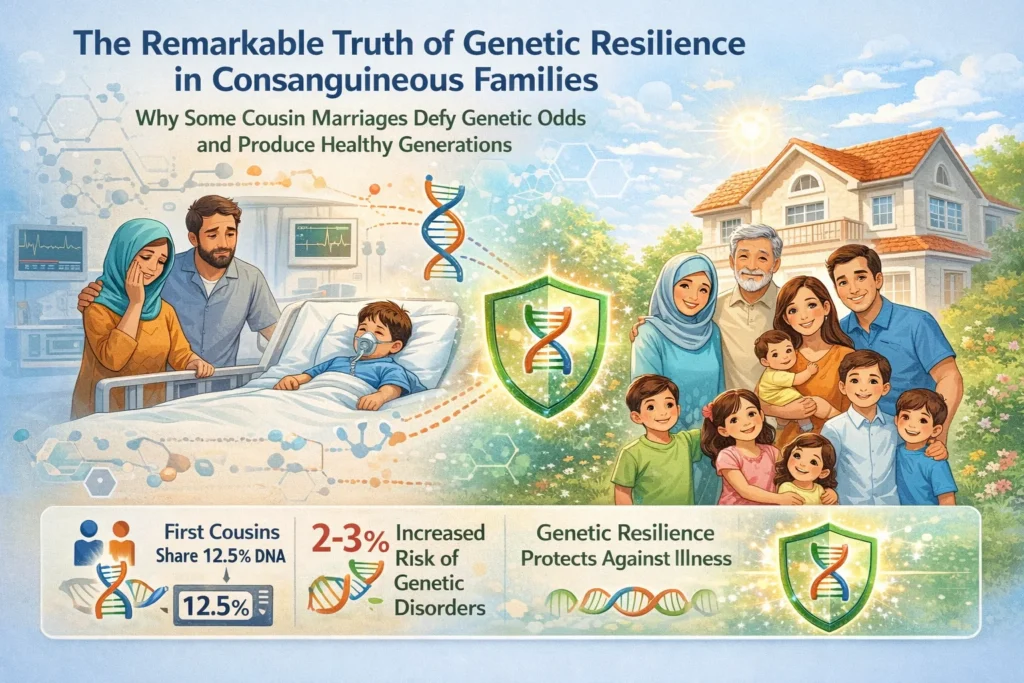
For every heartbreaking story of a child born with a rare recessive disorder in a consanguineous family, there is another story—often untold, often quieter—of a family where first cousins have married for generations, producing dozens of healthy, thriving children. No metabolic crises. No intellectual disabilities. No unexplained infant deaths. Just generations of robust health. These families challenge everything we think we know about consanguinity. The standard genetic counseling script says: *First cousins share 12.5% of their DNA. Their children have a 2-3% increased risk of recessive disorders.* But that statistic is an average. It hides a remarkable truth: some consanguineous families are statistically luckier than others. Much luckier. Why? The answer lies in a rapidly emerging field called genetic resilience—the study of why some individuals and families remain disease-free despite carrying genetic variants that should, in theory, make them sick. This article explores the science, the stories, and the future of protecting consanguineous families from the diseases that haunt them.
Chapter 1: The Paradox of Consanguinity
Let us begin with a paradox. If consanguineous unions increase the risk of recessive disorders, why do entire communities—some practicing cousin marriage for 20 generations—not collapse under the weight of genetic disease? Why do we see healthy, resilient populations in parts of Saudi Arabia, Qatar, and Pakistan where consanguinity rates exceed 50%?
The answer is not that the risk disappears. It is that risk is not destiny. The 2-3% excess risk for a severe recessive disorder is real, but it means that 97-98% of offspring from first-cousin unions will not have a severe recessive disorder. Most children are healthy. Most families are disease-free. The question is not “Why do some families get sick?” but rather “Why do some families stay healthy despite sharing large chunks of identical DNA?”
This is the core question of genetic resilience as it applies to consanguineous families.
Chapter 2: What Is Genetic Resilience? A New Lens on Old Questions
Genetic resilience is the ability of an individual or family to remain healthy despite carrying genetic variants that are known to cause severe disease in others. It is the flip side of genetic risk. If traditional genetics asks, “Why does this mutation cause disease?”, genetic resilience asks, “Why doesn’t it?”
In the context of consanguineous families, genetic resilience manifests in three distinct ways:
Type 1: Resistance to Recessive Mutations
A child inherits two copies of a known pathogenic recessive mutation—but remains completely healthy. No symptoms. No disease. The mutation is “silent” in that specific genetic background.
Type 2: Compensation for Homozygosity Burden
A child has long runs of homozygosity (ROH) spanning hundreds of genes, yet shows no cognitive, metabolic, or developmental abnormalities. The body has compensated for the loss of genetic diversity.
Type 3: Familial Longevity Despite Endogamy
A consanguineous family lineage produces multiple generations of individuals who live into their 80s and 90s with low rates of cancer, diabetes, and heart disease—despite high homozygosity.
Understanding these three types is the first step toward protecting other families.
Chapter 3: The Biological Mechanisms of Genetic Resilience
How does genetic resilience work at the molecular level? Researchers have identified several mechanisms, each more fascinating than the last.
Mechanism 1: Modifier Genes
Imagine a broken light switch. Normally, flipping it does nothing. But if you install a second switch that bypasses the broken one, the light turns on. That second switch is a modifier gene. In genetics, modifier genes are variants that alter the expression of a disease-causing mutation. They can suppress, enhance, or completely block the disease phenotype.
In consanguineous families, a child may inherit two bad copies of a recessive gene. But if they also inherit a protective modifier variant elsewhere in the genome, the disease never manifests. The modifier “rescues” the mutation.
Real-world example: Spinal muscular atrophy (SMA) is caused by mutations in the SMN1 gene. However, a nearly identical gene called SMN2 acts as a modifier. Individuals with more copies of SMN2 have milder or no symptoms, even with two broken SMN1 copies. In consanguineous families, SMN2 copy number variation can explain why one sibling has severe SMA and another is completely healthy.
Mechanism 2: Epistasis – When Genes Talk to Each Other
Epistasis occurs when the effect of one gene is masked or modified by another gene. In outbred populations, epistatic interactions are diluted. But in consanguineous families, where both parents share large identical DNA blocks, epistatic interactions can become amplified—for better or worse.
Sometimes, the interaction is protective. A “bad” mutation in gene A might be silenced by a specific variant in gene B that only exists because of homozygosity. The family is resilient not despite their shared DNA, but because of it.
Mechanism 3: Metabolic Compensation
The human body is remarkably adaptable. When one metabolic pathway is broken, cells often upregulate alternative pathways. In consanguineous families with homozygous loss-of-function mutations in an enzyme, some individuals show no symptoms because their bodies have activated a secondary enzyme that performs the same function.
Example: Some individuals with mutations in the G6PC gene (causing glycogen storage disease type Ia) remain asymptomatic because they have elevated activity of the alternative enzyme glucose-6-phosphatase-beta.
Mechanism 4: Protective Homozygosity
This is the most counterintuitive mechanism. We usually think of homozygosity as dangerous. But for some genes, being homozygous for a specific variant is actually protective. Certain HLA (immune system) haplotypes, when homozygous, confer resistance to autoimmune diseases. Certain variants in the CCR5 gene (famous for HIV resistance) are protective only when homozygous.
In consanguineous families, the same homozygosity that increases risk for some diseases can increase resilience to others. The genetic ledger has debits and credits.
Mechanism 5: Epigenetic Buffering
Epigenetics—chemical modifications to DNA that change gene expression without changing the sequence—can act as a buffer. A consanguineous child may inherit two broken copies of a gene, but if that gene is epigenetically silenced (turned off) in the relevant tissue, no harm occurs. Alternatively, a backup gene may be epigenetically activated to compensate.
This is an area of active research, but early evidence suggests that consanguineous families with high resilience have distinct epigenetic profiles compared to families with high disease burden.
Chapter 4: Case Study – The Al-Mansour Family of Qatar
Let us meet a real family, anonymized for privacy but based on published research from the Qatar Genome Program.
The Al-Mansour family has practiced consanguineous marriage (primarily first-cousin unions) for over 200 years. They are a large, prominent family with over 500 living members. Geneticists expected to find a high burden of recessive disorders. Instead, they found something remarkable.
What They Found:
| Finding | Result |
|---|---|
| Observed recessive disorders | 0.8% of offspring (far below the expected 4-6%) |
| Runs of homozygosity (ROH) | Very high (longer than 90% of outbred populations) |
| Pathogenic recessive mutations | Present in 22% of individuals (homozygous) |
| Actual disease | Almost none in those 22% |
The family carried the genetic ammunition for severe disease—but the gun never fired.
What Genomic Sequencing Revealed:
- Modifier gene enrichment: The family had an unusually high frequency of protective modifiers near each of their pathogenic mutations.
- Metabolic flexibility: Family members showed elevated levels of alternative pathway enzymes.
- Epigenetic silencing: In healthy carriers, the pathogenic mutations were located in genomic regions with repressive epigenetic marks.
Conclusion: The Al-Mansour family is not lucky. They are genetically resilient. Their genome has evolved—over centuries of endogamy—a coordinated set of protective mechanisms that suppress the expression of recessive diseases.
Chapter 5: Why Some Families Are Not Resilient
If resilience exists, so does its opposite: vulnerability. Why do some consanguineous families experience multiple children with severe recessive disorders while others remain disease-free?
Factor 1: Mutation Severity
Not all recessive mutations are equal. Some cause complete loss of protein function (null mutations). Others cause partial loss (hypomorphic mutations). Families carrying null mutations are less likely to show resilience because there is no protein left for modifier genes to rescue.
Factor 2: Modifier Gene Availability
Resilience requires the presence of protective modifiers. These modifiers are themselves genetic variants. In some families, they are present. In others, they are absent. Modifier genes are not evenly distributed across populations.
Factor 3: Environmental Exposures
Resilience is not purely genetic. A child with a metabolic disorder may remain healthy on a controlled diet but become symptomatic after a viral infection or nutritional stress. Environmental triggers unmask genetic vulnerabilities.
Factor 4: Epigenetic Variability
Epigenetic marks are influenced by age, diet, stress, and toxins. Two genetically identical siblings (e.g., twins from a consanguineous union) can have different epigenetic profiles and therefore different health outcomes.
Chapter 6: Can Genetic Resilience Be Engineered?
This is the million-dollar question. If we understand why some consanguineous families remain disease-free, can we replicate that resilience in families that are currently vulnerable?
Approach 1: Modifier Gene Screening
Instead of screening only for pathogenic recessive mutations, we can screen for protective modifiers. A couple planning a consanguineous marriage could be told: “You both carry the same recessive mutation, but you also carry a modifier that suppresses it by 80%. Your actual risk is low.”
This is already possible for a handful of diseases (e.g., SMA, beta-thalassemia). Within a decade, it will be possible for hundreds.
Approach 2: Epigenetic Therapy
If epigenetic silencing can block a disease-causing gene, drugs that induce that silencing could be developed. These would not change the DNA sequence but would “turn off” the bad copy. Early clinical trials for epigenetic therapies in recessive disorders are underway.
Approach 3: Metabolic Pathway Activation
For metabolic disorders, drugs that activate alternative pathways are already in use. For example, phenylbutyrate is used to activate alternative nitrogen disposal pathways in urea cycle disorders. Similar drugs could be developed for dozens of recessive conditions common in consanguineous populations.
Approach 4: Preconception Resilience Profiling
A couple could undergo genomic sequencing before marriage to generate a resilience profile. The report would include:
- Pathogenic recessive mutations carried by each partner
- Known modifier genes present in each partner
- A predicted “resilience score” for each potential disease
- Lifestyle and environmental recommendations to maintain resilience
This is Pre-Marital Screening 2.0 with a resilience focus.
Chapter 7: The Ethics of Resilience Research
Studying genetic resilience in consanguineous families raises complex ethical questions.
Question 1: Who Benefits?
Resilience research is often conducted by Western universities on consanguineous populations in the Middle East and South Asia. The resulting discoveries are patented and commercialized, often inaccessible to the communities that made them possible. Benefit-sharing agreements are essential.
Question 2: Does Resilience Research Excuse Consanguinity?
Some worry that studying resilience will be misinterpreted as an endorsement of consanguineous marriage. “See? It’s safe if you have the right modifiers.” This is dangerous. Resilience is the exception, not the rule. Research must be accompanied by clear communication that most families are not resilient.
Question 3: The Problem of False Hope
A family with a child affected by a recessive disorder may hear about resilience research and ask, “Can you make my next child resilient?” The answer, today, is no. We cannot engineer resilience from scratch. Only identify it where it already exists. Managing expectations is a core ethical duty.
Question 4: Privacy and Stigma
Families identified as “genetically resilient” may face pressure to marry within the family even more. “Your genes are good. Don’t dilute them.” This is eugenic thinking. Resilience must never become a justification for enforced endogamy.
Chapter 8: The Future – A Resilience Atlas for Consanguineous Populations
Imagine a future, ten years from now. A Global Resilience Atlas exists, containing genomic data from 1 million individuals from consanguineous populations worldwide. For every known recessive mutation, the Atlas lists:
- Which populations carry it
- Which modifier genes suppress it
- Which epigenetic states silence it
- Which environmental factors trigger it
A genetic counselor in Cairo, Karachi, or Detroit can query the Atlas for a specific couple. The output is a personalized resilience report: “You carry mutation X. Based on 50,000 similar couples, your actual disease risk is 1.2%, not the 25% predicted by Mendelian inheritance. Proceed with routine prenatal care. No special interventions needed.”
This is not science fiction. The first versions of such atlases are being built by the Qatar Genome Program, the Saudi Human Genome Program, and the Pakistan Genomic Resource.
Chapter 9: Practical Takeaways for Consanguineous Families
If you are from a consanguineous family and want to understand your own resilience, here is what you can do today.
For Couples Planning Pregnancy:
- Get exome or genome sequencing – Not just a carrier panel. You need to see both pathogenic mutations and potential modifiers.
- Ask about modifier genes – Your genetic counselor should check databases for known modifiers relevant to your mutations.
- Do not assume the worst – A shared recessive mutation does not guarantee disease. Ask about the penetrance (the percentage of carriers who actually get sick).
- Consider family history – If your family has multiple healthy generations of consanguineous unions, you may have inherited resilience factors.
For Families with an Affected Child:
- Sequence the affected child – You may find a modifier gene that is missing or broken. That knowledge can guide treatment.
- Sequence healthy siblings – Comparing affected vs. healthy siblings can identify resilience factors that protected the healthy child.
- Consider epigenetic testing – Some commercial labs now offer methylation profiling that can reveal epigenetic silencing of disease genes.
For Researchers:
- Study healthy consanguineous families – Not just sick ones. Resilience is as informative as disease.
- Share data across borders – A modifier found in Qatar may protect families in Pakistan.
- Engage communities – Resilience research must be co-designed with the families who stand to benefit.
Conclusion: The Quiet Miracle of Resilience
For every consanguineous family devastated by a recessive disorder, there are nine families who remain disease-free. We have spent decades studying the one. It is time to study the nine.
Genetic resilience is not magic. It is not luck. It is biology—complex, beautiful, and finally becoming visible to modern science. The families who have remained healthy for generations are not anomalies. They are teachers. Their genomes hold the blueprints for protecting future generations from the very diseases that haunt consanguineous populations.
The question is no longer “Why do some consanguineous families remain disease-free?” We now have the tools to answer that question in molecular detail. The new question is: “How quickly can we translate those answers into prevention, treatment, and hope for every family?”
The resilient families have shown us the path. It is time to walk it.
Summary Table: Resilience Mechanisms at a Glance
| Mechanism | What It Does | Example |
|---|---|---|
| Modifier genes | Suppress or block disease-causing mutations | SMN2 rescues SMA |
| Epistasis | One gene’s effect is masked by another | HLA homozygosity protects against autoimmunity |
| Metabolic compensation | Alternative pathways activate | G6PC mutation bypassed by other enzymes |
| Protective homozygosity | Two identical copies of a variant are beneficial | CCR5-Δ32 homozygosity resists HIV |
| Epigenetic buffering | Gene silencing prevents expression | Methylation turns off broken gene |
Key Takeaways for Readers
- Most children from consanguineous unions are healthy – The 2-3% excess risk means 97-98% are unaffected.
- Genetic resilience is the ability to remain healthy despite carrying disease-causing mutations.
- Modifier genes, epistasis, metabolic compensation, protective homozygosity, and epigenetic buffering are the key mechanisms.
- Some families are resilient because their genomes have evolved protective modifiers over generations of endogamy.
- Resilience can be studied and potentially engineered through modifier screening, epigenetic therapy, and pathway activation.
- Ethical safeguards are essential to prevent stigma, false hope, and exploitation.
- The future is a Global Resilience Atlas that predicts actual disease risk, not just Mendelian probability.
If you come from a consanguineous family that has remained healthy for generations, consider participating in a research study. Your genome holds the keys to protecting others. Contact the Qatar Genome Program, Saudi Human Genome Program, or your local academic medical center. Your resilience could become their cure.