
If you come from a culture where consanguineous marriages (unions between blood relatives) are common—or if you are simply curious about the genetics behind family intermarriage—you have likely asked this question:
“How closely related is too close? At what point does the genetic risk actually spike?”
The answer is not a smooth, gradual curve. Yes, a very clear threshold exists. And once you cross it, the risk of serious genetic disorders in children rises significantly—sometimes doubling or even tripling.
In this article, we will break down:
- The coefficient of relatedness
- The exact threshold where risk spikes
- Why first cousins are the danger zone
- Real-world data from population studies
- What you need to know before marriage or pregnancy
What Is the Coefficient of Relatedness (r)?
Before understanding the threshold, you need one simple genetic concept: the coefficient of relatedness (r) . This number tells you what fraction of genes two relatives share because they inherited them from a common ancestor.
| Relationship | Coefficient of Relatedness (r) | Shared DNA |
|---|---|---|
| Parent-child / Full siblings | 0.5 | 50% |
| Half-siblings / Grandparent-grandchild | 0.25 | 25% |
| Aunt/uncle – Niece/nephew | 0.25 | 25% |
| First cousins | 0.125 | 12.5% |
| First cousins once removed | 0.0625 | 6.25% |
| Second cousins | 0.03125 | 3.125% |
| Unrelated individuals | 0 | 0% |
The higher the r value, the greater the chance that both parents carry the same harmful recessive gene.
The Threshold: Where Does Risk Spike Significantly?
Here is the direct answer to your question:
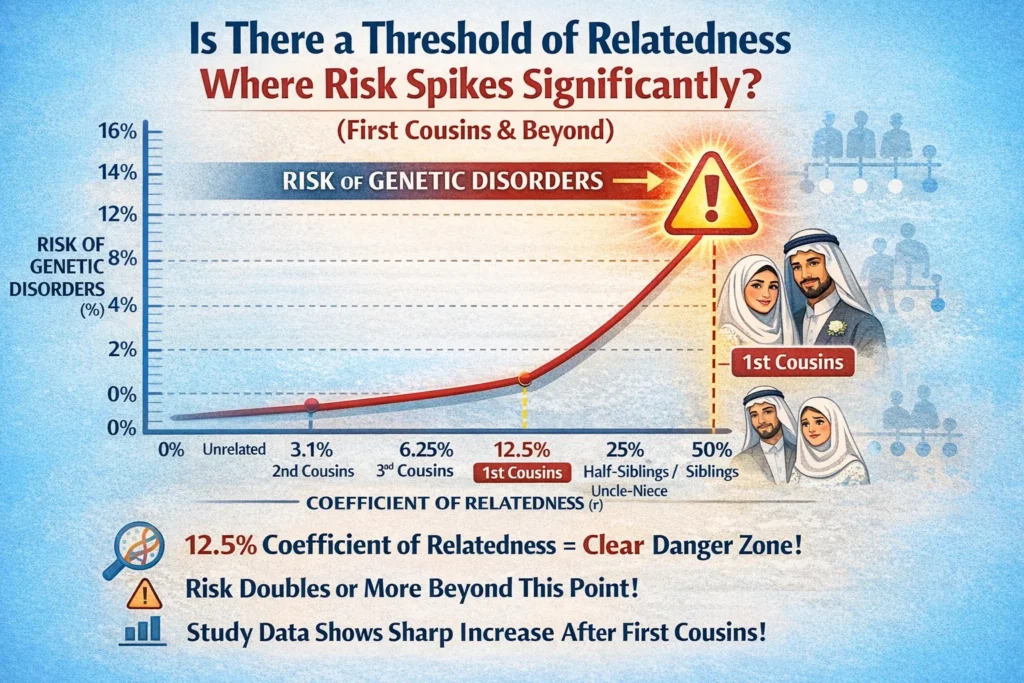
The risk spikes significantly at a coefficient of relatedness of r ≥ 0.125 — which means first cousins and any closer relationship.
Below that threshold (second cousins or more distant, r ≤ 0.03125), the increased risk is minimal—usually less than 1–2% above the general population baseline.
Above that threshold, the risk becomes clinically significant and cannot be ignored.
By the Numbers: How Much Does Risk Actually Increase?
Let us look at the baseline first.
For an unrelated couple, the risk that a child will be born with a serious autosomal recessive disorder (such as cystic fibrosis, thalassemia, spinal muscular atrophy, or metabolic disorders) is approximately 2–3%.
Now, here is how that risk changes with relatedness:
| Relationship | Coefficient (r) | Risk of Serious Recessive Disorder |
|---|---|---|
| Unrelated | 0 | 2–3% (baseline) |
| Second cousins | 0.03125 | 3–4% (minimal increase) |
| First cousins | 0.125 | 4–6% (2x baseline) |
| Uncle-niece / Aunt-nephew | 0.25 | 10–15% (5x baseline) |
| Siblings / Parent-child | 0.5 | 25–40% (10x baseline) |
The spike is real. Moving from second cousins to first cousins doubles the risk. Moving from first cousins to uncle-niece nearly triples it again.
Why Does the Risk Spike at First Cousins? (Autozygosity Explained)
The biological reason is called autozygosity —the probability that a child inherits two identical copies of a harmful recessive gene from a common ancestor.
Every person carries 1–2 lethal recessive mutations plus several milder ones. When parents are unrelated, the chance they carry the same mutation is very low.
But when parents are blood relatives, they are more likely to inherit identical DNA segments from their shared ancestor.
- At the first-cousin level (r = 0.125): Approximately 6.25% of the genome is autozygous (identical by descent). This is enough to meaningfully increase disease risk.
- At the second-cousin level (r = 0.03125): Only ~1.5% is autozygous — considered negligible.
- At the sibling level (r = 0.5): A massive 25% of the genome is autozygous — devastating.
This is why first cousins mark the threshold. Below that, nature gives you a pass. At that level, biology begins to take notice.
What Does Real-World Data Say?
Large-scale population studies from regions where consanguineous marriage is common (parts of India, Pakistan, the Middle East, North Africa, and South Asia) confirm this threshold consistently.
| Study Finding | Conclusion |
|---|---|
| Second cousins or more distant | No statistically significant increase in infant mortality, birth defects, or intellectual disability. |
| First cousins | Clear, measurable increase in autosomal recessive conditions, rare metabolic disorders, and congenital heart defects. Infant mortality rises by ~3–5% above baseline. |
| Double first cousins (r = 0.25) | Risks approach those of uncle-niece unions. Multiple recessive disorders become common. |
| Uncle-niece or sibling unions | Most offspring affected by serious genetic or developmental abnormalities. Universally prohibited. |
Source consensus: The American College of Medical Genetics, European Society of Human Genetics, and WHO all recognize first cousins as the threshold for meaningful genetic risk.
Important Exceptions & Nuances
Not every first-cousin union carries the same risk. Several factors matter:
1. Background Consanguinity in the Population
- In communities where cousin marriage has occurred for many generations, natural selection has often purged the most harmful recessive alleles. The risk may be slightly lower.
- In populations where cousin marriage is rare, first-cousin unions may carry a higher risk because harmful recessives are still present in the gene pool.
2. Family-Specific Genetic Load
- If the shared grandparents carried a specific recessive disease gene, the risk for that particular disorder can be much higher than the general 4–6% estimate.
3. Prenatal Screening Changes Everything
- Modern couples at or above the first-cousin threshold can undergo carrier screening before pregnancy. If both carry the same recessive mutation, they have options:
- Prenatal diagnosis
- IVF with preimplantation genetic testing (PGT)
- Using donor gametes
- Adoption
With proper screening, the actual risk can be reduced to near zero.
What Should You Do If You Are in a Consanguineous Marriage?
If you are married to or planning to marry a blood relative, here is a practical checklist:
✅ If You Are Second Cousins or More Distant (r ≤ 0.03125)
- The risk increase is minimal.
- Routine prenatal care is sufficient.
- No special genetic screening is typically recommended unless there is a known family history of a specific disorder.
✅ If You Are First Cousins (r = 0.125) or Closer
- Do this before pregnancy (ideally before marriage):
- Visit a genetic counselor.
- Get carrier screening for common recessive disorders in your ethnic group.
- If both carry the same mutation, discuss reproductive options.
- During pregnancy:
- Consider detailed anomaly scan at 18–20 weeks.
- Discuss prenatal diagnostic testing (amniocentesis or CVS) if high-risk carrier status is identified.
Legal and Ethical Context
| Relationship | Legal Status in Most Countries |
|---|---|
| Parent-child, siblings | Universally illegal (criminal offense) |
| Aunt/uncle – Niece/nephew | Illegal in most countries |
| First cousins | Legal in most of the world (including most of Europe, India, Brazil, Canada, Australia, and ~20 US states) but restricted or illegal in some places (e.g., China, South Korea, and ~25 US states) |
| Second cousins | Legal everywhere |
The legal controversy around first-cousin marriage exists precisely because first cousins sit exactly at the threshold — the risk is real but not catastrophic, allowing room for cultural and personal judgment.
Final Verdict: Yes, There Is a Clear Threshold
To answer your original question directly:
Yes, there is a statistically and clinically significant threshold of relatedness where risk spikes. That threshold is first cousins (coefficient of relatedness r = 0.125).
- Below this threshold (second cousins or more distant, r ≤ 0.03125): Risk is minimal and generally not a medical concern.
- At this threshold (first cousins, r = 0.125): Risk doubles from 2–3% to 4–6%.
- Above this threshold (uncle-niece, siblings, r ≥ 0.25): Risk becomes severe (10–40%), and such unions are almost universally discouraged or illegal.
Understanding this threshold empowers you to make informed decisions — not out of fear, but out of genetic literacy.
Frequently Asked Questions (FAQs)
Q1: Is it safe for first cousins to have children?
It is not risk-free, but the absolute risk of a serious disorder is 4–6% — meaning 94–96% of children are healthy. Many first-cousin couples have healthy children. However, genetic counseling and carrier screening are strongly recommended.
Q2: Do second cousins face any increased risk?
The increased risk is very small (approximately 1% above baseline) and is generally considered clinically negligible.
Q3: Can genetic testing eliminate the risk completely?
Yes, for known recessive disorders. Preconception carrier screening can identify shared mutations. If none are found, the risk drops to baseline. If a shared mutation is found, IVF with PGT can prevent affected children.
Q4: Why is sibling marriage much worse than first-cousin marriage?
Siblings share 50% of their genes (r = 0.5) versus 12.5% for first cousins. The autozygosity is four times higher, leading to a 25–40% risk of serious recessive disorders.
Share This Article
If you found this information useful, please share it with anyone who might be considering or is already in a consanguineous marriage. Genetic literacy saves lives and prevents unnecessary suffering.
Have questions? Leave a comment below or consult a certified genetic counselor.