
Pregnancy is a journey filled with anticipation, but for too many families, that joy is overshadowed by uncertainty. Complications such as preeclampsia (PE), gestational diabetes mellitus (GDM), fetal growth restriction (FGR), and preterm birth affect millions of pregnancies worldwide. According to the World Health Organization, complications during pregnancy and childbirth are a leading cause of death among young women globally.
The current standard of care—relying on maternal risk factors, blood pressure monitoring, ultrasounds, and glucose tests—has saved countless lives. However, these methods often detect problems only after symptoms appear, limiting the window for prevention.
But what if we could predict these complications before they happen?
Thanks to rapid advances in molecular biology, we are entering a new era of prenatal medicine. Researchers have identified specific biomarkers—measurable biological indicators found in blood, saliva, and even urine—that can signal the risk of developing severe pregnancy complications, sometimes months before clinical symptoms arise.
This article explores the most promising biomarkers that could predict pregnancy complications, from cell-free RNA to metabolic profiles, and how they are set to revolutionize maternal-fetal health in the USA.
What Are Pregnancy Biomarkers?
Biomarkers are objective, quantifiable characteristics of biological processes. In the context of pregnancy, they are typically molecular signatures—such as fragments of RNA, specific proteins, or metabolites—that are released by the placenta and the mother’s body into the bloodstream.
Think of them as an early warning system. A healthy placenta releases a specific “profile” of molecules into the mother’s blood. When the placenta begins to function poorly (a condition known as placental dysfunction), that molecular profile changes drastically. By capturing these changes via a simple blood draw or saliva test, clinicians could identify a pregnancy that is veering off course long before traditional methods raise a red flag.
Here are the most significant types of biomarkers currently being studied:
- Cell-free RNA (cfRNA): Fragments of genetic instructions released by the placenta.
- Cell-free DNA (cfDNA) Methylation: Chemical modifications to DNA that indicate gene activity.
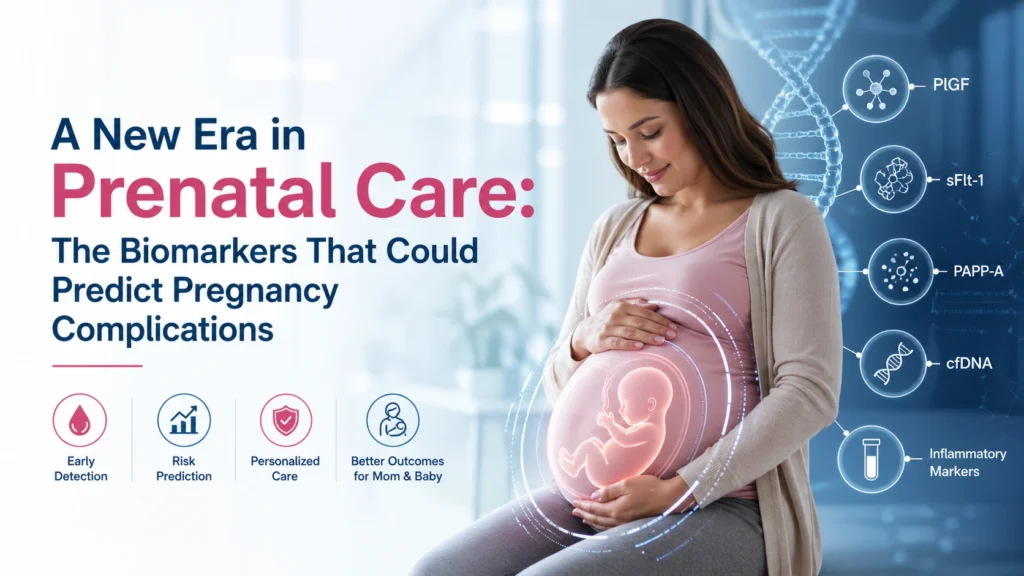
- Proteins: Specific molecules like PLGF, sFlt-1, and PAPPA that regulate blood vessel growth.
- MicroRNAs (miRNAs): Small RNA molecules that control gene expression.
- Metabolites: Small molecules like amino acids and lipids involved in metabolism.
1. Preeclampsia and Fetal Growth Restriction (FGR)
Preeclampsia (PE) is a severe hypertensive disorder affecting 5-10% of pregnancies and a leading cause of maternal and infant mortality worldwide. It is often accompanied by Fetal Growth Restriction (FGR), where the baby fails to grow at the expected rate.
The Two-Gene Breakthrough (LEP and PAPPA2)
A landmark study conducted by researchers at the University of Cambridge, published in Nature Communications, analyzed cell-free RNA in maternal blood collected during the Pregnancy Outcome Prediction Study (POPS). The results were striking: elevated levels of just two mRNAs—Leptin (LEP) and Pappalysin 2 (PAPPA2) —were powerful predictors of pregnancies complicated by both preeclampsia and fetal growth restriction.
The predictive model achieved an AUC (Area Under the Curve) of ~0.82 in a replication sample set. This means the test has a high degree of accuracy in distinguishing between a healthy pregnancy and one that will develop complications. Notably, after these conditions were clinically diagnosed, the association was even stronger, achieving an AUC of ~0.95.
The sFlt-1/PlGF Ratio
For years, the ratio of two proteins—soluble fms-like tyrosine kinase-1 (sFlt-1) to Placental Growth Factor (PlGF) —has been a gold-standard research target. An imbalance (too much sFlt-1, too little PlGF) indicates that the mother’s blood vessels are not functioning properly, starving the placenta of blood.
A study investigating a saliva test for preeclampsia found that the salivary sFLT-1:PlGF ratio was significantly higher in women who later developed preeclampsia. This non-invasive approach could predict the disease onset with a mean latency of 10.7 weeks before diagnosis. This represents an incredible opportunity for early intervention.
Epigenetics: DNA Methylation
Beyond RNA, researchers are looking at “epigenetics”—specifically, cell-free DNA methylation profiling. Because pregnancy complications often involve abnormal placental development due to hypoxia (lack of oxygen), the DNA released from these stressed cells carries unique chemical tags.
A 2025 study demonstrated that such a non-invasive cfDNA methylation strategy could identify pregnancies at high risk for preeclampsia as early as 12 weeks of gestation—months before symptoms appear.
2. Gestational Diabetes Mellitus (GDM)
Gestational Diabetes Mellitus is characterized by high blood sugar that develops during pregnancy. It increases the risk of having a large baby (macrosomia), preterm labor, and developing type 2 diabetes later in life.
Metabolic Profiling
A multi-omics profiling study (combining lipidomics and transcriptomics) revealed distinct alterations in women with GDM. Similarly, an analysis of the “Born in Bradford” cohort involving over 10,000 women found that elevated levels of a systemic inflammation marker called Glycoprotein Acetyls (GlycA) were significantly associated with an increased risk of GDM.
Other research points to glutamate and branched-chain amino acids as key predictors of GDM, with glutamate achieving a predictive accuracy of AUC 0.81. When researchers combined specific lipids and bile acids, the accuracy for distinguishing diabetic from healthy pregnancies rose to AUC 0.90.
Placental Factors in GDM
A study comparing women with GDM alone versus those with GDM and Severe Preeclampsia found that the combination of complications resulted in significantly higher levels of placental resistin and LCN-2 (Lipocalin-2). These proteins were also correlated with worse glucose and lipid metabolism, suggesting they could serve as dual biomarkers for overlapping metabolic and hypertensive disorders.
3. First-Trimester Screening for Multiple Outcomes
The ultimate goal of biomarker research is to unify testing. Instead of separate tests for separate diseases, scientists hope to run a single blood panel in the first trimester that calculates a risk profile for multiple outcomes.
A study examining microRNAs (miRNAs) —tiny regulators of gene expression—proposed predictive models using maternal blood collected between 10 and 13 weeks of gestation. The detection rates were remarkable:
- Late Miscarriage: 84.85%
- Gestational Diabetes requiring therapy: 89.47%
- HELLP Syndrome (a severe form of preeclampsia): 92.86%
- Stillbirth: 91.67% (achieved using miRNAs alone)
These findings are revolutionary because they suggest that the “soil” for complications later in pregnancy (like preterm birth or stillbirth) is detectable in the mother’s blood in the first trimester.
Early Pregnancy Loss and Ectopic Pregnancy
Biomarkers are also helping solve the most difficult dilemmas of early pregnancy: differentiating between a viable intrauterine pregnancy, a miscarriage, and an ectopic pregnancy (EP).
A study utilizing machine learning to analyze 24 biomarkers in 218 patients with pain or bleeding in early pregnancy found excellent predictive capabilities.
- Predicting Viability: A model using PSG3 (Pregnancy-specific beta-1-glycoprotein 3), chorionic gonadotropin-alpha subunit, and PAPPA achieved a maximum sensitivity of 93.3% and specificity of 98.6% (97.4% accuracy).
- Predicting Location: A separate model using sFLT-1, PSG3, and TFPI2 achieved 98.5% sensitivity for detecting ectopic pregnancies.
These models could dramatically reduce the time to diagnosis for life-threatening ectopic pregnancies.
The Future of Prenatal Care in the USA
For the average American patient, these advancements mean a shift from reactive to proactive care.
Instead of waiting for high blood pressure to appear (preeclampsia) or failing a glucose tolerance test at 28 weeks (GDM), a future expectant mother might provide a blood or saliva sample at her 12-week appointment.
A machine-learning algorithm would analyze the cfRNA, metabolites, and protein ratios (like sFlt-1/PlGF). The result would be a personalized risk score:
- *”Your risk for early-onset preeclampsia is low, but your inflammatory markers indicate a 40% higher risk for gestational diabetes.”*
With this knowledge, the physician could prescribe low-dose aspirin (for preeclampsia risk) or refer the patient to a metabolic nutritionist early in the pregnancy (for GDM risk).
Challenges to Overcome
While the science is promising, there are hurdles before these tests become standard at your local OB-GYN office:
- Validation: Many biomarkers have been identified in research settings but require large, diverse clinical trials to prove they work across different races and ethnicities.
- Standardization: Labs need to agree on how to measure these molecules (e.g., ELISA vs. PCR vs. Mass Spectrometry) so results are consistent across hospitals.
- Cost and Insurance: New genetic and proteomic tests can be expensive. It will take time for insurance providers to cover them universally.
Conclusion
The landscape of maternal-fetal health is changing. The days of relying solely on blood pressure cuffs and measuring fundal height are giving way to a molecular approach. Biomarkers that could predict pregnancy complications—from placental proteins and cell-free RNA to metabolic signatures and microRNAs—offer the promise of a 9-month head start in protecting both mother and child.
By identifying preeclampsia at week 12 instead of week 36, we can prevent emergency C-sections and neonatal ICU stays. By flagging metabolic risks for GDM in the first trimester, we can implement nutritional interventions that result in healthier birth weights.
For the millions of American women who will become pregnant this year, this research is not just academic; it is the roadmap to safer, more personalized, and more peaceful pregnancies.
Disclaimer: This article is for informational purposes only and does not constitute medical advice. Always consult with a qualified healthcare provider for diagnosis and treatment options regarding prenatal health and pregnancy complications.