
Pregnancy is a time of hope, but for many expectant parents, it is also a time of anxiety. Will the baby be healthy? Are there any hidden genetic conditions? For decades, the only way to get definitive answers was through invasive procedures like amniocentesis or chorionic villus sampling (CVS)—tests that carry a small but real risk of miscarriage.
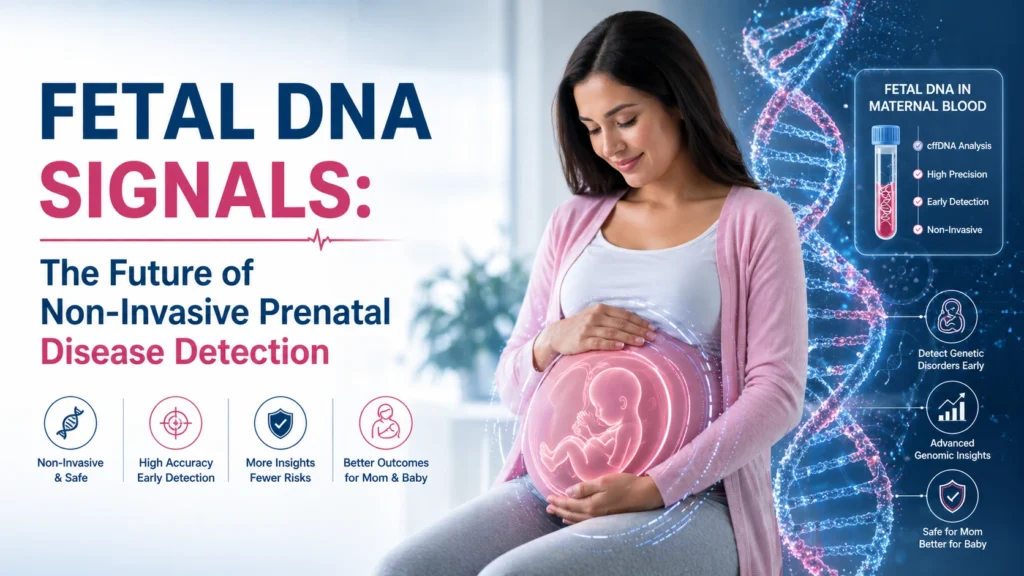
But a revolutionary shift is underway. Hidden within a pregnant woman’s bloodstream are tiny fragments of her unborn child’s genetic material. These Fetal DNA Signals are transforming prenatal care, allowing doctors to detect hundreds of genetic conditions with nothing more than a simple blood draw from the mother’s arm.
This non-invasive approach, often called Non-Invasive Prenatal Testing (NIPT) or cell-free fetal DNA (cffDNA) analysis, is now considered one of the most significant advancements in reproductive medicine in the past 50 years. As technology evolves, these signals are becoming even more powerful, capable of detecting not just chromosomal abnormalities like Down syndrome but also single-gene disorders and even predicting pregnancy complications.
This article explores the science behind Fetal DNA Signals, what they can detect today, and what the future holds for non-invasive prenatal disease detection.
What Are Fetal DNA Signals?
To understand the revolution, you first need to understand the biology.
During pregnancy, the placenta undergoes a natural process of cell turnover. As placental cells die, they release small fragments of DNA into the mother’s bloodstream. These fragments are called cell-free fetal DNA (cffDNA) . They are typically very small—usually between 150 and 200 base pairs in length.
Remarkably, these Fetal DNA Signals can be detected as early as 5 to 7 weeks of gestation . By 10 weeks, there is enough fetal DNA circulating in the mother’s blood (usually 4-20% of the total cell-free DNA) to perform reliable genetic analysis.
Crucially, because this DNA is fetal in origin, analyzing it allows doctors to peek into the baby’s genetic blueprint without ever touching the baby. The mother’s blood essentially becomes a window into the womb.
How Is It Different from Traditional Testing?
| Feature | Traditional Invasive Testing | Non-Invasive (Fetal DNA Signals) |
|---|---|---|
| Method | Needle inserted into uterus (amniocentesis/CVS) | Simple blood draw from mother’s arm |
| Risk of Miscarriage | ~0.1-0.5% | Zero |
| Timing | 15-20 weeks (amnio) or 10-13 weeks (CVS) | As early as 9-10 weeks |
| Conditions Detected | Full genome (all chromosomes and single genes) | Primarily aneuploidies (extra/missing chromosomes) and select microdeletions |
| Turnaround Time | 1-3 weeks | 3-7 days |
What Fetal DNA Signals Can Detect Today
Over the past decade, NIPT using Fetal DNA Signals has become a standard part of prenatal care in the United States. The American College of Obstetricians and Gynecologists (ACOG) now recommends offering NIPT to all pregnant women, regardless of age or risk factors.
Here is what current technology can reliably detect:
1. Chromosomal Aneuploidies (Extra or Missing Chromosomes)
This is the most common use of NIPT. These conditions occur when a baby has an extra copy of a chromosome (trisomy) or a missing copy (monosomy).
- Trisomy 21 (Down syndrome): The most common chromosomal condition. NIPT has a detection rate of over 99% with a very low false positive rate.
- Trisomy 18 (Edwards syndrome): A severe condition associated with major birth defects. Detection rate is similarly high.
- Trisomy 13 (Patau syndrome): Another severe condition with a poor prognosis.
- Monosomy X (Turner syndrome): A condition affecting females where one X chromosome is missing.
2. Sex Chromosome Aneuploidies
NIPT can also determine fetal sex with high accuracy and detect conditions involving the sex chromosomes, such as:
- Klinefelter syndrome (XXY)
- Triple X syndrome (XXX)
- Jacob syndrome (XYY)
3. Select Microdeletion Syndromes
More advanced NIPT panels can detect small missing pieces of chromosomes (microdeletions). These include:
- 22q11.2 deletion syndrome (DiGeorge syndrome)
- 1p36 deletion syndrome
- Cri-du-chat syndrome (5p deletion)
Note: Detection rates for microdeletions are generally lower than for whole chromosome abnormalities, and pre-test counseling is essential.
The Cutting Edge: Beyond Aneuploidies
While NIPT for Down syndrome is now routine, researchers are pushing the boundaries of what Fetal DNA Signals can reveal. The next frontier is single-gene disorders and whole-genome sequencing.
Detecting Single-Gene Disorders
Single-gene disorders (also called monogenic disorders) are caused by mutations in a specific gene. They include devastating conditions like:
- Cystic fibrosis (CF)
- Sickle cell anemia
- Spinal muscular atrophy (SMA)
- Huntington’s disease
- Hemophilia
Detecting these conditions using cffDNA is more challenging because the signal is weaker. Unlike an extra whole chromosome (which creates a clear dosage difference), a single-letter mutation in a gene is a subtle change.
However, recent advances in digital PCR and next-generation sequencing (NGS) are making this possible. Today, targeted NIPT for specific single-gene disorders (like achondroplasia or thanatophoric dysplasia—both forms of dwarfism) is available when the father carries a known mutation.
The holy grail is non-invasive whole-genome sequencing—reading every single one of the baby’s 3 billion DNA letters from a maternal blood sample. While this is not yet clinically routine, several research studies have successfully demonstrated its feasibility. This would allow doctors to screen for hundreds of genetic diseases simultaneously, with zero risk to the fetus.
Epigenetic Signals: The Hidden Layer
Beyond the DNA sequence itself, researchers are studying fetal DNA methylation patterns. Methylation is a chemical “tag” placed on DNA that controls whether a gene is turned on or off.
Certain genetic conditions and pregnancy complications (like preeclampsia or fetal growth restriction) leave unique methylation fingerprints on fetal DNA. By analyzing these epigenetic signals, scientists hope to predict:
- Gestational age (potentially reducing false term dates)
- Preeclampsia risk (months before symptoms)
- Fetal growth restriction (FGR)
- Placental health and function
This layer of information is invisible to standard sequencing but holds immense clinical value.
Key Applications in Disease Detection
| Disease Category | Specific Conditions | Detection Method Using Fetal DNA Signals |
|---|---|---|
| Chromosomal Aneuploidies | Down syndrome (T21), Edwards (T18), Patau (T13), Turner (XO) | Counting chromosome copy numbers (dosage analysis) |
| Sex Chromosome Aneuploidies | Klinefelter (XXY), Triple X (XXX), Jacob (XYY) | Counting X/Y-specific sequences |
| Microdeletions | DiGeorge (22q11.2), Cri-du-chat (5p), 1p36 deletion | Detecting loss of specific DNA segments |
| Single-Gene Disorders | Cystic fibrosis, sickle cell, SMA, hemophilia, achondroplasia | Targeted NGS or digital PCR looking for paternal or de novo mutations |
| Epigenetic Abnormalities | Preeclampsia risk, FGR, placental dysfunction | Analyzing fetal DNA methylation patterns |
| Rhesus (Rh) Blood Type | Rh incompatibility between mother and fetus | Detecting presence of the RHD gene in fetal DNA (for Rh-negative mothers) |
Advantages Over Traditional Methods
The rise of Fetal DNA Signals has fundamentally changed the counseling and management of pregnancy.
For Expectant Parents:
- Zero risk of miscarriage: The most significant advantage. No needles near the baby.
- Early results: Information is available by the end of the first trimester, allowing for more time to make informed decisions.
- Reduced anxiety: A “low risk” NIPT result can provide significant reassurance.
- Boy or girl?: Accurate fetal sex determination as early as 9 weeks.
For the Healthcare System:
- Fewer invasive procedures: High-risk NIPT results are confirmed with diagnostic testing, but low-risk results mean many women can skip amniocentesis entirely.
- Better resource allocation: High-risk pregnancies can be flagged early for specialist monitoring.
Limitations and Considerations
No test is perfect. While Fetal DNA Signals are powerful, they are screening tests, not diagnostic tests.
1. False Positives and Negatives
A positive NIPT result does not guarantee the baby has a condition. It indicates an increased risk, which should be confirmed with diagnostic testing (amniocentesis or CVS). Similarly, a negative result is highly reassuring but does not guarantee a completely healthy baby, as NIPT does not detect all conditions.
2. Confined Placental Mosaicism (CPM)
Occasionally, the placenta has genetic abnormalities that the baby does not share. Because NIPT analyzes placental DNA, this can lead to a false positive result. CPM accounts for a significant percentage of discordant NIPT results.
3. Maternal Factors
Sometimes, the “signal” is not purely fetal. A mother’s own undiagnosed cancer or a vanishing twin can contribute cell-free DNA and skew results.
4. Not a Complete Screen
Standard NIPT does not detect structural birth defects (like heart defects or spina bifida), nor does it screen for many common genetic conditions that are not caused by aneuploidy or microdeletions. A normal NIPT result should be complemented by a detailed anatomy ultrasound at 18-22 weeks.
The Future: What’s Next for Fetal DNA Signals?
The trajectory of this technology points toward increasingly comprehensive and accessible prenatal genomics.
Whole-Genome NIPT
Within the next 5-10 years, many experts predict that whole-genome NIPT will become clinically available. This would allow screening for virtually all genetic conditions—from chromosomal abnormalities to rare single-gene disorders—in a single, non-invasive test.
At-Home Testing?
Some companies are already exploring direct-to-consumer fetal DNA testing. However, this raises significant ethical concerns regarding genetic counseling, informed consent, and the potential for misuse of fetal genetic information.
Integration with Artificial Intelligence (AI)
AI algorithms are being trained to analyze complex patterns within Fetal DNA Signals that human eyes might miss. Machine learning models can integrate genetic data with maternal clinical data (age, weight, blood pressure) to produce highly personalized risk predictions for everything from preterm birth to preeclampsia.
Earlier Detection
As sequencing technologies become more sensitive, reliable detection may be possible as early as 5 weeks of gestation —before many women even know they are pregnant. This could open doors to very early intervention for certain treatable conditions.
Ethical Considerations
With great power comes great responsibility. The ability to read a baby’s entire genetic blueprint from a maternal blood draw raises profound ethical questions:
- What conditions should we screen for? Only severe, childhood-onset diseases? Or also adult-onset conditions like Huntington’s or BRCA mutations?
- What about variants of unknown significance (VUS)? How do we counsel parents about genetic changes that we don’t yet understand?
- Who owns the fetal genetic data? The mother? The father? The future child?
- What about sex selection? NIPT can determine fetal sex as early as 9 weeks. How do we prevent misuse for non-medical sex selection?
Professional organizations like ACOG and the International Society for Prenatal Diagnosis (ISPD) are actively developing guidelines to ensure that the clinical implementation of these powerful technologies is accompanied by robust genetic counseling and ethical oversight.
Conclusion
Fetal DNA Signals have already changed the landscape of prenatal care. What was once science fiction—reading a baby’s DNA from a tube of the mother’s blood—is now a routine clinical reality for millions of American women each year.
Today, these signals can detect Down syndrome, other chromosomal conditions, and select single-gene disorders with high accuracy and zero risk to the fetus. Tomorrow, they will likely provide a complete, non-invasive genetic blueprint of the unborn child, enabling early diagnosis and, in some cases, early intervention.
As technology continues to advance—powered by next-generation sequencing, AI, and epigenetics—the ability to predict, diagnose, and potentially treat fetal diseases will only grow. The future of prenatal medicine is already here. It is safe, it is early, and it is written in the Fetal DNA Signals flowing through every pregnant mother’s blood.
Disclaimer: This article is for informational purposes only and does not constitute medical advice. Non-Invasive Prenatal Testing (NIPT) is a screening test, not a diagnostic test. All abnormal or high-risk NIPT results should be confirmed with diagnostic testing (amniocentesis or CVS). Always consult with a qualified healthcare provider or genetic counselor regarding prenatal testing options and results.