
Different Types of Magnesium Supplements and Benefits: The Complete Guide to Choosing the Right One for Sleep, Anxiety, Constipation & Heart Health
Magnesium is the unsung hero of human health. It participates in over 300 enzymatic reactions in your body, yet up to 50% of people are deficient without even knowing it. Fatigue, muscle cramps, poor sleep, anxiety, headaches, and constipation are all silent signs of low magnesium.
But here is where most people get confused: not all magnesium is created equal.
Understanding the different types of magnesium supplements and benefits is the key to unlocking better sleep, reduced anxiety, regular digestion, and a healthier heart. Walk into any pharmacy or scroll through Amazon, and you will see magnesium citrate, glycinate, oxide, malate, threonate, and more. Which one should you choose?
This 1,500-word guide breaks down every major type of magnesium, its unique benefits, best uses, potential side effects, and exactly how to take it for maximum absorption.
🧠 Support Your Magnesium Journey with Premium Tools 🧠
💤 Magnesium Glycinate
🧠 Magnesium L-Threonate
💧 Magnesium Citrate Powder
🧴 Magnesium Oil Spray
🛁 Epsom Salt (Magnesium Sulfate)
Why Magnesium Matters: A Quick Overview
Before diving into the different types, let us establish why this mineral is so critical.
| Body Function | How Magnesium Helps |
|---|---|
| Nervous system | Regulates neurotransmitters, calms overactive nerves |
| Muscle function | Prevents cramps, spasms, and twitching |
| Sleep quality | Activates GABA receptors for deeper rest |
| Heart rhythm | Maintains steady heartbeat and blood pressure |
| Bone health | Works with calcium and vitamin D to build bone |
| Blood sugar | Improves insulin sensitivity |
| Digestion | Relaxes intestinal muscles to relieve constipation |
A deficiency can manifest as insomnia, migraines, fibromyalgia, high blood pressure, irregular heartbeat, and even depression.
Now, let us explore each type of magnesium supplement so you can match the right one to your specific health concern.
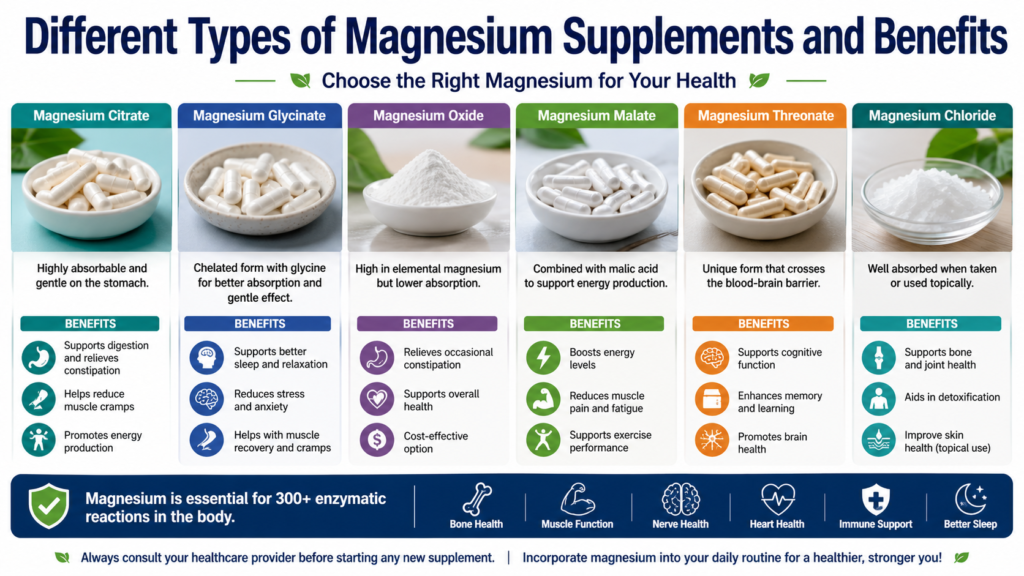
1. Magnesium Glycinate (Best for Anxiety, Sleep & Stress)
Chemical structure: Magnesium bound to the amino acid glycine.
Benefits:
- Highest bioavailability – extremely well absorbed by the body
- Gentle on the stomach – rarely causes digestive upset
- Promotes deep sleep – glycine itself acts as a calming neurotransmitter
- Reduces anxiety and stress – lowers cortisol levels
- Helps with fibromyalgia and chronic pain
Best for:
- Insomnia and poor sleep quality
- Generalized anxiety disorder or panic attacks
- People with sensitive stomachs who cannot tolerate other forms
- Chronic stress and adrenal fatigue
Dosage:
200-400 mg before bedtime.
Potential side effects:
Minimal. Rarely causes loose stools because of high absorption.
Bottom line:
The overall best magnesium supplement for most people, especially if sleep and anxiety are your primary concerns.
2. Magnesium Citrate (Best for Constipation & Digestion)
Chemical structure: Magnesium bound to citric acid.
Benefits:
- Excellent for constipation – draws water into the intestines
- Moderately well absorbed – better than oxide
- Helps with indigestion and bloating
- May prevent kidney stones (citrate binds to oxalates)
Best for:
- Occasional or chronic constipation
- Preparing for colonoscopy (doctors often prescribe it)
- People who need both magnesium replenishment and digestive support
Dosage:
200-400 mg daily. Higher doses (500-1000 mg) are used for constipation relief.
Potential side effects:
Diarrhea, abdominal cramping, and loose stools if taken in excess.
Bottom line:
The go-to choice for constipation and digestive regularity. Not ideal for daily long-term use if you have normal bowel movements.
3. Magnesium Oxide (Best for Heartburn & Low Cost)
Chemical structure: Magnesium bound to oxygen (the most common, least absorbable form).
Benefits:
- Very inexpensive – widely available
- Effective for heartburn and indigestion (works as an antacid)
- High elemental magnesium per dose (60% magnesium by weight)
- May help migraines in higher doses
Best for:
- Temporary heartburn relief
- People on a very tight budget
- Those who need a bulk laxative effect (though citrate is better for this)
Dosage:
200-400 mg. For migraines, up to 600 mg has been studied.
Potential side effects:
Poor absorption (only 4% bioavailable). High risk of loose stools and gastrointestinal distress.
Bottom line:
Not recommended for general magnesium supplementation due to poor absorption. Skip this unless you need a cheap antacid.
4. Magnesium Malate (Best for Chronic Fatigue & Muscle Pain)
Chemical structure: Magnesium bound to malic acid (found in apples and fruits).
Benefits:
- Excellent for fibromyalgia and chronic fatigue syndrome
- Boosts energy production – malic acid is involved in ATP synthesis
- Reduces muscle pain and tenderness
- Well absorbed with fewer digestive side effects
Best for:
- Fibromyalgia
- Chronic fatigue syndrome (ME/CFS)
- Muscle aches, soreness, and tension
- People who feel tired even after sleeping
Dosage:
200-400 mg, preferably taken in the morning (it can be slightly energizing).
Potential side effects:
Mild digestive upset if taken on an empty stomach.
Bottom line:
The best magnesium for fatigue and muscle pain. Take it in the morning for an energy boost without jitters.
5. Magnesium L-Threonate (Best for Brain Health & Memory)
Chemical structure: Magnesium bound to threonic acid (a vitamin C metabolite).
Benefits:
- Uniquely crosses the blood-brain barrier
- Raises brain magnesium levels more effectively than any other form
- Improves memory, learning, and cognitive function
- May help with brain fog, dementia, and Alzheimer’s prevention
- Reduces symptoms of depression and anxiety at the neural level
Best for:
- Brain fog and poor concentration
- Age-related cognitive decline
- Students or professionals needing mental clarity
- People with a family history of Alzheimer’s or dementia
Dosage:
1,000-2,000 mg (divided into 2-3 doses) because the molecule is larger.
Potential side effects:
Very mild. Headaches have been reported in some individuals initially.
Bottom line:
The premium choice for brain health. It is more expensive than other forms but worth it for cognitive benefits.
6. Magnesium Taurate (Best for Heart Health & Blood Pressure)
Chemical structure: Magnesium bound to the amino acid taurine.
Benefits:
- Powerful cardiovascular support – taurine also benefits the heart
- Lowers high blood pressure effectively
- Reduces palpitations and arrhythmias
- Improves insulin sensitivity (benefits blood sugar)
- Calms the nervous system like glycinate
Best for:
- High blood pressure
- Heart palpitations or irregular heartbeat
- Congestive heart failure (as supportive therapy)
- Diabetes or metabolic syndrome
Dosage:
200-400 mg daily, with or without food.
Potential side effects:
Very rare. Generally well tolerated.
Bottom line:
The best magnesium for heart health. If you have cardiovascular concerns, this is your top choice.
7. Magnesium Chloride (Best for Topical Use & Detox)
Chemical structure: Magnesium bound to chlorine.
Benefits:
- Well absorbed orally and transdermally (through the skin)
- Supports liver detoxification pathways
- Effective for muscle cramps and aches when used as oil or flakes
- Boosts skin health (used in magnesium bath flakes)
Best for:
- People who cannot tolerate oral supplements (use magnesium oil on skin)
- Athletes with muscle soreness (magnesium baths)
- Detox protocols
- Improving eczema or psoriasis (topical)
Dosage (oral): 200-400 mg.
Topical: Spray magnesium oil on legs or arms; rinse after 20-30 minutes.
Potential side effects:
Oral forms can cause digestive upset. Topical may cause mild tingling or itching.
Bottom line:
Excellent for topical use and detox support. Ideal if oral magnesium upsets your stomach.
8. Magnesium Sulfate (Best for Muscle Soaking – Epsom Salt)
Chemical structure: Magnesium bound to sulfur and oxygen (Epsom salt).
Benefits:
- Relieves sore muscles and joint pain when added to bath water
- Reduces stress and promotes relaxation
- Improves skin conditions (eczema, psoriasis)
- Helps draw out toxins (traditional use)
Best for:
- Post-workout recovery
- Relaxation baths before bed
- Arthritis and joint pain
Dosage:
Add 1-2 cups to warm bath water. Soak for 15-20 minutes.
Potential side effects:
Oral use causes severe diarrhea (not recommended for internal use).
Bottom line:
Only for bathing, not internal use. A wonderful addition to a self-care routine.
Comparison Table: Different Types of Magnesium Supplements and Benefits
| Type | Best For | Bioavailability | Stomach Tolerance | Best Time to Take |
|---|---|---|---|---|
| Glycinate | Sleep, anxiety, stress | ⭐⭐⭐⭐⭐ High | Excellent | Bedtime |
| Citrate | Constipation | ⭐⭐⭐⭐ Good | Moderate (can cause loose stool) | Morning or with meals |
| Oxide | Heartburn, low cost | ⭐ Very low | Poor | With food |
| Malate | Fatigue, muscle pain | ⭐⭐⭐⭐ Good | Good | Morning |
| L-Threonate | Brain health, memory | ⭐⭐⭐⭐⭐ High (brain) | Excellent | Divided doses (AM/PM) |
| Taurate | Heart health, blood pressure | ⭐⭐⭐⭐ Good | Excellent | Morning or evening |
| Chloride | Topical use, detox | ⭐⭐⭐ Moderate (oral) | Moderate | Anytime |
| Sulfate | Muscle soaking (Epsom salt) | N/A (topical) | N/A | Bath time |
Signs You May Need Magnesium (Deficiency Symptoms)
- Muscle cramps, twitches, or spasms
- Insomnia or restless sleep
- Anxiety, irritability, or panic attacks
- Constipation
- Migraines or tension headaches
- High blood pressure
- Fatigue and low energy
- Heart palpitations
If you experience three or more of these, adding the right magnesium supplement could be life-changing.
Start here:
│
├─ Do you have insomnia or anxiety?
│ └─ YES → Magnesium Glycinate (bedtime)
│
├─ Do you have constipation?
│ └─ YES → Magnesium Citrate (morning)
│
├─ Do you have chronic fatigue or muscle pain?
│ └─ YES → Magnesium Malate (morning)
│
├─ Do you have brain fog or memory concerns?
│ └─ YES → Magnesium L-Threonate (divided doses)
│
├─ Do you have high blood pressure or palpitations?
│ └─ YES → Magnesium Taurate (daily)
│
├─ Does oral magnesium upset your stomach?
│ └─ YES → Magnesium Chloride (topical oil or flakes)
│
└─ Do you just want general relaxation?
└─ YES → Magnesium Glycinate or Epsom salt baths
Can You Take Multiple Types of Magnesium?
Yes. Many people take:
- Magnesium Glycinate at night for sleep
- Magnesium Malate in the morning for energy
- Epsom salt baths as needed for muscle relaxation
Just do not exceed the upper tolerable limit of 350-400 mg of elemental magnesium per day from supplements (food sources are fine).
Food Sources of Magnesium (Bonus)
While supplements are helpful, do not forget these magnesium-rich foods:
- Dark leafy greens (spinach, kale)
- Pumpkin seeds
- Almonds and cashews
- Black beans
- Dark chocolate (85%+ cacao)
- Avocado
- Bananas
- Fatty fish (salmon, mackerel)
Faqs:
Q: Which type of magnesium is best for sleep?
A: Magnesium glycinate is the clear winner for sleep due to its calming effects and high absorption.
Q: Which type of magnesium is best for anxiety?
A: Magnesium glycinate again. Some also benefit from L-threonate for brain-based anxiety.
Q: Can I take magnesium every day?
A: Yes, up to 350-400 mg of elemental magnesium daily is safe for most adults.
Q: Does magnesium interact with medications?
A: Yes. Magnesium can interact with antibiotics, diuretics, bisphosphonates, and blood pressure medications. Consult your doctor.
Q: How long does magnesium take to work?
A: Sleep and anxiety benefits may be felt within a few days to one week. Constipation relief occurs within 6-12 hours.
Which form of magnesium is most beneficial?
Short answer: There is no single “most beneficial” form—it depends entirely on your specific health goal.
However, if forced to choose one forgeneral health, Magnesium Glycinate is widely considered the best all-around option due to its high bioavailability, excellent gut tolerance, and broad benefits for sleep, anxiety, and overall deficiency correction .
| If Your Goal Is… | Most Beneficial Form |
|---|---|
| Sleep, anxiety, stress reduction | Magnesium Glycinate |
| Brain health, memory, focus | Magnesium L-Threonate |
| Heart health, blood pressure | Magnesium Taurate |
| Energy, fatigue, muscle pain | Magnesium Malate |
| Constipation relief | Magnesium Citrate |
Should you take magnesium if you take PPI?
Short answer: YES, absolutely. If you take proton pump inhibitors (PPIs) long-term, you should be especially vigilant about your magnesium levels—and may need supplementation.
The Science:
PPIs (omeprazole, esomeprazole, lansoprazole, pantoprazole, etc.) are among the most commonly prescribed medications worldwide. However, long-term use interferes with magnesium absorption in the intestines by changing gut pH and disrupting active magnesium transport channels (TRPM6 and TRPM7) .
Key Findings from Medical Literature:
- Hypomagnesemia occurs in approximately20% of long-term PPI users vs. 13% of non-users
- Serious adverse events includetetany (muscle spasms), cardiac arrhythmias, and seizures
- Low magnesium can lead to secondaryhypocalcemia and hypokalemia that is resistant to calcium or potassium supplementation alone
- The FDA recommends monitoring magnesium levels before starting long-term PPI therapy and periodically thereafter
What You Should Do:
- Do not stop your PPI without consulting your doctor
- Ask your doctor to check your serum magnesium level
- If deficient, magnesium supplementation is safe and effective, but choose a well-absorbed form (glycinate, malate, or taurate)
- In severe cases, discontinuing the PPI may be necessary to restore normal magnesium levels
Warning: Some cases of PPI-induced hypomagnesemia areresistant to oral magnesium supplementation and require PPI discontinuation. Work with your doctor.
What are the best 3 magnesiums to take?
Based on clinical evidence and common health goals, thetop 3 magnesium supplements are:
What is the best magnesium supplement for CFS (Chronic Fatigue Syndrome)?
Short answer: Magnesium Malate is the most recommended form for CFS/ME (Myalgic Encephalomyelitis/Chronic Fatigue Syndrome) .
Why Magnesium Malate for CFS?
CFS is characterized bymitochondrial dysfunction—your cells cannot produce or utilize energy efficiently. Magnesium malate addresses this at the cellular level:
Clinical Context:
- Magnesium malate is frequently recommended by physicians for CFS/ME symptom management
- It may help reducepost-exertional malaise (PEM)—the hallmark “crash” after minimal activity
- It is also beneficial forfibromyalgia, which often overlaps with CFS
Note: While no supplement cures CFS/ME, magnesium malate addresses the intracellular magnesium deficit common in these patients and supports mitochondrial energy production .
Which type of magnesium is best? (Quick Reference)
| Your Primary Concern | Best Form |
|---|---|
| Sleep problems / Insomnia | Magnesium Glycinate |
| Anxiety / Stress | Magnesium Glycinate |
| Brain fog / Memory | Magnesium L-Threonate |
| High blood pressure | Magnesium Taurate |
| Heart palpitations | Magnesium Taurate |
| Chronic fatigue / Low energy | Magnesium Malate |
| Muscle pain / Fibromyalgia | Magnesium Malate |
| Constipation | Magnesium Citrate |
| Heartburn / Low budget | Magnesium Oxide (less absorbable) |
| Sensitive stomach | Magnesium Glycinate |
| Topical use (muscle soak) | Magnesium Chloride (oil) or Sulfate (Epsom salt) |
Types of Magnesium Chart
| Form | Bioavailability | Best For | GI Tolerance | Best Time |
|---|---|---|---|---|
| Glycinate | High | Sleep, anxiety, general health | Excellent | Bedtime |
| L-Threonate | High (brain) | Memory, focus, cognitive health | Excellent | Divided doses |
| Taurate | Good | Heart health, blood pressure | Excellent | Morning/Evening |
| Malate | Good | Energy, fatigue, muscle pain | Good | Morning |
| Citrate | Good | Constipation | Moderate (loose stools) | Morning |
| Oxide | Very low | Heartburn, cheap laxative | Poor | With food |
Magnesium L-Threonate (Deep Dive)
What it is: Magnesium bound to threonic acid (a vitamin C metabolite).
Why it is special: It is theonly form of magnesium clinically proven to cross the blood-brain barrier and raise magnesium levels in the brain and cerebrospinal fluid .
Key Evidence:
- A 2010 MIT study (published in Neuron) first identified that magnesium L-threonate significantly elevates brain magnesium concentrations while other forms cannot
- A double-blind, placebo-controlled study in healthy adults showed significant improvements inall five cognitive subcategories (memory quotient, visual recognition, verbal memory, etc.)
- Another clinical trial showed a modeled7.5-year improvement in cognitive age compared to placebo
Best For:
- Age-related cognitive decline
- Brain fog and poor concentration
- Memory retention (both short-term and long-term)
- Supporting overall brain health
Dosage:
Typical dose: 1,000-2,000 mg daily (divided into 2-3 doses) .
Magnesium Taurate (Deep Dive)
What it is: Magnesium bound to the amino acid taurine.
Why It Is Unique for Heart Health:
Both magnesium and taurine independently support cardiovascular function. Together, they:
- Help lower blood pressure
- May reduce cardiac arrhythmias (irregular heartbeat)
- Stabilize heart muscle cells and improve circulation
- Provide antioxidant effects that protect heart tissue
Best For:
- High blood pressure (hypertension)
- Heart palpitations
- General cardiovascular support
- People who want heart-specific benefits without digestive side effects
Evidence:
A 2019 animal study found magnesium taurate significantly decreased blood pressure in hypertensive rats . While more human studies are needed, it is widely recommended for cardiovascular applications.
Best type of magnesium for muscle cramps
Short answer: Magnesium Glycinate is generally best for nighttime or generalized muscle cramps, whileMagnesium Malate may be better for daytime or exercise-related cramps.
| Cramp Type | Best Form | Why |
|---|---|---|
| Nighttime leg cramps | Magnesium Glycinate | High absorption, calming effect on nerves |
| Post-exercise muscle cramps | Magnesium Malate | Supports energy recovery and ATP production |
| Menstrual cramping | Magnesium Glycinate | Reduces prostaglandins and muscle tension |
| General muscle twitching/spasms | Magnesium Glycinate | Gentle on stomach for daily use |
Mechanism: Magnesium blocks calcium from entering muscle cells, allowing muscles to relax. Deficiency leads to uncontrolled calcium influx and sustained contraction (cramp) .
7 forms of magnesium in one pill
Yes, combination products containingmultiple magnesium forms are available commercially. These products aim to provide broad-spectrum benefits by including forms that target different body systems:
| Typical Inclusion | Purpose in Blend |
|---|---|
| Glycinate | Sleep, anxiety, general absorption |
| Citrate | Constipation, quick absorption |
| Malate | Energy, muscle function |
| Oxide | Elemental magnesium content (bulk) |
| Taurate | Heart health |
| L-Threonate | Brain health (less common in blends due to cost) |
| Chloride | Topical/detox support (more common in liquid blends) |
Note: While convenient, these blends may not provide enough of any single form to achieve its specific therapeutic benefit. For targeted results (e.g., brain health), individual supplementation with L-threonate is superior.
Magnesium Malate (Deep Dive)
What it is: Magnesium bound to malic acid (found naturally in apples and fruits).
Why It is Unique for Energy:
Malic acid is adirect intermediate in the Krebs cycle—the primary metabolic pathway that generates ATP (energy) in your mitochondria .
Key Benefits:
Best For:
- Chronic fatigue syndrome (CFS/ME)
- Fibromyalgia
- Post-exercise recovery
- Daytime energy support (take in morning)
Best magnesium supplement for muscles (Summary)
| Muscle Issue | Best Magnesium Form |
|---|---|
| General muscle relaxation | Magnesium Glycinate |
| Post-workout recovery | Magnesium Malate |
| Muscle cramps (nighttime) | Magnesium Glycinate |
| Muscle pain (chronic/fibromyalgia) | Magnesium Malate |
| Topical muscle soak | Magnesium Sulfate (Epsom salt bath) |
Final Summary Table
| Question | Answer |
|---|---|
| Most beneficial overall? | Magnesium Glycinate (for general health) |
| Take with PPI? | Yes (but monitor levels; consult doctor) |
| Top 3 best forms? | Glycinate, L-Threonate, Malate |
| Best for CFS? | Magnesium Malate |
| Best for brain? | Magnesium L-Threonate |
| Best for heart? | Magnesium Taurate |
| Best for muscle cramps? | Magnesium Glycinate |
| Best for energy? | Magnesium Malate |
Medical Disclaimer
This article is for informational purposes only and does not constitute medical advice. Always consult a healthcare provider before starting any new supplement regimen, especially if you are pregnant, nursing, taking medications, or have kidney disease.
Affiliate Disclosure
*This post contains affiliate links to the Cosmoclinic-20 store on Amazon. As an Amazon Associate, we earn a commission from qualifying purchases at no extra cost to you.*