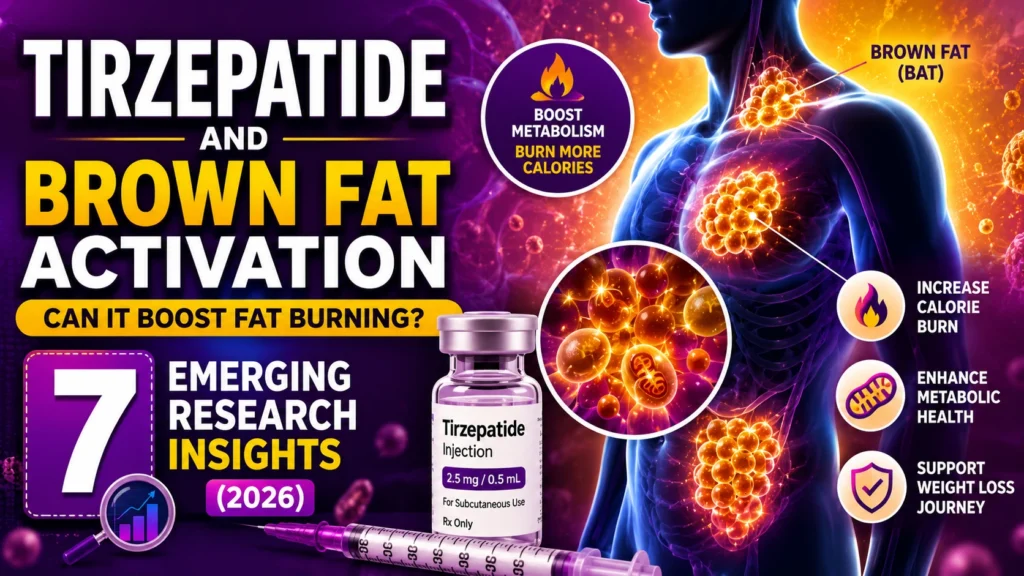

- Tirzepatide does more than suppress appetite—it directly activates brown adipose tissue (BAT), a metabolically active fat that burns calories (Korkut & Aksu, 2025).
- Brown fat activation occurs through the cAMP-PGC-1α-UCP1 signaling pathway, independent of reduced food intake (Zhao et al., 2025).
- Preclinical studies show tirzepatide counteracts the decline in BAT activity typically seen with caloric restriction (Liu et al., 2025).
- Human clinical evidence from the TABFAT trial demonstrates that tirzepatide increases BAT activity from 41.2% to 64.7% of participants (Herman et al., ENDO 2026).
- This dual mechanism—appetite suppression plus energy expenditure—may explain tirzepatide’s superior weight loss effects compared to GLP-1 receptor agonists alone.
🔬 What Is Brown Adipose Tissue (BAT)?
Brown adipose tissue is a specialized type of fat that generates heat through a process called non-shivering thermogenesis. Unlike white adipose tissue (WAT), which stores excess energy, BAT actively burns calories to produce heat (Cannon & Nedergaard, 2004).
| Feature | Brown Adipose Tissue (BAT) | White Adipose Tissue (WAT) |
|---|---|---|
| Primary Function | Energy expenditure through heat production | Energy storage |
| Mitochondrial Density | High (rich in mitochondria) | Low |
| UCP1 Expression | High | Absent or very low |
| Lipid Droplets | Multiple, small (multilocular) | Single, large (unilocular) |
| Thermogenic Capacity | High | Minimal |
| Metabolic Impact | Protective against obesity | Contributes to obesity when excessive |
BAT was once thought to disappear after infancy, but imaging studies in the early 2000s confirmed its presence in adult humans. It constitutes approximately 1-2% of total adipose mass and is found in regions including the cervical, supraclavicular, and paraspinal areas (Nedergaard et al., 2007).
🧪 How Tirzepatide Activates Brown Fat
The scientific evidence reveals that tirzepatide activates brown adipose tissue through a direct, adipocyte-intrinsic mechanism (Zhao et al., 2025).
The cAMP-PGC-1α-UCP1 Signaling Pathway
Research published in the European Journal of Pharmacology demonstrates that tirzepatide promotes the browning of white fat via the cAMP signaling pathway (Zhao et al., 2025). Here’s how it works:
- Tirzepatide binds to GLP-1 and GIP receptors on adipocytes.
- This activates adenylyl cyclase, increasing intracellular cAMP levels.
- cAMP activates protein kinase A (PKA), which in turn activates PGC-1α.
- PGC-1α upregulates UCP1 (uncoupling protein 1), the key thermogenic protein.
- UCP1 uncouples mitochondrial respiration, dissipating energy as heat instead of storing it as fat (Zhao et al., 2025).
When researchers blocked this pathway with the adenylyl cyclase inhibitor SQ22536, the effects of tirzepatide were significantly attenuated, confirming that cAMP signaling is a critical mediator of tirzepatide’s action on fat cells.
Beyond Appetite Suppression: Direct Fat-Burning Effects
A study published in Biomedicine & Pharmacotherapy made a crucial distinction: while most of tirzepatide’s weight loss comes from reduced food intake, the drug exerts specific, independent effects on adipose tissue (Liu et al., 2025). To prove this, researchers used a pair-fed control group—mice that consumed the same amount of food as tirzepatide-treated mice but didn’t receive the drug.
The results were striking:
- Both groups lost similar amounts of weight, confirming appetite suppression is the primary driver of weight loss.
- However, only the tirzepatide-treated group showed significant BAT activation and improvements in glucose tolerance (Liu et al., 2025).
- Tirzepatide counteracted the natural decline in BAT activity that occurs with caloric restriction—the pair-fed mice showed reduced BAT thermogenesis, while the tirzepatide group maintained high BAT activity.
Molecular Changes in Adipose Tissue
RNA sequencing revealed that tirzepatide coordinates the upregulation of gene programs involved in thermogenesis and lipid metabolism (Liu et al., 2025). In brown adipose tissue, tirzepatide upregulated 426 genes, with significant enrichment in pathways related to thermogenesis and oxidative phosphorylation.
Key molecular changes include:
- Increased expression of UCP1, the core thermogenic protein (Zhao et al., 2025)
- Upregulation of PGC-1α, a master regulator of mitochondrial biogenesis (Zhao et al., 2025)
- Enhanced expression of Dio2, which converts thyroid hormone to its active form
- Modulation of Cyp1a1, an enzyme that may influence thermogenic responses
🐭 Preclinical Evidence: What Animal Studies Show
Study 1: WAT Browning via cAMP Signaling
In a high-fat diet-induced obese mouse model, tirzepatide treatment resulted in (Zhao et al., 2025):
- Significant reduction in body weight and adipose tissue mass
- Marked reduction in adipocyte hypertrophy
- Increased expression of browning markers (PGC-1α and UCP1) in white adipose tissue
- Decreased lipid droplet accumulation in 3T3-L1 adipocytes
Study 2: Differential Effects on Adipose Depots
The Biomedicine & Pharmacotherapy study revealed that tirzepatide affects different fat depots in distinct ways (Liu et al., 2025):
| Adipose Depot | Tirzepatide Effect | Mechanism |
|---|---|---|
| Brown Adipose Tissue (BAT) | Significant activation, increased thermogenic activity, reduced lipid droplet size | Upregulation of thermogenic genes, increased substrate oxidation |
| Subcutaneous WAT | Reduced adipocyte size, altered lipid metabolism | Enhanced fatty acid oxidation (Acox1, Cpt2) |
| Visceral WAT | Reduced fat mass | Reduced inflammation, leptin reduction |
Study 3: Reversing BAT Whitening in Estrogen Deficiency
A study published in Life Sciences investigated tirzepatide’s effects in a model combining obesity, type 2 diabetes, and estrogen deficiency (representing postmenopausal metabolic dysfunction) (Korkut & Aksu, 2025). Tirzepatide treatment:
- Reversed BAT “whitening” (the pathological transition of brown fat to a white-like state)
- Restored multilocular adipocyte morphology in BAT
- Increased expression of thermogenic markers (UCP1, β3-adrenergic receptor)
- Normalized markers of endoplasmic reticulum stress and autophagy dysfunction
- Reduced systemic inflammation (leptin by 3.6-fold, resistin by 42%)
🧑⚕️ Human Clinical Evidence: The TABFAT Trial
Until recently, most evidence for tirzepatide’s effects on brown fat came from animal studies. The Tirzepatide Brown and Beige Adipose Tissue Activation (TABFAT) trial represents a landmark shift (Herman et al., ENDO 2026).
Study Design
The TABFAT trial is a randomized, placebo-controlled clinical trial in premenopausal women with obesity (Herman et al., ENDO 2026). Thirty-four participants were randomized 1:1 to receive tirzepatide or placebo for 24 weeks. Researchers used multimodal imaging including:
- 18F-FDG-PET/CT
- MRI with water-fat separation
- Infrared thermography
Key Findings Presented at ENDO 2026
According to results presented at the Endocrine Society’s annual meeting in Chicago (Herman et al., ENDO 2026):
- Tirzepatide significantly increased BAT activity from 41.2% to 64.7% of participants—a major increase.
- BAT volume increased as confirmed by multiple imaging modalities.
- Evidence of WAT browning was observed, with white subcutaneous fat showing signs of conversion to more metabolically active “beige” fat.
Dr. Rok Herman, lead investigator, commented: “Tirzepatide doesn’t just help people lose weight; it also activates brown adipose tissue, representing a major milestone in obesity research” (Herman et al., ENDO 2026).
He added: “We found that tirzepatide significantly increased brown adipose tissue activity and volume, and it also showed potential signs of converting white subcutaneous fat into more metabolically active ‘beige’ fat” (Herman et al., ENDO 2026).
📋 Comparative Table: Tirzepatide vs. Other Weight Loss Approaches
| Feature | Tirzepatide | Semaglutide | Diet/Exercise Alone |
|---|---|---|---|
| Appetite Suppression | ✔️ Strong (dual GLP-1/GIP agonism) | ✔️ Moderate | ❌ No |
| BAT Activation | ✔️ Direct activation via cAMP pathway | ⚠️ Limited evidence | ❌ May decrease during caloric restriction |
| WAT Browning | ✔️ Promotes beige fat conversion | ⚠️ Some evidence in mice | ❌ Limited |
| Preserves Energy Expenditure | ✔️ Counteracts metabolic adaptation | ⚠️ Unknown | ❌ Often declines |
| Anti-inflammatory Effects | ✔️ Reduces leptin, resistin, inflammatory cytokines | ✔️ Some effects | ⚠️ Moderate |
| Weight Loss Efficacy | ✔️ Up to 36% achieve ≥15% body weight loss | ✔️ Up to 20% achieve ≥15% body weight loss | ⚠️ Variable, often limited |
| Mechanism Beyond Appetite | ✔️ Direct adipose tissue effects | ⚠️ Primarily appetite-driven | ❌ Limited to lifestyle changes |
What Makes Tirzepatide Unique?
The GIP receptor component of tirzepatide is particularly significant for adipose tissue effects (Zhao et al., 2025). Unlike GLP-1 receptors, which are predominantly expressed in the pancreas and central nervous system, GIP receptors are expressed directly in adipose tissue. This provides a mechanistic pathway for tirzepatide’s direct effects on fat metabolism beyond appetite suppression.
❓ Semantic FAQs
While both are GLP-1 receptor agonists, only tirzepatide is a dual GIP/GLP-1 receptor agonist. The GIP receptor component allows tirzepatide to act directly on adipocytes, promoting BAT activation via the cAMP-PGC-1α-UCP1 pathway. Semaglutide (a GLP-1 receptor agonist alone) has limited direct effects on adipose tissue, though some preclinical studies suggest it may influence BAT (Zhao et al., 2025).
Human evidence now confirms tirzepatide activates brown adipose tissue. The TABFAT trial presented at ENDO 2026 showed a significant increase in BAT activity from 41.2% to 64.7% of participants after 24 weeks of tirzepatide treatment (Herman et al., ENDO 2026). While earlier studies were primarily in mice (Liu et al., 2025), these clinical results validate the mechanism in humans.
Previous attempts to pharmacologically activate brown fat (e.g., β3-adrenergic receptor agonists) often failed due to side effects like increased heart rate. Tirzepatide appears to activate BAT through a different pathway—the cAMP-PGC-1α-UCP1 axis—without significant cardiovascular side effects. In fact, tirzepatide has shown cardiovascular benefits in clinical trials (Herman et al., ENDO 2026).
Partially. While most weight loss comes from appetite suppression, BAT activation contributes by increasing energy expenditure. This is clinically relevant because caloric restriction typically leads to “metabolic adaptation”—a decline in energy expenditure that makes weight loss harder to sustain. Tirzepatide counteracts this decline by maintaining or increasing BAT activity (Liu et al., 2025). This may help explain why tirzepatide leads to greater weight loss than drugs that only suppress appetite.
The discovery that tirzepatide activates BAT opens new therapeutic avenues. Future drugs might combine appetite suppression with direct thermogenic activation, offering more comprehensive obesity management. The TABFAT trial’s success suggests that measuring BAT activity could become a biomarker for treatment response (Herman et al., ENDO 2026). Researchers are now exploring whether combining tirzepatide with leptin could further enhance weight loss by increasing BAT thermogenesis (Korkut & Aksu, 2025).
This article is for informational and educational purposes only and does not constitute medical advice. Tirzepatide is a prescription medication that should only be used under the supervision of a qualified healthcare provider. The information presented here is based on preclinical and clinical research, but individual results may vary. Always consult with your physician before starting, stopping, or changing any medication or treatment plan. This article may contain affiliate links, and the author may receive compensation from qualifying purchases.