

Prefer this source for health information?
Select IntelliNewz as a preferred source in Google Search to see our content highlighted in eligible features.
✨ Boost Your Hair Regimen
Pair your exosome therapy with clinically‑inspired hair support. Our readers love these top‑rated serums, supplements, and tools for enhanced results.
 Serum
Serum Supplement
📖 Table of Contents
- What Are Exosomes and How Do They Work for Hair Loss?
- Common Side Effects of Exosome Hair Treatment
- Rare and Serious Adverse Events
- Long-Term Safety Considerations
- Who Should Avoid Exosome Therapy?
- Clinical Evidence: What the Studies Show
- FAQs About Exosome Hair Treatment Safety
- Medical Review & Editorial Standards
What Are Exosomes and How Do They Work for Hair Loss?
Exosomes are microscopic extracellular vesicles—essentially tiny communication packages—that cells naturally produce to exchange information with other cells. In hair loss treatment, exosomes are typically derived from mesenchymal stem cells (often from adipose tissue or umbilical cord) and are injected into the scalp or applied topically with delivery assistance.
The therapeutic effect centers on activating the Wnt/β-catenin signaling pathway, a crucial mechanism that stimulates dermal papilla cells, promotes hair follicle stem cell activity, and enhances hair shaft elongation. Preclinical studies show exosomes upregulate hair growth-related genes and increase alkaline phosphatase (ALP) activity, key markers of hair follicle health.
Common Side Effects of Exosome Hair Treatment
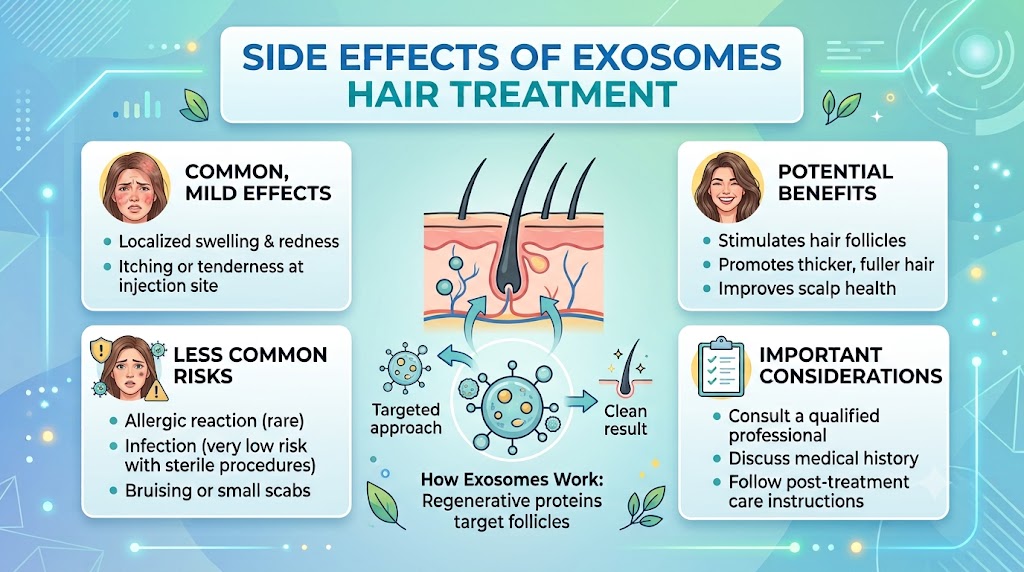
Clinical studies consistently report that exosome therapy is generally well-tolerated, with side effects predominantly mild and transient. The most frequently reported adverse events include:
Injection-Related Reactions
- Erythema (redness): Mild scalp redness occurs in approximately 12% of patients, typically resolving within 24 hours.
- Edema (swelling): Localized swelling at injection sites.
- Pain and tenderness: Mild discomfort during and shortly after administration.
- Itching: Temporary pruritus reported in some cases.
Delivery-Associated Effects
When topical exosomes are combined with physical enhancement techniques like plasma or sonophoresis, patients may experience post-procedure erythema resolving spontaneously within 24 hours or mild scalp irritation.
Rare and Serious Adverse Events
While the safety profile appears favorable, it is critical to note that long-term safety data is limited, and the overall certainty of evidence is considered low due to small sample sizes and lack of long-term follow-up.
Reported Serious Events in Dermatology
In the broader field of dermatology, at least 10 serious adverse events have been reported, though these were not specifically linked to hair loss treatments.
Potential Risks Requiring Vigilance
- Infection: Rare cases of scalp infection have been documented.
- Immunogenicity: While no significant immune responses have been observed in clinical trials, the theoretical risk exists, particularly with allogenic exosome sources.
- Off-label Risks: Many current applications use non-standardized, off-label regimens, making comprehensive safety assessment challenging.
Research Gaps
Current evidence is limited by small sample sizes, lack of control groups, absence of long-term follow-up data, and heterogeneous protocols (varying exosome sources, isolation methods, storage conditions).
Long-Term Safety Considerations
One of the most significant unanswered questions concerns long-term safety. Current studies typically follow patients for only 12-24 weeks, leaving considerable uncertainty about:
- Late-onset adverse effects: Events that may emerge months or years after treatment.
- Repeated treatment risks: Safety of multiple sessions over extended periods.
- Cancer risk: Theoretical concerns about growth-promoting mechanisms requiring long-term surveillance.
- Donor site effects: Impact on the scalp microenvironment over time.
The International Society of Hair Restoration Surgery has called for long-term safety data to validate exosome therapy’s risk-benefit profile before widespread adoption.
Who Should Avoid Exosome Therapy?
While exosome therapy is generally considered safe for most individuals, certain populations should approach with caution:
Absolute Contraindications
- Active scalp infections or open wounds in the treatment area.
- Scarring alopecia from conditions like lupus (may not benefit).
Relative Contraindications
- Autoimmune disorders: Theoretical risk of immune system stimulation.
- Pregnancy and breastfeeding: Insufficient safety data.
- Cancer history: Growth-promoting mechanisms may theoretically affect cancer cells.
- Allergies to exosome source materials.
Clinical Evidence: What the Studies Show
Efficacy Data
The first prospective clinical study using ADSC-exosomes demonstrated favorable clinical outcomes, with improvements in hair density (hairs/cm²), hair shaft diameter (µm), and terminal-to-vellus hair ratio. In a 2026 pilot study of 25 patients with androgenetic alopecia:
- 72% showed improvement on the Hair Growth Improvement Scale (HGIS).
- 68% reported being satisfied or very satisfied with results.
- Three patients (12%) reported mild transient erythema.
Safety Data Summary
| Adverse Event | Frequency | Severity | Resolution |
|---|---|---|---|
| Erythema | ~12% | Mild | <24 hours |
| Edema | Uncommon | Mild | Spontaneous |
| Pain/Tenderness | Uncommon | Mild | Spontaneous |
| Infection | Rare | Variable | Requires treatment |
| Serious systemic events | None reported | N/A | N/A |
Data from clinical studies across 125+ patients.
FAQs About Exosome Hair Treatment Safety
✅ Our Review Process
This article is based on a systematic review of peer-reviewed clinical studies, including:
- Systematic reviews from the Hair Transplant Forum International
- Clinical studies published in Taylor & Francis journals
- Peer-reviewed research from Dermatologic Surgery
- Pilot clinical trials published in the Journal of Craniofacial Surgery
🔬 Limitations Acknowledged
- Small sample sizes in most available studies
- Short-term follow-up (typically 12-24 weeks)
- Lack of standardized protocols across studies
- Need for larger randomized controlled trials
📅 Content Currency: Last updated: August 2026 • Key sources: 2024-2026 peer-reviewed publications • Review cycle: Annual review or sooner if significant new evidence emerges.
The Bottom Line
Exosome therapy represents an exciting advancement in hair restoration with a favorable short-term safety profile. The side effects of exosomes hair treatment are predominantly mild and transient, including redness, swelling, and injection-site discomfort. However, significant evidence gaps remain:
- Long-term safety data is unavailable
- Manufacturing standards are inconsistent
- Regulatory oversight is evolving
As research continues, larger controlled trials will be essential to validate both efficacy and long-term safety. Patients considering exosome therapy should seek treatment from qualified practitioners using standardized, properly manufactured products and maintain realistic expectations about outcomes.
Add IntelliNewz as a preferred source in Google Search to see our health content highlighted in Top Stories, AI Overviews, and AI Mode.