

By Dr. mohammed abdul azeem siddiqui
Reviewed for emerging genetic technology trends
Every year, millions of couples worldwide marry their cousins. In some communities, consanguineous marriages account for 20–50% of all unions. While most children born to cousins are healthy, the risk of autosomal recessive genetic disorders is approximately double that of unrelated parents.
For decades, the only options for consanguineous couples were:
- Preconception carrier screening
- Pre-implantation genetic diagnosis (PGD) during IVF
- Prenatal testing with potential termination
- Accepting the risk
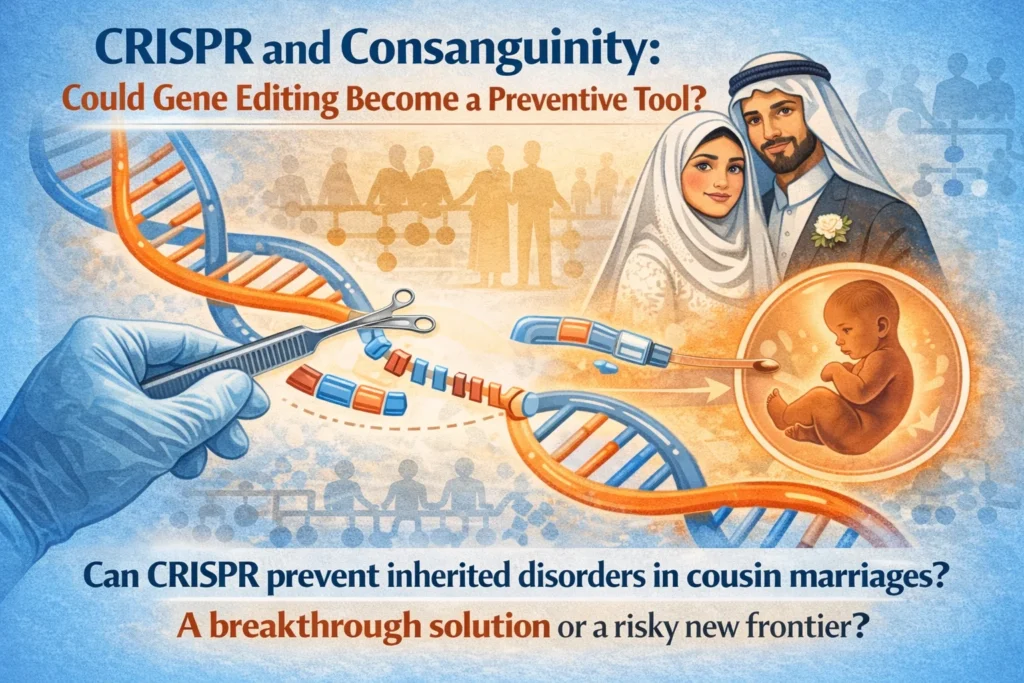
But a new question is emerging from laboratories around the world: Could CRISPR gene editing prevent genetic disorders in cousin marriages before they start?
The answer is complex, controversial, and closer than you might think.
What Is CRISPR? A Quick Primer
CRISPR (Clustered Regularly Interspaced Short Palindromic Repeats) is a revolutionary gene-editing tool often described as “molecular scissors.” It allows scientists to:
- Target a specific sequence of DNA
- Cut the DNA at that exact location
- Remove, repair, or replace the genetic code
Think of it as a find-and-replace function for the human genome. The technology has already been used to treat sickle cell anemia in living patients, and researchers are exploring applications for hundreds of genetic diseases.
But using CRISPR on embryos — before a baby is born — is a different story entirely.
The He Jiankui Controversy: What Happened?
In November 2018, the world learned that Chinese scientist He Jiankui had allegedly created the first gene-edited babies .
Working in Shenzhen, He recruited couples where the father was HIV-positive and the mother was HIV-negative. Using CRISPR, he attempted to disable the CCR5 gene in embryos — a gene that produces a protein HIV uses to enter cells. The goal was to create babies resistant to HIV infection .
The result? Twin girls, pseudonymously named “Lulu” and “Nana,” were born with edited genomes .
The Fallout
The scientific community reacted with swift and universal condemnation :
He Jiankui was later fired from his university position, and Chinese authorities launched an investigation. He was eventually fined and imprisoned .
“It is a great blow to the global reputation and development of biomedical research in China,” said a joint statement from 100 Chinese scientists .
The Russian Follow-Up: Five Couples Want CRISPR Babies to Avoid Deafness
The He scandal did not end the conversation. In 2025, Russian biologist Denis Rebrikov announced that five Russian couples who are deaf want to use CRISPR to have a biological child who can hear .
These couples have a specific situation: both parents have a recessive form of deafness, meaning all their children would normally inherit the same condition. Unlike many genetic diseases, PGD (screening embryos) cannot help here — because every embryo would inherit the deafness genes .
Rebrikov argues his case is more ethically justifiable than He’s because:
- There is a clear medical need (preventing a serious disability)
- The couples have no alternative biological path to a hearing child
- He plans to seek government approval before proceeding
But critics remain unconvinced. CRISPR expert Gaetan Burgio of Australian National University told New Scientist: “It’s too early, it’s too risky” .
And research published in Nature Medicine raised new concerns: analyzing 400,000 medical records, scientists found that individuals with two mutated copies of the CCR5 gene (the same edit He Jiankui made) had a significantly higher death rate between ages 41 and 78, including a four-fold increased risk of dying from the flu .
How Could CRISPR Help Consanguineous Couples?
Now, let’s connect this to cousin marriages.
The Problem for Consanguineous Couples
When two blood relatives have children, they are more likely to carry the same recessive gene mutations. For example:
- Both partners carry a mutation for cystic fibrosis (CF)
- Each pregnancy has a 25% chance of producing a child with CF
- PGD can screen embryos, but if both parents carry the mutation, 25% of embryos are affected and must be discarded
The CRISPR Solution (Theoretical)
In theory, CRISPR could:
- Identify embryos that have inherited two copies of a disease-causing mutation
- Edit the mutation out of the embryo’s DNA
- Implant a now-healthy embryo that is still biologically related to both parents
This would be revolutionary for consanguineous couples because it would allow them to have genetically related children without the risk of recessive disorders — something PGD alone cannot offer.
Savior Siblings: Another Application
CRISPR could also be used to conceive “savior siblings” — children who can serve as stem cell or bone marrow donors for an older sibling with a genetic illness .
For example, a couple with a child who has Fanconi anemia (a genetic disorder curable with a sibling stem cell transplant) faces extremely low odds of conceiving a natural donor match without the disease — less than 3 in 16 embryos meet both criteria .
CRISPR could edit embryos to:
- Remove the disease-causing mutation
- Match the older sibling’s HLA type for donation
“Coupling gene editing with PGD would be a way forward of making this a much more efficient and somewhat less toxic approach,” said Dr. George Daley, dean of Harvard Medical School .
The Current Reality: What’s Available Now vs. What’s Coming
| Approach | Available Now? | For Consanguineous Couples? |
|---|---|---|
| Preconception Carrier Screening | ✅ Yes | ✅ Highly recommended |
| PGD (embryo screening) | ✅ Yes | ✅ Yes (discards affected embryos) |
| Prenatal Diagnosis (CVS/amnio) | ✅ Yes | ✅ Yes |
| CRISPR embryo editing | ❌ No (experimental only) | ❌ Not approved anywhere |
| CRISPR savior sibling | ❌ No | ❌ Not approved |
What You Can Do Today
While you wait for CRISPR to become safe and legal, here is the evidence-based checklist for consanguineous couples planning pregnancy:
1. Preconception Genetic Carrier Screening
Request expanded carrier screening (blood or saliva) for hundreds of recessive disorders. If both partners carry the same mutation, you have options.
2. Pre-Implantation Genetic Diagnosis (PGD)
If both are carriers, IVF with PGD allows you to select embryos without the disease-causing mutations.
3. Prenatal Monitoring
If you prefer natural conception, high-resolution ultrasound and diagnostic testing (CVS or amniocentesis) can detect many disorders early.
4. Genetic Counseling
Meet with a board-certified genetic counselor (NSGC member) to understand your specific risks and options.
Support Your Genetic Health Today
While gene editing is not yet available, you can support your overall reproductive and cellular health with these science-backed supplements.
For Cellular Health & DNA Repair
NAC (N-Acetylcysteine) – Supports glutathione production, the body’s master antioxidant for protecting DNA from oxidative damage.
For Methylation & Genetic Expression
Methylfolate (Active B9) – Essential for proper DNA methylation and genetic expression. Many people have MTHFR mutations that impair folate metabolism.
For General Preconception Health
Prenatal Vitamin with Methylfolate – Supports healthy egg and sperm development.
👉 Get Prenatal Vitamins on Amazon
For Immune Support
Vitamin D3 + K2 – Supports immune function and genetic regulation.
The Ethical Debate: Should We Edit Embryos for Consanguinity?
Even if CRISPR becomes safe, profound ethical questions remain.
Arguments For
- Prevention, not elimination: Editing prevents disease without discarding embryos (unlike PGD)
- Reproductive autonomy: Couples should have the right to use technology for healthy children
- Consanguinity is cultural: For many communities, cousin marriage is traditional and valued — CRISPR respects that while reducing risk
Arguments Against
- Off-target risks: Unintended edits could cause cancer or other diseases
- Germline modification: Changes affect all future generations — we cannot predict long-term consequences
- Slippery slope: Could lead to “designer babies” for non-medical traits (eye color, height, intelligence)
- Informed consent: Future generations cannot consent to being edited
“The technology is not ready. It is not surprising, but it is very disappointing and unsettling,” said Jennifer Doudna, one of CRISPR’s discoverers, responding to Rebrikov’s plans .
The Regulatory Landscape: USA vs. The World
In the USA, the FDA currently considers gene-edited embryos to be an unapproved drug product — meaning clinical use is illegal .
What the Experts Say
Dr. George Daley, Harvard Medical School: “Families are driven to go to great lengths to seek technology that will address the health needs of even a single child with an ultra-rare disease” .
Professor Joyce Harper, UCL: “Today’s report of genome editing human embryos is premature, dangerous and irresponsible” .
David Baltimore, Nobel Laureate: “We have never done anything that will change the genes of the human race, and we have never done anything that will have effects that will go on through the generations” .
The Bottom Line for Consanguineous Couples
CRISPR gene editing is not yet a safe or legal option for preventing genetic disorders in cousin marriages. The technology remains experimental, the risks are significant, and the ethical consensus is that we are not ready.
But that does not mean you are without options.
Today, consanguineous couples can:
- Undergo expanded carrier screening before pregnancy
- Use IVF with PGD to select healthy embryos
- Access prenatal diagnosis during pregnancy
- Work with genetic counselors to understand personalized risks
CRISPR may one day offer a path to genetically related, disease-free children without discarding embryos. But that day is likely 5–10 years away — at minimum.
For now, the responsible approach is to use the proven tools already available while watching this revolutionary technology mature.
Ready to Take Control of Your Reproductive Genetics?
Build your preconception genetic health kit on Amazon:
- Expanded carrier screening (request through your doctor or online services like Invitae)
- NAC supplement for cellular health
- Methylfolate for genetic expression
- Prenatal vitamins for preconception support
👉 Click Here to Shop Genetic Health Supplements on Amazon
Frequently Asked Questions
Q1: Can I use CRISPR to prevent my child from inheriting a genetic disorder from my cousin spouse?
A: Not yet. CRISPR embryo editing for reproductive purposes is not approved in the USA or any major country. The technology is still experimental and carries significant risks.
Q2: Is there any legal way to access embryo gene editing?
A: No. In the USA, the FDA considers gene-edited embryos to be an unapproved drug. Research is allowed, but implanting edited embryos is prohibited.
Q3: What if I’m already pregnant?
A: Prenatal diagnosis (CVS or amniocentesis) can detect many genetic disorders. If a disorder is found, you can work with a genetic counselor and maternal-fetal medicine specialist to plan next steps.
Q4: How accurate is PGD compared to CRISPR?
A: PGD is highly accurate (>99% for most conditions) and is the current gold standard for couples who know they carry specific genetic mutations. CRISPR is not yet accurate enough for clinical use.
Q5: Will CRISPR ever be available for consanguineous couples?
A: Likely yes, but not for several years. Safety trials must first demonstrate that off-target risks are eliminated. Regulatory approval will then take additional years.
Disclaimer: This article contains affiliate links. As an Amazon Associate, I earn from qualifying purchases. This information is for educational purposes only and is not a substitute for professional medical or genetic counseling advice. CRISPR embryo editing is not approved for clinical use. Always consult with a board-certified genetic counselor and reproductive specialist before making family planning decisions.