
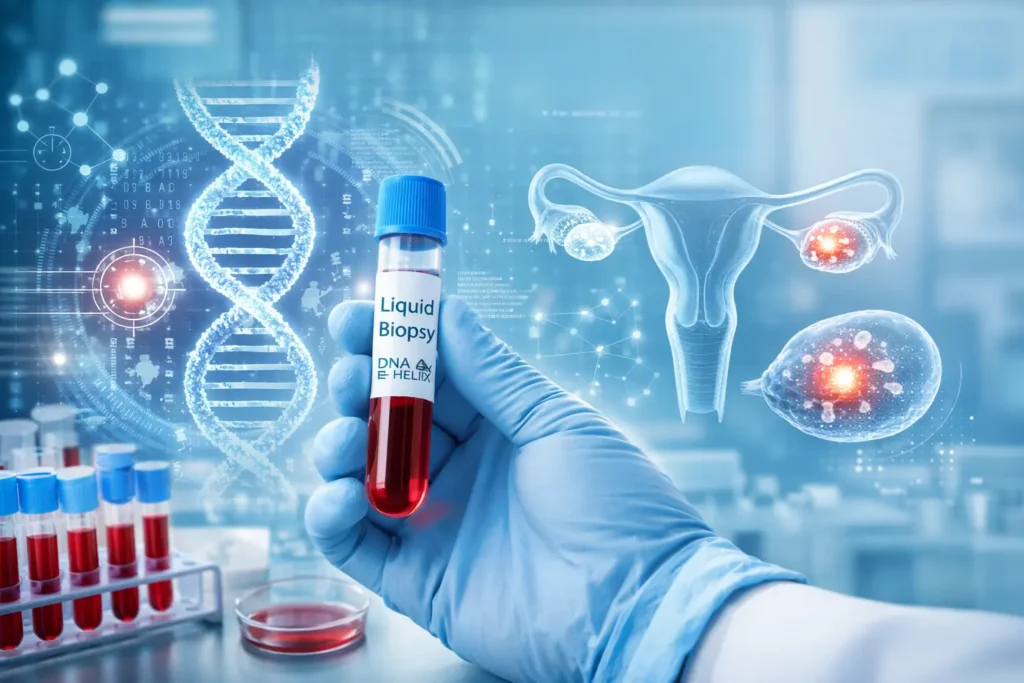

Early detection and ongoing monitoring are critical to improving outcomes for women’s cancers such as breast, ovarian, endometrial, and cervical cancer. Traditional tissue biopsies and imaging have limitations: they can be invasive, costly, stressful, and often fail to detect subtle, early changes in tumor biology.

How Next-Generation Blood Tests Are Changing Detection, Monitoring, and Personalized Treatment
“Liquid biopsy powered by CRISPR technology represents a paradigm shift in women’s oncology. We are now able to detect cancer-associated DNA in blood at levels far below what traditional methods allow, enabling earlier intervention, more precise monitoring, and truly personalized care.”
— Dr. Mohammed Abdul Azeem Siddiqui
Expert Perspective🩺 Afraid of Painful Cancer Biopsies?
There Is a Better Way.
Liquid Biopsy – A Simple Blood Test for Cancer Detection
No surgery.
No tumor needles.
No fear.
❌ Traditional Biopsies
- Cut biopsy
- Tru-cut biopsy
- FNAC
- Painful
- Stressful
- Risk of bleeding & infection
✅ Liquid Biopsy
- Just a blood test
- Non-invasive
- Safe & painless
- Highly sensitive
- Repeatable anytime
🧬 How It Works
- Blood sample is taken
- Cancer DNA is extracted
- CRISPR & genetic analysis is done
- Doctors guide treatment
🎯 Helps In
Patients unfit for surgery
Early cancer detection
Monitoring treatment
Detecting recurrence
Ask your doctor about Liquid Biopsy Today
What Is Liquid Biopsy?
A liquid biopsy is a blood test that detects pieces of DNA or cells shed by a tumor into the bloodstream. These include:
- Circulating tumor DNA (ctDNA): fragments of DNA released by dying tumor cells
- Cell-free DNA (cfDNA): DNA fragments in the blood from various cells
- Circulating tumor cells (CTCs) and extracellular vesicles carrying tumor material
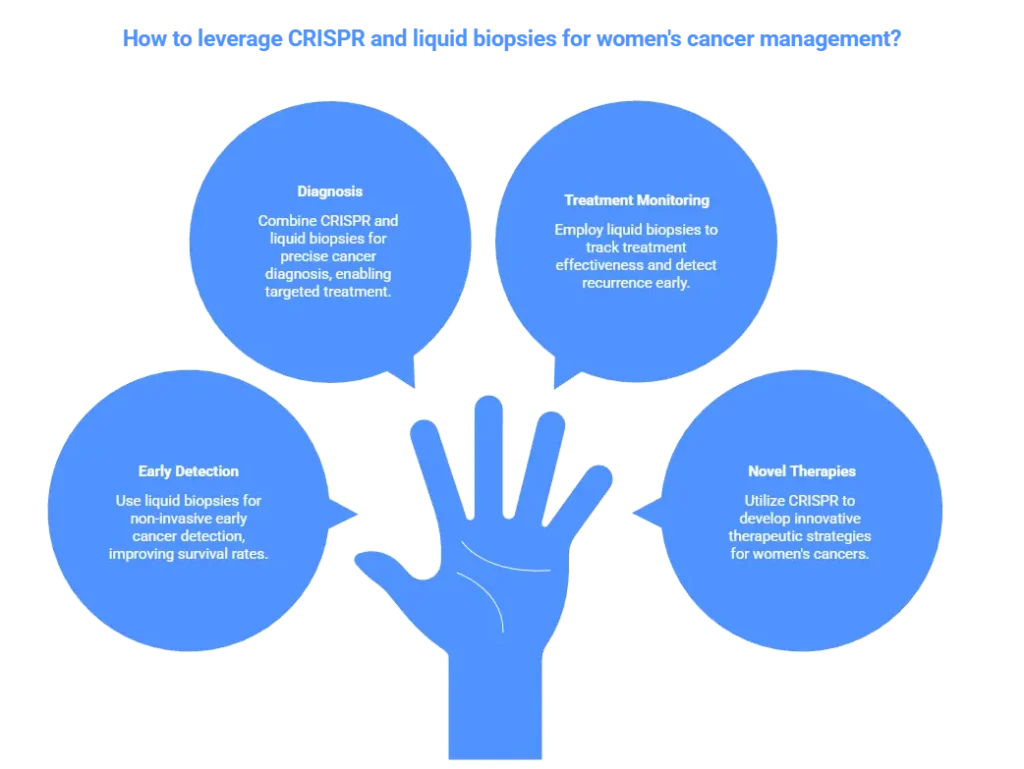
ctDNA reflects the genetic makeup of a tumor, including mutations and changes that drive cancer growth. Because ctDNA can be released even from small or early-stage tumors, it enables detection far earlier than imaging or symptoms typically allow.
How CRISPR Enhances Liquid Biopsy
Although liquid biopsy is powerful, detecting extremely low levels of ctDNA — especially in early disease — is technically challenging. That’s where CRISPR technology comes in.
CRISPR is most widely known as a gene-editing tool, but certain CRISPR-associated (Cas) enzymes can also be programmed to recognize specific DNA sequences with very high precision. When combined with liquid biopsy, CRISPR can:
✔ Detect single-molecule mutations
Advanced CRISPR assays like Cas12-based platforms can identify minute ctDNA fragments in blood — even at levels as low as femtomolar concentrations — making them suitable for early detection.

CRISPR Liquid Biopsy – General Understanding
Learn the basics of CRISPR liquid biopsy, how it works, and why it’s transforming cancer detection. This section answers the most common questions for patients and families.
✔ Identify early-stage cancer signatures
CRISPR enhanced tests can target mutations associated with women’s cancers — for example, BRCA, TP53, KRAS, PTEN — enabling earlier identification than conventional methods.
✔ Monitor treatment response and recurrence
By repeatedly sampling blood, clinicians can see how ctDNA levels rise or fall in response to therapy — offering dynamic, personalized monitoring.
In essence, CRISPR turns a routine blood draw into a microscopic cancer surveillance system.
Why This Matters for Women’s Cancers
Women’s cancers vary in how they develop, spread, and respond to treatment. CRISPR-powered liquid biopsy helps in several key ways:
1. Early Detection Before Symptoms or Tumor Growth
Many women’s cancers, especially ovarian and endometrial cancer, are diagnosed only after symptoms appear — often at already advanced stages. ctDNA may be detectable in blood months before tumors become visible on imaging, offering a crucial window for early intervention.
2. Non-Invasive Monitoring
Traditional biopsies require surgical procedures with associated risks. Liquid biopsy requires only a simple blood draw, making it safer and more comfortable for patients — particularly useful for patients who cannot undergo repeated tissue biopsies.
3. Personalized Treatment Decisions
Different tumors have different genetic profiles even within the same cancer type. ctDNA analysis with CRISPR can reveal:
- Treatment-sensitive mutations
- Genetic changes linked to resistance
- Tumor evolution over time
These insights help doctors tailor therapies — for example, adjusting treatment for a breast cancer patient based on ctDNA patterns. Research has even shown that ctDNA levels can predict how well patients respond to specific treatments such as targeted drugs or chemotherapy.
Clinical Uses of CRISPR-Liquid Biopsy in Women’s Cancer
Breast Cancer
Breast cancer is the most common cancer in women globally. New blood tests capable of detecting ctDNA can identify relapse years before scans show a tumor in some cases, allowing earlier therapeutic action.
CRISPR enhancements improve detection of key mutations like:
- BRCA1 / BRCA2
- TP53
- PIK3CA
- HER2
These biomarkers guide treatment and prognosis.
Ovarian Cancer
Ovarian cancer often presents with vague symptoms and is frequently diagnosed late. ctDNA and cfDNA analysis can detect tumor DNA fragments and provide signals of disease presence and burden.
Studies have shown:
- ctDNA correlates with tumor burden
- ctDNA dynamics can indicate recurrence earlier than traditional markers like CA-125
This can guide repeat surgeries and chemotherapy decisions more effectively.
Endometrial Cancer
Liquid biopsy is also being studied in endometrial cancer, where ctDNA patterns and classifiers show strong potential to distinguish cancer patients from healthy individuals.
While work is ongoing to improve diagnostic performance, early research indicates that ctDNA profiles — especially when combined with other biomarkers — can support risk stratification and early intervention.
Cervical Cancer
Cervical cancer — largely caused by high-risk HPV infection — also sheds tumor DNA into the blood. CRISPR-enhanced liquid biopsies may detect HPV-related ctDNA early, complementing existing HPV screening strategies and potentially identifying early molecular changes before cellular abnormalities are detected.
Advantages of CRISPR-Powered Liquid Biopsy
Liquid biopsy on its own is already minimally invasive, but CRISPR elevates its capabilities significantly:
| Benefit | Explanation |
|---|---|
| Minimally invasive | Only requires a blood draw; no surgery |
| Rapid and highly sensitive | Detects very low ctDNA levels |
| Ongoing longitudinal monitoring | Can be repeated often, unlike scans |
| Personalized cancer insights | Shows mutation evolution over time |
| Broad applicability | Useful in early detection, treatment monitoring, recurrence, and prognostication |
This positions CRISPR-liquid biopsy as a foundational tool for precision oncology in women’s health — shifting care from reactive to proactive.
Current Challenges and Future Research
Although promising, widespread clinical use of CRISPR-liquid biopsy still faces hurdles:
Sensitivity and Standardization
Because ctDNA levels can be extremely low — especially in early cancer — detecting them consistently requires highly sensitive assays. Ongoing research is improving these techniques.
Clinical Validation
More large-scale clinical trials are needed to establish standardized protocols and confirm long-term benefits across diverse populations and cancer types.
Integration with Clinical Workflows
Liquid biopsy must be integrated thoughtfully into existing care pathways — for screening, monitoring, and therapy decisions — so that it meaningfully improves patient outcomes.
Despite these challenges, major advances in CRISPR designs and platforms are rapidly pushing the technology toward routine clinical utility.
The Future: A New Era in Women’s Cancer Care
CRISPR-powered liquid biopsy is reshaping how we view cancer detection and management:
“Tests that once required tissue removal and hospital stays may soon be replaced by simple, repeatable blood draws.”
While traditional methods like imaging and tumor biopsies will remain important, liquid biopsy offers:
- Early detection at the molecular level
- Sensitive monitoring of cancer dynamics
- Rapid personalization of therapy
- Reduced need for invasive procedures
Together, these capabilities are laying the foundation for precision, patient-centered cancer care — especially for women. Early diagnosis and personalized management can significantly improve survival rates and quality of life.
Conclusion
CRISPR combined with liquid biopsy represents a powerful, next-generation approach to women’s cancer detection and treatment. By identifying circulating tumor DNA with astonishing precision, this technology enables:
✔ Non-invasive cancer screening
✔ Early detection before tumors are visible
✔ Personalized therapy decisions
✔ Real-time monitoring of treatment success
✔ Early detection of recurrence
With ongoing research and validation, CRISPR-liquid biopsy will help transform cancer care from reactive to proactive, precise, and patient-friendly — representing a major advance in modern oncology and women’s health.
🔬 Liquid Biopsy FAQs
1. What is a liquid biopsy test for cancer?
A liquid biopsy test for cancer is a blood test that detects circulating tumor DNA (ctDNA) released by cancer cells, helping in early detection, treatment monitoring, and recurrence tracking.
2. What is liquid biopsy in breast cancer?
Liquid biopsy in breast cancer analyzes ctDNA in blood to detect cancer-related mutations, monitor treatment response, and predict recurrence.
3. How effective is liquid biopsy for breast cancer detection?
Liquid biopsy for breast cancer can identify genetic tumor markers early and monitor disease progression without invasive tissue biopsies.
4. How is liquid biopsy used in metastatic breast cancer?
In metastatic breast cancer, liquid biopsy helps track tumor evolution, detect resistance mutations, and guide changes in treatment.
5. How much does a liquid biopsy cost?
The cost of a liquid biopsy depends on the type of cancer panel, lab technology, and number of genes tested. Prices vary by region and test complexity.
6. Can liquid biopsy be used for triple-negative breast cancer?
Yes. Liquid biopsy for triple-negative breast cancer helps detect aggressive tumor mutations, monitor response to therapy, and identify early relapse.
7. How are liquid biopsies used in cancer investigation and management?
Liquid biopsies support cancer diagnosis, guide personalized treatment, track response, and detect recurrence through non-invasive blood tests.
8. Is liquid biopsy useful in endometrial cancer?
Yes. Liquid biopsy in endometrial cancer can detect cancer DNA in blood, assist in early diagnosis, and monitor recurrence after treatment.
Medical Disclaimer: This article is for educational purposes only and does not replace professional medical advice. Consult a qualified health professional for diagnosis and treatment decisions.