
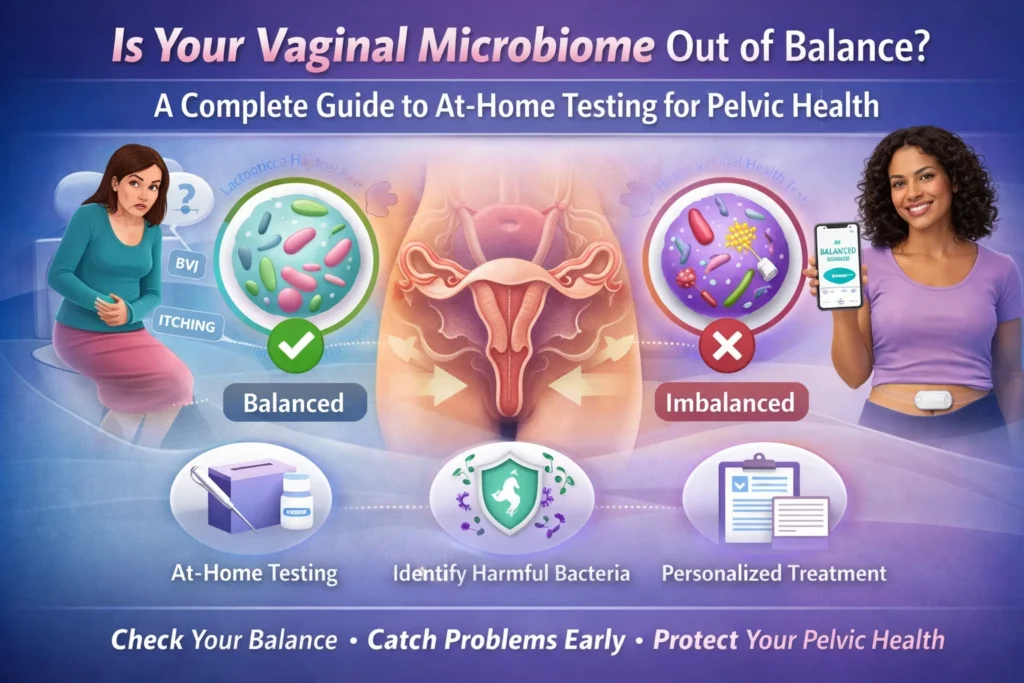

For decades, women’s pelvic health complaints—odor, discharge, discomfort, recurrent infections—were met with a one-size-fits-all answer: “It’s probably just a yeast infection.” But modern science has revealed a far more complex reality. At the center of vaginal wellness lies the vaginal microbiome: a dynamic ecosystem of billions of bacteria that influences everything from infection risk to fertility to pregnancy outcomes.
The rise of direct-to-consumer testing now allows women to analyze their own microbiome from home. But what exactly are these tests? And do you need one? Let’s answer every question you didn’t know you had.
What is a vaginal microbiome test?
A vaginal microbiome test is a laboratory analysis that identifies and quantifies the specific species of bacteria, yeast, and sometimes viruses living in your vaginal canal. Unlike a standard doctor’s swab that looks for a handful of known pathogens (like Candida or Chlamydia), a microbiome test uses advanced DNA sequencing technology—typically 16S rRNA gene sequencing or qPCR—to map the complete bacterial landscape.
What it tells you:
- Which bacterial species are present (down to the strain level).
- The relative abundance of each species.
- Your “vaginal community state type” (CST)—a classification system researchers use to categorize microbiome profiles.
- The ratio of protective bacteria (primarily Lactobacillus species) to disruptive or pathogenic bacteria.
What it does NOT tell you:
- It cannot diagnose active STIs like gonorrhea or chlamydia unless the test is specifically designed for that.
- It does not replace a pelvic exam or clinical diagnosis of structural issues.
The results are typically delivered through a smartphone app or web dashboard, often with personalized supplement or probiotic recommendations.
What is a vaginal health test?
This is a broader term that can encompass several types of at-home assessments. A vaginal health test generally refers to any self-administered kit that measures one or more markers of vaginal wellness. These fall into three main categories:
| Test Type | What It Measures | Example Use Case |
|---|---|---|
| pH test | Vaginal acidity (normal is 3.8–4.5) | Quick screening for bacterial vaginosis (BV) |
| Single-pathogen test | Specific organisms like Candida (yeast) or Gardnerella (BV) | Confirming a suspected infection |
| Microbiome sequencing test | Complete bacterial profile (dozens to hundreds of species) | Recurrent or unclear symptoms; fertility optimization |
Many commercial “vaginal health tests” are actually pH strips with a basic app. True microbiome tests are more expensive but provide exponentially more data.
Search Link: Click here to browse at-home vaginal pH and health tests on Amazon
What is an at-home vaginal microbiome test?
An at-home vaginal microbiome test is a mail-in kit that allows you to collect your own sample (typically via a vaginal swab) in the privacy of your bathroom, send it to a certified laboratory, and receive digital results days later. These tests have become increasingly popular among USA women for three reasons:
- Convenience – No appointment, no waiting room, no stirrups.
- Privacy – For women with trauma history or cultural discomfort with pelvic exams.
- Longitudinal tracking – You can test monthly to see how your microbiome responds to probiotics, diet, or antibiotics.
How it works:
- Order the kit online (or via Amazon).
- Swab the lower third of the vaginal canal (instructions are detailed).
- Place the swab in a stabilization tube and mail it back in a prepaid envelope.
- Receive results in 5–14 days via a secure app.
Important note: Most at-home tests are not FDA-approved as diagnostic devices. They are marketed as “wellness” or “informational” tests. However, many partner with CLIA-certified (Clinical Laboratory Improvement Amendments) labs, meaning the lab processing is held to clinical standards.
Search Link: Click here to find at-home vaginal microbiome test kits on Amazon
Is your vaginal microbiome out of balance? 15 questions to ask yourself
If you are wondering whether you need a microbiome test, start here. Answer these questions honestly.
Symptom-Based Questions
- Do you experience recurrent vaginal itching or burning that doesn’t fully resolve with over-the-counter yeast treatments?
- Do you have a persistent “fishy” odor that worsens after intercourse or during menstruation?
- Is your vaginal discharge unusual in color (gray, yellow-green), consistency (thin and watery, or cottage-cheese-like), or volume?
- Do you have pain or discomfort during intercourse (dyspareunia) without an obvious cause?
- Do you experience burning with urination when a UTI has been ruled out?
Recurrence and Treatment History Questions
- Have you had three or more yeast infections or BV diagnoses in the past 12 months?
- Do antibiotics always trigger a vaginal infection for you?
- Have you been treated for “recurrent BV” but the symptoms keep coming back within weeks?
- Do you have a diagnosed condition that disrupts the microbiome, such as diabetes, HIV, or an autoimmune disorder?
Lifestyle and Life Stage Questions
- Have you recently started or changed hormonal birth control? (Progestin-only methods can alter microbiome composition.)
- Are you perimenopausal or menopausal? (Estrogen decline reduces protective Lactobacillus.)
- Do you have a new or multiple sexual partners? (Semen has a high pH and can temporarily disrupt the vaginal ecosystem.)
- Do you douche or use scented feminine hygiene products? (These are strongly linked to microbiome disruption.)
Fertility and Pregnancy Questions
- Are you trying to conceive and have experienced unexplained infertility or recurrent early miscarriage? (Certain microbiome profiles, especially those low in L. crispatus, are associated with implantation failure.)
- Are you pregnant and concerned about preterm birth risk? (A non-Lactobacillus-dominant microbiome is a known risk factor for preterm delivery.)
If you answered “yes” to three or more of these questions, your vaginal microbiome may be out of balance—a condition technically called dysbiosis.
What does a “balanced” vs. “unbalanced” vaginal microbiome look like?
Balanced (Normobiosis)
- Dominant species: Lactobacillus crispatus, L. iners, L. gasseri, or L. jensenii.
- pH: 3.8–4.5.
- Key function: Lactobacilli produce lactic acid and hydrogen peroxide, creating an acidic environment that kills pathogens.
- Symptoms: None. Minimal or clear, odorless discharge.
Unbalanced (Dysbiosis)
- Dominant species: Gardnerella vaginalis, Atopobium vaginae, Prevotella, Mobiluncus, or Candida albicans.
- pH: Above 4.5 (often 5.0–7.0).
- Key problem: Pathogenic bacteria form a biofilm that resists antibiotics and Lactobacillus recolonization.
- Symptoms: Odor, abnormal discharge, itching, burning, pain.
| Microbiome State | Dominant Bacteria | Typical Symptoms | Risk Level |
|---|---|---|---|
| Optimal | L. crispatus >90% | None | Very low |
| Suboptimal | L. iners dominant (a weak Lactobacillus) | Often none, but vulnerable to BV | Moderate |
| Mild dysbiosis | Mixed Lactobacillus + low Gardnerella | Intermittent mild odor | Moderate |
| Severe dysbiosis | Gardnerella + BV-associated bacteria | Persistent fishy odor, gray discharge | High |
| Cytolytic vaginosis | Overgrowth of L. crispatus (too much of a good thing) | Burning, pain, discharge that worsens before period | Requires different treatment |
Commercially Available At-Home Vaginal Microbiome Tests for USA Customers
Several reputable companies offer these tests to US consumers. Below are the most well-validated options, available via Amazon affiliate links.
1. Evvy Vaginal Microbiome Test
Best for comprehensive sequencing and clinical support.
Evvy is the market leader in this space. They use shotgun metagenomic sequencing (the highest resolution method) to identify every species in your sample. Their results include:
- Your unique Community State Type (CST).
- A “Protection Score” (0–100) measuring Lactobacillus dominance.
- Specific pathogen detection (including Ureaplasma and Mycoplasma).
- A personalized protocol with recommended probiotics, prebiotics, and lifestyle changes.
Important: Evvy results are not diagnostic, but they offer a telehealth consultation to discuss treatment options with a clinician.
Search Link: Click here to check Evvy on Amazon
2. Thorne Vaginal Health Test
Best for integration with overall health data.
Thorne uses qPCR technology, which is highly accurate for quantifying specific bacterial targets. Their test focuses on 12 key species, including all major Lactobacillus strains and the primary BV-associated bacteria. Results integrate with Thorne’s broader health platform if you use their other tests (gut, hormone, metabolic).
Search Link: Click here to check Thorne Vaginal Health Test on Amazon
3. MicroGenDX Vaginal Pathogen Panel
Best for clinical-grade pathogen detection.
MicroGenDX is a CLIA-certified lab used by many urologists and gynecologists. Their at-home kit requires a clinician’s signature (provided via their telemedicine service). This is the closest you can get to a “prescription-grade” microbiome test without seeing a doctor in person. They use next-generation sequencing (NGS) and report antibiotic resistance genes.
Search Link: Click here to check MicroGenDX on Amazon
4. Juno Bio Vaginal Microbiome Test
Best for research-grade data at a lower price.
Juno Bio uses 16S rRNA sequencing (similar to Evvy but slightly lower resolution). Their dashboard is highly visual and includes comparisons to “healthy” reference populations. They also test for the presence of Chlamydia trachomatis and Neisseria gonorrhoeae (though confirmatory clinical testing is still recommended).
Search Link: Click here to check Juno Bio on Amazon
5. Natalist Vaginal Health Test (pH + BV)
Best for a simple, affordable starting point.
If you are not ready for a $150+ microbiome sequencing test, Natalist offers a dual-panel test that checks vaginal pH and the presence of BV-associated sialidase enzyme. It is not a microbiome test, but it is a useful screening tool to determine if you need a more comprehensive analysis.
Search Link: Click here to check Natalist on Amazon
How to interpret your results
Receiving a microbiome report can be overwhelming. Here is a simple framework.
If your test shows high Lactobacillus dominance (>70%):
- Action: Generally, do nothing. Focus on maintenance: cotton underwear, avoiding douching, staying hydrated.
- Caution: If you have burning symptoms despite high Lactobacillus, you may have cytolytic vaginosis (overgrowth). This requires reducing Lactobacillus via baking soda baths, not probiotics.
If your test shows low Lactobacillus and high Gardnerella/BV-associated bacteria:
- Action: This is classic bacterial vaginosis dysbiosis. Standard treatment is prescription antibiotics (metronidazole or clindamycin) from a doctor. Follow with vaginal probiotics containing L. crispatus (specific strains like LACTIN-V).
- Avoid: Over-the-counter “BV cures” without antibiotic backup—they rarely work.
If your test shows no dominant species (high diversity without Lactobacillus):
- Action: This is often seen after antibiotics or in estrogen-deficient states (menopause). Consider vaginal estrogen (prescription) plus a multi-strain Lactobacillus probiotic.
If your test shows Candida species:
- Action: This indicates yeast. Over-the-counter fluconazole (Diflucan) or azole creams typically work. If recurrent, ask your doctor for resistance testing.
Frequently asked questions
Can my vaginal microbiome affect my fertility?
Yes. Multiple studies show that women undergoing IVF have significantly lower implantation and live birth rates if their endometrial or vaginal microbiome is non-Lactobacillus-dominant. A 2022 study in Human Reproduction found that L. crispatus dominance was associated with a 70% live birth rate versus 30% in dysbiotic women.
Can my partner affect my vaginal microbiome?
Yes. Unprotected intercourse introduces semen (pH 7.2–8.0), which temporarily raises vaginal pH. For women with low Lactobacillus resilience, this can trigger BV. Some research suggests that treating male partners with topical antibiotics may reduce BV recurrence, though this is not yet standard practice.
How often should I test?
- For recurrent infections: Test at baseline, after treatment (to confirm resolution), and then 3 months later (to ensure stability).
- For fertility optimization: Test 2–3 months before attempting conception, then again after any antibiotic exposure.
- For general wellness: Once per year is sufficient for asymptomatic women.
Are these tests covered by insurance?
Generally, no. Most at-home microbiome tests are considered “wellness” products and are not reimbursed by health insurance. However, if your doctor orders a clinical vaginal culture or PCR panel through a lab like LabCorp or Quest, that is typically covered (but tests for far fewer species).
Can I do a vaginal microbiome test while on my period?
Most manufacturers recommend testing 5–7 days after your period ends. Menstrual blood has a higher pH and can temporarily alter bacterial composition, leading to misleading results.
What is the difference between a vaginal microbiome test and a UTI test?
A vaginal microbiome test analyzes the vaginal canal (external to the cervix). A UTI test analyzes urine from the bladder. While the two ecosystems are related (bacteria can migrate), they are distinct. If you have urinary symptoms (burning, frequency), you need a urine test, not a vaginal swab.
Search Link: Click here for at-home UTI test kits on Amazon
The bottom line: Should you take a vaginal microbiome test?
Yes, consider testing if you fall into any of these categories:
- You have recurrent BV or yeast infections (3+ per year).
- You have persistent symptoms despite negative standard STD and infection panels.
- You are trying to conceive after 6+ months of unsuccessful attempts.
- You have a history of preterm birth or are planning a pregnancy.
- You simply want to understand your baseline pelvic health.
No, you probably do not need a test if:
- You have no symptoms and no fertility concerns.
- You have acute symptoms (pain, fever, heavy discharge)—see a doctor immediately instead.
- You have a known STI exposure—get standard clinical testing first.
The vaginal microbiome is a frontier of women’s health that is only now being mapped. At-home testing puts this data in your hands—but always interpret it with a healthcare provider, especially before starting any new treatment.
Disclaimer: This article contains affiliate links. As an Amazon Associate, the author may earn a commission from qualifying purchases. The information provided is for educational purposes and does not constitute medical advice. Always consult a qualified healthcare provider for diagnosis and treatment of vaginal health conditions.
Quick Reference: Amazon Search Links for Vaginal Health Products (USA)
| Product Category | Search Link |
|---|---|
| Vaginal microbiome tests (all brands) | Search on Amazon → |
| Vaginal pH test strips | Search on Amazon → |
| BV home tests | Search on Amazon → |
| Yeast infection tests | Search on Amazon → |
| Vaginal probiotics (L. crispatus) | Search on Amazon → |
| At-home UTI test kits | Search on Amazon → |