
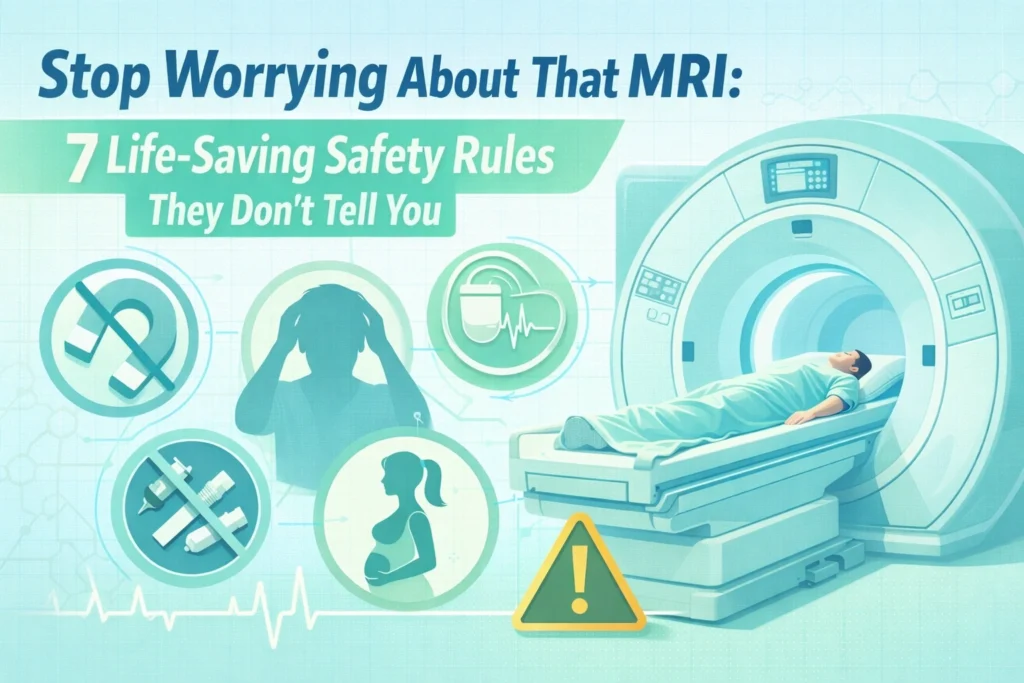

Don’t Be Scared, Be Smart
Let’s be real—walking into a room full of massive machines that can see through your body is a little intimidating. You might wonder: “Is this safe? Will I glow in the dark? What happens if I make a mistake?”

Here’s the good news: Medical imaging is incredibly safe when proper precautions are followed. Millions of Americans get X-rays and MRIs every year with zero problems. But safety isn’t automatic—it requires knowledge and attention from both medical staff AND patients.
This guide gives you practical, no-nonsense information about who should stay away from these machines and what you absolutely need to know before walking into that room.
PART 1: X-RAY MACHINES – The Invisible Beam
How X-Rays Actually Work
Think of X-rays like an extremely powerful flashlight that shines through your body. Dense things like bones block the light and show up white. Soft things like muscles let some light through and show up gray. Air lets all the light through and shows up black.
The “light” is actually radiation—the same kind that comes from the sun and nuclear power plants, just at much lower levels for medical use.
Who Should NOT Be Near an X-Ray Machine
Pregnant Women – This Is Non-Negotiable
This is the #1 rule in radiology. If there’s any chance you might be pregnant, you MUST tell your doctor and the X-ray technologist before the exam.
Why? A developing baby’s cells are dividing rapidly, making them much more sensitive to radiation damage. Even low doses could potentially cause problems.

What pregnant women should know:
- If you need an X-ray for a serious medical emergency (like a broken leg from a car accident), they’ll shield your abdomen and pelvis with lead aprons
- For non-emergency X-rays, they’ll usually wait until after delivery
- Dental X-rays are generally safe during pregnancy with proper shielding, but always tell your dentist you’re pregnant first
Children – Extra Care Required
Kids aren’t just small adults. Their growing bodies are more sensitive to radiation, and they have more years of life ahead for any potential effects to develop.
What parents should know:
- Pediatric hospitals use special “child-sized” radiation doses
- Always ask if they’re using pediatric protocols
- Never hold your child during an X-ray unless you’re wearing a lead apron and it’s absolutely necessary
- If you’re pregnant, someone else should hold your child during X-rays
People Having Repeated X-Rays
One X-ray is no big deal. But if you’re getting X-rays frequently (like weekly for medical conditions), the cumulative radiation adds up.
What to discuss with your doctor:
- Ask if there are alternatives like ultrasound or MRI that don’t use radiation
- Keep a log of your X-rays (date, type, where done) to track your cumulative exposure
- Ask if they can use the lowest possible dose protocols
People with Certain Medical Conditions
Some conditions make people more sensitive to radiation:
- Genetic conditions like ataxia-telangiectasia (rare) – These affect the body’s ability to repair radiation damage
- Previous radiation therapy patients – Areas that received cancer radiation shouldn’t get additional X-rays unless absolutely necessary
Practical Precautions: What YOU Need to Do
Before the X-Ray:
- The Golden Rule: Tell them if you’re or might be pregnant. Even if you think it’s impossible, even if you’re only 12, even if you’ve already told three people. Say it again.
- Remove everything metal: Jewelry, glasses, dentures, hearing aids, belts with metal buckles, underwire bras, piercings. Metal shows up on X-rays and blocks the view.
- Strip down appropriately: They’ll give you a gown. Street clothes can have buttons, zippers, and snaps that mess up the image.
- Leave your phone in the waiting room: It won’t hurt you, but it’ll be in the way.
During the X-Ray:
- Hold still – REALLY still. Moving blurs the image. If they can’t see clearly, they’ll have to do it again (more radiation).
- Follow breathing instructions: Sometimes they’ll say “take a deep breath and hold” to move your diaphragm out of the way for chest X-rays.
- Lead aprons are your friends: If they put a heavy lead apron over parts of your body not being X-rayed, don’t move it. That’s your protection.
After the X-Ray:
- Nothing special needed. You’re not radioactive. You won’t set off airport security. You can hug your kids immediately.
- Keep your images: Most places give you a CD or online access. Keep these for your records—future doctors might want to compare.
The Truth About X-Ray Risks
The dose matters. A chest X-ray gives you about the same radiation as 10 days of natural background radiation (what you get from the sun, soil, etc.). A dental X-ray is like 1 day of background radiation. A CT scan is higher—like 2-3 years of background radiation—but still much lower than the level where we see proven harm.
The risk from a single necessary X-ray is so small it can’t be measured. The risk from NOT getting a needed X-ray (missing a broken bone, pneumonia, or tumor) is real and immediate.
PART 2: MRI MACHINES – The Giant Magnet
How MRI Actually Works
Imagine the world’s most powerful magnet—like 30,000 times stronger than Earth’s magnetic field. Now imagine lying inside it while it uses radio waves to make your body’s water molecules wiggle. A computer turns those wiggles into incredibly detailed pictures.
CRITICAL FACT: MRI uses NO radiation. Zero. None. It’s completely different from X-rays and CT scans.
Who Should NOT Be Near an MRI Machine
People with Metal in Their Bodies – This Is Life or Death
This is not a suggestion. This is not optional. The MRI magnet is SO powerful that it can:
- Pull metal objects through your body like a bullet
- Heat up metal implants and burn surrounding tissue
- Stop pacemakers from working (causing cardiac arrest)
- Move metal fragments in your eyes (causing blindness)
Absolute NOs – Do Not Enter the MRI Room If You Have:
- Pacemakers or defibrillators – Unless it’s specifically an “MRI-safe” modern pacemaker (about 50% are now)
- Cochlear implants (inner ear hearing devices) – Contains metal and electronics
- Some aneurysm clips in your brain – Older ones can move and cause fatal bleeding
- Metal fragments in your eyes – From grinding metal, welding, or certain military injuries
- Some implanted drug pumps – Like insulin pumps or pain medication pumps
- Neurostimulators – For Parkinson’s, chronic pain, or epilepsy
Gray Areas – Tell Your Doctor and Technologist About:
- Stents in your heart arteries – Most modern stents are MRI-safe after 6 weeks
- Artificial joints and screws – Usually safe but may distort the image
- Dental implants and braces – Will distort images of your face/brain but usually safe
- Tattoos – Some older inks contain iron. They might burn slightly. Tell them where your tattoos are.
- IUDs – Usually safe but tell them you have one
- Shrapnel or bullets – Critical to know location and type
- Vascular filters – Like IVC filters in your veins
- Heart valves replacements – Most are safe but must be verified
People with Certain Medical Conditions
- Claustrophobia – About 5% of people can’t handle the enclosed space
- Very large patients – Machines have weight limits (typically 350-550 pounds)
- Kidney problems – For contrast dye MRIs only
- Inability to lie still – Parkinson’s, severe pain, or anxiety
Pregnant Women – The Rules Are Different Than X-Ray
MRI is actually considered safe during pregnancy because there’s no radiation. However, most hospitals still avoid it in the first trimester unless absolutely necessary, just to be extra cautious. Always tell them if you’re pregnant.
Practical Precautions: What YOU Need to Do
The Screening Questionnaire – Take It Seriously
Before any MRI, you’ll fill out a detailed safety questionnaire. This is NOT just paperwork. It’s literally a life-saving document.
What they need to know:
- Every surgery you’ve ever had (and what hardware was put in)
- Any metal in your body from injuries or accidents
- Your job history (welding, metalwork = higher chance of metal fragments in eyes)
- Tattoos and permanent makeup
- Allergies (to contrast dye)
- Kidney problems (if getting contrast)
- Pregnancy or breastfeeding status
The Day of Your MRI:
- Wear absolutely NO metal:
- No jewelry (remove piercings at home—they won’t let you in with them)
- No watches, fitbits, or smart jewelry
- No underwire bras (the wire will heat up and could burn you)
- No belts with metal buckles
- No zippers if possible (wear sweatpants with a drawstring)
- Empty ALL pockets (keys, coins, phone, wallet)
- Leave everything in a locker: Phones, credit cards, and watches will be erased or damaged by the magnet. Hearing aids will be destroyed. Don’t bring them in.
- Change into their gown: Street clothes often have hidden metal—snaps, zippers, even some fabrics have metallic threads.
- Tell them about patches: Nicotine, birth control, pain patches might have metal foil. They need to know.
- Remove makeup: Some mascaras and eyeshadows contain metal particles that can distort facial/brain images.
During the MRI:
- The noise is NORMAL. MRIs sound like jackhammers—loud, rhythmic banging. You’ll get earplugs or headphones.
- Hold still. Even tiny movements blur the images. They’ll give you cushions and straps to help.
- You can talk to them. You’ll have a call button or squeeze bulb. Use it if you’re uncomfortable.
- Close your eyes before going in. If you’re claustrophobic, keeping your eyes closed the whole time helps.
- Breathe normally. Unless they tell you otherwise for specific sequences.
If You’re Getting Contrast Dye (Gadolinium):
- It’s not iodine-based like CT contrast (different allergy risks)
- Tastes funny going in—like warm metal
- You might feel cold or flushing—normal
- Tell them immediately if you have trouble breathing or your throat swells (rare allergic reaction)
- Drink extra water afterward to flush it out
The Truth About MRI Risks
MRI is extraordinarily safe when protocols are followed. The only real dangers come from:
- Metal that shouldn’t be there (why screening is crucial)
- Contrast reactions (rare, usually mild)
- Nerve stimulation (extremely rare with modern machines)
- Burns (if you make a loop with your legs or arms touching, or if you have certain tattoos)
No radiation means no cancer risk. MRI can be repeated safely as often as needed.
PART 3: COMPARING THE TWO – Quick Reference
| Factor | X-Ray / CT | MRI |
|---|---|---|
| Uses radiation? | Yes | No |
| Metal danger? | No (just image artifacts) | YES – LIFE THREATENING |
| Pregnancy risk? | Significant – tell them | Probably safe but minimized |
| Claustrophobia? | Rare (CT is open) | Common (tube is tight) |
| Time | Seconds to minutes | 30-60 minutes |
| Noise | Quiet | Very loud |
| Cost | Lower | Higher |
PART 4: SPECIAL SITUATIONS AND FREQUENTLY ASKED QUESTIONS
“I’m a Welder/Machinist – Can I Get an MRI?”
Maybe, but you need special screening. Metal fragments in your eyes from grinding or welding are a real concern. They’ll likely do X-rays of your eye sockets first to check for metal before letting you near the MRI.
“What If I Have a Tattoo?”
Most modern tattoos are fine. But if your tattoo is:
- Large and dark (lots of ink)
- Made with certain red or brown inks (contain iron)
- Located right where the MRI is scanning
…you might feel a warming sensation. Tell the technologist. They can put a cold pack on it or monitor you closely. Rarely, tattoos can cause burns, so don’t hide them.
“I’m Claustrophobic – What Are My Options?”
You have several:
- Open MRI – Wider, less enclosed machines (but image quality may be slightly lower)
- Sedation – Your doctor can prescribe anti-anxiety medicine
- Closed-eye technique – Close eyes before going in, keep them closed, pretend you’re somewhere else
- Music – Many places let you bring your own playlist
- Practice run – Some places let you see the machine beforehand
“Can I Drive Afterward?”
- X-ray/CT without sedation: Yes, absolutely fine
- CT with contrast: Usually yes, though some people feel a little weird
- MRI without sedation: Yes
- MRI with sedation: No – you’ll need someone to drive you
“What About Contrast Dye Reactions?”
For CT (iodine-based contrast):
- If you’ve had a reaction before, tell them
- If you have asthma or allergies, higher risk
- They can pre-medicate you with steroids and antihistamines
- Diabetics on metformin may need to stop it temporarily
For MRI (gadolinium-based contrast):
- Much lower allergy risk
- Main concern is kidney disease – they’ll check your blood work first
“Can I Bring Someone With Me?”
- X-ray: Usually not, because of radiation exposure
- MRI: Not into the magnet room (metal danger), but they can be in the control room watching you on camera
“What If I Forget to Tell Them Something?”
If you remember something AFTER you’ve gone in—like a metal implant or possible pregnancy—tell them immediately. They can stop the exam. Better to stop and sort it out than take risks.
PART 5: YOUR SAFETY CHECKLIST
Before Any Imaging Exam
- Tell them if you’re or might be pregnant (even if you think it’s impossible)
- List all surgeries and implants (even old ones)
- Mention any metal in your body (bullets, shrapnel, metal fragments)
- List all allergies (especially to contrast dye)
- Mention claustrophobia or anxiety
- Remove all jewelry and metal objects
- Leave valuables at home or in locker
For X-Ray Only
Lead apron over areas not being imaged (if offered)
- Hold still when instructed
- Hold breath if told to
For MRI Only
- COMPLETE the safety questionnaire thoroughly
- Remove ALL metal (including underwire bras and body piercings)
- Tell them about tattoos
- Tell them about any welding/metalwork history
- Wear earplugs or headphones
- Hold still – don’t cross your arms or legs (can cause burns from loops)
- Use call button if you need help
The Bottom Line
Medical imaging saves lives every single day. The machines are designed with safety in mind, and the technologists operating them are highly trained professionals who do this hundreds of times per year.
Your job is simple:
- Be honest about your medical history
- Follow instructions exactly
- Speak up if something doesn’t seem right
The technologist’s job is to keep you safe while getting the best possible images. Work together, and you’ll be in and out with nothing to worry about except maybe the cold jelly or the weird banging noises.
Remember: The person who knows most about your body is YOU. If something feels off, if you forgot to mention something, if you’re uncomfortable—say something. That’s not being difficult. That’s being safe.
FAQs:
1️⃣ Is a chest X-ray safe for children?
Yes. A pediatric chest X-ray uses a very low dose of radiation. Hospitals follow the ALARA (As Low As Reasonably Achievable) principle to minimize exposure. Protective measures such as lead aprons and thyroid collars are used when appropriate to enhance safety.
2️⃣ Why does my child need to wear a lead apron during an X-ray?
A lead apron helps shield sensitive organs from unnecessary radiation exposure. Although the radiation dose is already low, shielding provides an additional layer of protection—especially important for growing children.
3️⃣ How much radiation does a child receive from a chest X-ray?
A single chest X-ray exposes a child to a very small amount of radiation—typically comparable to a few days of natural background radiation from the environment. The diagnostic benefits usually far outweigh the minimal risk.
This guide is for general information. Always follow the specific instructions from your healthcare provider and the imaging facility. When in doubt, ask questions. Good facilities welcome questions—it shows you’re paying attention to your safety.