
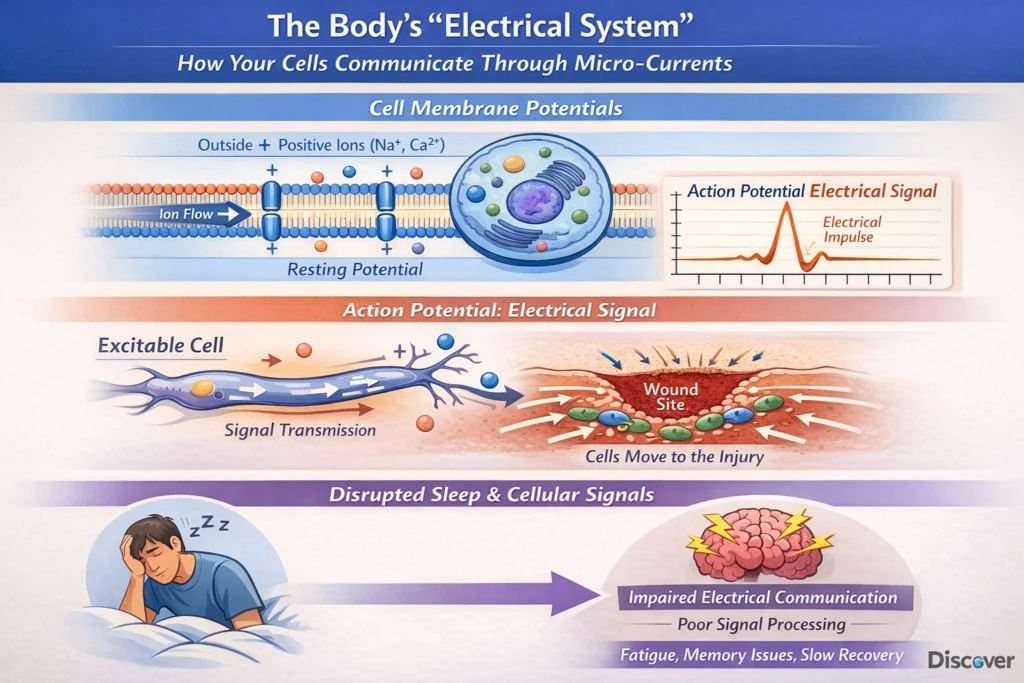

How Your Cells Communicate Through Micro-Currents: The Body’s “Electrical System” Every living cell in your body generates tiny electrical signals. These signals—often just a few millivolts—are not “electricity” like wall power, but they are fundamental to life: coordinating movement, sensing the environment, regulating organ function, and even guiding how wounds heal.
Despite this, mainstream health sites rarely explain this cellular communication clearly. Let’s unpack it in simple, evidence-based terms.
Voltage: The Language of Life
How Cellular Communication Powers Your Health
What Bioelectricity Is
At the core of cellular electrical communication is bioelectricity — the electrical potentials and currents produced by cells and tissues. These arise because ions (charged particles like sodium, potassium, and calcium) move across cell membranes, creating voltage differences called membrane potentials.
In excitable cells (like neurons and muscle), changes in these membrane potentials create action potentials — rapid electrical signals that travel along cells to trigger nerve impulses or muscle contraction.
How Wounds Heal Faster When Electrical Signals Are Restored
When tissue is injured, the normal electrical gradients across the skin and epithelium (surface cells) are disrupted. The wound itself generates endogenous electric fields — tiny bioelectric currents that point toward the wound center. Cells involved in healing detect these fields and orient their movement toward the injured area, a process called galvanotaxis or directed electrical migration.
Research shows that these micro-electrical cues help guide collective cell migration, accelerating healing. Without proper electrical signaling, the coordination of cell movement is less efficient, potentially slowing repair.
Review articles also find that natural voltage gradients are associated with wound healing rates across animals and even plants.
Why Poor Sleep Disrupts Cellular Communication
Sleep isn’t just rest — it’s a biological reset for cells. Adequate sleep supports protein synthesis, gene regulation, and the maintenance of cellular homeostasis. When sleep is disrupted or insufficient, cells experience stress and changes in how they handle electrical and chemical signaling.
At the neuronal level, sleep deprivation alters key signalling pathways that depend on electrical activity and downstream molecular cascades (e.g., cAMP-PKA and neurotransmitter systems). These changes impair how neurons communicate and adapt — which contributes to memory problems and slower physiological recovery.
While research in humans is ongoing, many of these effects can be traced back to disruptions in electrical and biochemical signaling within and between cells during wake and sleep states.
Relation to Nerve Pain
Pain itself is an electrical signal. Specialized sensory neurons called nociceptors detect potentially harmful stimuli and convert them into electrical impulses that travel through the nervous system to the brain.
Bioelectrical medicine — the therapeutic use of electrical stimulation — can modulate these signals. By activating large-fiber pathways or engaging inhibitory circuits, electrical stimulation can reduce the perception of pain and enhance endogenous pain-relief mechanisms like opioid and serotonin release.
Connection to Fatigue
Fatigue often emerges when electrical signalling fails to match the needs of tissues. For example:
- When neurons fire repetitively without adequate recovery (as in prolonged wakefulness), electrical gradients and ion balances are disrupted.
- Metabolic stress in cells — which depends on membrane potentials and ion flux — increases under sleep loss and inflammation.
This altered cellular electrical balance can translate into the subjective sense of physical and mental fatigue, slower responses, and reduced recovery efficiency.
Slow Recovery and Cellular Communication
Efficient recovery from injury, infection, or stress requires coordinated cellular signalling — both chemical and electrical. Cells depend on tightly regulated ion gradients to transmit signals that control protein synthesis, division, migration, and repair mechanisms.
When electrical communication falters — due to stress, poor sleep, inflammation, or metabolic imbalance — signals become less precise or slower, and recovery processes (like immune response or tissue regeneration) are prolonged.
In Summary: Your Electrical Body
Bioelectricity is real: Cells use tiny ion currents for communication and function.
- Wound healing depends on electrical cues: Endogenous electric fields guide cells to repair injuries.
- Sleep supports cellular signaling: Disrupted sleep perturbs electrical and molecular pathways involved in healing and memory.
- Pain and fatigue are linked to electrical function: Sensory signals and fatigue thresholds depend on membrane potentials and ion flows.
While electrical signaling often operates beneath conscious awareness, it is central to virtually all aspects of physiology — from nerve impulses to tissue recovery. Understanding this system helps explain why sleep, healing, and sensory processes are so tightly interwoven with bioelectric integrity.
Here are powerful, real-world examples you can directly correlate with human cellular micro-currents:
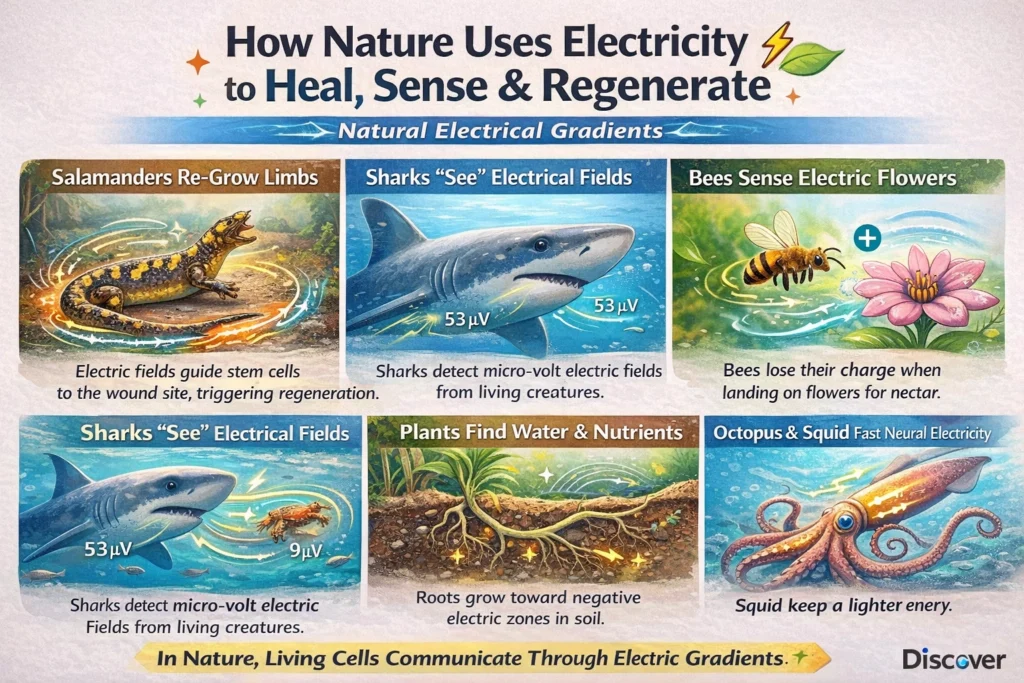
🌍 1. Salamanders & Axolotls – Regrowing Limbs with Electricity
When a salamander loses a limb, the wound immediately generates a voltage gradient.
- The injured tissue becomes electrically negative
- Surrounding healthy tissue becomes positive
- This electric field guides stem cells to the wound site
(same principle as human wound galvanotaxis)
If researchers block the electric current, regeneration fails.
If they restore it, the limb regrows correctly.
Correlation to humans:
Your skin and tissues also produce wound electric fields. Faster healing = stronger, organized bioelectric signals.
🦈 2. Sharks & Rays – “Seeing” Electricity
Sharks don’t rely on sight alone.
They detect micro-volt electrical fields produced by:
- Beating hearts
- Muscle movement
- Ion flow in living tissue
Their sensory organs, called Ampullae of Lorenzini, can detect signals as low as:
0.0000005 volts (0.5 microvolts)
Correlation to humans:
Your nerves and muscles communicate in the same electrical range — just internally.
🐝 3. Bees – Using Electric Fields to Communicate
Bees carry a positive electric charge when flying.
Flowers are negatively charged.
When a bee lands:
- The electric field changes
- Other bees detect that change
- They know the flower was just visited
Correlation to humans:
Your cells also read and respond to field changes, not just chemicals.
🌱 4. Plants – Root Navigation by Electricity
Plant roots use electrical gradients in soil to:
- Sense water
- Detect nutrients
- Avoid obstacles
They grow toward negative electrical zones — a process known as electrotropism.
Correlation to humans:
Your healing cells move using the same rule:
Cells migrate along electrical gradients.
🐙 5. Octopus & Squid – Fast Neural Electricity
Squid have some of the largest nerve axons on Earth.
Scientists first discovered action potentials in squid neurons.
This is the same electrical spike used in:
- Human nerves
- Your heart rhythm
- Your brain waves
Correlation:
Your nervous system runs on the same physics as marine life.
🧠 Big Picture
| Nature | Humans |
|---|---|
| Salamander limb regrowth | Skin wound healing |
| Shark electric sensing | Nerve signal detection |
| Bee field communication | Cellular voltage shifts |
| Plant electrotropism | Cell migration |
| Squid neurons | Human action potentials |
🔑 Core Principle
Life is guided by electrical information first — chemistry follows.
Before hormones, before enzymes, before inflammation:
voltage changes tell cells what to do.
This is why:
- Poor sleep
- Chronic stress
- Inflammation
- Metabolic disease
All impair electrical signaling first, and symptoms appear later.
FAQs: Cellular Electricity & Electrolytes
Understanding how sodium, potassium, and calcium create the electrical signals that power every function in your body.
Electrolytes create electricity through a fascinating process called the “sodium-potassium pump” and action potentials. Here’s how it works:
The Cellular Battery Concept: Each of your cells maintains an electrical charge across its membrane, like a tiny battery. Inside the cell is negatively charged, while outside is positively charged.
The Three-Step Electrical Process:
- Resting State: Cells have more potassium inside and more sodium outside, creating a voltage difference of about -70 millivolts.
- Firing (Depolarization): When a nerve needs to send a signal or a muscle needs to contract, sodium channels open. Positively charged sodium ions flood into the cell, rapidly changing the voltage to about +40 millivolts. This is the electrical impulse.
- Reset (Repolarization): Potassium channels open, allowing potassium ions to flow out, restoring the negative charge inside the cell. The sodium-potassium pump then actively transports ions back to their original positions, recharging the cellular battery.
Sodium (Na+)
- Role: The “spark” – initiates electrical impulses
- Location: Primarily outside cells
- Action: Rushes IN to start signal
Potassium (K+)
- Role: The “resetter” – ends impulses
- Location: Primarily inside cells
- Action: Flows OUT to reset cell
Calcium (Ca++)
- Role: The “trigger” – for muscle contraction
- Action: Released inside cells to activate muscles
- Special: Also vital for bone health
This cycle happens millions of times per second throughout your nervous system and muscles. Without proper electrolyte balance, these electrical signals become disrupted, leading to everything from muscle cramps to irregular heartbeats.
Electrolyte imbalances manifest in specific ways because each mineral controls different electrical functions. Here are the most common symptoms and their underlying causes:
Key Insight: Symptoms often appear because your cells can’t properly generate or conduct electrical signals when electrolytes are out of balance.
Most Common Signs & Their Electrical Causes:
- Muscle Cramps & Twitches:
- Cause: Disrupted calcium signaling or sodium-potassium imbalance
- Electrical Reason: Muscles receive erratic or continuous contraction signals
- Common When: Heavy sweating, dehydration, intense exercise
- Fatigue & Brain Fog:
- Cause: Low sodium or potassium affecting cellular energy production
- Electrical Reason: Nerve cells can’t efficiently transmit signals; “cellular batteries” drain faster
- Common When: Chronic stress, poor diet, excessive caffeine/alcohol
- Heart Palpitations or Irregular Heartbeat:
- Cause: Potassium or calcium imbalance
- Electrical Reason: The heart’s natural pacemaker cells generate irregular electrical impulses
- Important: This requires immediate medical attention
- Headaches & Dizziness:
- Cause: Sodium imbalance affecting fluid balance in brain cells
- Electrical Reason: Brain cells swell or shrink, disrupting normal electrical activity
- Common When: Dehydration, excessive water intake without electrolytes
- Numbness or Tingling:
- Cause: Calcium or magnesium imbalance
- Electrical Reason: Nerves fire spontaneously or fail to transmit signals properly
Common Causes of Imbalance: Heavy sweating during exercise, vomiting/diarrhea, certain medications (diuretics, blood pressure drugs), kidney disorders, poor diet, excessive alcohol consumption, and drinking too much water without electrolyte replacement.
When to Seek Help: While mild imbalances can often be corrected with diet, severe symptoms like heart palpitations, confusion, seizures, or extreme weakness require immediate medical attention.
For most healthy people eating a balanced diet, food alone provides sufficient electrolytes. However, specific circumstances may require supplementation. Here’s a comprehensive guide:
The General Rule: Food first, supplements only when necessary. Whole foods provide electrolytes in balanced ratios with other nutrients that aid absorption and function.
Electrolyte-Rich Food Sources:
Potassium Sources
- Bananas (1 medium: 422mg)
- Sweet potatoes (1 medium: 542mg)
- Spinach (1 cup cooked: 839mg)
- Avocados (1 whole: 975mg)
- Coconut water (1 cup: 600mg)
Calcium Sources
- Dairy products (milk, yogurt)
- Leafy greens (kale, broccoli)
- Fortified plant milks
- Sardines with bones
- Almonds & tofu
Magnesium Sources
- Nuts & seeds (pumpkin, almonds)
- Dark chocolate
- Legumes (black beans)
- Whole grains
- Leafy greens
When Food Might Not Be Enough (Consider Supplements):
- Athletes & Heavy Sweaters: Endurance athletes losing liters of sweat may need electrolyte drinks during/extended exercise
- Illness Recovery: After vomiting/diarrhea, electrolyte solutions can help faster recovery
- Medical Conditions: Certain conditions (Crohn’s, kidney disease) or medications (diuretics) may require supplementation under medical supervision
- Extreme Heat Exposure: Working outdoors in high temperatures with heavy sweating
- Very Low-Carb Diets: Ketogenic diets cause increased electrolyte excretion initially
Supplement Caution:
- Potassium supplements should only be taken under medical supervision – too much can cause dangerous heart rhythms
- Sodium is rarely deficient in modern diets; most people get plenty (often too much) from processed foods
- Calcium supplements should be balanced with vitamin D and magnesium for proper absorption
- Many commercial sports drinks contain excessive sugar; consider sugar-free electrolyte tablets or natural alternatives
Simple Homemade Electrolyte Drink: Mix 1 liter water + ¼ tsp salt (sodium) + ¼ tsp potassium salt (like Morton Lite Salt) + juice of 1 lemon (potassium) + optional natural sweetener. This provides balanced electrolytes without excessive sugar or additives.
Key Takeaway
Your body’s electricity depends on a delicate balance of sodium, potassium, and calcium. Most people maintain this balance through a varied diet, but during intense exercise, illness, or specific medical conditions, electrolyte awareness becomes crucial for optimal cellular function.
Important Information for Educational Purposes Only
The information presented in this content is for educational and informational purposes only and is not intended as medical advice, diagnosis, or treatment. The content reflects conceptual medical perspectives and should not be construed as professional medical guidance.
- This content is not a substitute for professional medical advice, diagnosis, or treatment
- Always seek the advice of your physician or other qualified health provider with any questions you may have regarding a medical condition
- Do not disregard professional medical advice or delay seeking it because of information presented here
- The concepts discussed represent emerging perspectives in medical science and may not reflect standard medical practice
- Individual medical needs vary significantly; consult with healthcare professionals for personalized medical advice
Statements regarding dietary supplements, electrolyte balance, or specific health approaches have not been evaluated by the Food and Drug Administration and are not intended to diagnose, treat, cure, or prevent any disease.
Consultation Requirement: Before making any changes to your diet, exercise routine, medication regimen, or health management approach, consult with a qualified healthcare professional who can assess your individual circumstances.