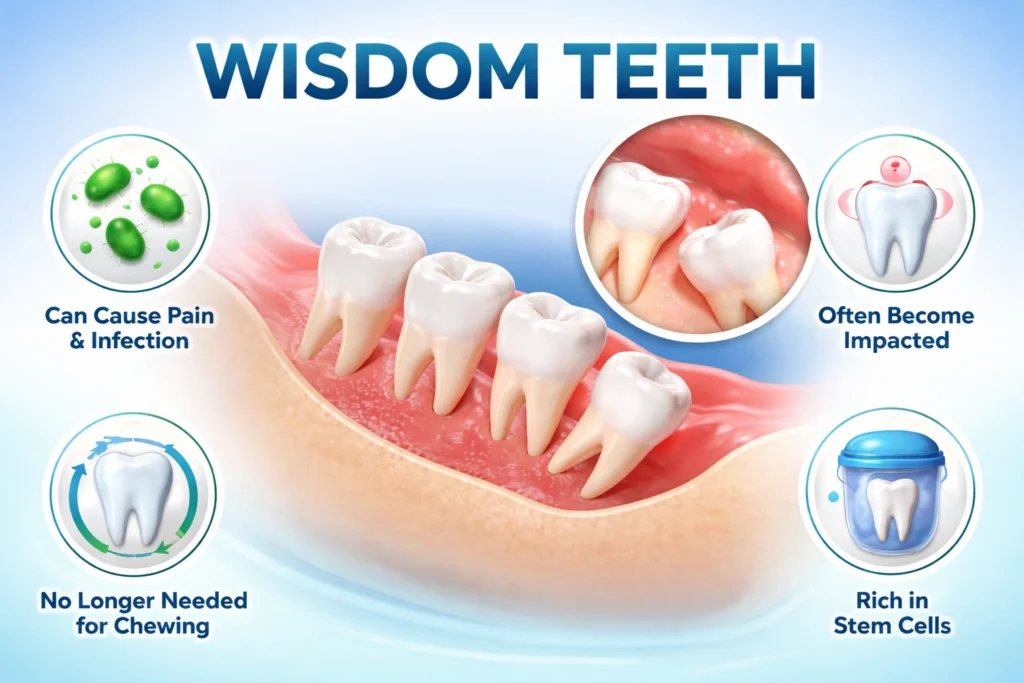

Wisdom teeth—clinically called third molars—are the last set of teeth to erupt, usually between ages 17–25. Their “importance” depends on evolutionary biology, oral function, and modern dental context.
🧠 Why Wisdom Teeth Exist (Evolutionary Perspective)
Historically, wisdom teeth were useful and even necessary:
- Early humans had larger jaws and a coarse diet (raw plants, tough meats).
- Third molars helped grind fibrous food efficiently.
- Tooth wear and loss were common, so extra molars acted as backup teeth.
👉 In that context, wisdom teeth had clear functional importance.
🦷 Their Role in Modern Humans
Today, their importance is much reduced:
1. Limited Functional Benefit
- Modern diets are softer and processed.
- Our jaws are generally smaller, leaving little space.
- Most chewing functions are already handled by first and second molars.
2. No Essential Role
- You can live completely normally without them.
- They are not required for speech, digestion, or facial structure.
⚠️ Common Problems with Wisdom Teeth
Instead of being helpful, they often cause issues:
- Impaction (trapped in gums or bone)
- Pain and swelling
- Infections or cysts
- Damage to nearby teeth
- Crowding or misalignment
Because of this, dentists frequently recommend removal.
🏥 When Wisdom Teeth Are Important
They can still have some conditional value:
- If they erupt properly and align well, they can function like normal molars.
- In rare cases, they may be used as support for dental bridges.
- They can be a backup if other molars are lost.
- Past: Essential for survival and chewing tough foods
- Present: Mostly non-essential and often problematic
- Clinical view: Keep them only if they are healthy, aligned, and painless
Do Wisdom Teeth Contain Stem Cells?
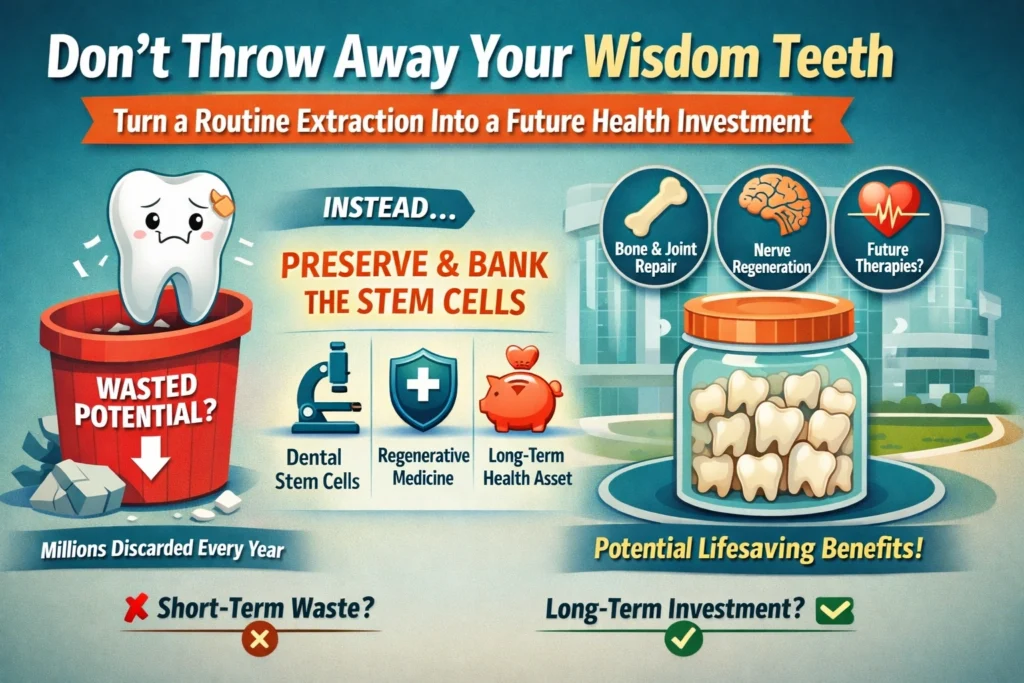
Yes. Dental tissues—especially the pulp inside wisdom teeth—contain dental stem cells, a subset of mesenchymal stem cells.
These cells have shown potential in research areas like:
- Bone regeneration
- Nerve repair
- Dental tissue engineering
So scientifically, wisdom teeth can be a viable stem cell source.
🏥 What Is Tooth Banking (Cryopreservation)?
Some companies offer tooth stem cell banking, where extracted teeth are preserved at very low temperatures.
Process:
- Tooth is extracted (usually for clinical reasons)
- Stem cells are isolated or the whole tooth is stored
- Stored using cryogenic technology for future use
⚠️ Reality Check: Current Clinical Use
Here’s the critical part:
- Most applications are still experimental or in early clinical stages
- There are no widely adopted, routine medical treatments today using dental stem cells
- Future use is promising but not guaranteed
👉 This means preservation is more like a biological “insurance policy”, not a currently actionable therapy.
💰 Cost vs Benefit Consideration
Tooth banking typically involves:
- Initial processing fees
- Annual storage costs
You should weigh:
- Financial commitment over years
- Uncertain future utility
- Availability of alternative stem cell sources (like bone marrow or induced pluripotent stem cells)
🦷 Should You Preserve Your Wisdom Teeth?
✔️ Consider preservation if:
- Teeth are being removed anyway
- You’re interested in future regenerative medicine
- Cost is not a concern
❌ Not necessary if:
- You’re extracting teeth solely for storage
- You expect guaranteed medical use (not realistic yet)
- Wisdom teeth do contain valuable stem cells
- Preservation is optional and forward-looking, not medically essential today
- It’s best seen as a speculative investment in future healthcare, not a necessity
Managing wisdom tooth pain without extraction is possible in many cases—but only if the underlying cause is mild or temporary (e.g., gum inflammation rather than severe impaction or infection). Here’s a clinically grounded approach.
🦷 Common Causes of Wisdom Tooth Pain
Pain typically arises from:
- Pericoronitis (inflamed gum over a partially erupted tooth)
- Food/debris trapped around the tooth
- Pressure from eruption
- Early-stage infection
⚡ Fast Pain Relief (Short-Term Control)
1. Warm Salt Water Rinse
- Mix ½ teaspoon salt in warm water
- Rinse 2–3 times daily
✔ Reduces inflammation and bacterial load
2. Targeted Oral Hygiene
- Use a soft-bristled toothbrush angled behind the last molar
- Consider an interdental brush or water flosser
✔ Prevents food impaction (a major pain trigger)
3. Cold Compress
- Apply on cheek (15–20 min)
✔ Reduces swelling and numbs pain
4. Over-the-Counter Pain Relief
- Ibuprofen (anti-inflammatory, preferred)
- Paracetamol (alternative)
✔ Follow dosage guidelines strictly
5. Antiseptic Mouthwash
- Chlorhexidine (short-term use)
✔ Helps control infection around partially erupted teeth
🧬 Medium-Term Management (Avoid Recurring Pain)
6. Manage Gum Flap (Pericoronitis)
- Dentist may clean under the gum flap
- In some cases, minor removal of excess gum tissue (operculectomy)
7. Diet Adjustments
- Avoid hard, sticky, or spicy foods
- Prefer soft foods during flare-ups
8. Maintain Low Bacterial Load
- Consistent brushing + flossing
- Hydration to prevent dry mouth
⚠️ When Pain Will NOT Resolve Without Extraction
Non-surgical management will fail if you have:
- Impacted tooth pressing adjacent molar
- Recurrent infections
- Pus discharge or severe swelling
- Jaw stiffness or fever
👉 In these cases, avoiding extraction can worsen complications.
🚫 What to Avoid
- Don’t apply aspirin directly to gums (can burn tissue)
- Avoid ignoring persistent pain >3–4 days
- Don’t rely only on painkillers long-term
🧾 Bottom Line
- You can control and reduce wisdom tooth pain with hygiene, anti-inflammatory measures, and antiseptics
- This works best for mild inflammation or partial eruption issues
- If the root cause is structural (impaction), pain relief is temporary—not a cure