
If you have ever received a mammogram report filled with confusing medical terms, you are not alone. Among the most misunderstood yet critical findings on a breast imaging report are references to breast density, fibroglandular density in breast tissue, and the various breast density categories. Understanding these terms could save your life.
What Is Breast Density?
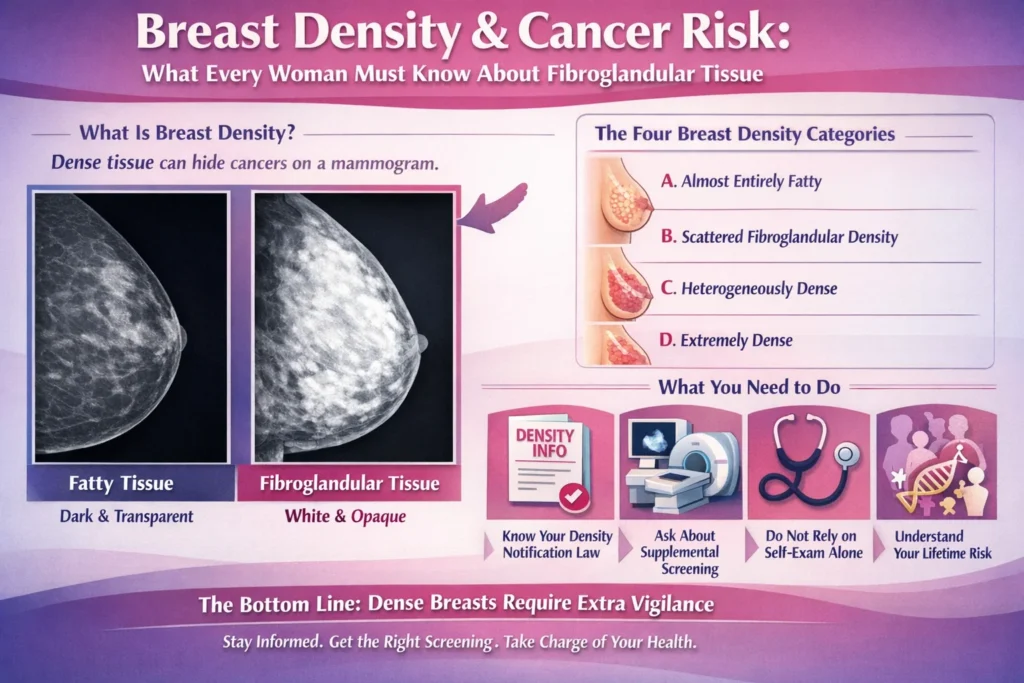
When doctors talk about breast mammogram density, they are not referring to how a breast feels during a self-exam. Instead, mammogram density measures the relative amount of fibroglandular tissue (milk ducts, lobes, and supportive tissue) compared to fatty tissue.
On a mammogram:
- Fatty tissue appears dark and transparent.
- Fibroglandular tissue appears white and opaque.
The more fibroglandular tissue you have, the higher your breast mammogram density. This matters because both cancer and fibroglandular density in breast tissue appear white on an X-ray. In other words, density breast cancer risk is elevated not just biologically, but also diagnostically—cancer can hide in plain sight.
The Four Breast Density Categories
Radiologists classify breast composition using standardized breast density categories defined by the American College of Radiology’s BI-RADS system. Your report will state one of the following breast density category labels:
Category A: Almost Entirely Fatty
The breasts are composed almost entirely of fat. There is very little fibroglandular density of breasts. This is the easiest category in which to spot cancer.
Category B: Scattered Fibroglandular Density
Mostly fatty tissue with a few areas of scattered fibroglandular density breast. Most cancers remain visible, though small lesions may be partially obscured.
Category C: Heterogeneously Dense
This is where things get tricky. Breast tissue density is heterogeneously dense means the breast contains large areas of fibroglandular tissue that can obscure small masses. This is a common finding, especially in premenopausal women.
Category D: Extremely Dense
The highest category of breast mammogram density. Nearly the entire breast is composed of fibroglandular density of breasts, making it very difficult to detect cancer on a standard mammogram.
Why Breast Density Category Matters for Cancer Risk
Women with dense breasts (Categories C and D) face a two-fold problem:
- Masking Effect: As noted, because both cancer and fibroglandular density breast appear white, tumors can hide within normal tissue. Up to 40% of cancers in dense breasts may be missed on a standard mammogram.
- Independent Risk Factor: Beyond masking, having high fibroglandular density in breast tissue is itself an independent risk factor for developing breast cancer. Women with extremely dense breasts have a 4–6 times higher risk compared to women with fatty breasts.
What Does “Breast Tissue Density Is Heterogeneously Dense” Mean for You?
If your report states that breast tissue density is heterogeneously dense, you fall into Category C. This is the most common dense category, affecting approximately 40% of women over 40. It signals that:
- You need supplemental screening (ultrasound, MRI, or 3D mammography/tomosynthesis).
- You should discuss risk reduction strategies with your doctor.
- You may benefit from shorter screening intervals.
Beyond the Mammogram: What to Do If You Have High Fibroglandular Density of Breasts
Knowing your breast density category is only the first step. Here is what you should do next:
1. Know Your State’s Density Notification Law
Over half of US states, plus many countries, now require mammography providers to inform women if they have high breast mammogram density. If you were not told, ask for your report.
2. Ask About Supplemental Imaging
For women with fibroglandular density breast, adding whole-breast ultrasound or MRI can detect cancers that mammograms miss. Tomosynthesis (3D mammography) also improves detection in heterogeneously dense breasts.
3. Do Not Rely on Self-Exam Alone
Because dense tissue feels nodular, it can be difficult to feel small lumps. Clinical exams by a professional are essential.
4. Understand Your Lifetime Risk
High fibroglandular density of breasts combined with family history or genetic mutations may qualify you for high-risk screening protocols.
The Bottom Line: Density Is Common, But Not a Death Sentence
Having a breast density category of C or D is not abnormal—it is simply a biological variation. However, it does require a more proactive approach to breast health. Thousands of women with fibroglandular density in breast tissue go on to live long, healthy lives because they sought supplemental screening and understood the masking effect.
The takeaway: next time you receive a mammogram report, look for your breast density category. If it says breast tissue density is heterogeneously dense or extremely dense, do not panic. Instead, make an appointment to discuss additional imaging. Knowledge of mammogram density in breast is not fear—it is power.
Disclaimer: This article is for educational purposes and does not constitute medical advice. Always consult a radiologist or breast specialist to interpret your personal breast density findings and determine appropriate screening.