
Alarming Study Reveals Glyphosate Use in Argentina Linked to 738% Increase in Breast Cancer Risk
A groundbreaking case-control study conducted in Argentina’s agricultural heartland has uncovered a startling connection between living near glyphosate-treated fields and breast cancer. The research found that women residing close to agricultural areas face a breast cancer risk 7.38 times higher than those living farther away—a staggering 638% increase above baseline risk .
The Study: A Closer Look at the Numbers
Published in Frontiers in Toxicology in May 2025, this peer-reviewed study was conducted by researchers from Argentina’s National Scientific and Technical Research Council (CONICET), the National University of the Litoral, and Argentina’s National Institute of Epidemiology . The research team examined 90 women from the Province of Santa Fe, a region of intense agricultural activity where glyphosate-based herbicides have been extensively used since the introduction of genetically modified, glyphosate-resistant soybeans in the mid-1990s .
Key Findings
| Finding | Result |
|---|---|
| Breast cancer risk increase | OR: 7.38 (95% CI: 2.74–21.90) |
| Women with detectable glyphosate in urine | 86.1% |
| Urinary glyphosate concentration range | 0.37–10.07 µg/g creatinine |
| AMPA detection rate | 0% (not detected in any sample) |
The Odds Ratio (OR) of 7.38 means women living near agricultural fields were more than seven times as likely to have breast cancer compared to women living farther away .
Why This Finding Is So Significant
Widespread Exposure Confirmed
The study documented the “ubiquitous presence” of glyphosate in adult women from Argentina, with detectable levels found in over 86% of participants . This confirms that environmental exposure—not just occupational contact—is resulting in widespread absorption of this herbicide into the human body.
The “Cocktail Effect”
A critically important nuance emerged from the research: urinary glyphosate concentrations alone showed no difference between cancer patients and healthy controls . However, residential proximity to agricultural fields was strongly associated with increased cancer risk. This apparent contradiction suggests that exposure to multiple agrochemicals simultaneously—rather than glyphosate alone—may be driving the elevated risk .
The researchers concluded that “exposure not only to GLY but also to agrochemicals in general, could predispose to the development of BC in Argentina” .
Argentina’s Glyphosate Problem: A Perfect Storm
Argentina’s agricultural transformation explains why this issue has reached crisis proportions:
- Massive adoption of GMO soybeans beginning in the mid-1990s
- Dramatic increase in glyphosate application making Argentina one of the world’s leading consumers of the herbicide
- Minimal regulatory oversight historically, with growing public concern now prompting local restrictions but no comprehensive national bans
Context from Other Studies
A 2024 study in Buenos Aires Province found that 13% of the general population had quantifiable glyphosate in their urine—all from environmental rather than occupational exposure. The primary sources identified included:
- Unloading agrochemicals at nearby warehouses
- Grain storage complexes
- Pesticide drift from fields
- Self-propelled sprayers passing through residential streets
The Broader Scientific Context
Glyphosate’s Controversial Classification
Glyphosate’s safety has been hotly debated among regulatory bodies worldwide:
| Organization | Classification | Year |
|---|---|---|
| International Agency for Research on Cancer (IARC) | “Probably carcinogenic to humans” (Group 2A) | 2015 |
| European Food Safety Authority (EFSA) | “Insufficient evidence” for carcinogenicity | 2015 |
| US Environmental Protection Agency (EPA) | “Not likely to be carcinogenic to humans” | 2017 |
Notably, the European Union recently voted to extend glyphosate use until 2033 , despite ongoing scientific controversy.
Endocrine Disruption Mechanisms
Beyond direct carcinogenicity, mounting evidence indicates glyphosate acts as an endocrine disruptor—interfering with hormonal signaling pathways. Specifically, glyphosate has been shown to:
- Modulate estrogen receptor alpha activity
- Enhance transcriptional activation in breast cancer cell lines
This hormonal mechanism provides a biologically plausible explanation for the observed breast cancer link, even if glyphosate’s direct carcinogenicity remains debated.
Previous Epidemiological Studies
While the IARC based its 2A classification largely on non-Hodgkin lymphoma associations, studies have produced mixed results:
- Positive associations reported in Swedish, Canadian, and US studies for NHL and multiple myeloma
- A large pooled study found no relationship with all NHL types but did detect an association with follicular lymphoma (an NHL subtype)
Limitations and the Path Forward
Study Limitations
Researchers acknowledge important constraints:
- Small sample size (90 women total)
- Geographic limitation (only Santa Fe Province)
- Potential recall bias in residential history reporting
- Cross-sectional design cannot establish causation
Next Steps
The study authors explicitly call for “further and broader assessments of BC distribution in relation to agrochemical exposure across different regions of Argentina” . Ongoing research includes a 2026 study examining joint exposure to glyphosate and glufosinate in male populations in Córdoba Province .
Implications for Public Health
For Argentina
With breast cancer already the leading cause of cancer death in Argentine women (6,100 annual deaths, 22,000 new cases per year, representing 32.1% of total cancer incidence), these findings demand urgent regulatory attention .
The study validates what rural communities have long suspected: proximity to intensive agriculture carries health risks that extend beyond occupational exposure to encompass entire families living near treated fields.
Global Relevance
For countries with similar agricultural practices—including the United States, Brazil, Canada, and nations across Europe—these findings raise important questions about:
- Setback distances between agricultural fields and residential areas
- Drift mitigation requirements for aerial and ground spraying
- Biomonitoring programs for communities near intensive agriculture
- Long-term health surveillance in agricultural regions
Conclusion: A 638% Risk Increase Demands Action
The 7.38-fold increase in breast cancer risk associated with living near agricultural fields in Argentina represents one of the strongest epidemiological signals yet linking glyphosate-based agriculture to human cancer. While the herbicide itself may not be the sole culprit—the “agrochemical cocktail” hypothesis suggests cumulative exposure matters—the public health implications are unmistakable.
As Argentina continues to expand its agricultural frontier, the evidence mounts that current regulatory protections are inadequate. Whether this research prompts policy changes in Argentina or influences international regulatory assessments remains to be seen. What is clear is that for women living in the shadow of Argentina’s soy fields, the cancer risk is no longer hypothetical—it has been quantified, and it is alarming.
🇦🇷 Do they use glyphosate in Argentina?
Yes—extensively.
Argentina is one of the world’s largest users of glyphosate because of its large-scale cultivation of glyphosate-resistant (GM) soybeans, maize, and cotton. Since the late 1990s, adoption of no-till farming + herbicide-tolerant crops has made glyphosate central to its agricultural system.
👉 Key point: Argentina is among the top global consumers in total volume, not per hectare efficiency.
🚫 Which country has banned glyphosate?
There is no universal global ban, but several countries/regions have partial bans, restrictions, or phase-out policies:
Countries with bans/restrictions:
- 🇦🇹 Austria – attempted full ban (faced EU legal constraints; partial restrictions remain)
- 🇱🇺 Luxembourg – announced ban, later rolled back partially
- 🇩🇪 Germany – planned phase-out (policy evolving)
- 🇫🇷 France – strong restrictions, not a full ban
- 🇲🇽 Mexico – planned phase-out (implementation gradual)
- 🇻🇳 Vietnam – banned imports/use
👉 Important nuance:
Most countries regulate rather than fully ban glyphosate due to its agricultural importance.
🌍 Which country uses the most glyphosate?
By total volume:
- 🇺🇸 United States – largest global user
- 🇧🇷 Brazil
- 🇦🇷 Argentina
👉 These countries dominate due to:
- Large agricultural land area
- Heavy use of GM herbicide-tolerant crops
📊 Interpreting the 2017 “highest-use countries” data
You mentioned:
Denmark, Poland, Netherlands, Portugal, France (≥0.32 kg/ha)
This is correct—but refers to usage intensity (per hectare), NOT total use.
High-use (per hectare intensity):
- 🇩🇰 Denmark
- 🇵🇱 Poland
- 🇳🇱 Netherlands
- 🇵🇹 Portugal
- 🇫🇷 France
👉 These are smaller countries with intensive farming, so per-hectare use appears higher.
📉 Lowest-use countries (per hectare)
As you stated:
- 🇹🇷 Turkey
- 🇱🇹 Lithuania
- 🇱🇻 Latvia
- 🇬🇧 United Kingdom
- 🇨🇭 Switzerland
👉 Reasons for lower use:
- Different cropping systems
- Stricter regulations
- Less reliance on herbicide-tolerant crops
⚖️ Key Insight (Most People Miss This)
There are two different metrics:
- Total consumption (tonnes) → dominated by large agricultural economies
- Usage intensity (kg/hectare) → higher in smaller, intensive farming countries
👉 That’s why:
- USA/Brazil/Argentina = highest total use
- Denmark/France = highest per-hectare use
- 🌿 Glyphosate Weed Killer: Complete Q&A Guide (2026)
🔍 What is glyphosate weed killer?
Glyphosate is a non-selective systemic herbicide that kills weeds by inhibiting the EPSP synthase enzyme, essential for plant growth. It is absorbed through leaves and transported throughout the plant, killing roots and shoots.
⚗️ How does glyphosate work?
Glyphosate disrupts the shikimic acid pathway, preventing plants from producing essential amino acids. This leads to gradual plant death within 7–14 days.
🧪 What is the ideal glyphosate weed killer mix ratio?
Standard mixing guidelines:
Light weeds: 1–2% solution (10–20 ml per liter of water)
Moderate weeds: 2–3% solution
Tough/perennial weeds: 3–5% solution
👉 Always adjust based on product concentration (e.g., 41% SL formulations differ from ready-to-use).
🏆 What is the best glyphosate weed killer?
Top-performing options globally include:
Roundup Concentrate Plus Weed & Grass Killer
Compare-N-Save 41% Glyphosate Concentrate
RM43 Total Vegetation Control
👉 “Best” depends on:
Concentration (higher = more economical)
Additives (surfactants improve penetration)
Intended use (lawns vs industrial areas)
👉 Conclusion: Roundup is essentially a formulated glyphosate product, not a different chemical.
🛒 Where can I buy glyphosate weed killer?
Online:
Amazon – Wide variety, competitive pricing
Flipkart – Popular in India
Retail stores:
Home Depot (US)
Local agricultural supply stores in India
📍 Glyphosate weed killer near me — how to find it?
Search for:
कृषि सेवा केंद्र (Agri input shops)
Garden nurseries
Hardware stores
👉 In India, common local brands include:
UPL Glyphosate formulations
Bayer herbicide lines
🧴 What is “Glyphosate Weed Killer Roundup”?
It refers to glyphosate-based products sold under the Roundup brand, widely used for:
Lawn weed control
Garden maintenance
Industrial vegetation management
⚠️ Is glyphosate safe to use?
Key safety points:
Safe when used as directed
Avoid skin and eye contact
Do not spray near food crops unless labeled safe
Keep away from pets until dry
Controversy:
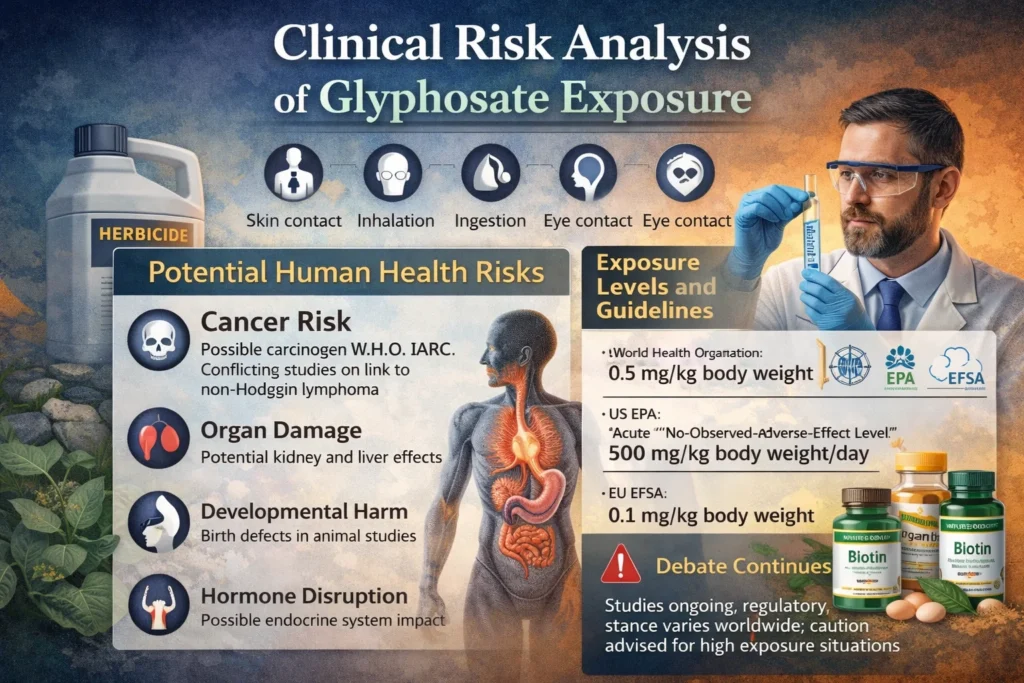
Glyphosate has been debated regarding cancer risk, but regulatory bodies differ:
WHO’s IARC: “Probably carcinogenic”
EPA: “Not likely carcinogenic when used properly”
👉 Use protective gear and follow label instructions strictly.
🌱 Does glyphosate kill all plants?
Yes — it is non-selective, meaning it kills:
Weeds
Grass
Crops (if exposed)
👉 Use carefully to avoid damaging desired plants.
⏳ How long does glyphosate take to work?
Visible effects: 3–7 days
Full kill: 1–2 weeks
🌧️ Does rain affect glyphosate?
Yes. Most products require:
Rain-free period: 4–6 hours minimum
🧬 Does glyphosate stay in soil?
Binds tightly to soil particles
Breaks down within weeks to months
Minimal residual activity
🌾 Can glyphosate be used before planting?
Yes — commonly used for:
Pre-plant weed control
Field clearing
🧠 What are common mistakes when using glyphosate?
Using incorrect dilution
Spraying during rain
Not adding surfactant (if required)
Cutting weeds too soon after spraying
💰 Is glyphosate cost-effective?
Yes — especially concentrates:
One bottle can make 10–50 liters of solution
📦 Glyphosate weed killer on Amazon — what to look for?
Concentration (e.g., 41% SL)
Reviews and ratings
Packaging size
Brand reliability
🧾 Final takeaway
Glyphosate remains one of the most effective and widely used herbicides worldwide, but:
Proper dilution is critical
Safety precautions are essential
Brand differences mainly affect formulation, not core chemistry
🧾 Bottom Line
- Argentina: heavy user
- No universal ban: only partial bans/restrictions globally
- Highest total use: United States
- Your 2017 data: accurate for per-hectare usage, not total consumption