
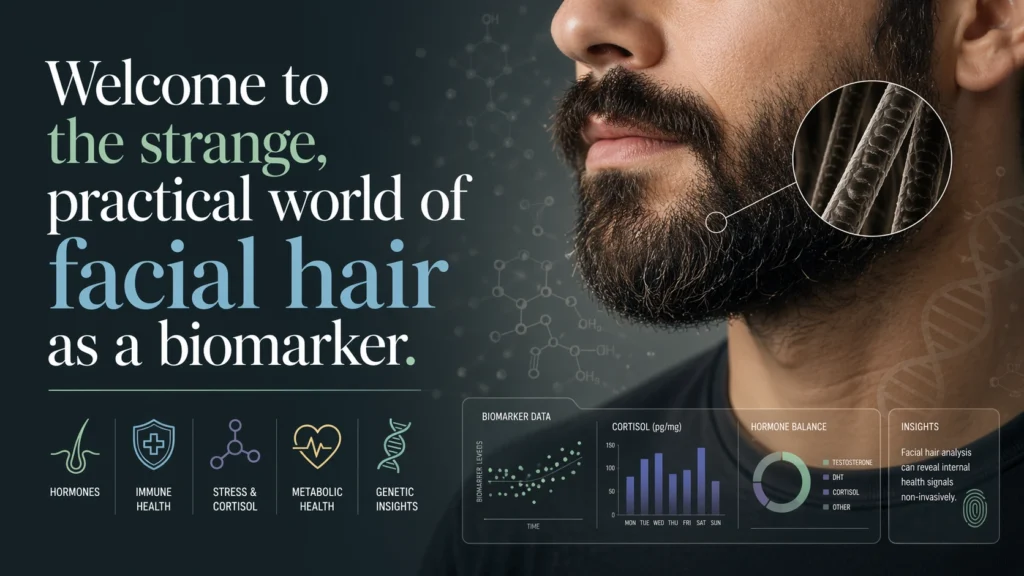

Let’s be honest: most men grow a beard for one of three reasons. They want to look tougher, they want to hide a weak chin, or they’re just too lazy to shave.Welcome to the strange, practical world of facial hair as a biomarker.
But what if I told you that the hair sprouting from your jawline is essentially a biological USB drive? A slow-growing, publicly visible data logger that has been recording your stress levels, diet, and hormonal health for months.
Welcome to the strange, practical world of facial hair as a biomarker.
For decades, doctors have used blood tests and urine samples to measure what’s going on inside you. Those tests are like a snapshot—they show you what happened in the last 24 hours. Your beard? That’s a feature-length documentary.
Here is how to read what your beard is telling you—and why you might want to stop trimming long enough to listen.
The Cortisol Time Capsule (Stress)
Here is the most practical takeaway: Your beard stores stress.
When you experience a tough week—a work deadline, a fight with a partner, a sleepless night parenting—your body releases cortisol. As your facial hair grows, it absorbs circulating hormones and locks them into the keratin structure.
Unlike a blood test, which resets every morning, a one-inch beard contains a three-month historical record of your average cortisol levels.
Scientists at the University of Southern Queensland have proven this. They shaved men’s beards, measured cortisol in the hair shafts, and could accurately predict who was working night shifts or dealing with chronic anxiety months prior.
Practical advice: If you feel “burnt out” but your bloodwork looks normal, ask a functional medicine doctor about a hair cortisol test. It won’t require a needle—just a few snips from your chin.
The Androgen Mirror (Testosterone and Metabolism)
Here is where it gets interesting for the gym-goers and the tired dads.
Facial hair is a direct byproduct of dihydrotestosterone (DHT), a derivative of testosterone. If your beard suddenly thins, grows patchy, or slows its growth rate by more than 40%, it is not a “genetic quirk.” It is a potential red flag for:
- Late-onset hypogonadism (dropping testosterone)
- Thyroid dysfunction (hypothyroidism notoriously thins terminal hair)
- Nutritional deficiency (specifically iron, zinc, or biotin)
Conversely, a beard that suddenly becomes coarser or darker in your 30s might indicate rising DHT—which, ironically, is also linked to male pattern baldness on the head. You can’t win them all.
Practical advice: Take a photo of your beard every three months under the same lighting. If you see significant shedding without changing your grooming routine, add a thyroid panel and ferritin test to your next blood work.
Heavy Metals and Environmental Toxins
This is the part that will make you paranoid—but it might save your life.
Facial hair absorbs environmental pollutants just like it absorbs hormones. Arsenic, lead, mercury, and cadmium all bind to the sulfur atoms in keratin.
Multiple forensic toxicology studies have shown that bearded men living in urban areas have significantly higher levels of airborne lead in their beards than clean-shaven men. Your beard is literally an air filter. The scary part? It doesn’t just trap the particles on the surface—it absorbs them into the root over time.
Practical advice: If you work in manufacturing, welding, near heavy traffic, or in older buildings with lead paint, do not grow a long beard unless you wash it twice daily with a chelating shampoo. Otherwise, you are sleeping with a toxin sponge inches from your mouth.
The “Patchy” Diagnosis (Alopecia Areata vs. Normal)
Let’s clear up a common panic attack.
If you suddenly lose a coin-sized, perfectly round patch of beard hair, do not assume it’s just stress. That pattern—known as ophiasis when it’s on the jaw—is a classic sign of alopecia areata, an autoimmune condition where your white blood cells attack your own hair follicles.
This is a genuine biomarker for immune dysfunction. People with alopecia areata have a higher lifetime risk of developing thyroiditis, vitiligo, or rheumatoid arthritis.
Practical advice: One bald patch? Monitor it. Two or more, or if it grows over three months? See a dermatologist. Don’t just cover it with a longer beard. That’s like putting tape over a check-engine light.
How to Turn Your Beard Into a Health Diary (3 Simple Steps)
You don’t need a lab coat. You just need to stop ignoring what’s on your face.
- Track the growth rate. Shave on day one. Measure the length on day 30. Average growth is 0.3 to 0.5 mm per day. If you are below 0.2 mm, get your thyroid checked.
- Monitor the texture. Soft and wispy = possibly low DHT. Coarse and wiry = normal or high androgens. Sudden brittleness and split ends = biotin or B-vitamin deficiency.
- Watch for pigment changes. A stripe of white hair in a young beard is rarely aging. It can indicate localized vitiligo or, in rare cases, a nerve compression issue (Hutchinson’s sign).
The Bottom Line
Your beard is not just a fashion statement. It is a low-cost, non-invasive, continuous monitoring device that you have been shaving into the sink every morning.
The medical community is slowly waking up to the value of facial hair as a biomarker. In the next decade, expect to see “beard cortisol tests” as routine as cholesterol checks. Until then, you have two choices: ignore the data, or start paying attention to what your own face is telling you.
And if you see a guy with a perfectly groomed, healthy, thick beard? He’s not just lucky. He probably has excellent hormone levels, low chronic stress, and no heavy metal poisoning.
Go ahead. Ask him for his bloodwork. He might just show you his shaving mirror instead.