
What You’ve Been Told (And Why It’s Wrong)
If you have PCOS, you’ve probably heard something like this:
“Your ovaries aren’t working right.”
“You have too many cysts on your ovaries.”
“It’s a reproductive problem.”
So you focus on your ovaries. You try supplements for “female hormones.” You go to gynecologists. You track your cycles.
And yet… nothing changes.
That’s because your ovaries are not the real problem. They are just the messenger.
The real cause of PCOS lives somewhere else entirely. It lives in your blood. And its name is insulin.
In this article, I will explain—in plain, simple language—what insulin is, how it secretly controls your PCOS symptoms, and what you can do today to finally feel better. No complicated science. No shame. Just the truth.
Part 1: Meet Insulin – Your Body’s Traffic Cop
Imagine your body is a busy city. The roads are your blood vessels. The cars are sugar (glucose) from the food you eat.
Every time you eat—especially carbohydrates like bread, rice, pasta, fruit, or sweets—sugar enters your bloodstream. That sugar needs to get out of your blood and into your cells to be used as energy.
Enter insulin.
Insulin is a hormone made by your pancreas (an organ near your stomach). Think of insulin as a traffic cop. It knocks on the doors of your cells and says:
“Open up! Sugar delivery is here.”
In a healthy body, this works smoothly. Insulin shows up, cells open, sugar enters, blood sugar returns to normal. Everyone is happy.
But in a body with PCOS, something is broken.
Part 2: Insulin Resistance – When the Traffic Cop Gets Ignored
In about 75 out of 100 women with PCOS, the cells stop listening to insulin. They become rude. They ignore the knocks. This is called insulin resistance.
Let’s stick with our traffic cop analogy.
The traffic cop (insulin) knocks. No answer. Knocks harder. Still no answer. Finally, the cop starts screaming and pounding on the door.
Your pancreas says: “Fine! I’ll send MORE insulin!”
So now your body is flooded with too much insulin. The sugar eventually gets inside the cells, but only after a massive, exhausting fight.
Here’s what high insulin does to a body with PCOS:
| What High Insulin Does | Result |
|---|---|
| Tells your ovaries to make extra testosterone | Acne, facial hair, hair loss on scalp |
| Blocks your liver from making SHBG (a protein that mops up excess testosterone) | Even more free testosterone floating around |
| Causes your body to store fat (especially belly fat) | Weight gain that feels impossible to lose |
| Triggers inflammation | Fatigue, brain fog, joint pain |
| Prevents ovulation | Irregular or missing periods, infertility |
Do you see it? Almost every single PCOS symptom—from acne to missed periods to belly fat—starts with too much insulin, not with your ovaries.
Your ovaries are just following orders. Bad orders.
Part 3: The Cyst Confusion – Why “Polycystic” Is a Misleading Name
Let’s talk about those cysts. The name Polycystic Ovary Syndrome makes it sound like cysts are the main problem. They are not.
Here’s what actually happens:
High insulin → ovaries make extra testosterone → testosterone prevents eggs from maturing and being released (ovulation) → those immature eggs pile up as tiny follicles (often mistaken for cysts) → an ultrasound shows “polycystic ovaries.”
The cysts are a symptom, not the cause. They are the smoke, not the fire.
Many women with PCOS don’t even have cysts on their ovaries. And some women without PCOS do have cysts. That’s why doctors now say the name is confusing and unhelpful.
The real name should be: Insulin Resistance Syndrome of the Ovaries. But that’s a mouthful. So we’re stuck with PCOS for now.
Part 4: How Do You Know If Insulin Is Your Problem?
You don’t need to guess. Here are common signs that insulin resistance is driving your PCOS:
- You gain weight easily, especially around your belly
- You crave carbs and sugar constantly (especially after meals)
- You feel tired or “hangry” if you go too long without eating
- You have dark, velvety patches on your neck, armpits, or knuckles (called acanthosis nigricans)
- You have skin tags
- You feel sleepy after eating a meal (especially lunch)
- Your period is irregular or missing
You can also ask your doctor for specific blood tests:
| Test | What It Measures | PCOS-Friendly Target |
|---|---|---|
| Fasting insulin | Insulin level after not eating for 8-12 hours | Less than 8 μIU/mL (many labs say “normal” up to 25, but that’s too high for PCOS) |
| HOMA-IR | A calculation using fasting glucose and fasting insulin | Less than 2.0 |
| Glucose tolerance test with insulin | Measures how insulin responds to a sugar drink | Insulin should not spike dramatically |
Important: Many doctors only check blood sugar (glucose) and say it’s “normal.” But in early insulin resistance, blood sugar can be normal while insulin is already through the roof. You must ask for insulin to be tested.
Part 5: The Good News – Insulin Is Reversible
Here is the most important sentence you will read today:
Insulin resistance is not permanent. You can reverse it.
You don’t need expensive medications (though some help). You don’t need extreme diets. You don’t need to punish yourself.
You just need to stop feeding insulin the foods it loves most: sugar and excess carbohydrates.
Think of it this way. High insulin is like a fire. Every time you eat sugar or too many carbs, you throw gasoline on that fire. When you stop throwing gasoline, the fire dies down.
Let’s talk about exactly how to do that.
Part 6: How to Lower Insulin Naturally (Without Starving Yourself)
1. Change What You Eat First
You don’t need to eat less. You need to eat differently.
| Instead of This (High Insulin) | Try This (Lower Insulin) |
|---|---|
| Sugary cereal, oatmeal, granola, smoothies | Eggs, vegetables, avocado, leftover dinner |
| Sandwiches, wraps, pasta, rice bowls | Protein + vegetables + healthy fat (salad with chicken and olive oil) |
| Fruit juice, soda, sweet coffee drinks | Water, unsweetened tea, black coffee |
| Chips, crackers, pretzels, granola bars | Nuts, cheese, hard-boiled eggs, olives, raw veggies with hummus |
| Dessert after every meal | Dessert once a week (or zero-sugar options like berries with whipped cream) |
The simple rule: Every meal should have protein + fat + vegetables. If you add carbs (like rice or bread), keep them small—about the size of your fist.
2. Change the Order You Eat
This sounds strange, but it works like magic.
New rule: Vegetables first. Then protein and fat. Then carbs last.
Why? Vegetables have fiber. Fiber creates a net in your stomach that catches sugar and slows its release into your blood. This means less insulin is needed.
One study found that eating in this order lowers blood sugar spikes by up to 40%—without changing a single ingredient.
3. Change When You Eat (Time-Restricted Eating)
Your insulin needs a break. Every time you eat—even healthy food—insulin goes to work. If you eat from 7 AM to 10 PM, your insulin works for 15 hours straight. It gets exhausted.
Try eating within a 10-hour window (for example, 9 AM to 7 PM). For the other 14 hours, drink only water, tea, or black coffee.
This gives your insulin time to rest and become sensitive again.
4. Move Your Body (But Not Too Much)
You don’t need to run marathons. You need two types of movement:
| Type | Example | Why It Helps |
|---|---|---|
| Walking after meals | 10-15 minute walk after breakfast, lunch, and dinner | Lowers blood sugar immediately |
| Strength training | Squats, lunges, push-ups, resistance bands | Builds muscle, and muscle eats sugar without needing much insulin |
Walking for 10 minutes after a meal can lower your glucose spike by up to 30%. That is more powerful than many medications.
5. Sleep and Stress (The Forgotten Pieces)
When you don’t sleep enough, your body releases cortisol (stress hormone). Cortisol makes insulin resistance worse. When you are stressed all the time, the same thing happens.
Simple fixes:
- Aim for 7-8 hours of sleep (same bedtime every night)
- Take 5 minutes of deep breathing before meals to lower stress hormones
- Go outside in the morning (natural light helps regulate hormones)
Part 7: What About Medication?
Some women need extra help lowering insulin. That is not failure. That is smart medicine.
Metformin is a medication that helps your body respond better to insulin. It has been used safely for decades. Many women with PCOS find it reduces cravings, helps with weight loss, and brings back their periods.
Myo-inositol is a supplement that works like a mild version of metformin. It is a type of vitamin-like substance that helps insulin signal your cells. Many studies show it improves ovulation and reduces testosterone.
Talk to your doctor about both options. But remember: medication works best with diet and lifestyle changes, not instead of them.
Part 8: Real-Life Stories – What Happens When You Lower Insulin
Sarah’s Story (Age 34)
Sarah had PCOS for 12 years. She tried everything: herbal supplements, acupuncture, birth control pills, expensive creams for her acne. Nothing helped.
Then she learned about insulin. She stopped eating cereal for breakfast and started eating eggs. She replaced her afternoon soda with water. She walked for 10 minutes after dinner.
Within 3 months:
- Her acne cleared by 80%
- She got her first natural period in 2 years
- She lost 14 pounds without counting calories
- Her sugar cravings disappeared
She said: “I spent 12 years blaming my ovaries. They were innocent the whole time.”
Priya’s Story (Age 27)
Priya had been told she might never have children. Her cycles came every 60-90 days. Her doctor put her on metformin and explained insulin resistance.
She started eating protein at every meal and cut out fruit juice and lattes. She did squats at home three times a week.
After 5 months, her cycles became regular (every 32 days). She became pregnant naturally 2 months later.
Part 9: Common Questions (Answered Simply)
Q: Does this mean I can never eat bread or rice again?
A: No. It means you eat them occasionally and in small portions. Think of them as a “sometimes” food, not a daily staple. And always eat them with protein, fat, and vegetables.
Q: What about fruit? Is fruit bad?
A: Whole fruit is fine in small amounts (one serving per day). Berries are best. Avoid fruit juice and dried fruit—they are sugar bombs.
Q: How long until I see changes?
A: Many women notice fewer cravings and better energy within 3-7 days. Period changes and weight loss usually take 4-12 weeks. Be patient and consistent.
Q: I am thin. Can I still have insulin resistance?
A: Yes. About 20-30% of women with PCOS are lean. You can have insulin resistance at any weight. It is about what is happening inside your cells, not on the scale.
Q: Do I have to give up all carbs forever?
A: No. Once your insulin improves (usually after 3-6 months of consistent changes), you can add back small amounts of healthy carbs like sweet potatoes, beans, and quinoa. But you will always need to be mindful.
Part 10: Your 7-Day Start-Up Plan
You don’t have to change everything at once. Start here:
| Day | One Small Change |
|---|---|
| 1 | Replace breakfast with eggs + vegetables (or a protein shake) |
| 2 | Walk 10 minutes after dinner |
| 3 | Replace one sugary drink (juice, soda, latte) with water |
| 4 | Add protein to lunch (chicken, fish, tofu, or beans + cheese) |
| 5 | Stop eating 3 hours before bed |
| 6 | Do squats or lunges for 5 minutes (anytime) |
| 7 | Eat vegetables first at your largest meal |
By day 7, you will already feel a difference.
Final Takeaway: You Are Not Broken
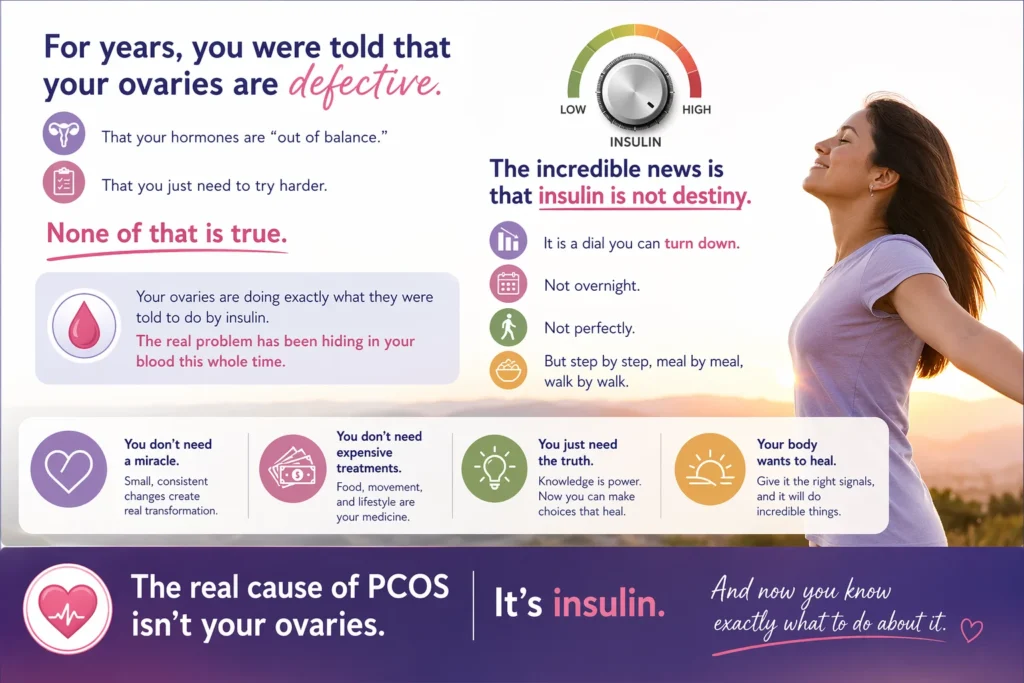
For years, you were told that your ovaries are defective. That your hormones are “out of balance.” That you just need to try harder.
None of that is true.
Your ovaries are doing exactly what they were told to do by insulin. The real problem has been hiding in your blood this whole time.
The incredible news is that insulin is not destiny. It is a dial you can turn down. Not overnight. Not perfectly. But step by step, meal by meal, walk by walk.
You don’t need a miracle. You don’t need expensive treatments. You just need the truth.
The real cause of PCOS isn’t your ovaries. It’s insulin.
And now you know exactly what to do about it.
Summary: Key Points to Remember
| Old Belief | New Truth |
|---|---|
| PCOS is a problem with my ovaries | PCOS is a problem with insulin |
| I have too many cysts | Cysts are a symptom, not the cause |
| I need to balance my female hormones | I need to lower my insulin first — hormones will follow |
| I must eat less and exercise more | I must eat differently (protein + fat + vegetables first) |
| PCOS is permanent | Insulin resistance is reversible |
| I am broken | I am not broken. My advice was wrong. |
This article is for informational purposes and does not replace medical advice. Consult your healthcare provider before making significant changes to your diet, exercise, or medication.