
I Ate ‘Clean’ for My PCOS and Got Worse. Here Are 8 ‘Healthy’ Foods Secretly Fueling Your Symptoms — Starting With Your Morning Smoothie.You followed the rules.
You swapped sugary cereal for granola. Replaced soda with fruit smoothies. Chose brown rice over white. Said yes to salads and no to dessert.
You did everything the wellness world told you to do. You ate “clean.” You were virtuous.
And yet… your PCOS symptoms got worse.
🚨 8 “Healthy” Foods That Betray Your PCOS
⚠️ The diet mistakes that keep your symptoms alive — swipe to see each culprit
More acne. More bloating. More fatigue. Hair thinning instead of thickening. Cycles even more unpredictable. The scale creeping up despite your best efforts.
You are not alone. And you are not failing.
The dirty secret of the nutrition industry is this: “Healthy” for the general population is not the same as “healthy” for PCOS. Many foods marketed as virtuous — smoothies, oatmeal, whole grains, dried fruit, veggie chips, and even some salads — can spike your insulin, fuel inflammation, and worsen hormonal chaos.
In this article, you will discover 8 so-called “healthy” foods that may be betraying your PCOS body — starting with the #1 culprit most women consume every single morning. More importantly, you will learn exactly what to swap in (without feeling deprived).
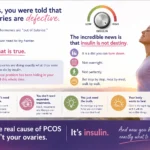
Because your PCOS isn’t broken.
Your diet advice was.
Let’s fix it.
Why PCOS Changes Everything You Know About “Healthy Eating”
Before we name names, you need to understand why standard healthy advice backfires in PCOS.
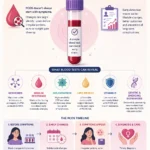
Polycystic Ovary Syndrome is not just a reproductive disorder. At its core, it is a metabolic condition characterized by:
| Feature | What It Means |
|---|---|
| Insulin resistance | Your cells ignore insulin, so your body pumps out more — which triggers your ovaries to make excess testosterone |
| Chronic inflammation | Low-grade, silent inflammation worsens every PCOS symptom from acne to brain fog |
| Low SHBG | Sex Hormone-Binding Globulin (SHBG) mops up excess testosterone. Insulin suppresses SHBG, leaving free testosterone to cause chaos |
Because of these factors, foods that are perfectly fine for someone without PCOS can become metabolic landmines for you.
Now, let’s meet the 8 imposters.
Mistake #1: The Morning Fruit Smoothie (The #1 Culprit)
Why it seems healthy: Fruits are packed with vitamins, antioxidants, and fiber. Blending them feels fresh, vibrant, and nourishing.
Why it backfires in PCOS: A typical homemade smoothie contains 3-4 servings of fruit in one cup. Without enough protein, fat, or chewing (yes, chewing matters for satiety signals), that natural sugar hits your bloodstream like a freight train.
The PCOS problem: Fructose (fruit sugar) is metabolized almost entirely by your liver. A large fructose load worsens fatty liver, insulin resistance, and inflammation — all of which make PCOS symptoms scream.
Real-life example: A “healthy” smoothie with 1 banana, 1 cup mango, 1 cup pineapple, and 1/2 cup orange juice contains roughly 60-70 grams of sugar. That is more sugar than two glazed doughnuts.
The fix:
- Limit fruit to 1/2 cup per smoothie (berries are best — lowest glycemic)
- Add 20-30g protein (whey, plant powder, or Greek yogurt)
- Add healthy fat (1 tbsp almond butter, 1/4 avocado, or flaxseed)
- Add leafy greens (spinach or kale) to buffer sugar absorption
- Chew something alongside it — a hard-boiled egg or a handful of nuts
PCOS-friendly smoothie formula: 1 scoop protein powder + 1/2 cup frozen berries + 1 cup spinach + 1 tbsp almond butter + unsweetened almond milk.
Mistake #2: Granola and Oatmeal – Breakfast’s Sweet Trap
Why it seems healthy: Oats are whole grains. Granola has nuts and seeds. Both are fiber-rich and heart-healthy.
Why it backfires in PCOS: Most commercial granolas are sugar delivery systems — honey, maple syrup, cane sugar, dried fruit, and chocolate chips. Even “low sugar” varieties often contain 10-15g sugar per tiny serving. Oatmeal, while less sugary, is still a carbohydrate-dense meal that, without protein, spikes blood sugar.
The PCOS problem: Your first meal of the day sets your metabolic tone. A high-carb breakfast raises glucose and insulin, which then stay elevated and volatile for the rest of the day. This primes you for cravings, fatigue, and hormonal disruption.
The fix:
- Savory breakfast is the PCOS superpower: eggs + vegetables + avocado
- If you must have oatmeal, use steel-cut oats (lowest glycemic), limit to 1/2 cup cooked, and stir in a scoop of protein powder
- Make low-carb granola at home: nuts + seeds + coconut flakes + egg white + stevia or monk fruit → bake until crispy
Test yourself: Check your blood sugar 1-2 hours after breakfast. If it rises more than 30 mg/dL from baseline, that breakfast is not PCOS-friendly.
Mistake #3: Brown Rice, Quinoa, and Whole Wheat – “Better” Is Not “Good Enough”
Why it seems healthy: Whole grains are less processed than white flour. They have more fiber, vitamins, and minerals.
Why it backfires in PCOS: For an insulin-resistant body, every carbohydrate requires more insulin than it should. Even complex carbs can overwhelm your metabolic capacity, especially in large portions or when eaten alone.
The PCOS problem: Insulin resistance means your cells are partially deaf to insulin’s knock. Your pancreas has to shout louder and longer to get glucose into cells. Each grain-heavy meal forces your body into this exhausting hormonal fight.
The fix:
- Treat grains as a side dish (1/2 cup cooked maximum), not the main event
- Prioritize non-starchy vegetables as your primary carb source (broccoli, zucchini, cauliflower, asparagus, leafy greens)
- On days you eat grains, pair them with double the protein and fat
Better plate for PCOS: 50% non-starchy vegetables + 25% lean protein + 25% healthy fats + (optional) 1/2 cup grains or starchy vegetables.
Mistake #4: Dried Fruit – Nature’s Candy, Literally
Why it seems healthy: “No sugar added” dried apricots, dates, mangoes, and raisins feel like a wholesome snack or salad topper.
Why it backfires in PCOS: Drying fruit removes water and concentrates sugar dramatically. One cup of grapes has 15g sugar. One cup of raisins has 85g+ sugar. Portion control evaporates because dried fruit is tiny, chewy, and hyper-palatable.
The PCOS problem: Dried fruit delivers a rapid, dense sugar load without the water and volume that signal fullness. Most women eat 3-4 “servings” without realizing it, triggering a massive insulin spike.
The fix:
- If you eat dried fruit, treat it as a condiment (a few chopped dates in a recipe), never a snack
- Choose fresh, whole fruit in limited portions (one small apple, a handful of berries)
- Snack on olives, nuts, seeds, cucumber slices, or bell pepper strips instead
The 3-bite rule: If you cannot stop at 3 bites of a food, do not start. Dried fruit fails this test for most PCOS women.
Mistake #5: Low-Fat Dairy – The Fat Was Never the Enemy
Why it seems healthy: Low-fat and non-fat dairy have fewer calories and less saturated fat. For decades, we were told fat is bad.
Why it backfires in PCOS: When fat is removed from yogurt, cottage cheese, or milk, the product often contains more sugar or artificial thickeners to improve taste and texture. Worse, fat is essential for PCOS — it slows carbohydrate absorption, supports hormone production, and reduces inflammation.
The PCOS problem: Low-fat dairy is higher in lactose (milk sugar) relative to protein and fat. This means a higher glucose and insulin response compared to full-fat versions.
The fix:
- Choose full-fat, plain Greek yogurt (no added sugar, no fruit-on-the-bottom)
- Use whole milk, unsweetened if you tolerate dairy
- Consider fermented dairy (kefir, skyr, labneh) which has probiotics that improve gut health and reduce systemic inflammation
- Test dairy-free for 2-3 weeks — some women with PCOS find dairy worsens acne and bloating regardless of fat content
Mistake #6: Agave, Honey, Coconut Sugar, and Maple Syrup – Natural ≠ Neutral
Why it seems healthy: These sweeteners are unrefined, minimally processed, and contain trace minerals or antioxidants.
Why it backfires in PCOS: Your body does not distinguish between “natural” sugar and white sugar. All carbohydrates break down into glucose and fructose in your bloodstream. In fact, agave nectar is higher in fructose (85-90%) than high-fructose corn syrup (55%) , making it even worse for insulin resistance and fatty liver.
The PCOS problem: Sugar is sugar. Whether it comes from a honeycomb or a candy bar, it still triggers insulin release. For insulin-resistant PCOS, all added sugars — regardless of source — are problematic.
The fix:
- Use zero-glycemic sweeteners: stevia, monk fruit, erythritol, or allulose
- Train your palate to enjoy less sweetness over 2-3 weeks (your taste buds adapt)
- Add cinnamon, vanilla extract, or unsweetened cocoa powder to foods for perceived sweetness without sugar
The hard truth: Honey on oatmeal is not better than sugar on oatmeal. Both spike insulin.
Mistake #7: Veggie Chips and Gluten-Free Snacks – The Health Halo Scam
Why it seems healthy: “Made with real vegetables!” “Gluten-free!” “Non-GMO!” The packaging screams virtue.
Why it backfires in PCOS: Read the ingredients. Most veggie chips are potato starch, corn starch, or rice flour with a sprinkle of vegetable powder for color and flavor. They are ultra-processed, high in refined carbohydrates, inflammatory seed oils (sunflower, safflower, canola), and salt. Gluten-free packaged goods are often worse — rice, tapioca, and potato starches are all high-glycemic ingredients.
The PCOS problem: These foods spike blood sugar and insulin just like regular potato chips or cookies. The “health halo” makes you feel justified eating three times as much.
The fix:
- Make kale chips at home: toss kale leaves with olive oil and salt, bake at 300°F for 15-20 minutes
- Make zucchini chips or radish chips the same way
- Snack on raw vegetables + guacamole or hummus
- Choose single-ingredient snacks: nuts, seeds, olives, hard-boiled eggs, beef jerky (no sugar added), cheese (if tolerated)
The label test: If a packaged food has more than 5 ingredients or any ingredient you cannot pronounce, it does not belong in a PCOS diet.
Mistake #8: Fruit Juice (Even Fresh-Pressed, Cold-Pressed, Organic) – Liquid Sugar
Why it seems healthy: Fresh juice is vibrant, “cleansing,” and packed with vitamins. It feels like self-care in a glass.
Why it backfires in PCOS: Juicing removes all the fiber that would normally slow sugar absorption. You are left with water, sugar, and a small amount of vitamins. An 8-ounce glass of orange juice contains 22g of sugar — the same as a can of Coca-Cola. Apple juice is even higher. Carrot juice is concentrated starch.
The PCOS problem: Liquid sugar is absorbed almost instantly through your stomach lining, causing a sharp glucose spike followed by a reactive insulin surge. This hormonal rollercoaster fuels acne, cravings, fatigue, and ovarian testosterone production.
The fix:
- Eat the whole fruit (with fiber intact) — and even then, limit to one small serving per day
- Drink water with lemon, cucumber, mint, or ginger for flavor without sugar
- If you absolutely crave juice, make it 90% green vegetables (celery, cucumber, spinach, kale, parsley) + 10% lemon or lime + a tiny slice of apple or ginger. Drink with a meal, not alone.
The question to ask: Would you drink a can of soda for breakfast? If not, do not drink fruit juice.
The PCOS-Friendly Plate: Your New Template
Instead of obsessing over what to remove, build every meal around this visual guide:
| Plate Section | Fill With | Examples |
|---|---|---|
| 50% | Non-starchy vegetables | Broccoli, spinach, zucchini, bell peppers, cauliflower, asparagus, arugula, kale, cabbage |
| 25% | Lean or plant protein | Chicken, turkey, fish, eggs, tofu, tempeh, edamame, pea protein, bone broth |
| 25% | Healthy fats | Avocado, olive oil, coconut oil, nuts, seeds, grass-fed butter, ghee, fatty fish (salmon, sardines, mackerel) |
| Optional (½ cup) | Low-glycemic carbs | Berries, cooked quinoa, sweet potato, lentils, black beans, chickpeas (if tolerated) |
The order of eating matters too: Vegetables first, then protein and fat, then carbs last. This sequence alone can reduce your glucose spike by up to 40%.
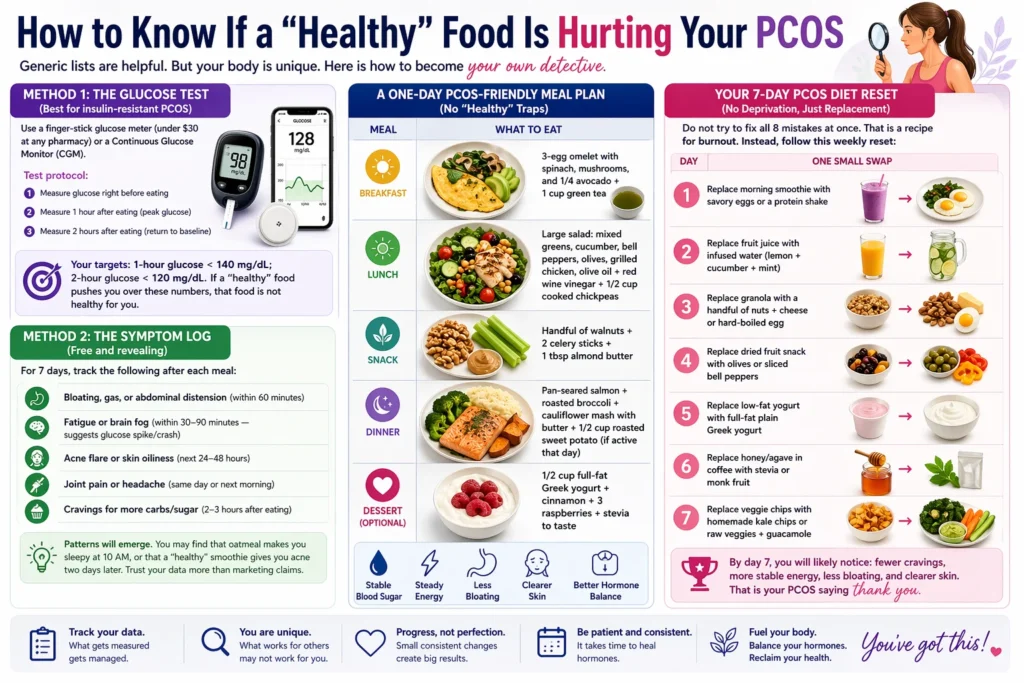
How to Know If a “Healthy” Food Is Hurting Your PCOS
Generic lists are helpful. But your body is unique. Here is how to become your own detective.
Method 1: The Glucose Test (Best for insulin-resistant PCOS)
Use a finger-stick glucose meter (under $30 at any pharmacy) or a Continuous Glucose Monitor (CGM) .
Test protocol:
- Measure glucose right before eating
- Measure 1 hour after eating (peak glucose)
- Measure 2 hours after eating (return to baseline)
Your targets: 1-hour glucose < 140 mg/dL; 2-hour glucose < 120 mg/dL. If a “healthy” food pushes you over these numbers, that food is not healthy for you.
Method 2: The Symptom Log (Free and revealing)
For 7 days, track the following after each meal:
- Bloating, gas, or abdominal distension (within 60 minutes)
- Fatigue or brain fog (within 30-90 minutes — suggests glucose spike/crash)
- Acne flare or skin oiliness (next 24-48 hours)
- Joint pain or headache (same day or next morning)
- Cravings for more carbs/sugar (2-3 hours after eating)
Patterns will emerge. You may find that oatmeal makes you sleepy at 10 AM, or that a “healthy” smoothie gives you acne two days later. Trust your data more than marketing claims.
A One-Day PCOS-Friendly Meal Plan (No “Healthy” Traps)
| Meal | What to Eat |
|---|---|
| Breakfast | 3-egg omelet with spinach, mushrooms, and 1/4 avocado + 1 cup green tea |
| Lunch | Large salad: mixed greens, cucumber, bell peppers, olives, grilled chicken, olive oil + red wine vinegar + 1/2 cup cooked chickpeas |
| Snack | Handful of walnuts + 2 celery sticks + 1 tbsp almond butter |
| Dinner | Pan-seared salmon + roasted broccoli + cauliflower mash with butter + 1/2 cup roasted sweet potato (if active that day) |
| Dessert (optional) | 1/2 cup full-fat Greek yogurt + cinnamon + 3 raspberries + stevia to taste |
Your 7-Day PCOS Diet Reset (No Deprivation, Just Replacement)
Do not try to fix all 8 mistakes at once. That is a recipe for burnout. Instead, follow this weekly reset:
| Day | One Small Swap |
|---|---|
| 1 | Replace morning smoothie with savory eggs or a protein shake |
| 2 | Replace fruit juice with infused water (lemon + cucumber + mint) |
| 3 | Replace granola with a handful of nuts + cheese or hard-boiled egg |
| 4 | Replace dried fruit snack with olives or sliced bell peppers |
| 5 | Replace low-fat yogurt with full-fat plain Greek yogurt |
| 6 | Replace honey/agave in coffee with stevia or monk fruit |
| 7 | Replace veggie chips with homemade kale chips or raw veggies + guacamole |
By day 7, you will likely notice: fewer cravings, more stable energy, less bloating, and clearer skin. That is your PCOS saying thank you.
The Emotional Truth: You Were Never the Problem
If you have been trying so hard to eat “healthy” and your PCOS has only gotten worse, please hear this:
You were not failing. You were following the wrong map.
The standard nutrition advice — eat more whole grains, drink smoothies, snack on granola, choose low-fat dairy — was not designed for women with insulin resistance and hormonal imbalance. It was designed for the general population. And you are not general. You are specific.
Now you have the right map.
The 8 foods above are not “bad” foods. They are just not your foods. And letting them go is not deprivation. It is liberation from a cycle of guilt, confusion, and worsening symptoms.
Your PCOS isn’t broken. Your “healthy” diet was.
Now let’s build one that actually works for you.
FAQS:
Q: Can I ever eat these foods again?
A: Yes — once your PCOS is well-managed (insulin sensitivity improved, cycles regular, symptoms minimal), you may tolerate small amounts occasionally. But for most women, these foods remain “sometimes” or “rarely” foods, not daily staples.
Q: What if I am vegetarian or vegan?
A: Focus on tofu, tempeh, edamame, lentils, chickpeas, and pea protein. Be mindful that beans and legumes are higher in carbs — keep portions to 1/2 cup and pair with fat and protein.
Q: Will I lose weight on this approach?
A: Many women do, but weight loss is not the primary goal. The primary goal is lowering insulin, which naturally reduces fat storage, cravings, and hormonal chaos. Weight loss often follows as a side effect.
Q: How long until I see improvement?
A: Many women notice better energy, fewer cravings, and less bloating within 3-7 days. Skin and cycle improvements typically take 4-8 weeks. Be patient and consistent.
Final Takeaway
The wellness industry sold you a lie: that “clean eating” is universal. It is not. For PCOS, many of those virtuous foods are quiet saboteurs — spiking your insulin, inflaming your tissues, and worsening your symptoms while you blame yourself.
No more.
You now know the 8 imposters. You know the swaps. You know how to test foods for your body.
Your PCOS is not a punishment. It is information. And now you are armed with the right information to finally feel better.
One last time: Your PCOS isn’t broken. Your “healthy” diet was.
Let’s eat differently. Starting today.
This article is for informational purposes and does not constitute medical advice. Always consult a healthcare provider or registered dietitian before making significant dietary changes, especially if you have PCOS or other medical conditions.