
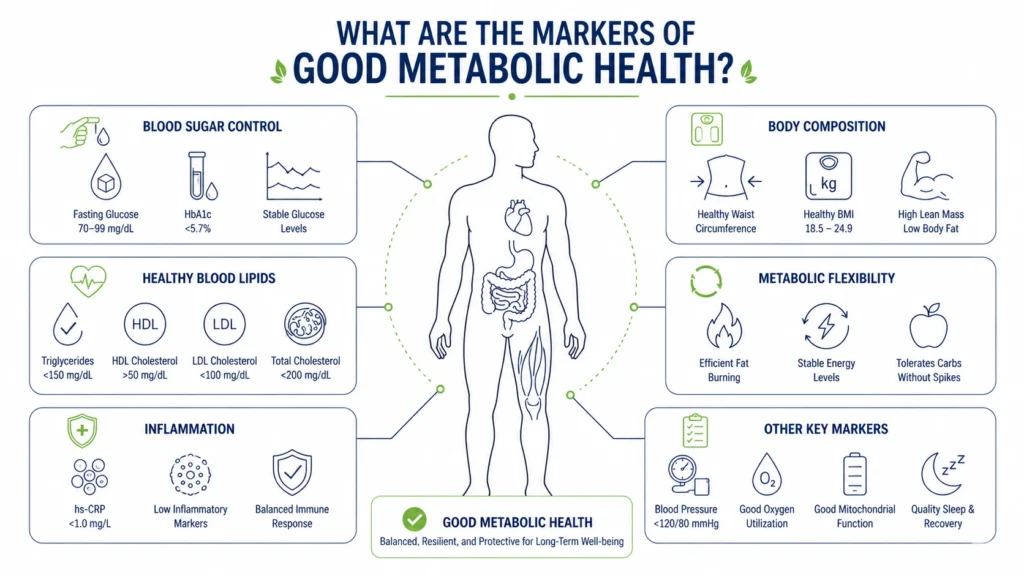

Good metabolic health goes far beyond the scale or how you feel. It’s measured by five key clinical markers: waist circumference, blood pressure, fasting blood glucose, triglycerides, and HDL cholesterol. Optimal levels mean your body efficiently processes energy, manages inflammation, and maintains hormonal balance. This article breaks down each marker, compares current standards with optimal targets, and provides actionable strategies to improve your metabolic health—because true wellness is about how your body functions, not just how it looks.
📑 Table of Contents
- 1. Introduction: Redefining Metabolic Health
- 2. What Are the Five Core Markers of Good Metabolic Health?
- 3. Comparative Study: Current Standards vs. Optimal Targets
- 4. Beyond the Big Five: Emerging Markers
- 5. The Mind-Metabolism Connection
- 6. Motivational Captions and Slogans
- 7. Semantic FAQs
- 8. Disclaimer
- 9. Disclosure
- 10. PS
1. Introduction: Redefining Metabolic Health
✨ “Health is not about the pounds you lose, but about the life you gain.”
For decades, we’ve been conditioned to measure health through a narrow lens: weight, BMI, and how we look in the mirror. But modern science tells us a different story. Metabolic health is the true foundation of vitality—it’s about how efficiently your body converts food into energy, regulates blood sugar, manages fat storage, and maintains internal balance.
The sobering reality? Only 12% of Americans are metabolically healthy according to a study published in Metabolic Syndrome and Related Disorders. That means nearly 9 out of 10 people have suboptimal metabolic function, often without knowing it. They may look healthy on the outside while their internal systems are quietly struggling.
💪 “Your metabolism is your life force—treat it like the treasure it is.”
But here’s the good news: metabolic health is dynamic and reversible. Unlike genetics or age, many metabolic markers can be improved through lifestyle choices. The first step is understanding what to measure. This article breaks down the key markers of good metabolic health, compares current standards with optimal targets, and gives you a roadmap to transform your internal environment.
2. What Are the Five Core Markers of Good Metabolic Health?
The scientific community has identified five key metrics that collectively define metabolic health. These are not arbitrary numbers—they are carefully chosen because they reflect how your body handles energy, inflammation, and cardiovascular risk.
1. Waist Circumference
📏 “Measure your waist, not your worth—but let it guide your health journey.”
Why it matters: Waist circumference is a direct measure of visceral fat—the dangerous fat that wraps around your internal organs. Unlike subcutaneous fat (the pinchable fat under your skin), visceral fat is metabolically active and releases inflammatory compounds that drive insulin resistance, heart disease, and type 2 diabetes.
Optimal targets:
- Men: Less than 40 inches (102 cm)
- Women: Less than 35 inches (88 cm)
The science: Even with a normal BMI, excess visceral fat significantly increases metabolic risk. Waist circumference is a better predictor of metabolic syndrome than BMI alone, which is why it’s the first marker on this list.
🔥 “Every inch you lose around your middle is a victory for your heart, your liver, and your future self.”
2. Blood Pressure
❤️ “Silent but deadly—know your numbers before they know you.”
Why it matters: Blood pressure is the force of blood against your artery walls. When it’s consistently elevated, it damages blood vessels, increases the workload on your heart, and is a major risk factor for heart attack, stroke, and kidney disease.
Optimal targets:
- Systolic (top number): Less than 120 mmHg
- Diastolic (bottom number): Less than 80 mmHg
The science: Blood pressure is closely tied to insulin resistance and inflammation. High blood pressure often accompanies other metabolic issues, creating a vicious cycle. Research shows that for every 20 mmHg increase in systolic pressure, the risk of cardiovascular mortality doubles.
🌊 “Let your blood pressure be a whisper, not a shout—calm inside, healthy outside.”
3. Fasting Blood Glucose
🍬 “Sugar is sweet, but stable blood sugar is sweeter.”
Why it matters: Fasting blood glucose measures how well your body manages sugar after an overnight fast. It reflects your baseline insulin sensitivity and is the first warning sign of prediabetes and type 2 diabetes.
Optimal targets:
- Normal: Less than 100 mg/dL (5.6 mmol/L)
- Prediabetes: 100–125 mg/dL
- Diabetes: 126 mg/dL or higher
The science: Chronically elevated fasting glucose indicates that your cells are becoming resistant to insulin. This leads to a cascade of issues: inflammation, fat storage, and increased cardiovascular risk. But note that truly optimal metabolic health aims for the lower end of the normal range—closer to 80–90 mg/dL.
⚡ “Stable sugar equals stable energy, stable mood, and a stable life.”
4. Triglycerides
🧈 “Fat in your blood is not your friend—show it the door.”
Why it matters: Triglycerides are the most common type of fat in your blood. They’re stored fat that your body uses for energy, but elevated levels indicate that your body is storing more fat than it can burn, often due to excess calories, sugar, or alcohol.
Optimal targets:
- Normal: Less than 150 mg/dL
- Borderline high: 150–199 mg/dL
- High: 200–499 mg/dL
The science: High triglycerides are strongly associated with insulin resistance and cardiovascular disease. They also contribute to metabolic syndrome, a cluster of conditions that include high blood pressure, high blood sugar, and abnormal cholesterol levels.
🏃 “Move more, eat clean—watch those triglycerides drop like a hot potato.”
5. HDL Cholesterol (The “Good” Cholesterol)
🛡️ “Be like HDL—sweep away the bad and protect your heart.”
Why it matters: High-density lipoprotein (HDL) cholesterol helps remove other forms of cholesterol from your bloodstream, transporting them to the liver where they’re processed and eliminated. Higher levels of HDL are protective against heart disease.
Optimal targets:
- Men: 40 mg/dL or higher
- Women: 50 mg/dL or higher
The science: HDL cholesterol acts as a scavenger, picking up excess LDL (“bad”) cholesterol and preventing it from building up in arteries. Low HDL is a strong predictor of cardiovascular risk and is often associated with insulin resistance and metabolic syndrome.
📈 “Raise your HDL—it’s the cholesterol that says ‘I’ve got your back.'”
3. Comparative Study: Current Standards vs. Optimal Targets
🎯 “Don’t settle for ‘normal’ when ‘optimal’ is within reach.”
One of the most important concepts in metabolic health is the distinction between clinically acceptable and biologically optimal. Many people have blood test results that fall within the “normal” range but are still at elevated risk. Here’s why:
The “Normal” Trap
The current medical standards are designed to catch disease, not to optimize health. They’re based on population averages, not on what’s ideal for longevity and vitality. For example:
- Fasting glucose of 99 mg/dL is considered “normal” by conventional standards, but research suggests that levels above 90 mg/dL already indicate increased insulin resistance.
- Blood pressure of 120/80 mmHg is at the upper end of optimal, yet many experts recommend aiming for 110/70 mmHg for optimal cardiovascular protection.
Comparative Table: Standard vs. Optimal
| Marker | Standard “Normal” | Optimal Target | Why Optimal Matters |
|---|---|---|---|
| Waist Circumference | M: <40″, F: <35″ | M: <37″, F: <32″ | Visceral fat is a driver of inflammation; lower is better. |
| Blood Pressure | <140/90 mmHg | <120/80 mmHg (ideally 110/70) | Even pre-hypertension increases cardiovascular risk. |
| Fasting Glucose | <100 mg/dL | <90 mg/dL | Insulin resistance begins well before 100 mg/dL. |
| Triglycerides | <150 mg/dL | <100 mg/dL | Lower triglycerides strongly correlate with metabolic fitness. |
| HDL Cholesterol | M: ≥40, F: ≥50 | M: ≥60, F: ≥60 | Higher HDL offers superior cardiovascular protection. |
The Clinical Significance of These Differences
A person with all markers at the “standard normal” level can still be metabolically unhealthy. Studies show that even subtle elevations in these markers multiply the risk of cardiovascular events and type 2 diabetes. In contrast, individuals at the optimal levels demonstrate significantly better long-term health outcomes.
🌟 “The difference between normal and optimal is the difference between surviving and thriving.”
The Triglyceride/HDL Ratio: A Super-Marker
One of the most powerful predictors of metabolic health is the triglyceride-to-HDL ratio. Research shows that this ratio is an excellent proxy for insulin resistance and cardiovascular risk.
- Optimal ratio: < 2.0
- High risk: > 3.0
This ratio is particularly useful because it captures the balance between fat storage (triglycerides) and fat clearance (HDL). When the ratio is elevated, it’s a clear sign that metabolic dysfunction is at play.
🔢 “Know your numbers, but more importantly, know your ratios—they tell the real story.”
4. Beyond the Big Five: Emerging Markers
⛏️ “The deeper you dig, the richer the insights.”
While the five core markers are essential, there are emerging biomarkers that provide additional clarity on metabolic health. These are especially useful for people with a family history of metabolic disease or those who want to optimize their health proactively.
Fasting Insulin and HOMA-IR
Why it matters: Fasting insulin measures how much insulin your pancreas produces to maintain glucose levels. Elevated insulin is often the earliest sign of metabolic dysfunction—occurring years before fasting glucose rises.
Optimal target:
- Fasting insulin: < 10 µIU/mL (ideally < 5 µIU/mL)
- HOMA-IR (insulin resistance score): < 1.0 (higher indicates resistance)
The science: Insulin resistance is the core defect in metabolic syndrome, type 2 diabetes, and many other conditions. Testing insulin directly gives you an early warning system. In fact, elevated insulin is linked to obesity, inflammation, and even certain cancers.
💉 “Lower your insulin, and you unlock your body’s natural power to heal, burn fat, and thrive.”
C-Reactive Protein (CRP)
Why it matters: High-sensitivity C-reactive protein (hs-CRP) is a marker of systemic inflammation. Chronic low-grade inflammation is both a cause and consequence of metabolic dysfunction.
Optimal target:
- hs-CRP: < 1.0 mg/L
The science: Elevated CRP is associated with insulin resistance, cardiovascular disease, and metabolic syndrome. It’s a powerful indicator that your body is under stress, often due to poor diet, lack of exercise, or excess fat.
🔥 “Fight inflammation daily—it’s the fire that fuels every chronic disease.”
Lipoprotein(a)
Why it matters: Lipoprotein(a) or Lp(a) is a type of LDL cholesterol that’s genetically determined and highly atherogenic. Elevated levels increase cardiovascular risk even when other markers are normal.
Optimal target:
- Lp(a): < 30 mg/dL
The science: Lp(a) promotes blood clot formation and accelerates atherosclerosis. Unlike LDL, which can be modified by diet, Lp(a) is largely genetic—but knowing your level helps you take preventive steps.
🧬 “Know your genetic hand, then play it wisely.”
5. The Mind-Metabolism Connection
🧠 “Your brain and your belly are in constant conversation—listen to both.”
Metabolic health isn’t just about what you eat—it’s about how you think, feel, and live. Emerging research highlights the powerful connection between mental health and metabolic function.
Stress and Metabolic Health
Chronic stress activates the HPA axis, releasing cortisol, which increases blood sugar, promotes fat storage (especially around the midsection), and drives inflammation. Over time, this creates metabolic havoc.
- Studies show that chronic stress is associated with a 20% increase in visceral fat.
- High cortisol is linked to insulin resistance, irrespective of diet.
Sleep and Metabolism
Sleep is when your body repairs, restores, and rebalances. Sleep deprivation disrupts leptin and ghrelin (hunger hormones), increases cortisol, and reduces insulin sensitivity by up to 30%.
- Optimal sleep: 7–9 hours per night
- Poor sleep: Linked to higher fasting glucose, lower HDL, and higher triglycerides
Emotional Regulation
Your emotional state influences eating behaviors, hormonal balance, and inflammation. Practices like mindfulness, gratitude, and stress-reduction techniques have measurable effects on metabolic markers, including reduced CRP and improved glucose control.
🌿 “Heal your mind, and your metabolism will follow.”
6. Motivational Captions and Slogans
✨ “Your body is your temple—treat it with the reverence it deserves.”
⏳ “The best time to start was yesterday. The next best time is now.”
📈 “Small daily improvements lead to stunning long-term results.”
🏃 “Metabolic health is not a destination—it’s a way of living.”
⚖️ “Don’t let the scale define you. Let the numbers that matter guide you.”
🥗 “Every meal is a chance to feed your health, not your disease.”
💪 “Strength doesn’t come from what you can do—it comes from overcoming what you thought you couldn’t.”
🔮 “Your future self will thank you for the choices you make today.”
🪞 “When you look in the mirror, see the potential—not the past.”
🧩 “Metabolic resilience is built one healthy habit at a time.”
7.FAQs
Metabolic health refers to how well your body processes energy, manages blood sugar, and maintains balanced hormone levels. It is defined by five core markers: waist circumference, blood pressure, fasting blood glucose, triglycerides, and HDL cholesterol. Achieving optimal levels means your body is functioning efficiently and is protected against chronic diseases.
Yes, it is possible to be metabolically healthy at a higher weight, though it’s less common. A person can be “metabolically healthy obese” (MHO) if they have normal blood pressure, glucose, and lipids despite excess weight. However, this is often a temporary state—many people with MHO eventually develop metabolic syndrome without intervention.
For most people, an annual health check is sufficient. However, if you have risk factors (family history, obesity, or a sedentary lifestyle), more frequent testing (every 6 months) can be helpful. Fasting insulin and HOMA-IR are particularly useful for early detection of insulin resistance.
While all markers matter, focusing on waist circumference and fasting glucose often yields the fastest improvements. Reducing visceral fat improves insulin sensitivity, which then positively impacts blood pressure, triglycerides, and HDL. It’s a domino effect—improve one, and others often follow.
Absolutely. Studies consistently show that diet (especially reducing sugar and refined carbs), regular exercise, stress management, and quality sleep can reverse prediabetes, reduce triglycerides, lower blood pressure, and raise HDL. The human body is remarkably adaptable and responds to positive changes quickly.
Research supports several evidence-based approaches. A Mediterranean-style diet, low-carbohydrate diets, and intermittent fasting have all been shown to improve metabolic markers. The most important factor is choosing a sustainable approach that reduces processed foods, added sugars, and promotes whole, nutrient-dense foods.
Genetics play a role, but they are not destiny. Many genetic variants affecting glucose and lipid metabolism can be mitigated by lifestyle choices. While some people have a higher baseline risk, epigenetics (how lifestyle influences gene expression) offers a powerful pathway for intervention. In other words, your habits can often override genetic predisposition.
Not exactly, but they are deeply interconnected. Poor metabolic health can lead to brain fog, mood swings, and fatigue, while chronic stress, anxiety, and depression can dysregulate metabolism. Taking care of both is essential for overall well-being, and improvements in one area often lead to benefits in the other.
8. Disclaimer
9. Disclosure
10. PS
🌱 PS
“Remember: Your metabolic health is the sum of your daily choices. Not a single perfect day, but the cumulative effect of thousands of small decisions. Choose wisely, move consistently, and always, always be kind to yourself—because the journey to better health is not a sprint, it’s a marathon. And you were built to run it.”
Start today. Your future self will be grateful. 💪
Markers of Good Metabolic Health · Your Guide to Thriving