
🌿 Postbiotics & Metabolic Resilience
Postbiotics are non-living bacterial byproducts that offer a stable, direct way to support metabolic health. They enhance insulin sensitivity, reduce inflammation, and improve lipid metabolism—key pillars of metabolic resilience. With advantages over probiotics (shelf-stable, no colonization needed), postbiotics are emerging as a promising next-generation tool, especially when used alongside prebiotics and probiotics.

📑 Table of Contents
1. Beyond Probiotics: What Are Postbiotics?
In the evolving landscape of metabolic health, a new player is generating considerable scientific interest: postbiotics. As researchers move beyond the traditional focus on probiotics, these non-living bacterial byproducts are emerging as a potentially powerful, stable, and targeted tool for enhancing metabolic resilience.
While the health benefits of a balanced gut microbiome are well-established, the shift toward postbiotics represents a significant paradigm change. This article explores the science behind this new frontier, examining whether postbiotics could indeed become the next essential tool in our metabolic health toolkit.
To understand the promise of postbiotics, it helps to use a simple analogy. Think of the gut microbiome as a busy restaurant kitchen:
- Probiotics are the chefs—live microorganisms that need to survive, establish themselves, and work to produce a healthy meal.
- Prebiotics are the ingredients—the fiber and nutrients that feed the chefs.
- Postbiotics are the finished meal—the bioactive compounds already prepared, packed with nutrients, and ready to deliver benefits immediately, without waiting for the chefs to cook or to be at their best.
Formally, postbiotics are defined as a “preparation of inanimate microorganisms and/or their components that confers a health benefit on the host”. They are not live bacteria. Instead, they are the bioactive metabolites—such as short-chain fatty acids (SCFAs), peptides, and cell-wall components—that microbes leave behind after fermentation or upon cell death.
This key difference gives postbiotics several distinct advantages over traditional probiotics. They are heat-stable, shelf-stable, and not reliant on colonization. This makes them a more practical and consistent tool, especially when the gut microbiome is disrupted by stress, a high-fat diet, or antibiotics.
2. The Science of Postbiotics and Metabolic Resilience
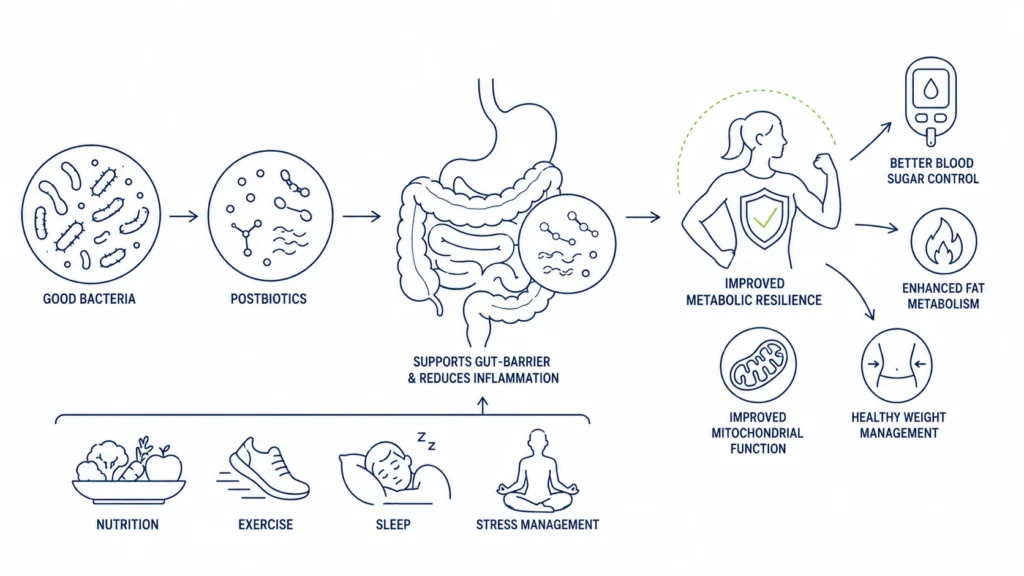
Metabolic resilience is the body’s ability to adapt to and recover from stressors like dietary changes, illness, and inflammation. The gut microbiome plays a central role in this process, and postbiotics appear to influence metabolic health through several key mechanisms.
Fueling the “Cellular Engine” and Improving Glucose Control
One of the most promising areas of research is postbiotics’ effect on glucose and energy metabolism. Short-chain fatty acids (SCFAs), like butyrate, are a major class of postbiotics. They act as a primary energy source for colon cells, helping to maintain a healthy gut barrier.
More importantly, SCFAs enhance insulin sensitivity in tissues and influence signaling pathways that regulate glucose uptake in the liver. This suggests that postbiotics can help maintain stable blood sugar levels and steady energy, which is crucial for avoiding the spikes and crashes that challenge metabolic resilience.
🧪 Research highlight: In a recent study, a heat-inactivated postbiotic outperformed its live probiotic counterpart in a high-fat diet mice model. The postbiotic group gained only 19.1% body weight over 15 weeks, compared to 46.7% in the control group. The postbiotic also maintained stable fasting blood glucose levels and increased colonic GLP-1, a key hormone for glucose homeostasis and satiety.
Modulating Inflammation and Immunity
Chronic, low-grade inflammation is a hallmark of metabolic dysfunction. Postbiotics appear to act as immune balancers, calming excessive inflammatory responses while maintaining the body’s ability to defend against threats.
Immunomodulatory mechanisms include:
- Reducing pro-inflammatory cytokines like TNF-α.
- Enhancing anti-inflammatory peptides and signaling molecules.
- Strengthening mucosal immunity by stimulating protective immune cells.
Furthermore, postbiotics like butyrate nourish gut epithelial cells, thereby maintaining the intestinal barrier and reducing “leaky gut”. This prevents harmful bacterial fragments like lipopolysaccharides (LPS) from entering the bloodstream and driving systemic inflammation, which is strongly linked to insulin resistance and other metabolic issues.
Influencing Lipid Metabolism and Weight Management
The gut also plays a significant role in how the body handles fats. Postbiotics influence enzymes that regulate fat storage in adipose tissue. Clinical trials are actively exploring the effect of postbiotics on weight management and metabolic health in individuals with a BMI between 25 and 32.
📊 Key finding: A randomized controlled trial on overweight and obese adults found that daily consumption of yogurt fortified with a postbiotic derived from Akkermansia muciniphila led to significant reductions in waist circumference, waist-to-height ratio, and body fat percentage compared to a control group. This suggests that specific postbiotic strains can offer favorable effects on weight management and body composition.
3. Postbiotics vs. Probiotics: A Direct Comparison
One of the central questions in the field is whether postbiotics offer a superior or complementary approach to probiotics.
A 2025 review in the journal Endocrine Reviews highlights the potential benefits of postbiotics. The authors note that while probiotics have limitations like the need for colonization and potential safety concerns (e.g., horizontal gene transfer), postbiotics avoid these issues. They are also easier to store, transport, and standardize.
This is supported by recent research comparing a heat-inactivated postbiotic to its live probiotic version. The study found that the postbiotic demonstrated distinct and arguably superior benefits in modulating gut microbiota composition. For instance, the postbiotic decreased the abundance of bacteria linked to obesity, a change not observed with the live probiotic.
However, the scientific consensus is not that postbiotics will replace probiotics, but rather that they may work together. Research on Lactiplantibacillus plantarum and its metabolite butyrate showed that the two elicit complementary microbial alterations. The postbiotic (butyrate) directly transforms the microbial structure towards an anti-inflammatory phenotype, while the probiotic influences the community via metabolic byproducts and niche adjustment. This points to the therapeutic potential of integrated probiotic–postbiotic approaches for enhancing gut health.
4. The Current and Future Landscape: Clinical Trials and Applications
The interest in postbiotics is not just theoretical. A growing number of clinical trials are investigating their potential.
| Area of Investigation | Clinical Trial Examples |
|---|---|
| Weight Management | Trials evaluating postbiotic supplements on weight, body composition, and metabolic health in overweight/obese individuals. |
| Type 2 Diabetes | Studies assessing the short-term efficacy and safety of postbiotics as an adjunct to standard anti-diabetic therapy. |
| Non-Alcoholic Fatty Liver Disease (NAFLD) | Research into the short-term efficacy and safety of postbiotics in patients with NAFLD. |
| Stress and Mood | Trials evaluating the effects of postbiotics on stress response, mood, sleep, and cognition. |
The results so far are promising. Studies have shown that postbiotics can lower triglycerides, cholesterol, and reduce lipid accumulation linked to obesity. They also show potential for improving liver function, as seen in the clinical trial with Akkermansia muciniphila postbiotic yogurt, which lowered AST levels, an indicator of liver health.
5. Conclusion
The science suggests that postbiotics could very well become a next-generation tool for improving metabolic resilience. Their unique properties—stability, specificity, and direct bioactivity—offer distinct advantages over traditional approaches.
While probiotics and prebiotics remain valuable, postbiotics represent a practical, scientifically robust way to support the gut-metabolic axis, improve insulin sensitivity, manage inflammation, and promote a healthy weight. As more human clinical trials are completed, we can expect to see postbiotics become an increasingly important part of the conversation about metabolic health and the future of personalized nutrition.
6. FAQs
Not necessarily. Current research suggests postbiotics may work with probiotics in a complementary fashion. Postbiotics offer a more direct, stable effect, while probiotics can help shape the broader microbial community. A combined approach may be most effective.
Postbiotics are heat-stable, do not require refrigeration, are not reliant on colonizing the gut, and eliminate the risk of horizontal gene transfer or pathogen expansion associated with live bacteria.
Postbiotics are found in fermented foods. Yogurt, kefir, and other fermented dairy products contain postbiotics. The recent clinical trial used a postbiotic-fortified yogurt. However, the specific strains and concentrations can vary widely.
Generally, postbiotics are considered safe. However, the scientific community notes that postbiotics can have “context-dependent effects,” meaning they can be both beneficial and detrimental depending on the specific compound and the host’s health status.
Postbiotic supplements and fortified foods are already available. As research continues to validate their efficacy in large-scale human trials, their presence in the market is expected to expand significantly.
7. Disclaimer
8. Disclosure
9. PS
🌱 PS
Think of your metabolic health as a garden. Probiotics are the seeds you plant, and prebiotics are the fertilizer. But postbiotics? They’re the fruit—ready to nourish you immediately, no waiting for the plant to grow. A resilient garden needs all three to thrive.
Postbiotics & Metabolic Resilience · The Science Behind a Healthier Future