
TL;DR
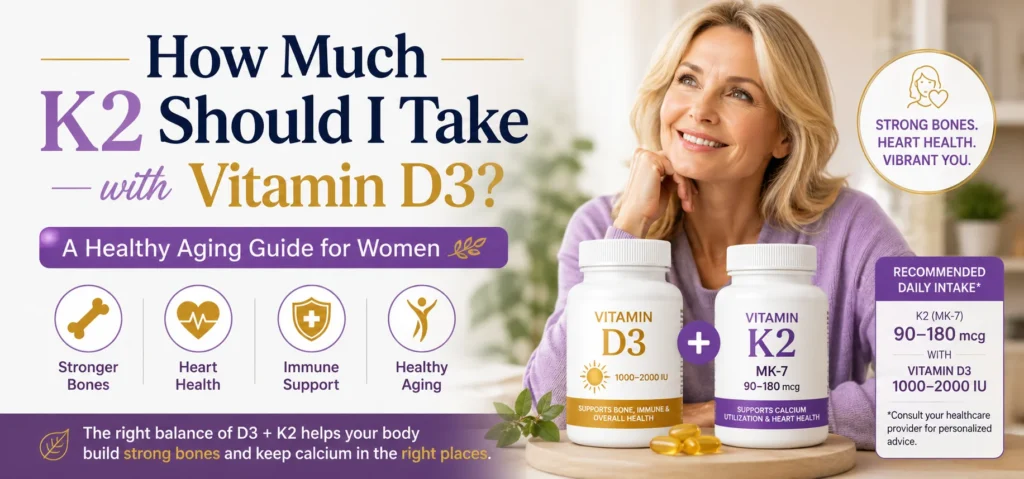
For most women, the recommended daily dose is 1,000 to 2,000 IU of vitamin D3 paired with 90 to 200 mcg of vitamin K2 (preferably as MK-7), taken with a meal that contains fat.
The “traffic controller” analogy explains the synergy: Vitamin D3 increases calcium absorption from your gut, while Vitamin K2 directs that calcium into your bones and away from your arteries. Without adequate K2, taking D3 alone may increase the risk of calcium depositing in soft tissues like blood vessel walls.
Vitamin D3 has a Tolerable Upper Intake Level of 4,000 IU per day, while Vitamin K2 has no established upper limit and is not known to be toxic. Most clinical studies use 90 to 200 mcg of MK-7 daily.
Always consult your healthcare provider before starting any new supplement regimen, especially if you take blood thinners like warfarin or have kidney disease.
Introduction: The Dynamic Duo of Healthy Aging
As women navigate their 40s, 50s, and beyond, hormonal changes—particularly declining estrogen levels—can silently impact bone density, cardiovascular health, and overall vitality. This is where the powerful combination of Vitamin D3 and Vitamin K2 comes into play.
These two vitamins are increasingly recognized as a nutritional essential for healthy aging. They don’t just work independently; they function synergistically to optimize how your body uses calcium—one of the most critical minerals for long-term health. Understanding how much K2 to take with Vitamin D3 is the first step toward protecting your bones and heart as you age.
🌟 “Your bones carried you through every chapter of your life. Now it’s time to carry them forward—with D3 for strength and K2 for direction.”
The Complete Guide: Vitamin D3 & K2 Synergy
When considering vitamin D3 and K2, many women ask, should you take vitamin D3 and K2 together? The answer lies in their remarkable synergy. Vitamin D3 with K2 works as a dynamic duo where vitamin D3 enhances calcium absorption from the gut, while vitamin K2 ensures proper calcium metabolism and vitamin K2 calcium transport directly into the bones, preventing arterial calcification. This vitamin D3 K2 combination offers profound vitamin D3 K2 benefits, including vitamin D3 for bone health and vitamin K2 for bone health, supporting bone mineralization, improving bone density, and aiding osteoporosis prevention—making vitamin D3 K2 for postmenopausal women and vitamin D3 K2 for women over 50 particularly crucial. Simultaneously, vitamin D3 cardiovascular health and vitamin K2 heart health work to protect arterial health. For those with vitamin D deficiency, a vitamin D3 K2 supplement helps achieve optimal vitamin D levels while also providing immune support and a healthy inflammatory response. Whether you are looking for the best vitamin D3 K2 supplement for yourself, vitamin D3 K2 for seniors, vitamin D3 K2 for men, or vitamin D3 K2 for immune health, understanding why take vitamin D3 with K2 is essential. While can you take vitamin D3 without K2 is possible, it is less effective and may leave calcium unguided. For optimal results, consider the proper vitamin D3 and K2 dosage and note that vitamin D3 K2 side effects are generally rare. Finally, knowing when to take vitamin D3 and K2—ideally with a fat-containing meal—maximizes absorption. This powerful vitamin D3 K2 for heart health and vitamin D3 K2 for calcium absorption duo truly makes vitamin D3 plus K2 the perfect partner to the sunshine vitamin, unlocking the full benefits of vitamin D3 and K2 for a vibrant, healthy life.
Why Vitamin D3 and K2 Work Better Together
Think of calcium as a baton in a relay race. Vitamin D3 is the first runner—it pulls calcium from your intestines into your bloodstream. But calcium in the blood needs direction. That’s where Vitamin K2 steps in as the second runner, guiding that calcium into your bones and teeth where it belongs.
Without enough K2, calcium can end up in places you don’t want it—your arteries, soft tissues, and kidneys. Over time, this can contribute to vascular stiffness and increase cardiovascular risk.
Vitamin K2 activates two critical proteins:
- Osteocalcin – binds calcium into your bone matrix, supporting bone mineral density
- Matrix Gla Protein (MGP) – the most potent inhibitor of vascular calcification, preventing calcium from depositing in arteries
A 2025 review in the Journal of Mid-life Health summarized it perfectly: “VD enhances calcium absorption; however, without adequate VK, this can lead to improper calcium utilization and ectopic calcification, particularly within arterial walls.”
💪 “Aging isn’t about slowing down—it’s about showing up for yourself with the nutrients that keep you moving, bending, and thriving.”
How Much Vitamin D3 Should You Take?
The recommended amount depends on which guidelines you follow:
| Guideline | Daily D3 Recommendation |
|---|---|
| NIH RDA (adults 1‑70) | 600 IU (15 mcg) |
| NIH RDA (over 70) | 800 IU (20 mcg) |
| Vitamin D Council | 2,000 IU |
| UK NHS | 800‑2,000 IU |
| Tolerable Upper Intake Level | 4,000 IU |
Many researchers argue the official RDA is too low for achieving optimal blood levels. For bone density, fall prevention, and overall health, the most favorable range appears to be 36‑40 ng/mL of serum 25(OH)D.
If you’re diagnosed with a deficiency, your doctor may prescribe a higher short-term dose—often 50,000 IU once weekly for 2‑3 months—before stepping down to a maintenance dose. A simple blood test measuring 25‑hydroxyvitamin D can tell you exactly where you stand.
❤️ “Strong bones. Healthy heart. Vibrant life. The D3 + K2 combination isn’t just science—it’s self‑care in action.”
How Much Vitamin K2 Should You Take with D3?
The short answer: 90 to 200 mcg of Vitamin K2 (MK-7) daily.
| K2 Daily Dose | Context |
|---|---|
| 90 mcg | Established as a beneficial daily dose |
| 90‑200 mcg | Range used in most clinical studies |
| 120 mcg | Common supplement amount |
| 180 mcg | Used in studies showing improved arterial elasticity |
| 720 mcg | High‑dose used in clinical research for severe coronary calcification |
Vitamin K2 has no established upper intake level because researchers haven’t found a dose that causes toxicity in healthy people. However, this does not apply if you take blood thinners like warfarin.
🌿 “Every woman over 40 deserves to know: your body isn’t failing you—it’s asking for the right support. Give it D3. Give it K2. Give it love.”
Vitamin K2: MK‑7 vs. MK‑4 – What’s the Difference?
You’ll see two forms of Vitamin K2 on supplement labels:
MK‑7 (Menaquinone‑7)
- Stays active in the body much longer
- Just 45‑90 mcg per day is enough to activate osteocalcin
- Most common and practical form for daily supplementation
- Found in fermented foods like natto
MK‑4 (Menaquinone‑4)
- Clears the body faster, requiring much higher doses
- 500 mcg per day had no measurable effect; 1,500 mcg per day did
- Some therapeutic protocols use 15,000 mcg (15 mg) or more under medical supervision
For most women taking a daily supplement, MK‑7 in the 90‑200 mcg range is the practical choice.
✨ “The best investment you’ll ever make is in your health. Start with the basics—sunshine vitamin D3 and the traffic controller K2—and watch your vitality soar.”
Why Women Over 40 Need This Combination Most
After age 40, a woman’s body undergoes significant changes that increase the need for D3 and K2:
- Declining Estrogen: Estrogen plays a fundamental role in maintaining bone density by regulating the balance between bone formation and breakdown. When estrogen levels drop—especially during perimenopause and menopause—bones become more fragile, increasing the risk of osteoporosis and fractures.
- Reduced Vitamin D Synthesis: The skin’s ability to synthesize vitamin D from sunlight decreases naturally with age.
- Insufficient K2 Intake: Many women don’t get enough Vitamin K2 from their diet. K2 is less well‑known but is crucial for directing calcium to bones and teeth rather than soft tissues like arteries.
- Lifestyle Factors: Sedentary habits, chronic stress, certain medications, and limited sun exposure can worsen these nutritional gaps.
“Por todo ello, a partir de los 40 años, asegurar un aporte adecuado de vitamina D3 y K2 no solo es clave para prevenir la osteoporosis, sino también para proteger el corazón y favorecer un envejecimiento saludable.” (From age 40, ensuring adequate intake of D3 and K2 is key not only for preventing osteoporosis but also for protecting the heart and promoting healthy aging.)
🦴 “Osteoporosis doesn’t happen overnight. But neither does prevention. Every capsule of D3 and K2 is a brick in the fortress of your future health.”
How to Take D3 and K2 for Maximum Absorption
Both Vitamin D3 and K2 are fat‑soluble vitamins, meaning they need dietary fat for optimal absorption.
Best practices:
- Take with a meal that contains healthy fats (avocado, olive oil, nuts, eggs, fatty fish)
- Take daily rather than in large intermittent doses
- Morning or lunchtime is often recommended, as some people find taking them late in the day can affect sleep
- Consistency matters—the key is daily, long‑term supplementation
Many combination supplements are available that pair D3 and K2 in one capsule or liquid. Typical formulations include:
| Product Example | D3 | K2 (MK‑7) |
|---|---|---|
| Lamberts D3 & K2 | 2,000 IU | 90 mcg |
| Jamieson K2 + D3 | 1,000 IU | 120 mcg |
| Vitamin D Plus K | 4,000 IU | 100 mcg |
| K‑Force | 5,000 IU | 180 mcg |
🌅 “Healthy aging isn’t about fighting time—it’s about fueling your body with what it needs to shine through every season of life.”
🌟 Looking for a trusted D3 + K2 supplement?
We recommend Smarter Vitamin D3 – Essential Vitamin K2 Complex – a high‑quality formula with the optimal MK‑7 form.
👉 Check Price & DetailsDisclosure: We may earn a small commission at no extra cost to you.
Safety, Side Effects, and Who Should Avoid It
Who should NOT take Vitamin K2 with D3 without medical supervision:
- People taking blood thinners like warfarin (Coumadin®)—Vitamin K can interfere with these medications
- Individuals with kidney disease
- Pregnant or breastfeeding women—some products carry this precaution
- Anyone with a medical condition or taking other medications
Vitamin D3 safety:
- The Tolerable Upper Intake Level is 4,000 IU per day
- Individuals taking 4,000 IU or more should have their vitamin D blood levels monitored
Vitamin K2 safety:
- No established upper limit
- Not known to be toxic
- However, if you take warfarin, keep your vitamin K intake consistent from day to day
Possible side effects: Generally well‑tolerated. Some people may experience mild digestive upset when starting supplementation.
FAQs
A: For 5,000 IU of D3, a common recommendation is 90‑200 mcg of K2 (MK‑7). Many combination supplements pair 5,000 IU D3 with 180 mcg K2. However, taking 5,000 IU D3 daily exceeds the official Tolerable Upper Intake Level of 4,000 IU. Consult your healthcare provider and consider getting your blood levels tested.
A: Vitamin K2 has no established upper limit and is not known to be toxic in healthy individuals. However, this does not apply if you take blood thinners like warfarin.
A: Taking D3 without sufficient K2 may increase the risk of calcium ending up in your arteries rather than your bones. D3 increases calcium absorption, but without K2 to direct that calcium, it can accumulate in soft tissues.
A: Take them together, preferably in the same supplement or at the same meal. They work synergistically, and both are fat‑soluble vitamins best absorbed with dietary fat.
A: Yes. A daily dose of 90 mcg of MK‑7 has been established as beneficial and is the amount used in many clinical studies. It’s sufficient to activate osteocalcin and support bone health.
A: Vitamin K2 is found in fermented foods (natto, sauerkraut), fermented dairy (certain cheeses, kefir), and egg yolks. However, many women don’t get enough from diet alone, making supplementation a practical option.
Disclaimer & Disclosure
Disclaimer: This article is for informational and educational purposes only and does not constitute medical advice. The information provided here is not intended to diagnose, treat, cure, or prevent any disease. Always consult a qualified healthcare professional before starting any new supplement, especially if you are pregnant, nursing, taking medications, or have a medical condition. Individual nutritional needs vary, and what works for one person may not be appropriate for another.
Disclosure: Some links in this article may be affiliate links. If you purchase products through these links, we may earn a small commission at no additional cost to you. We only recommend products we believe in and that align with our commitment to providing evidence‑based wellness information.
Remember: Your health journey is uniquely yours. Listen to your body, consult your healthcare provider, and take the steps that feel right for you. You’ve got this.