
If you have ever tiptoed out of a nursery, heart pounding, only to return three times in five minutes “just to check,” you already understand the profound anxiety that comes with caring for a newborn. Traditional baby monitors solved one problem—hearing your baby from another room. But they left a gaping hole when it came to actually understanding what was happening.
Is that breathing rhythm normal? Is the room too warm? Has your baby rolled into an unsafe position? A standard audio monitor cannot answer these questions.
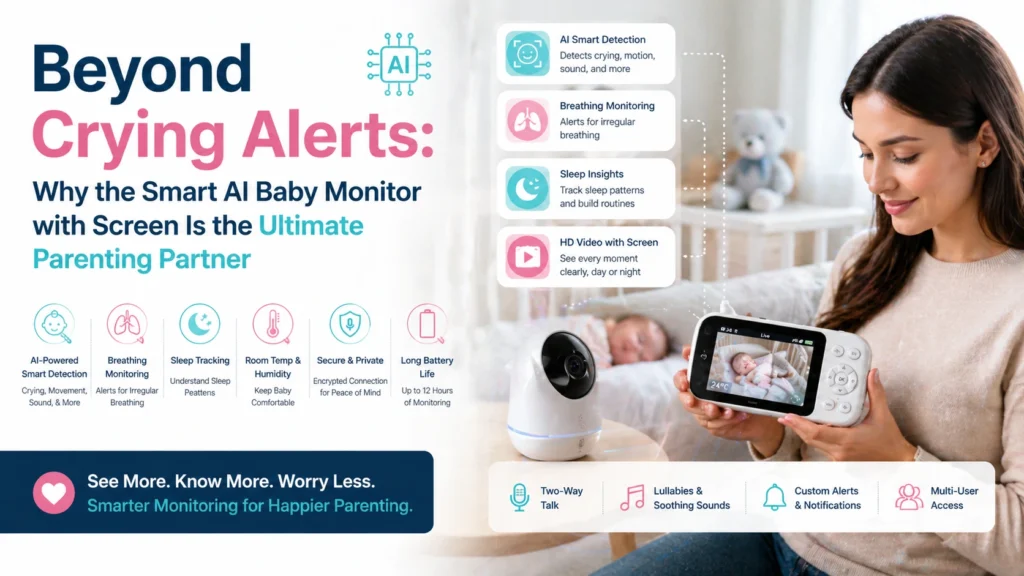
Enter the smart AI baby monitor with screen. This new generation of intelligent devices combines high-definition video, dedicated parent displays, and powerful artificial intelligence to do more than just show you your baby. It analyzes movement, tracks sleep patterns, detects potential dangers like a covered face or dangerous zone entry, and alerts you in real time.
For parents in the USA seeking true peace of mind, a smart AI baby monitor with screen is no longer a luxury—it is becoming an essential piece of nursery technology.
What Is a Smart AI Baby Monitor with Screen?
Unlike basic video monitors that simply stream a live feed to a handheld unit, a smart AI baby monitor with screen uses advanced computer vision and machine learning algorithms to actively monitor your baby’s wellbeing.
These devices typically include:
- A high-definition camera (often 1080p or 2K) with night vision
- A dedicated parent unit with a built-in screen (usually 5 to 7 inches)
- Smartphone app compatibility for monitoring on the go
- AI-powered alerts for crying, rollover, covered faces, and more
- Environmental sensors for temperature and humidity
The artificial intelligence is the true game-changer. By “learning” what normal movement and positioning look like, the AI can distinguish between harmless wiggling and a potentially dangerous situation, sending targeted alerts only when they truly matter.
Key Features to Look For
When shopping for the best smart AI baby monitor with screen for your family, prioritize these essential features:
🛒 The Best Smart AI Baby Monitors on Amazon
Click any product to check the latest price. Store ID: cosmoclinic-20 🇺🇸


📦 USA Amazon links | Store ID: cosmoclinic-20 | As an Amazon Associate, we earn from qualifying purchases.
Prices and availability are subject to change. Clicking links may result in a commission.
1. AI Safety Alerts
The most advanced monitors offer multiple AI detection capabilities:
- Covered face detection – Alerts you if a blanket or stuffed animal obscures your baby’s face
- Rollover detection – Notifies you when your baby turns onto their stomach
- Danger zone alerts – Allows you to set virtual boundaries and get notifications if your baby enters them
- Cry detection – Distinguishes between different types of cries and alerts accordingly
Many parents find covered face alerts particularly valuable during the first months when SIDS (Sudden Infant Death Syndrome) risk is highest .
2. High-Quality Video and Screen
Look for at least 1080p HD resolution on both the camera and the parent display. Models like the COCOCAM offer 2K QHD (1440p) video with 4x digital zoom, allowing you to check on tiny details like your baby’s breathing without entering the room .
Night vision is non-negotiable. The best infrared technology provides clear visibility in complete darkness without emitting disturbing red light.
3. Breathing and Sleep Monitoring
The most sophisticated models use AI to track breathing patterns without wearables. The BOOPOO Smart Baby Monitor, for example, analyzes video and audio data to provide real-time breathing frequency and historical tracking data . This contact-free approach eliminates the discomfort and potential interference of wearable sensors.
4. Dedicated Parent Screen vs. Smartphone Only
While app-based monitoring is convenient, a dedicated parent unit offers reliability during the night. You can glance at the screen without unlocking your phone, and the monitor continues working even if your phone’s battery dies or Wi-Fi fluctuates.
The VTech V-Care model brilliantly bridges both worlds, allowing you to view video on a handheld monitor, a tablet, or your smartphone .
5. Dual-Band Wi-Fi and Security
With smart devices, security is paramount. Look for monitors with AES 128-bit or 256-bit encryption and 2.4GHz/5GHz dual-band Wi-Fi support . Some models also offer local storage (SD card or built-in memory) as an alternative to cloud subscriptions, keeping your family’s data private.
Premium Smart AI Baby Monitor with Screen: Top Contenders
Based on expert reviews and parent testimonials, here are the leading options available for USA families.
VTech V-Care Smart Baby Monitor – Most Versatile
The VTech V-Care VC2105 stands out for its flexibility. It can function with or without Wi-Fi, making it reliable even during internet outages. You can view footage on the included handheld monitor, your smartphone, or a tablet. It offers zoom and pan features, temperature monitoring, and two-way talk. Importantly, there is no subscription required for core features .
Best for: Parents who want the freedom to use their monitor anywhere, without Wi-Fi dependency.
CuboAi Plus – Best AI Safety Features
The CuboAi Plus has earned a reputation for exceptional image quality and comprehensive AI alerts. It offers covered-face detection, rollover alerts, danger zone monitoring, and cry detection. The bird-shaped camera streams 1080p HD video day and night, and the app allows you to rewind up to 72 hours of footage. A 12-month Premium subscription is included, after which a free Basic Plan preserves major features .
Best for: Parents who prioritize sleep safety analytics and high-quality video.
Nanit Smart Baby Monitor – Best for Sleep Insights
The Nanit system, available with a floor stand or wall mount, features an 8-inch display with 1080p HD video. Its standout feature is automatic sleep tracking, which records sleep onset time, efficiency, and nighttime activity. The AI provides daily sleep scores and personalized guidance. It supports multi-user access and automatically captures your baby’s growth moments . Some advanced features require a subscription .
Best for: Data-driven parents who want detailed sleep analytics and coaching.
COCOCAM 2K AI Baby Monitor – Best Tech Package
The COCOCAM offers impressive specifications at a competitive price point. The 4MP camera delivers 2K QHD video, and the 5-inch 720p parent screen features a 3000mAh battery with VOX voice activation (the screen sleeps during silence and wakes when your baby cries). AI detection includes face coverage, stomach sleep alerts, and automatic tracking. It supports both 2.4GHz and 5GHz Wi-Fi with AES encryption and works with Alexa and Google Assistant .
Best for: Tech-savvy parents seeking premium features without a subscription lock-in.
Owlet Dream Duo 3 – Best for Health Monitoring
While the Owlet system pairs a camera (Dream Sight) with a wearable sock (Dream Sock), it represents the gold standard for health monitoring. The Dream Sock is the first and only FDA-cleared over-the-counter baby monitor, tracking pulse rate and oxygen levels. The Dream Sight camera offers 2K HD video, night vision, and room temperature monitoring. Together, they provide clinically-informed wellness insights .
Best for: Parents of premature babies or those who want medical-grade monitoring.
Parent Screen vs. Smartphone Only: Which Is Right for You?
One of the most common questions parents face is whether to choose a monitor with a dedicated screen or one that relies solely on a smartphone app.
| Feature | Dedicated Parent Screen | Smartphone Only |
|---|---|---|
| Reliability | Works even if Wi-Fi goes down (select models) | Requires stable Wi-Fi connection |
| Battery Life | Generally lasts through the night | Drains your phone battery rapidly |
| Convenience | Glance quickly without unlocking | Must open app and keep phone awake |
| Multi-tasking | Dedicated device just for monitoring | Ties up your phone |
| Price | Often higher for quality screens | Typically more affordable |
Our recommendation: A hybrid approach—a monitor with both a dedicated parent screen AND app access—offers the best of both worlds. You get the reliability of a dedicated device for nighttime monitoring and the flexibility of checking in from work using your smartphone.
Faqs:
What Is an AI Baby Monitor?
An AI baby monitor is a smart device that uses artificial intelligence to actively analyze your baby’s behavior and environment, rather than simply streaming video and audio. While traditional monitors require you to watch and listen constantly, AI monitors do the watching for you and alert you only when something requires attention.
How AI Baby Monitors Work
An AI baby monitor consists of two main components: a camera unit placed in the baby’s room (the “baby unit”) and a parent unit (either a dedicated handheld screen or a smartphone app) that displays the feed. The AI capabilities are powered by computer vision and machine learning algorithms that run either on the device itself (edge computing) or on the manufacturer’s cloud servers.
Key AI Features
Popular AI Monitor Brands
Leading brands in the AI baby monitor space include Nanit (known for breathing tracking and sleep insights), CuboAi Plus (bird-shaped camera with covered face and rollover alerts), Owlet Dream Duo (FDA-cleared sock for pulse and oxygen monitoring), and HubbleConnected SkyVision AI Pro (5-inch touch screen with dual-mode connectivity).
What Is the Best Baby Monitor with a Screen?
The “best” monitor depends on your priorities: versatility, advanced features, budget, or security. Based on expert reviews from CNET, PCMag, and parent testing, here are the top-rated options for 2026.
Best Overall: VTech V-Care Smart Baby Monitor VC2105
The VTech V-Care stands out for its versatility. You can view footage on a dedicated handheld monitor, a tablet, or your smartphone via the VTech Baby Plus app. Critically, it works with or without Wi-Fi—so if your internet goes down or you’re traveling, the handheld monitor remains functional. It includes zoom and pan features, temperature monitoring, and danger zone alerts for toddlers. No subscription is required for core features.
Best for: Parents who want flexibility and reliability without a monthly fee.
Best AI Features: CuboAi Plus Smart Baby Monitor
The CuboAi Plus excels at AI safety alerts. It offers covered face detection, rollover alerts, cry detection, and danger zone monitoring. The 1080p HD camera provides clear video day and night, and you can rewind up to 18 hours (or 3 days on the newest model) to review overnight activity. The bird-shaped design is nursery-friendly, and it transitions well as your baby grows into a toddler.
Best for: Parents who want comprehensive AI safety monitoring.
Best Sleep Tracking: Nanit Pro Complete Monitoring System
The Nanit Pro is the gold standard for data-driven parents. It tracks breathing using a sensor-free breathing band (patterns on the band allow the camera to detect tiny chest movements), monitors sleep patterns, and provides daily sleep scores. The system includes a floor stand or wall mount for optimal overhead positioning. An 8-inch display is available separately, but most parents use the app.
Best for: First-time and anxious parents who want detailed sleep analytics.
Note: Advanced features require a subscription after the first year. Nanit also requires a breathing band (sold separately) for respiratory monitoring.
Best Non-Wi-Fi (Most Secure): Eufy Spaceview Pro
The Eufy Spaceview Pro is the top choice for parents who want to avoid Wi-Fi entirely. It uses a direct 2.4GHz transmission between the camera and the 5-inch handheld screen, making it nearly impossible to hack remotely. Setup is straightforward, and no app is required. While it lacks advanced AI features like breathing tracking or sleep analytics, it delivers reliable, high-quality video with excellent night vision.
Best for: Security-conscious parents who prioritize privacy over smart features.
Best for Health Monitoring: Owlet Dream Duo 2
The Owlet Dream Duo 2 combines a Smart HD camera with the Dream Sock, the first and only FDA-cleared over-the-counter medical pulse oximetry solution for infants. The sock uses a photoplethysmography (PPG) sensor—similar to what hospitals use—to track heart rate and oxygen levels. The camera offers 2K HD video, night vision, and room temperature monitoring.
Best for: Parents of premature babies or those who want medical-grade health monitoring.
Quick Comparison
| Monitor | Screen Type | Wi-Fi Required? | Key Feature | Subscription Needed? |
|---|---|---|---|---|
| VTech V-Care | Handheld + App | No (optional) | Versatile dual-mode | No |
| CuboAi Plus | App only | Yes | Covered face + rollover alerts | Optional ($4.17/mo) |
| Nanit Pro | App only (8″ display optional) | Yes | Breathing + sleep analytics | Required after 1 year |
| Eufy Spaceview Pro | 5″ Handheld | No | Most secure | No |
| Owlet Dream Duo 2 | App only | Yes | FDA-cleared pulse oximetry | No |
Why Are Baby Monitors Discouraged?
The discouragement comes from official health organizations, not from a general opposition to baby monitors, but from concerns about their use as medical devices.
The American Academy of Pediatrics (AAP) Position
The AAP and the National Institutes of Health (NIH) explicitly recommend against using heart rate, breathing, motion, or other home monitors as a primary way to detect or prevent Sudden Infant Death Syndrome (SIDS).
The NICHD-led Collaborative Home Infant Monitoring Evaluation (CHIME) study examined babies at high risk for SIDS and found that monitors were not effective at identifying situations that might lead to SIDS. Based on this and other research, the AAP advises caregivers not to use these monitors to prevent SIDS or identify babies at risk for SIDS.
Important Distinction
The AAP distinguishes between two types of monitors:
- Medical-grade monitors (prescribed for specific health conditions like apnea): These may be appropriate under a doctor’s guidance.
- Consumer baby monitors: These are not approved as medical devices. A 2023 article noted there is “virtually no guidance for providers on advising families about the devices,” and the evidence for their effectiveness is limited.
The Problem with “Peace of Mind”
Ironically, the devices marketed to reduce parental anxiety can sometimes increase it. False alerts, inconsistent readings, and the burden of monitoring data can create new worries rather than resolving old ones. Some experts also caution that weighted blankets and other “safety” products marketed alongside monitors may actually increase SIDS risk.
What Health Authorities Recommend Instead
The AAP’s safe sleep guidelines remain the gold standard:
- Place babies on their backs to sleep
- Use a firm, flat sleep surface
- Keep soft objects and loose bedding out of the crib
- Room-share (not bed-share) for at least the first 6 months
If you choose to use a baby monitor for non-medical reasons, remember that it is not a substitute for safe sleep practices.
Why Avoid Wi-Fi Baby Monitors?
Wi-Fi baby monitors connect to your home network and often to the manufacturer’s cloud servers. This convenience comes with significant security and privacy risks.
The Security Risks
Yes, Wi-Fi baby monitors can be hacked. When hackers gain access, they may be able to:
- Watch and listen to your baby remotely
- Speak through the monitor’s two-way audio (real incidents of strangers talking through baby monitors have been reported)
- Access other devices on your home network
- Obtain personal information like daily routines and location data
How Wi-Fi Baby Monitors Get Hacked
Signs Your Baby Monitor May Be Hacked
- Strange noises, voices, or unexpected silence from the monitor’s speaker
- Unexplained camera movement (pan, tilt, or zoom)
- Settings changing without your input
- Unknown devices appearing on your home Wi-Fi network
- Unexpected alerts or messages in the monitoring app
How to Secure Your Wi-Fi Baby Monitor
If you choose a Wi-Fi model, take these precautions:
- Change default passwords immediately. Use a strong, unique password for both the monitor account and your Wi-Fi network.
- Enable two-factor authentication (2FA) if the app supports it.
- Keep firmware and apps updated. Security patches only work if you install them.
- Use WPA2 or WPA3 encryption on your home Wi-Fi network.
- Avoid port forwarding. If a monitor requires you to open ports on your router for remote viewing, consider a different model.
- Disable remote access when not needed. Some monitors let you turn off cloud features.
- Place the monitor at least 3 feet from the crib for electrical cord safety.
The Safer Alternative: Non-Wi-Fi Monitors
Non-Wi-Fi baby monitors use direct radio frequency transmission between the camera and the parent unit. They do not connect to the internet at all, making them essentially impossible to hack remotely. The Eufy Spaceview Pro and Infant Optics DXR-8 Pro are excellent examples.
Trade-offs: You lose the ability to check on your baby from work or while traveling, and you miss AI features like sleep analytics and breathing tracking.
The Best of Both Worlds: Dual-Mode Monitors
Some newer models offer dual-mode connectivity, allowing you to switch between secure local transmission and Wi-Fi mode as needed. The HubbleConnected SkyVision AI Pro, for example, lets you use the included 5-inch touch screen for local viewing (great for babysitters or grandparents) while also offering encrypted cloud access via the HubbleClub app for remote monitoring.
| Question | Answer |
|---|---|
| What is an AI baby monitor? | A smart monitor that uses computer vision and machine learning to actively analyze your baby’s behavior, sending alerts for events like covered faces, rollovers, and crying. |
| What is the best baby monitor with a screen? | VTech V-Care (best overall, works with/without Wi-Fi), CuboAi Plus (best AI features), Nanit Pro (best sleep tracking), Eufy Spaceview Pro (most secure/non-Wi-Fi). |
| Why are baby monitors discouraged? | Health organizations like the AAP discourage using consumer monitors to detect or prevent SIDS; studies show they are not effective for this purpose. They are not medical devices. |
| Why avoid Wi-Fi baby monitors? | Wi-Fi monitors can be hacked, allowing strangers to watch, listen, or speak through the device. Non-Wi-Fi or dual-mode monitors are significantly more secure. |
Final Thoughts
AI baby monitors are remarkable tools that can provide genuine peace of mind—alerting you to a rolled-over baby, tracking sleep patterns, and monitoring room conditions. For many parents, especially first-timers, these features are invaluable.
But they are not medical devices. No monitor replaces safe sleep practices: back sleeping, a firm mattress, and a crib free of soft objects. And if you choose a Wi-Fi-connected model, security must be a priority.
The best monitor for your family balances the features you truly need with the security and simplicity that let you sleep soundly—knowing your baby is safe, not anxiously watching a screen.
Disclaimer: This article is for informational purposes only and does not constitute medical advice. Always consult your pediatrician with questions about infant sleep safety and monitoring. The American Academy of Pediatrics recommends against using home monitors to prevent SIDS
Are Subscriptions Required?
This is a critical consideration. Some brands, like Nanit and CuboAi, offer extensive free features but gate advanced analytics behind monthly or annual subscriptions. Nanit requires a subscription for full sleep insights and video history . CuboAi charges $4.17 per month for Premium or $6.67 for Ultimate after the first free year .
Other brands, such as VTech, COCOCAM, and BOOPOO, offer all core features with no monthly fees, relying on local storage (SD cards or built-in memory) instead of cloud subscriptions .
If budgeting for ongoing costs is a concern, prioritize monitors that advertise “no monthly fee.”
Installation and Placement Tips
To get the most from your smart AI baby monitor with screen:
- Mount the camera above the crib: A bird’s-eye view provides the best angle for breathing monitoring and covered face detection.
- Ensure proper Wi-Fi signal: If using a Wi-Fi-dependent model, position the camera within range of your router. Dual-band (2.4GHz and 5GHz) support offers flexibility .
- Test alerts before relying on them: Some parents report too many notifications initially, but most apps allow you to adjust sensitivity levels .
- Secure your network: Change default passwords and enable encryption features to prevent unauthorized access.
Final Thoughts
Becoming a parent is a journey of constant learning—and constant worry. A smart AI baby monitor with screen cannot eliminate every fear, but it can replace vague anxiety with actionable information. Did the baby roll over? The monitor will tell you. Is breathing consistent? The AI is tracking it. Is the nursery too warm? A temperature alert will flash.
For USA families seeking the perfect blend of technology and peace of mind, investing in a high-quality smart monitor is one decision you will not regret. The devices below represent the very best options available on Amazon, each offering unique strengths to match different parenting styles and budgets.