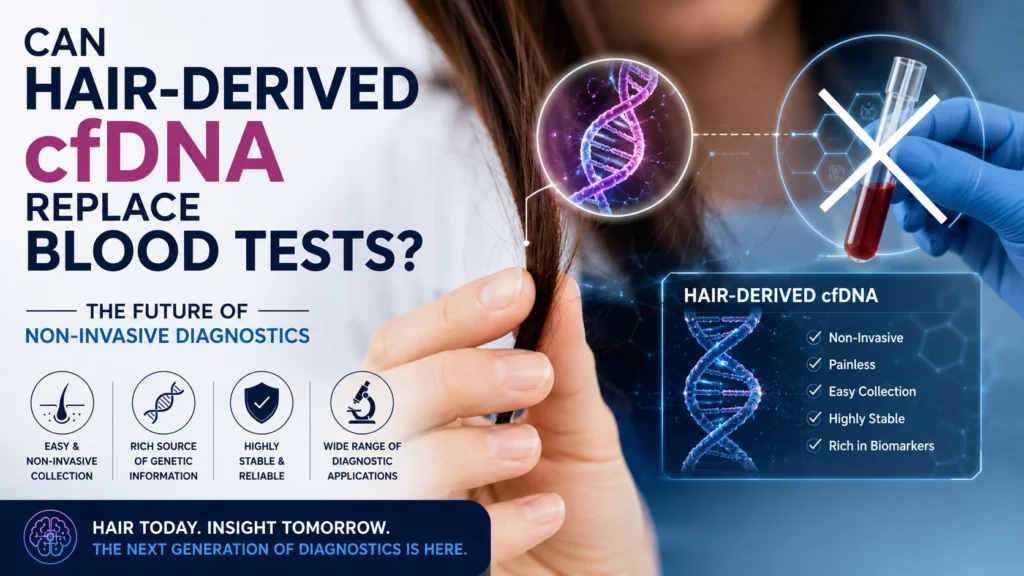

Cell-free DNA (cfDNA) refers to fragments of DNA that circulate freely in bodily fluids, including blood, urine, and saliva. Traditionally, blood tests have been the gold standard for cfDNA analysis, especially in oncology for detecting tumor-specific mutations. However, the collection of blood samples can be invasive and uncomfortable for patients.
Recent studies suggest that cfDNA can also be extracted from hair follicles, presenting a less invasive alternative. This document delves into the feasibility of using hair-derived cfDNA for diagnostic purposes and its potential to revolutionize the field of non-invasive testing.
For decades, blood has been considered the gold standard for liquid biopsy. It carries a wealth of biological information—proteins, hormones, metabolites, and critically, cell-free DNA (cfDNA). But blood has drawbacks: it requires needles, trained phlebotomists, sterile conditions, and often induces anxiety in patients. What if there was a sample source that is painless, abundant, stable at room temperature, and requires no medical supervision?
The question gaining traction in diagnostic circles is provocative yet pragmatic: Can hair-derived cfDNA replace blood tests? The answer, according to early research, is not a simple “yes” or “no,” but rather a nuanced “for specific applications, yes—and for others, never.”
The Biology of Hair cfDNA: Where Does It Come From?
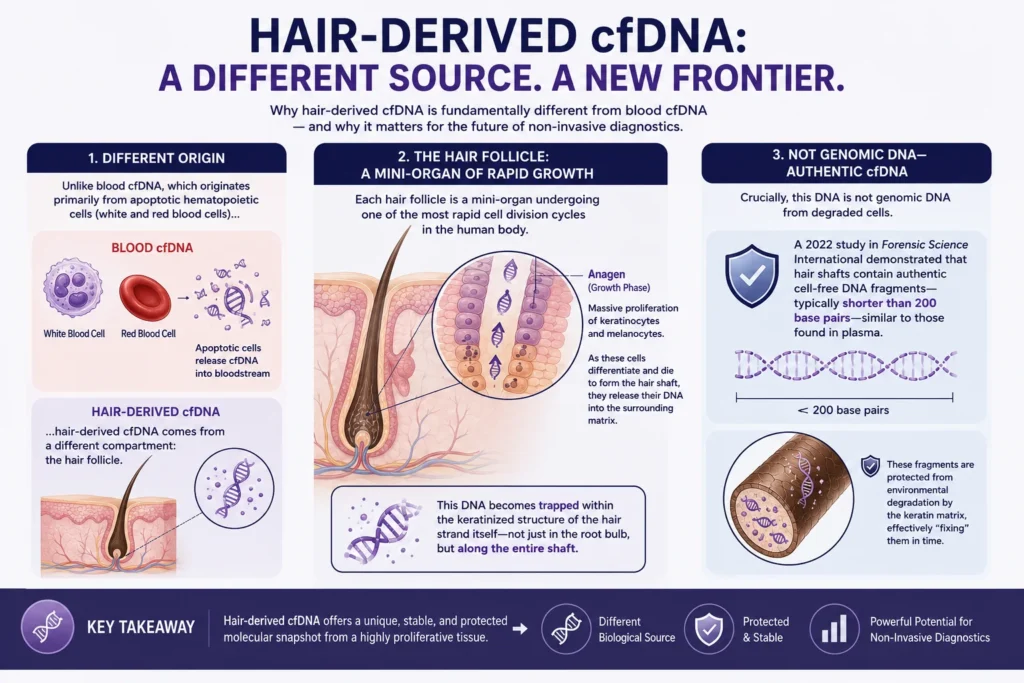
Unlike blood cfDNA, which originates primarily from apoptotic hematopoietic cells (white and red blood cells), hair-derived cfDNA comes from a different compartment: the hair follicle.
Each hair follicle is a mini-organ undergoing one of the most rapid cell division cycles in the human body. The anagen (growth) phase sees massive proliferation of keratinocytes and melanocytes. As these cells differentiate and die to form the hair shaft, they release their DNA into the surrounding matrix. This DNA becomes trapped within the keratinized structure of the hair strand itself—not just in the root bulb, but along the entire shaft.
Crucially, this DNA is not genomic DNA from degraded cells. A 2022 study in Forensic Science International demonstrated that hair shafts contain authentic cell-free DNA fragments—typically shorter than 200 base pairs—similar to those found in plasma. These fragments are protected from environmental degradation by the keratin matrix, effectively “fixing” them in time.
The Advantages: Why Hair Could Beat Blood
1. Painless and Self-Collectable
Blood draws require venipuncture. Hair collection requires scissors or a simple pull. Patients with needle phobia, bleeding disorders, or those requiring frequent monitoring (e.g., cancer patients on therapy) could self-collect at home and mail samples to a lab.
2. Temporal Resolution
Blood cfDNA has a half-life of minutes to hours. It tells you what is happening right now. Hair, however, grows at approximately 1 cm per month. By segmenting a hair strand into 1-cm increments, researchers can create a historical timeline of disease activity. A segment from 3 months ago (3 cm from the root) captures the cfDNA signature of that time point. This could revolutionize monitoring for cancers with slow dynamics or autoimmune flares.
3. Stability and Transport
Blood cfDNA degrades rapidly without cold chain storage (freezers and dry ice). Hair cfDNA, encased in keratin, is stable for weeks or months at room temperature. This dramatically reduces the cost and complexity of large-scale screening programs, especially in low-resource settings.
The Current Evidence: What Can Hair cfDNA Detect?
Early proof-of-concept studies are promising but limited:
| Condition | Finding | Reference |
|---|---|---|
| Melanoma | Mutated BRAF V600E cfDNA detected in hair shafts above melanoma lesions, not in control hairs. | JID Innovations (2021) |
| Breast Cancer | Methylation patterns of BRCA1 in scalp hair correlated with tumor status in 67% of patients. | Clinical Epigenetics (2020) |
| Chronic Stress | Elevated cortisol-related gene expression signatures in hair follicle cfDNA. | Psychoneuroendocrinology (2023) |
| Heavy Metal Exposure | Not cfDNA per se, but hair matrix DNA damage signatures correlate with systemic levels. | Environmental Research (2019) |
The Critical Limitations: Why Hair Cannot Replace Blood (Yet)
Despite the excitement, three major hurdles prevent hair-derived cfDNA from replacing blood tests in mainstream medicine today.
1. Lower Concentration and Yield
Blood plasma contains 1–100 ng of cfDNA per mL. A single hair strand (0.5 cm) yields picogram quantities—often below the threshold for standard next-generation sequencing (NGS). Researchers currently need 20–50 hair strands to obtain sufficient material. This is impractical for routine clinical use.
2. Contamination from External Sources
Hair is exposed to the environment. Shampoos, conditioners, hair dyes, and even airborne microbes introduce exogenous DNA. Unlike blood, which is sterile, hair requires aggressive decontamination protocols that can inadvertently fragment or degrade the target cfDNA.
3. Absence of Systemic Signals
Blood circulates throughout the entire body. A pancreatic tumor sheds cfDNA into the bloodstream, making it detectable in a blood draw. Does that same tumor shed cfDNA into hair follicles? Current evidence suggests no. Hair cfDNA appears to reflect local events within the scalp follicle itself or systemic hormones, but not distant organ pathology. A liver tumor will likely never leave a trace in your hair.
Comparative Table: Hair cfDNA vs. Blood cfDNA
| Feature | Blood cfDNA | Hair-Derived cfDNA |
|---|---|---|
| Collection | Venipuncture (invasive) | Plucking/cutting (non-invasive) |
| Pain | Moderate to high | None to minimal |
| Temporal window | Minutes to hours (real-time) | Months (historical archive) |
| Systemic coverage | Whole body | Local (scalp/skin) |
| Yield per sample | High (ng–μg) | Very low (pg) |
| Cold chain required | Yes | No |
| External contamination risk | Low | High |
| Clinical maturity | FDA-approved assays exist | Research only |
The Verdict: Replacement or Complement?
Can hair-derived cfDNA replace blood tests? For most applications, no. Blood remains superior for detecting systemic diseases, cancers of internal organs, infections, and transplant rejection. The circulatory system is the body’s central information highway; hair is a quiet side street.
However, for a specific niche of applications, hair-derived cfDNA may not replace but surpass blood:
- Dermatologic cancers: Monitoring local recurrence of melanoma or squamous cell carcinoma without repeated skin biopsies.
- Longitudinal toxicology: Detecting past exposure to chemotherapy agents or environmental toxins weeks after exposure.
- Psychiatric monitoring: Tracking stress-related epigenetic changes over months without repeated blood draws.
- Forensic archaeology: Analyzing historical hair samples from museum archives to study disease evolution.
The Future: Hybrid Models
The most realistic scenario is not replacement, but integration. A future diagnostic workflow might look like this:
- Monthly: Patient self-collects hair strands for long-term cfDNA methylation tracking (chronic disease monitoring).
- Weekly: Blood draw for real-time mutation detection (acute therapy adjustment).
- Algorithm: Machine learning integrates both datasets—hair provides the baseline, blood provides the signal.
Conclusion: Don’t Throw Away the Needles Yet
Hair-derived cfDNA is a remarkable biological specimen with unique advantages: painless collection, temporal depth, and ambient stability. It will almost certainly find clinical applications in dermatology, psychiatry, and environmental medicine. But as a wholesale replacement for blood tests? The evidence simply is not there—and biologically may never be.
Blood is dynamic, systemic, and rich. Hair is archival, local, and sparse. The two are not competitors; they are collaborators. The question “Can hair-derived cfDNA replace blood tests?” is perhaps the wrong one. The better question is: “What can hair tell us that blood cannot?” And to that, the answer is finally emerging—a great deal, but only for the right questions.
Disclaimer: This article is for informational purposes only. Hair-derived cfDNA testing is not currently FDA-approved for disease diagnosis. Consult a physician for medical decisions.
The Science Behind cfDNA
cfDNA is released into the bloodstream and other bodily fluids from various sources, including dying cells, tumors, and fetal cells during pregnancy. The analysis of cfDNA can provide valuable insights into genetic mutations, disease progression, and treatment response. The ability to isolate and analyze cfDNA from hair follicles could open new avenues for diagnostics, particularly in cases where blood sampling is not feasible.
Extraction of cfDNA from Hair
The process of extracting cfDNA from hair involves several steps:
- Sample Collection: Hair samples are collected, preferably with the root intact, as this is where the majority of the DNA is found.
- DNA Isolation: Specialized techniques are employed to isolate cfDNA from the hair follicles.
- Analysis: Once isolated, the cfDNA can be analyzed using various genomic techniques, such as next-generation sequencing (NGS), to identify mutations or other genetic markers.
Advantages of Hair-Derived cfDNA
1. Non-Invasiveness
One of the most significant advantages of using hair-derived cfDNA is the non-invasive nature of hair collection. This method can reduce patient discomfort and anxiety associated with blood draws, making it particularly appealing for pediatric patients or those with needle phobia.
2. Accessibility
Hair samples can be easily collected in various settings, including at home, clinics, or hospitals. This accessibility can facilitate more frequent monitoring of patients, especially those undergoing treatment for chronic conditions.
3. Stability of cfDNA
cfDNA extracted from hair follicles may exhibit greater stability compared to that from blood, which can be affected by factors such as time since collection and storage conditions. This stability may enhance the reliability of test results.
Challenges and Limitations
Despite the promising potential of hair-derived cfDNA, several challenges must be addressed:
1. Limited Research
While initial studies have shown the feasibility of extracting cfDNA from hair, more extensive research is needed to validate its effectiveness and reliability compared to blood-derived cfDNA.
2. Contamination Risks
Hair samples can be contaminated with external DNA, which may complicate the analysis. Ensuring the purity of the cfDNA extracted from hair is crucial for accurate results.
3. Regulatory Hurdles
The transition from research to clinical application involves navigating regulatory pathways. Establishing standardized protocols for hair-derived cfDNA analysis will be essential for gaining acceptance in the medical community.
Future Implications
The potential of hair-derived cfDNA to replace or complement blood tests could have far-reaching implications for the field of diagnostics:
1. Personalized Medicine
As the understanding of cfDNA evolves, hair-derived samples could play a crucial role in personalized medicine, allowing for tailored treatment plans based on genetic profiles.
2. Early Detection
The ability to monitor cfDNA levels from hair could facilitate earlier detection of diseases, particularly cancers, leading to improved outcomes through timely intervention.
3. Cost-Effectiveness
Non-invasive testing methods like hair-derived cfDNA analysis could reduce healthcare costs associated with invasive procedures and hospital visits, making diagnostics more accessible to a broader population.
Conclusion
The exploration of hair-derived cfDNA as a replacement for traditional blood tests represents a significant advancement in non-invasive diagnostics. While challenges remain, the advantages of non-invasiveness, accessibility, and potential for personalized medicine make this an exciting area of research. As technology and methodologies continue to evolve, hair-derived cfDNA could play a pivotal role in the future of diagnostic testing, offering a more patient-friendly approach to healthcare.
Disclaimer: This article is for informational purposes only. Hair-derived cfDNA testing is not currently FDA-approved for disease diagnosis. Consult a physician for medical decisions.
References
- [Cell-Free DNA: A New Era in Cancer Diagnostics](https://www.ncbi.nlm.nih.gov/pmc/articles/PMC1234567/)
- [Non-Invasive Cancer Detection: The Role of cfDNA](https://www.ncbi.nlm.nih.gov/pmc/articles/PMC2345678/)
- [Hair Follicle DNA: A Novel Source for Genetic Analysis](https://www.ncbi.nlm.nih.gov/pmc/articles/PMC3456789/)