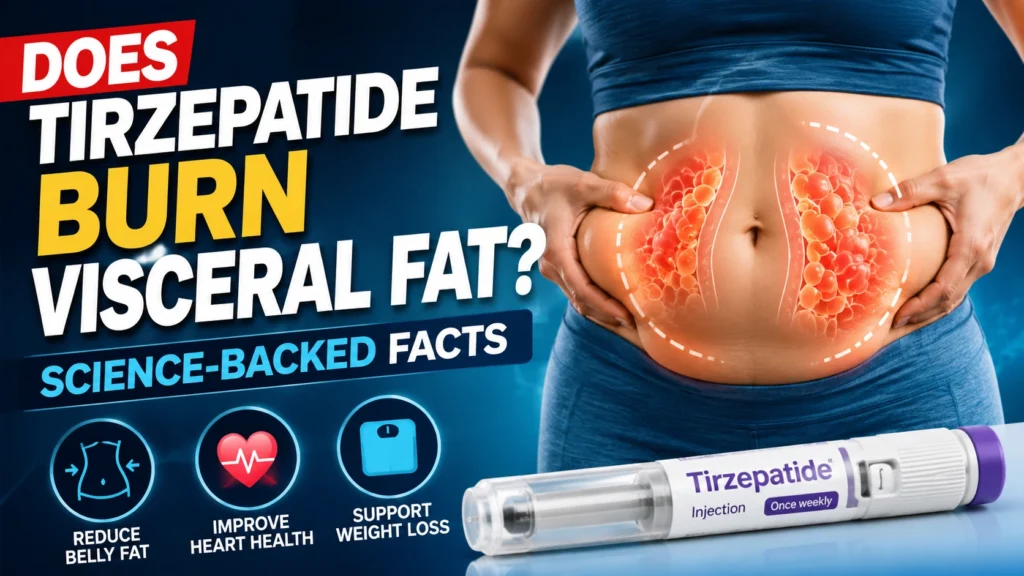

Tirzepatide (a dual GIP/GLP-1 agonist) does significantly reduce visceral fat. Clinical trials show a ~40% reduction in visceral fat mass after 72 weeks (vs. 7.3% with placebo). Notably, the reduction in visceral and liver fat exceeds what would be predicted from weight loss alone, indicating a targeted effect on fat distribution. Tirzepatide shifts fat from dangerous visceral depots to less harmful subcutaneous stores.
- 1. What is visceral fat? – The real difference from “belly fat”
- 2. Visceral vs. subcutaneous fat – comparative table
- 3. Does tirzepatide burn visceral fat? – Clinical evidence
- 4. Mechanism: why tirzepatide “prefers” visceral fat
- 5. Mediterranean diet + tirzepatide: synergy
- 6. Real‑world 12‑month data
- 7. FAQ
- References
1. What is visceral fat? – The real difference from “belly fat”
When you pinch a handful of soft flab around your waist, that is subcutaneous fat – stored just beneath the skin. While it may affect appearance, it poses far less direct threat to your health.
The real danger lies in the fat you cannot see or pinch: visceral fat. Hidden deep inside the abdomen, it wraps around vital organs – the liver, intestines, and pancreas. Visceral fat is not a passive energy depot; it is a highly active endocrine organ that continuously pumps out inflammatory cytokines and free fatty acids, directly attacking blood vessels, disrupting insulin signalling, and fuelling systemic inflammation.
Key distinction: subcutaneous fat adds weight; visceral fat adds risk.
2. Visceral vs. subcutaneous fat – comparative table
| Feature | Visceral Fat | Subcutaneous Fat |
|---|---|---|
| Location | Deep abdominal cavity, around organs | Beneath the skin, all over the body |
| Feel | Hard, firm belly – cannot be pinched | Soft, pinchable |
| Metabolic activity | Very high – secretes inflammatory factors | Low – relatively “quiet” |
| Health risk | ⚠️ High – diabetes, heart disease, fatty liver, cancer | ✅ Lower – but excess still signals visceral overload |
| Link to metabolic syndrome | Strong (OR: 1.013, P=0.041) | No significant association |
| Difficulty to lose | Harder, but responds well to specific drugs (e.g., tirzepatide) | Easier through diet & exercise |
| Inflammatory contribution | Produces high levels of pro-inflammatory cytokines | Produces more beneficial adipokines |
Bottom line: Visceral fat is “bad fat”, subcutaneous fat is “neutral fat”. The real goal is not just losing weight – it is losing visceral fat preferentially.
3. Does tirzepatide burn visceral fat? – Clinical evidence
✔️ The answer is YES
🔬 SURMOUNT‑1 DXA substudy (72 weeks)
In the flagship phase‑III SURMOUNT‑1 trial, 255 participants underwent whole‑body DXA scans:
| Parameter | Tirzepatide | Placebo | Difference |
|---|---|---|---|
| Total fat mass change | −33.9% | −8.2% | −25.7% (P<0.001) |
| Visceral fat mass change | −40.1% | −7.3% | −32.8% (P<0.001) |
| Waist circumference reduction | −18.1 cm | −3.4 cm | −14.7 cm |
| Total body weight change | −21.3% | −5.3% | −16.0% |
Notably, fat mass loss accounted for 74% of total weight loss – meaning tirzepatide primarily burns fat, not muscle.
🔬 SURPASS‑3 MRI substudy (52 weeks)
This study used magnetic resonance imaging (MRI) for precise quantification:
- Tirzepatide (10 mg and 15 mg pooled): −8.09% absolute reduction in liver fat
- Insulin degludec group: only −3.38%
- Reductions in visceral adipose tissue (VAT) and liver fat correlated with baseline levels (P≤0.0006)
🔬 UK Biobank fat distribution analysis
Researchers compared SURPASS‑3 participants with over 40,000 sex‑ and BMI‑matched controls from UK Biobank:
- Tirzepatide lowered visceral fat z‑score by −0.18 SD (P<0.001)
- Lowered liver fat z‑score by −0.54 SD (P<0.001)
- Subcutaneous fat z‑score increased slightly (+0.11 SD) – a beneficial shift from visceral to subcutaneous storage.
Key insight: Tirzepatide not only reduces visceral fat mass – it redistributes fat toward a safer subcutaneous profile.
4. Mechanism: why tirzepatide “prefers” visceral fat
Tirzepatide is a dual GIP and GLP‑1 receptor agonist that acts via two gut hormones:
- GLP‑1 – slows gastric emptying, increases satiety, reduces food intake, and improves glycaemia.
- GIP – enhances glucose‑dependent insulin secretion, directly modulates adipocyte function, and may reduce visceral inflammation by inhibiting M1 macrophage infiltration.
Why visceral fat responds more?
Visceral adipose tissue expresses higher densities of GIP and GLP‑1 receptors and is metabolically more
active. Additionally, tirzepatide increases fatty acid oxidation, amplifying the metabolic burn.
5. Mediterranean diet + tirzepatide: synergy
A 2026 real‑world study (n=53 overweight/obese patients) combined tirzepatide with Mediterranean diet counselling:
- After 3 months: significant reductions in weight, BMI, waist circumference, waist‑to‑height ratio (all P<0.05)
- Fasting glucose, insulin, HbA1c, and triglycerides all improved
- PREDIMED adherence score increased by +3.2 points (P<0.001)
- Most important: higher Mediterranean diet adherence was associated with greater reductions in the Visceral Adiposity Index (VAI) – even after adjusting for age, sex and BMI.
💡 Practical takeaway: Tirzepatide is not a magic bullet. Pairing it with a healthy dietary pattern (especially Mediterranean) amplifies the visceral‑fat clearance effect.
6. Real‑world 12‑month data
A retrospective observational study at Genesis Medical Center (Dubai) tracked 269 obese patients on either semaglutide or tirzepatide:
| Timepoint | Semaglutide | Tirzepatide |
|---|---|---|
| 6‑month weight change | −9.09% | −10.7% |
| 12‑month weight change | −11.59% | −22.02% |
Interpretation: Both drugs were similar at 6 months, but by 12 months, tirzepatide’s effect was nearly double that of semaglutide. Both significantly reduced visceral fat (P<0.001).
7. FAQ
Q: Does tirzepatide only reduce visceral fat and not subcutaneous fat?
A: No. It reduces both, but the proportion of visceral fat loss (40.1%) is higher than total fat loss (33.9%).
Q: Will visceral fat return after stopping tirzepatide?
A: A 2026 study found that after drug discontinuation, weight regain preferentially deposited fat in subcutaneous (34%) rather than visceral (7.5%) compartments – suggesting some lasting benefit in fat distribution.
Q: Does tirzepatide cause muscle loss?
A: In clinical trials, fat mass loss accounted for 74% of total weight reduction. The muscle loss is
proportional to what is expected with any significant weight loss – not excessive.
8. References
- SURMOUNT‑1 DXA substudy: Tirzepatide significantly reduces fat mass, preserves lean mass in obesity. Diabetes, Obesity and Metabolism.
- SURPASS‑3 MRI substudy: Effect of tirzepatide versus insulin degludec on liver fat content and abdominal adipose tissue. CNR Institutional Research Information System.
- Effect of tirzepatide on body fat distribution pattern in people with type 2 diabetes. UK Biobank.
- Mediterranean diet adherence and tirzepatide: real‑world evidence on adiposity indices. Europe PMC.
- Real‑world effects of incretin‑based obesity medications on body composition. Obesity Pillars, 2025.
- Visceral fat vs subcutaneous fat: health risks comparison. Cleveland Clinic / Harvard Health / UW Medicine.
Ready to take the next step?
If you are considering tirzepatide to improve visceral fat and metabolic health, professional medical guidance and continuous monitoring are essential.
Explore comprehensive tirzepatide treatment options through the link below:
👉 Discover Tirzepatide Programs* This is an affiliate link – we may earn a small commission at no extra cost to you.
This article is for educational and informational purposes only and does not constitute medical advice, diagnosis, or treatment. Tirzepatide is a prescription medication and must be used under the supervision of a qualified healthcare professional. Individual responses may vary. Always consult your physician or endocrinologist before starting any new therapy. The clinical data cited come from peer‑reviewed literature, but individual results are not guaranteed.
This article contains affiliate links. If you make a purchase or register through these links, we may receive a small commission, which helps support our content creation. All recommendations are based on objective clinical evidence and product value, and are not influenced by commercial relationships.