
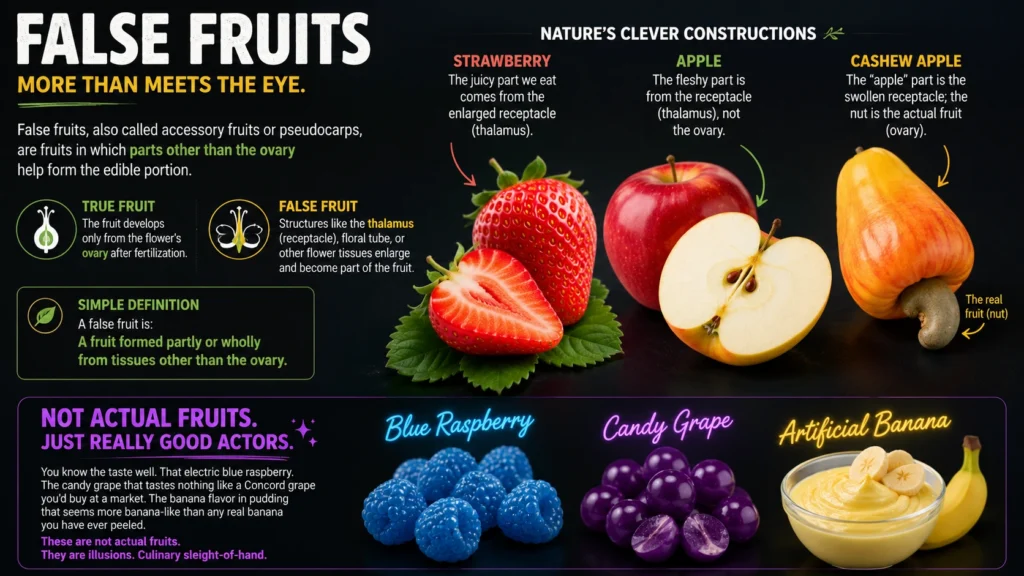

False fruits, also called accessory fruits or pseudocarps, are fruits in which parts other than the ovary help form the edible portion.
In a true fruit, the fruit develops only from the flower’s ovary after fertilization.
In a false fruit, structures like the thalamus (receptacle), floral tube, or other flower tissues enlarge and become part of the fruit.
Simple Definition
A false fruit is:
A fruit formed partly or wholly from tissues other than the ovary.You know the taste well. That electric blue raspberry. The candy grape that tastes nothing like a Concord grape you’d buy at a market. The banana flavor in pudding that seems more banana-like than any real banana you have ever peeled.
These are not actual fruits. They are illusions. Culinary sleight-of-hand.
Apple
- The fleshy edible part develops mainly from the thalamus/receptacle
- The actual ovary becomes the small core containing seeds
- Strawberry
- The red juicy part is enlarged receptacle tissue
- The tiny “seeds” on the outside are actually true fruits called achenes
- Cashew Apple
- The swollen colorful portion is not the true fruit
- The real fruit is the kidney-shaped structure containing the cashew nut
True fruits develop only from the ovary of a flower, and the edible part is mainly formed by the ovary wall. Examples of true fruits include Mango, Tomato, and Grape. In contrast, false fruits develop from the ovary along with other flower parts such as the receptacle or thalamus, which often become the fleshy edible portion. Common examples of false fruits are Apple, Strawberry, and Pear.
More Examples of False Fruits
Pear
Pineapple
Fig
Why Plants Develop False Fruits
False fruits help plants by:
Attracting animals for seed dispersal
Protecting seeds
Storing sugars and water
Increasing chances of reproduction
Interesting Fact
Botanically, the part we eat in a strawberry is not the true fruit, while the tiny dots outside are the real fruits
But if you have ever wondered what are fake fruits called—scientifically, culturally, and on ingredient labels—you are not alone. The answer is more layered than you might expect.
Let’s break down the vocabulary, the chemistry, and the strange psychological reasons fake fruit flavors dominate our modern food supply.
1. Are strawberries fake fruit?
Yes, botanically speaking, strawberries are “fake fruit” (also called accessory fruit or false fruit).
- Why? A true fruit develops only from the ovary of a flower. In a strawberry, the tiny seed-like dots on the outside are the actual “fruits” (each is an achene — a small dry fruit containing a seed). The juicy, red, sweet part we eat is the receptacle (the swollen flower base), not the ovary. Since the edible part comes from a different part of the flower, it’s not a true fruit.
In short: The red part = fake fruit. The tiny specks = true fruits.
2. Is a false fruit still a fruit?
Yes and no — it depends on who is speaking.
- Botanist: Would say “no” in a strict scientific context. A false fruit is technically not a “fruit” as defined by plant reproduction, because it includes non-ovary tissue. They might call it an “accessory fruit” instead.
- Everyday person / Nutritionist: Would say “yes.” In common language, anything sweet, seed-containing (or related), and plant-derived is a fruit. So strawberries, apples, and pineapples are all “fruit” in the grocery store sense.
Best answer: Botanically false, culinarily true.
3. Is a banana a true fruit or false fruit?
True fruit.
- Bananas develop entirely from the ovary of the flower. The flesh you eat is the mesocarp and endocarp (middle and inner layers of the ovary wall). There are no other flower parts (like receptacle) making up the edible portion. Bananas are actually berries in botanical terms — a type of fleshy true fruit that develops from a single ovary.
4. Why is pineapple a false fruit?
Pineapple is a false fruit because it forms from multiple flowers fusing together, plus the main stem.
- Detailed reason: A pineapple comes from a cluster of many flowers (an inflorescence), each producing its own ovary. As the fruits mature, they fuse together. But the tough, spiky, core and much of the flesh also includes tissue from the bracts and the flower stalk (peduncle). Since not all of the edible part comes from ovaries alone, it is a multiple accessory fruit — a type of false fruit.
First, What Are Fake Fruits Called?
The short answer: they go by many names.
If you scan ingredient lists or walk through a flavor chemistry lab, you will encounter different terms for the same artificial fruit experience. The most accurate umbrella terms include:
- Artificial flavors – The legal FDA term for any flavoring substance not derived from a natural source (like fruit, spice, or vegetable).
- Flavor esters – Specific chemical compounds (e.g., isoamyl acetate for banana) that mimic fruit aromas.
- Nature-identical flavors – A European term for synthetic copies of molecules found in real fruit. They are chemically identical to natural fruit compounds but made in a lab.
- Fruit aroma chemicals – Isolated scent molecules like ethyl butyrate (pineapple-strawberry) or methyl anthranilate (grape).
- Supernormal stimuli – A psychological term, not a label, but it describes why fake fruit feels more fruity than actual fruit.
In everyday speech? People call them imitation fruit, artificial fruit taste, candy fruit, or simply fake fruit.
But the industry prefers more technical names. What are fake fruits called on a yogurt label? Usually “artificial flavor” or “natural flavor” (which can still be heavily processed). The key is that none of these require real fruit juice or pulp.