
A woman’s nutritional needs evolve significantly with age. At 65, the body absorbs nutrients differently, metabolism slows, and the risk of chronic conditions like osteoporosis, heart disease, and cognitive decline rises, it becomes important to know What Vitamins Should a 65 Year Old Woman Take Daily?
While a balanced diet remains the gold standard for nutrition, even the healthiest eaters can struggle to meet specific increased demands through food alone. This leads to the common question in geriatric health: what vitamins should a 65 year old woman take daily?
The answer isn’t a one-size-fits-all multivitamin. Instead, experts recommend focusing on a targeted “core four” nutrients—plus one conditional supplement—that directly address the physiological changes of the sixth decade and beyond.
Disclaimer: Always consult a physician or registered dietitian before starting new supplements, as they can interact with medications common in this age group.
The Changed Gut: Why Absorption Matters More Than Intake
Before listing specific vitamins, it is crucial to understand why a 65-year-old woman cannot simply take the same pills she did at 40. As we age, gastric acid production often decreases (a condition called atrophic gastritis). This means even if she eats iron-rich steak or B12-fortified cereal, her stomach may not extract the nutrients effectively. Furthermore, certain medications (like proton pump inhibitors for reflux or metformin for diabetes) actively deplete key vitamins.
Consequently, the list of daily vitamins for a 65-year-old woman prioritizes forms of nutrients that are easy to absorb.
The Core Four: Non-Negotiable Daily Supplements
Based on consensus from the National Institutes of Health (NIH) and the North American Menopause Society, these four vitamins form the foundation of daily supplementation for women over 65.
1. Vitamin B12 (Cobalamin) – The Brain and Blood Protector
This is arguably the most critical supplement for women in this age group. Up to 40% of older adults have B12 malabsorption.
- Why she needs it: B12 is essential for nerve function, red blood cell formation, and DNA synthesis. A deficiency mimics dementia (memory loss, confusion) and causes peripheral neuropathy (tingling in the hands and feet).
- The daily dose: 2.4 micrograms (mcg). However, because absorption is an issue, doctors often recommend a crystalline form found in supplements (cyanocobalamin or methylcobalamin) rather than the protein-bound form in food.
- Form to buy: Sublingual (under the tongue) tablets or standard oral pills; injections are only for severe deficiency.
2. Vitamin D3 (Cholecalciferol) – The Bone and Immunity Regulator
As women age, skin synthesis of vitamin D drops dramatically. Sun avoidance and sunscreen use compound the problem.
- Why she needs it: Without sufficient D, the body cannot absorb calcium. This leads to osteomalacia (soft bones) and accelerates osteoporosis. Furthermore, Vitamin D is a key modulator of the immune system, helping to reduce inflammation.
- The daily dose: 800 to 2,000 International Units (IU). The Endocrine Society suggests that most 65+ women require at least 1,000–2,000 IU daily to maintain blood levels above 30 ng/mL.
- Form to buy: Vitamin D3 (not D2), as it is twice as effective at raising blood levels. Take it with a meal containing fat (avocado, eggs, olive oil) for absorption.
3. Calcium – But With a Caveat
Calcium requirements increase after menopause due to estrogen loss. However, recent research warns against high-dose calcium supplements due to potential cardiovascular risks.
- Why she needs it: To prevent the 1 in 3 women over 65 who will suffer a vertebral or hip fracture.
- The daily dose: 1,200 mg total (diet + supplement). A 65-year-old woman should aim to get 700–800 mg from food (yogurt, cheese, sardines, fortified plant milk) and supplement only 400–500 mg if diet falls short.
- Important caveat: Do not take calcium with iron supplements; they inhibit each other’s absorption. Take calcium carbonate with food, or calcium citrate (better for older stomachs) anytime.
4. Vitamin B6 (Pyridoxine) – The Metabolism Manager
While less famous than B12, B6 becomes increasingly important for immune function and homocysteine regulation (high homocysteine is a risk factor for heart disease and stroke).
- Why she needs it: It supports the production of neurotransmitters like serotonin and dopamine, influencing mood and sleep.
- The daily dose: 1.5 mg. Note that too much B6 (over 100 mg/day from supplements) can cause nerve damage, so stick to standard multivitamin levels or B-complex doses.
The Conditional Supplement: Magnesium
When asking what vitamins should a 65 year old woman take daily, magnesium often gets overlooked. It is involved in over 300 enzymatic reactions, including muscle function, blood pressure regulation, and sleep quality. However, not everyone needs it.
- Consider taking if: She suffers from constipation (magnesium citrate is a gentle laxative), muscle cramps, insomnia, or takes blood pressure medication.
- The daily dose: 320 mg. Most women over 65 consume less than this from food.
- Form to buy: Magnesium glycinate (best for sleep, less digestive upset) or magnesium citrate (best for constipation). Avoid magnesium oxide, which is poorly absorbed.
Two Vitamins to Avoid (Unless Prescribed)
Just as important as knowing what to take is knowing what to skip.
- Iron (Ferrous Sulfate): Unless a blood test confirms iron-deficiency anemia, most postmenopausal women should avoid iron supplements. Since menstruation has stopped, iron accumulates in the body. Excess iron is an oxidative stressor linked to heart disease and neurodegenerative disorders.
- Vitamin A (High Dose): While small amounts in a multivitamin are fine, high-dose standalone Vitamin A (over 3,000 mcg) is linked to increased hip fracture risk and liver damage in older adults.
The Practical Morning Strategy
Here is a sample daily supplement routine for a healthy 65-year-old woman (assuming a decent diet):
- Breakfast: 1,000 IU Vitamin D3 + 1.5 mg Vitamin B6 (or a B-complex).
- Lunch: 500 mg Calcium citrate + 200 mg Magnesium glycinate.
- Dinner: 2.4 mcg Vitamin B12.
Pro tip: Look for a “Senior Formula” or “50+” multivitamin. These are specially formulated with higher B12 and D, but lower (or zero) iron. Brands like Nature Made, Centrum Silver, and Garden of Life offer reliable third-party testing (USP or NSF seal).
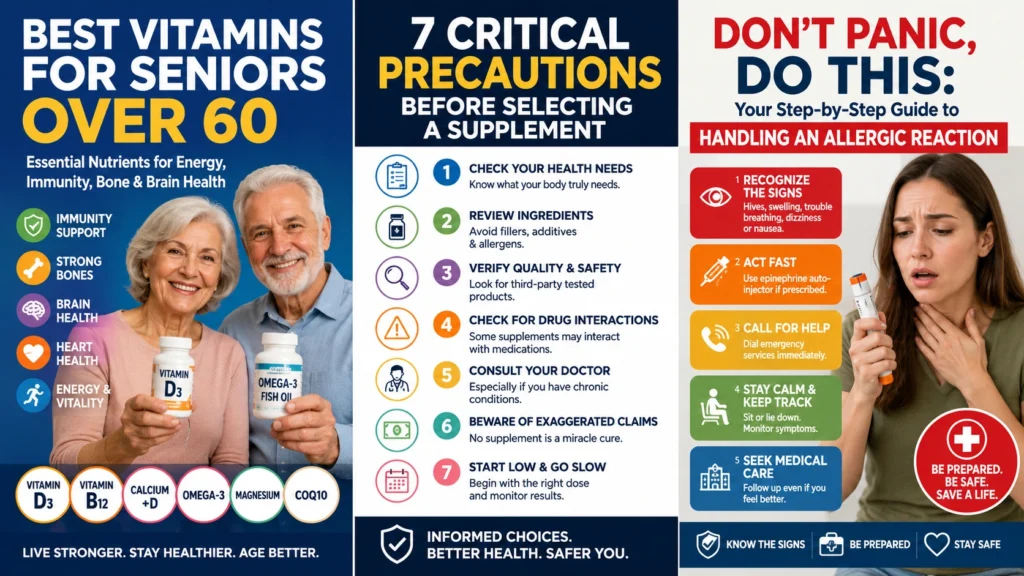
7 Critical Precautions Before Selecting a Supplement
Before you swallow that first pill, pause. Choosing the wrong supplement—or taking it incorrectly—can lead to liver damage, dangerous drug interactions, or even surgery complications. Here is what every consumer, especially adults over 65, must check first.
1. The Doctor Conversation (Non-Negotiable)
The precaution: Never start a supplement without telling your primary care physician and pharmacist.
Why it matters: A 65-year-old woman taking a blood thinner (like warfarin) could experience a life-threatening bleed if she adds high-dose vitamin E or fish oil. Similarly, St. John’s Wort can render birth control or heart medications useless. Your doctor needs to review your full medication list—including over-the-counter drugs—before you add anything.
The action: Bring the actual supplement bottle to your appointment. Do not rely on memory.
2. Know Your Baseline: Test, Don’t Guess
The precaution: Do not supplement based on symptoms or “general wellness” claims alone. Request blood work first.
Why it matters: Taking vitamin D when your levels are already optimal (above 50 ng/mL) can lead to toxicity over time, causing kidney stones and calcification of soft tissues. Taking iron without a confirmed deficiency is dangerous for postmenopausal women. Guessing wastes money and risks harm.
The action: Ask your doctor for a complete blood count (CBC) and specific tests for vitamin B12, vitamin D (25-hydroxy), ferritin (iron), and magnesium. Supplement only what is deficient.
3. Check for Surgery and Procedure Risks
The precaution: Stop all supplements at least two weeks before any scheduled surgery, dental procedure, or colonoscopy.
Why it matters: Many supplements act as blood thinners (garlic, ginkgo biloba, fish oil, vitamin E) or affect blood pressure (licorice root, ephedra). Anesthesiologists report that patients taking herbal supplements have higher risks of bleeding, heart rate fluctuations, and prolonged sedation.
The action: Inform your surgeon and anesthesiologist about every supplement you take. If you cannot pause a supplement due to a medical condition, your surgical team must adjust their protocol.
4. Verify Third-Party Testing (Avoid Contaminants)
The precaution: Never buy a supplement that lacks a verification seal from USP, NSF International, or ConsumerLab.
Why it matters: The FDA does not approve supplements for safety or efficacy before they hit store shelves. Independent testing has found that many store-brand or internet-purchased supplements contain:
- Heavy metals (lead, arsenic, mercury)
- Hidden prescription drugs (sildenafil in “male enhancement” pills, antidepressants in “mood support”)
- Zero active ingredient (just rice flour or sawdust)
- Incorrect dosage (10x the labeled amount of selenium, causing toxicity)
The action: Look for the black and yellow USP seal or the blue NSF mark on the bottle. If it’s not there, do not buy it—regardless of price or reviews.
5. Start Low, Go Slow (The Half-Dose Rule)
The precaution: Begin with half the recommended dose for the first week, even for “standard” vitamins.
Why it matters: Older adults have slower liver and kidney function. A dose that is safe for a 40-year-old may accumulate to toxic levels in an 75-year-old. Additionally, some people have genetic variations (like MTHFR mutations) that affect how they process B vitamins. A standard dose may cause insomnia, anxiety, or skin rashes.
The action: If the label says “take 2 capsules daily,” start with 1 capsule for 5–7 days. If no adverse effects occur (nausea, headache, palpitations, flushing), increase to the full dose. If symptoms appear, stop immediately and consult your doctor.
6. Watch for “Proprietary Blends” (Red Flag)
The precaution: Avoid any supplement that lists a “proprietary blend” or “complex” without disclosing individual ingredient amounts.
Why it matters: This labeling loophole allows manufacturers to hide exactly how much of each ingredient is present. A “joint support blend” might contain 500 mg of glucosamine (useful) and only 5 mg of turmeric (worthless). You are paying for filler, not medicine.
The action: Only buy supplements that list the exact milligram or microgram amount for each active ingredient. The label should look like a transparent recipe, not a secret formula.
7. Check for Expiration and Storage (The Hidden Hazard)
The precaution: Never use expired supplements, and never store them in a hot car, bathroom cabinet, or kitchen window.
Why it matters: Heat, humidity, and light degrade supplements rapidly. Expired vitamin C turns into oxalate (a kidney stone risk). Expired fish oil becomes rancid (oxidized), which promotes inflammation instead of reducing it. A bathroom medicine cabinet experiences 40–100% humidity shifts daily—perfect for destroying probiotics and B vitamins.
The action: Keep supplements in a cool, dark, dry place (a bedroom closet is ideal). Set a calendar reminder to check expiration dates every 6 months. Discard any bottle that smells “off” (fish oil should smell like fish, not paint thinner) or has changed color.
The Bottom Line: A Quick Pre-Selection Checklist
Before you add any supplement to your cart, ask these seven questions:
| # | Question | Red Flag |
|---|---|---|
| 1 | Have I told my doctor? | “No, it’s just a vitamin” |
| 2 | Did I get blood work confirming a need? | “I feel tired so I need iron” |
| 3 | Do I have surgery scheduled soon? | “Yes, next month” |
| 4 | Does the bottle have USP/NSF seal? | “I bought it cheap online” |
| 5 | Will I start with half the dose? | “More is better” |
| 6 | Are all ingredient amounts disclosed? | “Proprietary blend” on label |
| 7 | Is it stored in a cool, dry place? | “I keep it in the bathroom” |
If you answer “yes” to any red flag, stop. Go back to your doctor or pharmacist. Supplements are powerful tools for health—but only when selected with the same caution you would apply to a prescription medication.
Don’t Panic, Do This: Your Step-by-Step Guide to Handling an Allergic Reaction
You just started a new supplement—perhaps one of the vitamins recommended for a 65-year-old woman, like B12 or magnesium. Twenty minutes later, your skin feels itchy. Your lips feel strange. Your heart starts racing.
Panic sets in. That is the worst possible response.
Here is the truth: Most allergic reactions are mild and manageable. But even when they are serious, panic impairs judgment, raises blood pressure, and makes it harder to breathe. Staying calm is not just emotional advice—it is a medical necessity.
This guide will teach you exactly what to do, in order, so you can act decisively without fear.
First: Identify What You Are Dealing With
Not every negative response to a supplement is an allergy. Before you react, know the difference:
| Symptom | Likely Cause | Urgency |
|---|---|---|
| Mild itching, slight rash, mild nausea | Mild allergic reaction or simple intolerance | Low to Moderate |
| Hives (raised, red, itchy welts) | True allergic reaction | Moderate |
| Swelling of lips, tongue, or face | Moderate to severe allergy | High |
| Difficulty breathing, wheezing, throat tightness | Anaphylaxis (life-threatening) | Emergency (Call 911) |
| Upset stomach, diarrhea, headache | Intolerance or side effect (not allergy) | Low (Monitor) |
Key rule: If breathing is affected or the tongue/throat is swelling, this is an emergency. Skip the steps below and call emergency services immediately.
The “STOP” Protocol: Do This in Order
If you suspect a mild to moderate allergic reaction, follow STOP—Stay calm, Take it away, Observe, Prepare.
S – Stop and Stay Calm
- Stop taking the supplement immediately. Do not take “just one more to see what happens.”
- Sit down if you feel dizzy or lightheaded. Standing increases fall risk if blood pressure drops.
- Breathe slowly: Inhale for 4 seconds, hold for 4 seconds, exhale for 6 seconds. This activates the parasympathetic nervous system, which counteracts panic.
- Tell someone nearby: Say clearly, “I am having a possible allergic reaction. Please stay with me for 15 minutes.”
T – Take It Away (Remove the Offender)
- Put the supplement bottle aside so you do not accidentally take more.
- Drink a full glass of water (room temperature, not hot). This helps dilute any unabsorbed supplement in your stomach. Do not induce vomiting unless a poison control center tells you to—some supplements can cause more damage coming back up.
- Remove tight clothing (scarves, turtlenecks, tight jewelry) in case swelling occurs.
O – Observe and Document
- Take a photo of the reaction: rash, hives, or swelling. This helps doctors diagnose later.
- Write down the time you took the supplement and the time symptoms started.
- Check your breathing every 2 minutes. Say out loud: “I can take a full breath.” If that becomes difficult, move to emergency protocol.
- Monitor for escalation: Mild itching → hives → swelling → breathing difficulty. If it moves down this chain, act faster.
P – Prepare for Next Steps
Based on what you observe, choose one of the three paths below.
Three Paths: Mild, Moderate, or Severe
Path 1: Mild Reaction (Itching, Minor Rash, No Swelling)
Symptoms: Small red patches, mild itch, slightly upset stomach. Breathing is normal.
What to do:
- Take an over-the-counter oral antihistamine containing cetirizine (Zyrtec) , loratadine (Claritin) , or diphenhydramine (Benadryl) . Benadryl works fastest but causes drowsiness.
- Apply a cool, wet cloth to itchy areas. Do not scratch—scratching releases more histamine.
- Avoid hot showers (heat worsens histamine release).
- Symptoms should improve within 1–2 hours. If they worsen, move to Path 2.
When to see a doctor: If the rash persists more than 24 hours or spreads to the entire body.
Path 2: Moderate Reaction (Hives, Mild Lip/Face Swelling, No Breathing Issues)
Symptoms: Raised red welts (hives), puffiness around eyes or lips, but airways feel clear.
What to do:
- Take an antihistamine immediately (Benadryl is preferred for speed: 25–50 mg for adults).
- Call your doctor’s office or a nurse hotline. Tell them: “I have hives and mild swelling from a new supplement. Breathing is normal. Should I come in or go to urgent care?”
- Do not lie down flat if you feel dizzy—sit upright with legs elevated.
- Have someone drive you to urgent care if symptoms do not improve within 30 minutes of taking antihistamine.
Red flag: If swelling moves from lips to tongue or throat, this is escalating to severe. Proceed to Path 3.
Path 3: Severe Reaction (Anaphylaxis) – Call Emergency Services NOW
Symptoms (any one of these is an emergency):
- Difficulty breathing, wheezing, or gasping
- Swollen tongue or throat (feeling of a lump)
- Hoarse voice or trouble speaking
- Dizziness, fainting, or confusion (signs of dropping blood pressure)
- Nausea/vomiting combined with hives
- Feeling of “impending doom”
What to do (do not deviate):
- Call 911 (or your local emergency number) immediately. Do not wait. Do not “see if it gets better.”
- Say these exact words: “I am having anaphylaxis. I need an ambulance with epinephrine.”
- If you have an epinephrine auto-injector (EpiPen): Use it immediately. Inject into outer thigh, hold for 3 seconds. Even if you feel better afterward, you still need the ER—the reaction can return in 4–6 hours.
- Lie down with legs elevated (if breathing allows). This keeps blood flowing to the brain.
- Do not try to drive yourself or drink anything.
- Do not take oral antihistamines (they are too slow for anaphylaxis and will not stop swelling airways).
What NOT to Do (The Anti-Panic List)
When panic creeps in, people do irrational things. Avoid these common mistakes:
| Don’t | Why Not |
|---|---|
| Do not induce vomiting | Some supplements (like oil-based vitamins) can be aspirated into the lungs, causing chemical pneumonia. |
| Do not take more medication “to calm down” | Adding another unknown substance (like a sedative) can mask symptoms or cause drug interactions. |
| Do not lie down and “sleep it off” | If swelling progresses while you sleep, you may not wake up. |
| Do not take a hot bath | Heat dilates blood vessels and can worsen hives and drop blood pressure dangerously. |
| Do not drink alcohol or caffeine | Both can worsen histamine release and dehydration. |
| Do not scratch | Scratching damages skin barrier and releases more histamine, creating an itch-scratch cycle. |
| Do not drive yourself to the ER | You may lose consciousness behind the wheel. Call an ambulance or have someone else drive. |
After the Reaction: What to Do Next
Once the reaction has resolved (whether mild or treated severe), take these steps:
- Write down exactly what happened: Supplement name, dose, time taken, symptoms, and what treatment worked.
- Contact your doctor within 24 hours, even for mild reactions. They may want to report the reaction to the FDA’s MedWatch system.
- Do not try that supplement again unless your doctor supervises a controlled challenge test.
- Update your medical record so emergency responders and other doctors know about this allergy.
- Consider a medical ID bracelet if you have had a moderate or severe reaction. It can save your life if you cannot speak during a future emergency.
The One Thing That Reduces Panic: A Written Plan
Panic thrives on uncertainty. Eliminate uncertainty with a simple card kept in your wallet or on your refrigerator:
MY ALLERGIC REACTION PLAN
If I have trouble breathing or throat swelling → CALL 911
If I have hives or mild swelling:
- Take 25–50 mg Benadryl
- Call doctor: ___________
- Go to urgent care if no improvement in 30 min
Allergies: ___________________
Emergency Contact: ___________
Allergic reactions are scary, but fear is manageable. The moment you feel symptoms starting, repeat this to yourself: “I know what to do. I will stay calm. I will act step by step.”
Remember the three golden rules:
- Mild rash? Antihistamine and monitor.
- Swelling lips or hives? Call your doctor.
- Trouble breathing or throat tightness? Call 911 immediately—do not wait, do not panic, just act.
Your ability to stay calm is as important as any medication. Panic narrows the airway further. Calm keeps it open. Breathe. Assess. Act. You have got this.
The Bottom Line
The answer to what vitamins should a 65 year old woman take daily is not a shopping list—it is a medical strategy. Focus on B12, D3, and calcium as the absolute bedrock. Add magnesium if symptoms like cramps or poor sleep persist. And crucially, get blood work done annually to check vitamin D, B12, and ferritin (iron) levels.
Food remains the foundation: fatty fish for D, dairy for calcium, and lean meats for B12. Supplements are just that—a supplement to a healthy lifestyle, not a substitute for it. With the right daily regimen, a 65-year-old woman can protect her bones, sharpen her mind, and maintain the energy levels needed to enjoy her golden years to the fullest.
Medical Disclaimer & Editorial Review
This article has been reviewed by:
Dr. Mohammed Abdul Azeem Siddiqui
30 Years of Clinical Practice
(Internal Medicine & Geriatric Care)
Reviewer’s Note:
“The information provided in this guide regarding the ‘STOP Protocol’ for managing suspected allergic reactions is based on standard first-aid principles and clinical experience. However, every patient’s medical history is unique. This content is for educational purposes only and does not replace an in-person consultation with a qualified healthcare provider. Always seek immediate emergency medical attention if breathing difficulties, throat swelling, or loss of consciousness occur.”
Final Disclaimer:
This website, its authors, and Dr. Mohammed Abdul Azeem Siddiqui shall not be held liable for any improper use of this information or for adverse reactions resulting from self-treatment. Always consult your personal physician before starting, stopping, or changing any supplement or allergy management plan. Individual results may vary. In the event of a medical emergency, call your local emergency services (such as 911 or 112) immediately.