
Cockroach Milk: The Protein Drink of the Future? Nature’s Most Unlikely Superfood!
What if the next great superfood has been hiding in one of the most despised creatures on Earth? The cockroach—scourge of kitchens, symbol of urban blight—might hold the key to solving global protein shortages, feeding astronauts on Mars missions, and revolutionizing sports nutrition.
Yes, cockroach milk is real. And no, it’s not a joke.
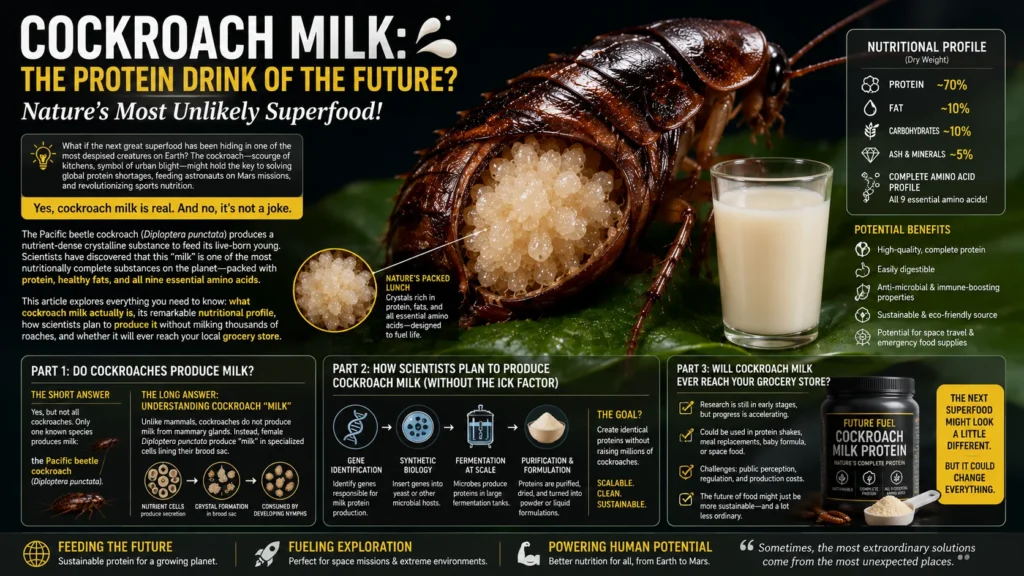
The Pacific beetle cockroach (Diploptera punctata) produces a nutrient-dense crystalline substance to feed its live-born young. Scientists have discovered that this “milk” is one of the most nutritionally complete substances on the planet—packed with protein, healthy fats, and all nine essential amino acids .
This article explores everything you need to know: what cockroach milk actually is, its remarkable nutritional profile, how scientists plan to produce it without milking thousands of roaches, and whether it will ever reach your local grocery store.
Part 1: Do Cockroaches Produce Milk?
The Short Answer
Yes, but not all cockroaches. Only one known species produces milk: the Pacific beetle cockroach (Diploptera punctata) .
The Long Answer: Understanding Cockroach “Milk”
First, let’s clarify what we mean by “milk.” Unlike cow’s milk, which comes from mammary glands, cockroach milk isn’t milk in the traditional sense. The Pacific beetle cockroach is unique among cockroaches because it is viviparous—it gives live birth rather than laying eggs .
To nourish its developing embryos inside its body, the mother secretes a pale, yellowish fluid from her brood sac. When the embryos consume this fluid, it crystallizes in their midguts, forming dense protein crystals .
So, do cockroaches have milk? Only this species does. Do cockroaches make milk? Yes, but only female Pacific beetle cockroaches, and only to feed their young. Does cockroach produce milk? In this specific case, yes—but it’s more accurate to call it a “milk-like protein crystal” than true milk.
What Is Cockroach Milk, Exactly?
What is cockroach milk? It is a crystallized lipoprotein secretion produced by Diploptera punctata to feed its embryos. The crystals form a solid matrix that acts like a time-release capsule, providing sustained nutrition to growing baby roaches .
Is cockroach milk real? Absolutely. The first scientific analysis was published in a peer-reviewed journal in 1977, with follow-up research confirming its remarkable properties in 2016 and beyond .
Part 2: Cockroach Milk Nutrition Facts
Cockroach Milk Nutrition: By the Numbers
Let’s get straight to what everyone wants to know: cockroach milk nutrition facts.
According to peer-reviewed research published in ScienceDirect and the Journal of the International Union of Crystallography, here is the cockroach milk nutritional value breakdown :
| Nutrient Component | Percentage of Composition |
|---|---|
| Protein | 45% |
| Carbohydrates | 25% |
| Lipids (Fats) | 16-22% |
| Free Amino Acids | 5% |
Cockroach Milk Nutrition Compared to Cow Milk
Cockroach milk nutrition compared to cow milk reveals a dramatic difference. Here is the cockroach milk keto nutrition facts comparison per 100 grams :
| Type of Milk | Calories (per 100g) |
|---|---|
| Cockroach Milk | 232 |
| Buffalo Milk | 110 |
| Cow Milk | 66 |
| Human Milk | 60 |
That means cockroach milk contains more than three times the calories of cow’s milk and four times the calories of an equivalent mass of buffalo milk, previously considered the most calorie-rich mammalian milk .
Cockroach Milk Protein Content
Cockroach milk protein content is where this substance truly shines.
How much protein in cockroach milk? Approximately 45 grams of protein per 100 grams of milk crystals .
Cockroach milk protein per 100g = 45g protein, which is significantly higher than traditional milk sources.
Protein in cockroach milk is also complete—it contains all nine essential amino acids that the human body cannot produce on its own: lysine, leucine, valine, histidine, isoleucine, methionine, phenylalanine, threonine, and tryptophan .
Cockroach Milk Nutrition Benefits
Cockroach milk nutrition benefits extend beyond just protein:
- Complete amino acid profile – Rare among non-meat foods
- Healthy fatty acids – Contains oleic acid, linoleic acid, and omega-3 fatty acids
- Time-release energy – The crystal structure provides sustained release of nutrients
- Vitamins and minerals – Contains essential micronutrients
- Lactose-free – Suitable for lactose-intolerant individuals
Cockroach milk is nutrition packed into a dense, stable crystal format. Nutritional value of cockroach milk is so high that researchers have called it a “complete food” .
Cockroach Milk Nutritional Benefits vs. Traditional Milk
Cockroach milk nutritional benefits compared to cow’s milk:
| Nutrient Aspect | Cow Milk | Cockroach Milk |
|---|---|---|
| Protein per 100g | ~3.2g | ~45g |
| Calories per 100g | 66 | 232 |
| Complete Amino Acids? | Yes | Yes |
| Lactose-free? | No | Yes |
| Time-release structure? | No | Yes |
Part 3: Cockroach Milk Protein Structure
The Biochemical Marvel
Cockroach milk protein structure is what makes this substance truly unique. Most food proteins are globular—they unfold quickly in the gut, causing rapid spikes in amino acids. The cockroach milk crystal is different.
It is a suspension-crystal: a solid lipoprotein matrix that acts like a time-release capsule. As it passes through the digestive system, the outer layers are stripped away methodically, like peeling an onion .
Cockroach protein milk delivers sustained nutrition over hours rather than minutes. Scientists have estimated that a single protein crystal provides energy release for over six hours, compared to a whey protein shake which is fully digested in about 90 minutes.
Cockroach milk protein structure makes it ideal for:
- Endurance athletes needing sustained energy
- Emergency food situations
- Space travel where every gram of food must count
As one researcher explained: “It’s time-released food. If you need food that is calorifically high, that is time released, and food that is complete—this is it” .
Part 4: How Do You Milk a Cockroach?
The Honest Answer: You Don’t
How do you milk a cockroach? The short answer is: you don’t. And you wouldn’t want to.
How to milk a cockroach is not like milking a cow. The Pacific beetle cockroach is tiny—about the size of a peanut. It produces milk in microscopic quantities. To get a single glass of cockroach milk the old-fashioned way, you would need to “milk” thousands of insects—a logistical nightmare that is both cruel and wildly inefficient .
Researchers estimate that it would require more than 1,000 dead cockroaches to produce just 100 grams (3.5 ounces) of cockroach milk crystals .
The Yeast Solution
Instead of milking cockroaches, scientists are doing something far more clever. An international team led by researchers at the Institute for Stem Cell Biology and Regenerative Medicine (inStem) in Bengaluru, India, has successfully sequenced the genes responsible for producing the milk crystals .
They plan to insert these genes into brewer’s yeast (Saccharomyces cerevisiae). Through fermentation—the same process used to make beer and bread—genetically engineered yeast could produce pure cockroach milk protein without a single roach involved .
Zero cockroaches are harmed. Zero cockroaches are involved beyond the initial gene sequencing.
Part 5: Cockroach Milk Price 1 Litre
Current Cost: Priceless (Literally)
Cockroach milk price 1 litre is impossible to state because the product does not yet exist for commercial sale. As of May 2026, cockroach milk is not available for human consumption anywhere in the world .
However, researchers can make educated estimates:
- Current extraction method (theoretical): Thousands of dollars per liter (due to the 1,000+ roaches per 100g requirement)
- Future yeast-fermented method (projected): Potentially competitive with premium plant-based proteins ($10-30 per liter equivalent)
- Commercial launch: Unlikely before 2030 at the earliest
The 2025 news headlines about cockroach milk being “three times more nutritious than cow’s milk” sparked renewed interest, but cockroach milk is not yet (and may never be) available for human consumption .
Part 6: Is FDA Approval in Place?
No FDA Approval Exists
Is cockroach milk FDA approved? The simple answer is no.
The U.S. Food and Drug Administration (FDA) has not reviewed, approved, or GRAS (Generally Recognized as Safe)-designated cockroach milk protein for human consumption. Similarly, the European Food Safety Authority (EFSA) has no existing category for “insect-milk analog produced in yeast” .
The Regulatory Path Forward
Before cockroach milk reaches shelves, several major hurdles remain:
- Allergenicity Testing – People with shellfish allergies may react to cockroach milk (both are arthropods). Large-scale human trials are needed.
- Long-Term Safety Studies – Early rodent studies show no adverse effects, but chronic studies lasting 1-2 years are required.
- Production Scaling – Current yeast fermentation yields need significant improvement.
- Novel Food Petition – Companies must petition for a new regulatory category, a process taking 5-10 years.
Cockroach milk as a human food remains in the research phase. No regulatory body has approved it for human consumption anywhere in the world as of May 2026 .
Part 7: Latest Research (2025-2026)
Recent Developments
Latest research on cockroach milk continues to generate excitement:
March 2025 – The Express Tribune reported that scientists confirmed cockroach milk contains three times the calories of buffalo milk, previously the most calorie-rich mammalian milk .
May 2026 – Farmbizafrica reported that researchers led by Leonard Chavas are working to bring cockroach milk under mass production, noting that proteins are an essential building block of bones, muscles, cartilage, skin, and blood .
Ongoing Research – The team at inStem in Bengaluru continues to work on the yeast production system, aiming to produce these protein crystals en masse .
The 2016 Breakthrough Study
The foundational research was published in July 2016 in the Journal of the International Union of Crystallography. The study, led by Sanchari Banerjee and the Ramaswamy group at inStem, revealed:
- The complete structure of the milk protein crystals
- That the crystals contain all essential amino acids
- The time-release mechanism of protein digestion
The 1977 Original Study
The first scientific analysis of cockroach milk composition was published in ScienceDirect in 1977, establishing the basic nutritional breakdown (45% protein, 25% carbohydrate, 16-22% lipid) that still stands today .
Part 8: Cockroach Milk Is the Protein Drink of the Future?
The Case For “Yes”
Proponents argue that cockroach milk is the protein drink of the future for several compelling reasons:
- Unmatched Nutritional Density – 232 calories and 45g protein per 100g
- Complete Amino Acid Profile – All nine essential amino acids
- Time-Release Structure – Sustained energy over hours
- Sustainable Production Potential – Yeast fermentation requires minimal land, water, and no animals
- Lactose-Free – Suitable for the 68% of humans with lactose malabsorption
Cockroach milk protein drink could potentially be formulated as a neutral-flavored, shelf-stable powder that mixes with water or milk alternatives.
The Case Against “Not Yet”
Cockroach milk protein grams may be impressive on paper, but significant obstacles remain:
- No Safety Data – Zero human trials conducted
- No Regulatory Approval – FDA, EFSA, and other agencies have not approved it
- Production Challenges – Yeast system still in development
- The “Yuck” Factor – Consumer disgust is a real psychological barrier
- Allergy Concerns – Potential cross-reactivity with shellfish allergies
A Balanced Verdict
Cockroach milk is fascinating science. Cockroach milk protein is objectively impressive. But cockroach milk protein drink is not hitting store shelves anytime soon.
As Healthline’s Wellness Wire concluded in May 2026: “There’s no research demonstrating that cockroach milk is safe for human consumption… we can consider this one nothing but hype” .
However, the same newsletter acknowledged its potential: “Technically, that makes it a ‘complete’ food—that is, it contains everything you need for healthy nutrition” .
Conclusion: Should You Drink Cockroach Milk?
The final answer is no—not yet, and maybe never.
While the nutritional numbers are extraordinary, cockroach milk remains a laboratory curiosity, not a consumer product. The path from petri dish to protein shake requires solving production challenges, proving safety, winning regulatory approval, and overcoming profound consumer disgust.
Cockroach milk is the protein drink of the future only if “the future” means 10-20 years from now, and only if researchers succeed in making it affordable, safe, and palatable.
For now, stick with your whey, pea, or soy protein. But watch this space—the humble Pacific beetle cockroach may yet revolutionize how the world eats.
Key Takeaways
| Question | Answer |
|---|---|
| Do cockroaches produce milk? | Only one species: Diploptera punctata |
| Is cockroach milk real? | Yes, it’s a crystalline protein substance |
| What is cockroach milk? | A time-release protein crystal from a live-bearing cockroach |
| Cockroach milk protein per 100g? | 45g (complete with all essential amino acids) |
| Cockroach milk price 1 litre? | Not commercially available |
| How to milk a cockroach? | You don’t—scientists use yeast fermentation |
| FDA approval? | No. None exists as of May 2026 |
| Latest research? | Ongoing yeast production development (2025-2026 |