
Imagine a bustling metropolis inside your digestive tract, teeming with trillions of microorganisms. What you feed them determines whether they become allies or adversaries in your health journey. Two nutritional powerhouses — polyphenols and prebiotic fibers — have emerged as the ultimate gut-health tag team.
Polyphenols are plant compounds with remarkable antioxidant properties, but their role extends far beyond fighting free radicals. Recent research reveals they act as next-generation prebiotics, selectively feeding beneficial gut bacteria while keeping harmful microbes in check. When paired with traditional prebiotic fibers, they create a symphony of health benefits that individual components cannot achieve alone.
This guide answers the burning question “What food is highest in polyphenols?” while exploring the gut-health revolution that’s transforming nutritional science.
What Exactly Are Polyphenols?
Polyphenols are naturally occurring compounds found in plants, characterized by multiple phenolic rings. Over 8,000 dietary polyphenols have been identified, spanning several classes including flavonoids, phenolic acids, lignans, and stilbenes. They serve as plants’ defense mechanisms against UV radiation, pathogens, and oxidative stress — and when we consume them, we inherit many of these protective benefits.
Why Polyphenols Matter for Your Gut
Polyphenols reach the colon largely intact, where gut bacteria transform them into bioactive metabolites that benefit the host. This process does more than just create useful compounds — it fundamentally reshapes your microbiome’s composition. Polyphenols:
- ✅ Promote beneficial bacteria like Akkermansia muciniphila, linked to improved gut barrier function
- ✅ Inhibit pathogenic bacteria through antimicrobial effects
- ✅ Support gut barrier integrity and immune function
- ✅ Work synergistically with dietary fiber to enhance short-chain fatty acid production
🏆 What Food Is Highest in Polyphenols? The Ultimate Ranking
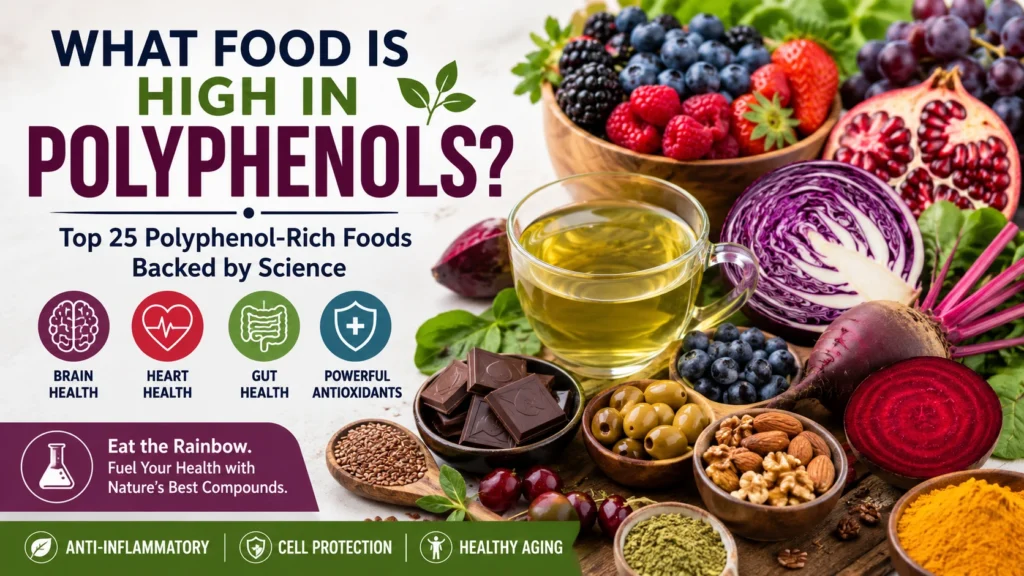
Based on comprehensive research, here’s the definitive answer to “What food is highest in polyphenols?” The champions vary by measurement method — per serving versus per capita consumption.
| Food Source | Polyphenol Content | Key Polyphenols |
|---|---|---|
| Walnuts | 3,529 mg (GAE) | Ellagitannins, flavonoids |
| Dark Chocolate | 1,617 mg | Flavonoids, theobromine |
| Sunflower Seeds | 1,358 mg | Chlorogenic acid, caffeic acid |
| Dried Raspberries (freeze-dried) | 2,452 mg | Anthocyanins, ellagitannins |
| Cloves & Spices | Extremely high | Eugenol, flavonoids |
| Cocoa Powder | Very high | Catechins, procyanidins |
🥇 Highest by Daily Consumption (Brazilian Diet Study): Coffee (169.5 mg), Beans (38.4 mg), Corn preparations (29.6 mg), Orange juice (23.3 mg).
💡 Key Takeaway: While walnuts and dark chocolate have the highest concentrations per 100g, coffee delivers the most polyphenols in real-world consumption patterns because people drink it daily in significant quantities.
Polyphenols Meet Prebiotic Fibers — A Gut-Health Power Couple
Dietary fiber and polyphenols share a remarkable relationship. Polyphenols often exist bound to dietary fiber in plant cell walls. When consumed together, they create synergistic effects that neither can achieve alone.
- Fiber ferments to produce short-chain fatty acids (SCFAs) that nourish colon cells
- Polyphenols modulate microbial composition and produce bioactive metabolites
- Together, they enhance gut barrier function, immune regulation, and metabolic health
Top Prebiotic Fiber Sources: Inulin (chicory root, Jerusalem artichokes), FOS (onions, garlic, leeks), Resistant starch (green bananas, lentils), Pectin (apples, citrus).
What Are the Best Polyphenols for Your Gut?
- Anthocyanins (berries, dark grapes) → increase microbiome diversity
- Catechins (green tea, cocoa) → stimulate beneficial bacteria, reduce inflammation
- Flavonoids (dark chocolate, onions) → support gut barrier function
- Resveratrol (red wine, grapes) → promotes Akkermansia growth
- Proanthocyanidins (cranberries, apples) → antimicrobial against pathogens
🥤 What Drink Is Highest in Polyphenols? Coffee leads the pack when considering typical consumption patterns, with 169.5 mg per average portion. Green tea offers concentrated catechins at 100–800 mg/kg, while red wine provides 80–300 mg/kg.
🥣 What Is a High Polyphenol Breakfast?
🍵 Green Tea with Lemon – enhances bioavailability.
☕ Coffee with Milk – polyphenols bind to milk proteins, doubling anti-inflammatory effects.
🫐 Berry Oatmeal – oats (prebiotic) + berries (anthocyanins).
🍫 Dark Chocolate (70%+ cacao) – flavonoid boost.
👑 Top 25 Polyphenol-Rich Foods Ranked by Science
| Rank | Food | Polyphenols (mg/100g) | Key Type |
|---|---|---|---|
| 1 | Cloves (dried) | 15,188 | Eugenol |
| 2 | Peppermint (dried) | 11,960 | Flavonoids |
| 3 | Star anise | 5,460 | Flavonoids |
| 4 | Cocoa powder | 3,448 | Flavanols |
| 5 | Walnuts | 3,529 | Ellagitannins |
| 6 | Mexican oregano | 2,319 | Flavonoids |
| 7 | Celery seed | 2,094 | Apigenin |
| 8 | Dried raspberries | 2,452 | Anthocyanins |
| 9 | Dark chocolate | 1,617 | Flavanols |
| 10 | Black chokeberry | 1,756 | Anthocyanins |
| 11 | Flaxseed meal | 1,528 | Lignans |
| 12 | Black elderberry | 1,359 | Anthocyanins |
| 13 | Sunflower seeds | 1,358 | Chlorogenic acid |
| 14 | Chestnuts | 1,215 | Phenolic acids |
| 15 | Common sage | 1,207 | Rosmarinic acid |
| 16 | Rosemary | 1,018 | Rosmarinic acid |
| 17 | Spearmint | 956 | Flavonoids |
| 18 | Common thyme | 878 | Thymol |
| 19 | Lowbush blueberry | 836 | Anthocyanins |
| 20 | Blackcurrant | 758 | Anthocyanins |
| 21 | Capers | 654 | Quercetin |
| 22 | Highbush blueberry | 560 | Anthocyanins |
| 23 | Black olives | 569 | Hydroxytyrosol |
| 24 | Hazelnuts | 495 | Flavonoids |
| 25 | Pecans | 493 | Ellagitannins |
💡 Real-world impact Spices top the list by weight, but you consume them in tiny amounts. For daily impact, coffee delivers the most polyphenols. Diversity matters more than chasing the highest numbers.
Polyphenols for Weight Loss — Fact or Fiction?
Research suggests certain polyphenols may support weight management through multiple mechanisms:
- Green tea – blocks enzyme that breaks down norepinephrine, increasing fat oxidation
- Cocoa/Dark chocolate – increases thermogenesis and energy expenditure
- Yerba mate – enhances fat oxidation during exercise
- MCT + Polyphenols – licorice flavonoid oil in MCT showed body fat reduction in clinical studies
⚠️ Reality Check: No single food burns fat magically. Weight loss requires a calorie deficit and physical activity. However, incorporating polyphenol-rich foods may provide metabolic support when combined with a healthy lifestyle.
MCT and Polyphenols — A Powerful Combination
Medium-chain triglycerides (MCTs) may enhance polyphenol absorption and bioavailability. Licorice flavonoid oil (LFO) in MCT showed significant body fat reduction in a 12-week study. This combination is increasingly found in functional foods and supplements.
What Happens If Consumed in Excess?
Polyphenols exhibit a hormetic dose-response relationship — beneficial at moderate doses, potentially harmful at high doses.
- Pro-oxidant activity – high doses can create reactive oxygen species
- Iron absorption impairment – may lead to anemia in susceptible individuals
- Thyroid hormone disruption – certain polyphenols interfere with thyroid function
- Hepatotoxicity / Nephrotoxicity – liver and kidney concerns with megadosing
- Drug interactions – cytochrome P450 enzyme interference
✅ Safe Approach: Get polyphenols from food, not supplements. Avoid megadosing on concentrated extracts. Consult healthcare providers if considering polyphenol supplements, especially if on medications.
References: ScienceDirect (2024), Oxford Academic (2004–2015), Creative Biolabs (2025), NIH/PMC (2023), MDPI (2025), Taylor & Francis (2026), J-Stage (2006), and other peer-reviewed sources.
© 2026 · Polyphenol & Prebiotic Guide · All rights reserved.