
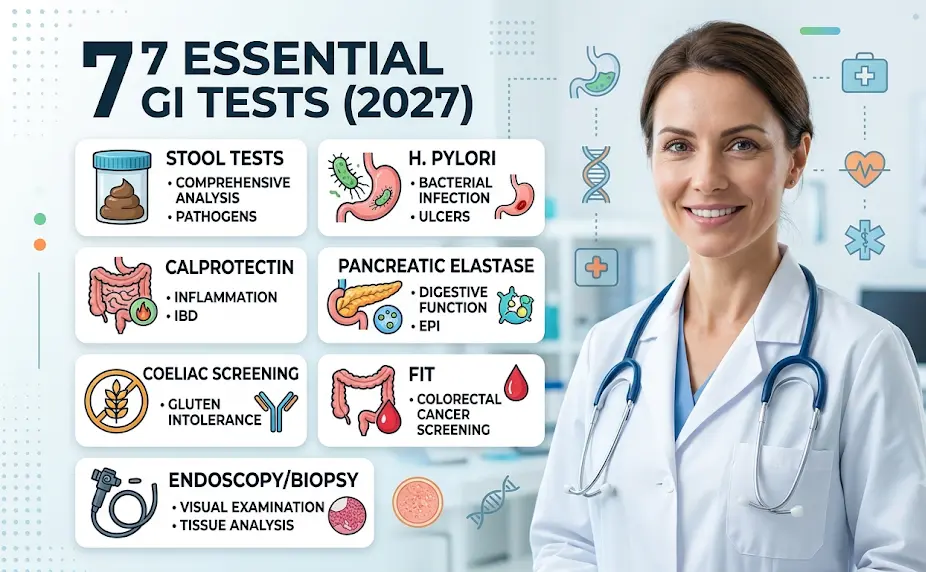

Quick Verdict / TL;DR
What this covers: Seven evidence-based gastrointestinal tests that help investigate common gut symptoms — stool routine microscopy, faecal calprotectin, FIT (faecal immunochemical test), H. pylori stool antigen, faecal pancreatic elastase-1, tissue transglutaminase IgA (tTG-IgA), and total IgA.
Leading options: For inflammation screening, faecal calprotectin is the most specific non-invasive stool marker. For detecting H. pylori, the stool antigen test is highly sensitive and convenient. Pancreatic elastase-1 is the best stool test for exocrine pancreatic insufficiency. tTG-IgA (with total IgA) is the standard coeliac screening duo. FIT is the preferred colorectal cancer screening stool test for average-risk adults.
Key limitations: No single test rules out all digestive disease. Test accuracy depends on proper collection, laboratory methods, and clinical context. Some tests (e.g., calprotectin, FIT) are screening tools, not diagnostic endpoints.
Who may benefit: Adults with persistent bloating, diarrhoea, constipation, abdominal pain, unexplained weight loss, suspected malabsorption, or a family history of coeliac disease or colorectal cancer — after discussing symptoms with a clinician.
Verify before buying: Always confirm the laboratory’s accreditation, the specific assay method, collection instructions, turnaround time, and whether a clinician’s referral is required. Prices vary widely; we note typical ranges where available but recommend checking current pricing directly.
Compare at-home and laboratory gastrointestinal test packages from trusted providers.
👉 Check Current GI Test Packages
Affiliate link. We may earn a commission at no extra cost to you.
Digestive symptoms are among the most common reasons adults seek medical care — and also among the most frustrating to investigate. Bloating, irregular bowel habits, abdominal pain, and fatigue can stem from dozens of different causes, from irritable bowel syndrome to coeliac disease, infection, inflammation, or pancreatic insufficiency. The good news is that modern gastrointestinal testing is more accessible than ever, with many stool and blood tests available through laboratories and at-home collection kits.
But which tests actually matter? In this guide, we compare seven essential gastrointestinal tests in 2027 — stool routine microscopy, faecal calprotectin, FIT, H. pylori stool antigen, faecal pancreatic elastase-1, tTG-IgA, and total IgA. We explain what each test measures, how accurate it is, what it typically costs in the US, and how to choose a reliable laboratory. Whether you are investigating a specific symptom or simply want a structured approach to gut health, this comparison will help you have a more informed conversation with your clinician.
Add IntelliNewz as a preferred source in Google to see more of our evidence-based health guides.
Table of Contents
- 1. Stool Routine Examination and Microscopy
- 2. Faecal Calprotectin Test
- 3. Faecal Immunochemical Test (FIT)
- 4. H. pylori Stool Antigen Test
- 5. Faecal Pancreatic Elastase-1
- 6. Tissue Transglutaminase IgA (tTG-IgA)
- 7. Total IgA Test
- Comparison Table: All 7 Tests at a Glance
- Best Laboratories Offering These Tests
- Individual Test Prices vs. GI Diagnostic Packages
- At-Home Collection vs. Laboratory Collection
- Which Gastrointestinal Tests Are Worth Paying For?
- How to Choose a Reliable Diagnostic Laboratory
- Frequently Asked Questions
- Final Verdict and Next Steps
1. Stool Routine Examination and Microscopy
What it is: A stool routine examination (also called stool microscopy or faecal microscopy) is one of the oldest and most fundamental gastrointestinal tests. A small stool sample is examined under a microscope and sometimes cultured to look for parasites (e.g., Giardia, Entamoeba), ova and cysts, undigested food, fat globules, pus cells, red blood cells, and abnormal bacteria or yeast.
What it can detect: Parasitic infections, malabsorption (by detecting excess fat), inflammatory cells, and sometimes occult blood. It is particularly useful in people with persistent diarrhoea, travel-related illness, or suspected parasitic infection.
Accuracy and limitations: Sensitivity varies widely depending on the pathogen and laboratory technique. A single negative sample does not rule out infection — many parasites are shed intermittently, so three samples on different days are often recommended. Routine microscopy is not a screening test for cancer or inflammatory bowel disease.
Typical cost (2027, US self-pay): $20–$60 at private laboratories; often covered by insurance when medically indicated.
2. Faecal Calprotectin Test
What it is: Calprotectin is a protein released by neutrophils (a type of white blood cell) during intestinal inflammation. A faecal calprotectin test measures its concentration in stool. It is widely used to distinguish inflammatory bowel disease (IBD — Crohn’s disease and ulcerative colitis) from irritable bowel syndrome (IBS).
What it can detect: Intestinal inflammation. Elevated levels suggest active inflammation somewhere in the gut, prompting further investigation (e.g., colonoscopy). Normal levels make IBD less likely, although they do not exclude it entirely.
Accuracy: Systematic reviews report pooled sensitivity around 90% and specificity around 80% for distinguishing IBD from IBS in adults, though cut-offs vary (typically 50 µg/g). False positives can occur with NSAID use, gastrointestinal infections, and age. False negatives are less common but possible with isolated small-bowel disease.
Typical cost (2027, US self-pay): $60–$150.
Compare faecal calprotectin test prices from accredited labs
View Current Calprotectin Test Options →3. Faecal Immunochemical Test (FIT)
What it is: FIT detects hidden (occult) blood in stool using antibodies specific to human haemoglobin. It is the most widely used non-invasive colorectal cancer screening test in many national programmes. Unlike older guaiac-based tests, FIT does not require dietary restrictions.
What it can detect: Lower gastrointestinal bleeding, which may be caused by polyps, colorectal cancer, or inflammation. A positive FIT usually leads to colonoscopy.
Accuracy: For colorectal cancer screening, FIT has a sensitivity of roughly 70–80% for cancer and lower for advanced adenomas. It is not a diagnostic test for cancer — a positive result requires colonoscopy. Annual or biennial FIT is recommended for average-risk adults in many guidelines, starting around age 45–50 (varies by country).
Typical cost (2027, US self-pay): $30–$100 (often free through national screening programmes outside the US).
4. H. pylori Stool Antigen Test
What it is: Helicobacter pylori is a bacterium that colonises the stomach and is a major cause of peptic ulcers and gastric cancer. The stool antigen test detects bacterial antigens in stool using enzyme immunoassay or immunochromatography.
What it can detect: Active H. pylori infection. It is also used to confirm eradication after antibiotic treatment (ideally at least 4 weeks after finishing antibiotics and 2 weeks after stopping proton pump inhibitors).
Accuracy: Pooled sensitivity and specificity are both around 90–95% in adults, making it one of the most reliable non-invasive tests. It is preferred over serology (blood antibody tests) because serology cannot distinguish past from current infection.
Typical cost (2027, US self-pay): $40–$120.
5. Faecal Pancreatic Elastase-1
What it is: Pancreatic elastase-1 is an enzyme produced by the pancreas that passes through the digestive tract largely intact. Measuring it in stool helps assess exocrine pancreatic function — that is, whether the pancreas is producing enough digestive enzymes.
What it can detect: Exocrine pancreatic insufficiency (EPI), which can occur in chronic pancreatitis, cystic fibrosis, pancreatic cancer, coeliac disease, and after pancreatic surgery. Symptoms of EPI include greasy, foul-smelling stools, weight loss, and malnutrition.
Accuracy: Faecal elastase-1 is considered the best single stool test for EPI, with sensitivity and specificity generally above 80–90% for moderate-to-severe insufficiency. It is less sensitive for mild insufficiency. The sample must be formed stool (not watery diarrhoea), as dilution can cause false low results.
Typical cost (2027, US self-pay): $80–$200.
6. Tissue Transglutaminase IgA (tTG-IgA)
What it is: This is the primary blood test for coeliac disease screening. It measures IgA antibodies against tissue transglutaminase, an enzyme involved in the autoimmune response triggered by gluten in genetically predisposed individuals.
What it can detect: Coeliac disease. A positive tTG-IgA (usually >10× upper limit of normal) is highly suggestive, especially in symptomatic patients, and may be followed by duodenal biopsy in some protocols. Importantly, the test is only valid while the patient is consuming gluten — a gluten-free diet can normalise results.
Accuracy: Pooled sensitivity and specificity are both approximately 90–95% in adults when used with total IgA. False negatives can occur in IgA deficiency, which is why total IgA should always be checked concurrently.
Typical cost (2027, US self-pay): $50–$150.
Need a coeliac screening test?
View At-Home Coeliac Test Options →Affiliate link. Verify the laboratory’s accreditation before ordering.
7. Total IgA Test
What it is: Total immunoglobulin A (IgA) is a blood test that measures the overall level of IgA antibodies. It is performed alongside tTG-IgA to rule out selective IgA deficiency, a condition affecting about 1 in 500 people, which can cause a false-negative coeliac screen.
What it can detect: IgA deficiency. If total IgA is low, the tTG-IgA result is unreliable, and a different test (e.g., IgG-based tissue transglutaminase or deamidated gliadin peptide) should be used.
Accuracy: Total IgA is a straightforward quantitative measurement; accuracy is high across accredited laboratories. It is not a stand-alone test for coeliac disease but an essential companion.
Typical cost (2027, US self-pay): $30–$80. Often bundled with tTG-IgA.
Comparison Table: All 7 Tests at a Glance
Prices are indicative 2027 ranges for private self-pay testing in the US and vary by laboratory, location, and whether a clinician’s referral is included. Verify current pricing before ordering.
| Test | Sample | What it detects | Key limitation | Typical US price |
|---|---|---|---|---|
| Stool routine microscopy | Stool | Parasites, fat, inflammatory cells | Intermittent shedding; multiple samples needed | $20–$60 |
| Faecal calprotectin | Stool | Intestinal inflammation (IBD vs IBS) | False positives with NSAIDs/infection | $60–$150 |
| FIT | Stool | Occult blood (colorectal cancer screening) | Not diagnostic; colonoscopy needed if positive | $30–$100 |
| H. pylori stool antigen | Stool | Active H. pylori infection | PPIs/antibiotics can affect results | $40–$120 |
| Faecal pancreatic elastase-1 | Stool | Exocrine pancreatic insufficiency | Less sensitive for mild EPI; watery stool invalid | $80–$200 |
| tTG-IgA | Blood | Coeliac disease | False negative in IgA deficiency | $50–$150 |
| Total IgA | Blood | IgA deficiency (companion to tTG-IgA) | Not diagnostic alone | $30–$80 |
Best Laboratories Offering These Tests
When comparing laboratories, prioritise accreditation (e.g., CAP, CLIA, ISO 15189), transparency about assay methods, clear collection instructions, and responsive customer support. Below are categories of providers that commonly offer these gastrointestinal tests. We do not rank them; instead, we outline what each type typically offers so you can choose based on your needs.
- National reference laboratories (e.g., LabCorp, Quest Diagnostics in the US): Broad test menus, physician-ordered, insurance-friendly. Useful if you want a clinician to interpret results.
- At-home stool test kits: Convenient collection at home, often paired with a telehealth consult. Verify which specific assays are used and whether results include a clinician review.
- Hospital-affiliated laboratories: Often required for certain specialised tests (e.g., pancreatic elastase) and provide integrated care.
- Independent accredited labs: Competitive self-pay pricing with home collection in many states.
We recommend confirming that any laboratory you choose participates in external quality assessment schemes for the specific test you need.
Compare accredited GI test providers
Check Current Test Packages →Individual Test Prices vs. GI Diagnostic Packages
Buying individual tests à la carte can be more expensive than a bundled package, but it also gives you flexibility to test only what is clinically relevant. Here is a general comparison:
| Approach | Typical price range (US, self-pay) | Pros | Cons |
|---|---|---|---|
| Individual tests | $30–$200 per test | Targeted; avoids unnecessary testing | Can add up; multiple collection kits |
| GI diagnostic package (e.g., stool + blood) | $150–$400 | Convenient; often includes clinician review | May include tests you don’t need |
If you have a specific symptom (e.g., suspected coeliac disease), individual tTG-IgA + total IgA is usually the most cost-effective first step. If you have vague, persistent gut symptoms, a structured package that includes calprotectin, FIT, and H. pylori antigen may provide broader reassurance — but discuss with a clinician first.
At-Home Collection vs. Laboratory Collection
At-home collection is convenient, especially for stool tests. You collect the sample in a provided kit and either drop it at a designated point or arrange a courier. Advantages include privacy and flexibility; disadvantages include the need to follow instructions precisely (e.g., sample stability, temperature) and potential delays in transit that can affect certain assays.
Laboratory collection is typically required for blood tests (tTG-IgA, total IgA) and is preferred when a clinician wants to ensure proper handling. It also allows immediate processing for time-sensitive tests. For stool tests, some laboratories accept home-collected samples if returned within a specified window (often 24–48 hours).
Always check the provider’s instructions: some tests (e.g., calprotectin) are stable for several days at room temperature, while others (e.g., pancreatic elastase) may require refrigeration.
Which Gastrointestinal Tests Are Worth Paying For?
Not every test is necessary for every person. Here is a practical framework:
- If you have chronic diarrhoea or suspected IBS/IBD: Faecal calprotectin is high-value. It can help avoid unnecessary colonoscopy if normal, or prompt timely investigation if elevated.
- If you have dyspepsia or a history of ulcers: H. pylori stool antigen is worth it — treating the infection can resolve symptoms and reduce cancer risk.
- If you have greasy, floating stools and weight loss: Faecal pancreatic elastase-1 is the key test for EPI.
- If you have unexplained iron deficiency or a family history of colorectal cancer: FIT is a reasonable screening option (but colonoscopy remains the gold standard for high-risk individuals).
- If you have symptoms suggestive of coeliac disease (bloating, diarrhoea, fatigue, dermatitis herpetiformis): tTG-IgA + total IgA is essential before starting a gluten-free diet.
- Stool routine microscopy: Worth it if you have travelled to endemic areas, have persistent diarrhoea, or suspected parasitic infection.
In general, tests ordered in response to specific symptoms and interpreted by a clinician offer the best value. Random “gut health” panels without clinical context can generate anxiety and unnecessary follow-up.
How to Choose a Reliable Diagnostic Laboratory
- Check accreditation: Look for CAP, CLIA, ISO 15189, or national equivalents. Accreditation indicates the lab meets quality standards.
- Ask about the assay method: For calprotectin, ELISA and immunoturbidimetric methods are common; for H. pylori, enzyme immunoassay is standard. Transparency about method helps interpret results.
- Confirm sample stability and transport: Ask how long the sample is stable and whether a cold chain is required.
- Review turnaround time: Most routine GI tests return results within 2–5 working days.
- Check whether clinician interpretation is included: Some at-home kits include a telehealth consult; others leave interpretation to you.
- Read independent reviews: Look for feedback on collection instructions, customer service, and billing transparency.
- Verify pricing and hidden fees: Confirm whether shipping, kit return, and consultation are included.
Ready to compare accredited GI test options?
View Current Test Packages →Quick Q&A
Q: What is the best stool test for digestive problems?
A: There is no single “best” stool test — it depends on your symptoms. Faecal calprotectin is best for detecting intestinal inflammation, H. pylori stool antigen for active H. pylori infection, and faecal pancreatic elastase-1 for exocrine pancreatic insufficiency.
Q: How accurate is faecal calprotectin?
A: Pooled studies report sensitivity around 90% and specificity around 80% for distinguishing IBD from IBS in adults, but results should always be interpreted alongside symptoms and clinical history.
Q: Can I test for coeliac disease at home?
A: Yes, some at-home kits offer tTG-IgA and total IgA testing via a finger-prick blood sample. However, a positive result should be confirmed by a clinician, and the test is only valid while consuming gluten.
Frequently Asked Questions
1. Which gastrointestinal test is most useful for bloating and diarrhoea?
Faecal calprotectin is often the first stool test because it helps distinguish inflammation (IBD) from functional symptoms (IBS). If you also have risk factors for coeliac disease, tTG-IgA plus total IgA is reasonable. A clinician can help prioritise based on your full history, including symptom duration, family history, and any red-flag features such as weight loss or rectal bleeding.
2. Do I need to fast or change my diet before these tests?
Most stool tests do not require fasting. However, for H. pylori stool antigen, you should avoid proton pump inhibitors for 2 weeks and antibiotics for 4 weeks before testing. For tTG-IgA, you must be consuming gluten for the test to be valid — a gluten-free diet can cause false-negative results. Always follow your laboratory’s specific instructions, as some assays have additional requirements.
3. How much do gastrointestinal tests cost in 2027?
Self-pay prices in the US vary. Individual stool or blood tests typically range from $30 to $200. Bundled GI packages may cost $150 to $400. Insurance may cover tests when medically indicated, but coverage varies by plan. Always confirm whether shipping, kit return, and clinician consultation are included in the quoted price.
4. Is faecal calprotectin better than a colonoscopy?
No. Calprotectin is a screening and triage tool, not a replacement for colonoscopy. A normal calprotectin can help avoid unnecessary colonoscopy in low-risk individuals, while an elevated result often prompts colonoscopy to visualise the bowel directly. Colonoscopy remains the gold standard for diagnosing IBD and colorectal cancer.
5. Can H. pylori be detected without an endoscopy?
Yes. The stool antigen test and urea breath test are both non-invasive and highly accurate for detecting active H. pylori infection. Serology (blood antibody) tests are less useful because they cannot distinguish past from current infection. Stool antigen is particularly convenient for confirming eradication after treatment.
6. What does a low pancreatic elastase result mean?
A low faecal pancreatic elastase-1 level (typically less than 200 µg/g) suggests exocrine pancreatic insufficiency. This should be confirmed with a clinician, who may recommend further testing and, if appropriate, pancreatic enzyme replacement therapy. Note that watery stool samples can dilute elastase and cause falsely low results, so a formed sample is preferred.
7. Are at-home stool test kits as accurate as laboratory tests?
When the same validated assay is used and the sample is returned promptly, accuracy should be comparable. However, improper collection or transport delays can affect results. Choose kits from accredited laboratories with clear instructions and, ideally, clinician support. Check whether the kit uses the same assay method as reference laboratories.
8. What is the best stool test for digestive problems?
There is no single best stool test because the right choice depends on your symptoms. Faecal calprotectin is best for detecting intestinal inflammation, H. pylori stool antigen for active H. pylori infection, and faecal pancreatic elastase-1 for exocrine pancreatic insufficiency. A clinician can help select the most appropriate test based on your clinical presentation.
9. How accurate is faecal calprotectin?
Pooled studies report sensitivity around 90% and specificity around 80% for distinguishing IBD from IBS in adults, but results should always be interpreted alongside symptoms and clinical history. Cut-offs vary by laboratory, and factors such as NSAID use or gastrointestinal infection can cause false positives.
10. Can I test for coeliac disease at home?
Yes, some at-home kits offer tTG-IgA and total IgA testing via a finger-prick blood sample. However, a positive result should be confirmed by a clinician, and the test is only valid while consuming gluten. If you have already started a gluten-free diet, discuss with your doctor before testing.
Final Verdict and Next Steps
There is no single “best” gastrointestinal test — the right choice depends on your symptoms, risk factors, and clinical context. For most people with persistent gut symptoms, a structured approach that combines a careful clinical history with targeted testing offers the best value.
- For suspected inflammation (IBD vs IBS): Faecal calprotectin is the leading non-invasive test.
- For suspected infection or parasites: Stool routine microscopy remains useful.
- For H. pylori: Stool antigen is reliable and convenient.
- For malabsorption or pancreatic symptoms: Faecal pancreatic elastase-1 is the key stool test.
- For coeliac screening: tTG-IgA + total IgA is the standard duo.
- For colorectal cancer screening in average-risk adults: FIT is a validated option, though colonoscopy remains the gold standard for high-risk individuals.
Before ordering any test, confirm the laboratory’s accreditation, collection requirements, and whether a clinician’s interpretation is included. And remember: test results are most meaningful when discussed with a qualified healthcare professional who can integrate them with your symptoms and history.
Take the next step toward gut clarity
Compare GI Test Packages Now →