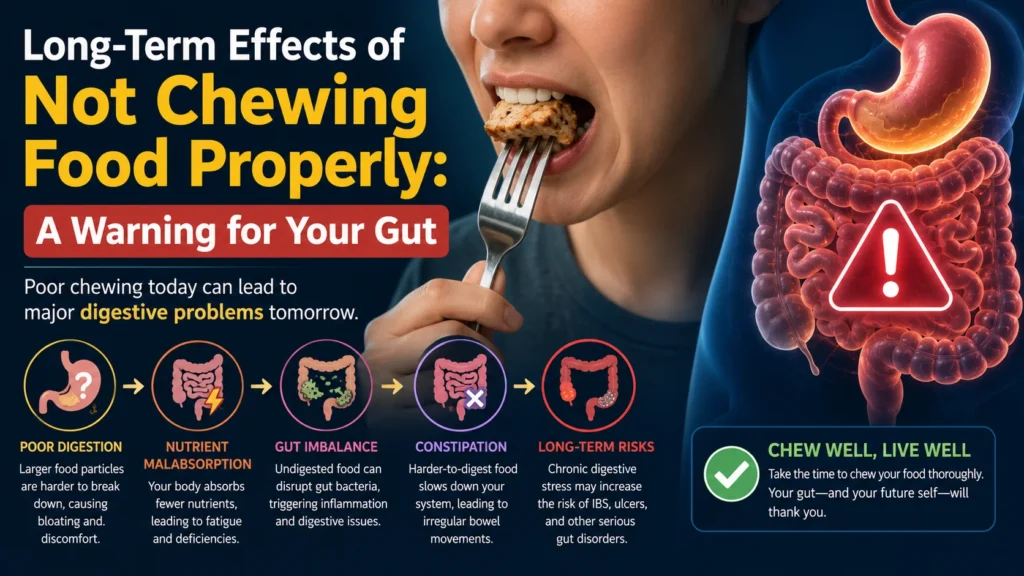

In our fast-paced world, eating has become a race. We scarf down sandwiches at desks, swallow protein bars in the car, and inhale dinner while scrolling through phones. Chewing often feels like an inconvenience—a boring delay between the plate and the swallow. But what happens when you consistently bypass this crucial step? The long-term effects of not chewing food properly are not limited to the occasional bout of indigestion. Over months and years, poor chewing rewires your digestive health, leading to chronic disease, nutrient deficiencies, and systemic inflammation.
Before we explore the consequences, we must first understand the science.
The Science of Chewing and Digestion
Digestion is often compared to a factory assembly line. Chewing is the first, and most critical, station. When you take a bite, your teeth perform mechanical digestion—tearing, grinding, and crushing food into smaller particles. Simultaneously, your salivary glands release saliva containing the enzyme amylase, which begins breaking down starches chemically. Your tongue mixes the food with saliva to form a soft, slippery ball called a bolus.
Here is the vital scientific principle: Digestion is a surface area game. A whole almond has very little surface area exposed to digestive enzymes. However, if you chew that almond 20 to 30 times, you turn it into a paste with millions of microscopic particles. This exponentially increases the surface area, allowing enzymes in your stomach and small intestine to do their job efficiently.
The science also reveals a nervous system connection. Chewing sends signals via the vagus nerve to your stomach, telling it to release hydrochloric acid and pepsinogen (which becomes the protein-digesting enzyme pepsin). It also signals the pancreas and gallbladder to prepare bile and pancreatic enzymes. In essence, chewing is the “start button” for your entire digestive machinery.
When you skip proper chewing, you bypass this entire activation sequence. Now, let’s examine what happens years down the road.
1. Chronic Malnutrition (The Stealth Epidemic)
The most insidious long-term effect is malnutrition that goes unnoticed. When food particles are too large, digestive enzymes can only break down the outer layer. The core of that food particle passes through your small intestine undigested and unabsorbed. Over years, this means you may eat plenty of calories but absorb only a fraction of the vitamins and minerals.
Specifically:
- Iron and B12 deficiency: Large meat particles require extensive chewing. Without it, you fail to extract heme iron and B12, leading to fatigue, anemia, and neuropathy.
- Calcium and magnesium loss: Poorly chewed leafy greens and nuts means these critical minerals exit in your stool, contributing over time to osteoporosis and muscle cramps.
2. Small Intestinal Bacterial Overgrowth (SIBO)
Undigested food is not inert. Large carbohydrate and protein particles that reach the small intestine become a feast for bacteria that do not belong there. This condition, known as SIBO, produces chronic bloating, diarrhea, abdominal pain, and brain fog. The bacteria ferment the undigested food, producing hydrogen or methane gas. Over years, this damages the intestinal lining, leading to leaky gut syndrome, where partially digested proteins enter the bloodstream and trigger autoimmune responses.
3. Chronic Gastritis and Stomach Lining Damage
Remember that chewing signals the stomach to produce acid? Without that signal, the stomach releases acid randomly or insufficiently. However, the worse problem occurs when large, jagged food particles enter the stomach. To break them down, the stomach churns more violently and secretes excess acid for longer periods. This chronic overwork inflames the stomach lining (gastritis), increasing the risk of peptic ulcers and, in severe long-term cases, gastric atrophy.
4. Pancreatic Exhaustion
The pancreas is not designed to compensate for poor chewing. When large food particles arrive, the pancreas must pump out massive amounts of enzymes to try and break them down. Decades of this overstimulation can lead to pancreatic insufficiency, where the organ becomes exhausted and cannot produce enough enzymes even for properly chewed food. This creates a vicious cycle of worsening malnutrition.
5. Dental Deterioration (Paradoxically)
Ironically, not chewing enough weakens your teeth. Chewing stimulates the flow of saliva, which bathes teeth in calcium, phosphate, and fluoride (remineralization). Saliva also neutralizes cavity-causing acids. Over years of quick eating and minimal chewing, saliva production declines. You also lose bone density in the jaw—a “use it or lose it” phenomenon—leading to tooth loss, gum recession, and even changes in facial structure.
6. Weight Gain and Metabolic Syndrome
Fast chewing is strongly linked to obesity. It takes approximately 20 minutes for your brain to receive leptin signals (the “full” hormone) from your stomach. When you swallow large chunks without chewing, you finish a meal in 5 to 10 minutes, consuming far more calories than needed before satiety kicks in. Long-term, this habit rewires appetite regulation, leading to insulin resistance and metabolic syndrome.
7. Esophageal Damage and GERD
Large, sharp food chunks (like poorly chewed nuts, chips, or steak) physically scrape the delicate lining of the esophagus each time you swallow. Over years, this chronic trauma can cause inflammation, strictures (narrowing of the esophagus), and worsening gastroesophageal reflux disease (GERD). In severe cases, it contributes to Barrett’s esophagus, a precancerous condition.
Reversing the Damage
The good news is that the body is remarkably resilient. Within weeks of adopting mindful chewing habits (aiming for 20 to 30 chews per bite, putting down utensils between mouthfuls), many of these effects can be halted or partially reversed. Digestion improves, bloating decreases, and energy levels rise.
However, for those who have spent decades inhaling their food, the damage to the pancreas, stomach lining, and nutrient stores may be permanent. The single most powerful preventive medicine is free and available at every meal: chew thoroughly.
The science of chewing and digestion teaches us a simple truth: digestion begins in the mouth, not the stomach. Treat your teeth as the first organ of digestion they were meant to be, and your entire digestive tract will thank you for decades to come.