
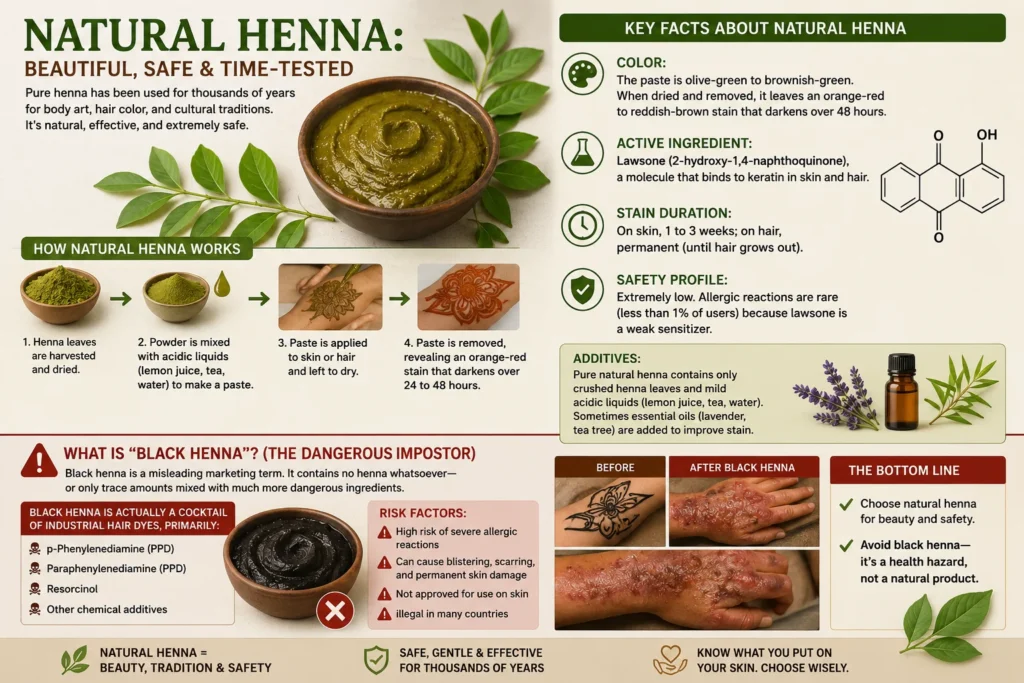

On sandy beaches, at music festivals, and in mall kiosks around the world, tourists and shoppers are often lured by the promise of a temporary tattoo. The artist holds up two pastes: one earthy green-brown, the other jet black. Both are called “henna.” But only one is safe.
The confusion between natural henna and black henna has sent thousands of people to emergency rooms with severe chemical burns, scarring, and lifelong allergies. Understanding the difference isn’t just cosmetic—it’s a medical necessity.
What Is Natural Henna? (The Safe One)
Natural henna is a dye derived from the leaves of the Lawsonia inermis plant, a flowering shrub native to North Africa, the Middle East, and South Asia. For over 5,000 years, it has been used to dye hair, skin, nails, and fabrics.
Key characteristics of natural henna:
- Color: The paste is olive-green to brownish-green. When dried and removed, it leaves an orange-red to reddish-brown stain that darkens over 48 hours.
- Active ingredient: Lawsone (2-hydroxy-1,4-naphthoquinone), a molecule that binds to keratin in skin and hair.
- Stain duration: On skin, 1 to 3 weeks; on hair, permanent (until hair grows out).
- Safety profile: Extremely low. Allergic reactions are rare (less than 1% of users) because lawsone is a weak sensitizer.
- Additives: Pure natural henna contains only crushed henna leaves and mild acidic liquids (lemon juice, tea, water). Sometimes essential oils (lavender, tea tree) are added to improve stain.
How natural henna works:
The lawsone molecules slowly migrate from the paste into the top layer of your skin (stratum corneum). They bind to skin proteins via a process called Michael addition, creating a semi-permanent stain. Because the molecules are relatively large, they don’t penetrate deeply, which is why the stain is not truly permanent and why it rarely triggers immune reactions.
What Is “Black Henna”? (The Dangerous Impostor)
Black henna is a misleading marketing term. It contains no henna whatsoever—or only trace amounts mixed with much more dangerous ingredients.
Black henna is actually a cocktail of industrial hair dyes, primarily:
The main culprit: Para-phenylenediamine (PPD)
PPD is a coal tar-derived chemical used in permanent hair dyes (especially dark shades). It is not approved for direct skin application in most countries, including the United States, Canada, the UK, and the European Union.
Other common ingredients in black henna:
- Para-toluenediamine (PTD) – A PPD alternative that is also sensitizing
- Sodium picramate – Another oxidative hair dye chemical
- Heavy metals – Cadmium, nickel, lead (contaminants from unregulated manufacturing)
Key characteristics of black henna:
- Color: The paste is jet black, dark blue-black, or charcoal gray.
- Drying time: Much faster than natural henna (15-30 minutes vs. 2-6 hours).
- Stain color: Immediately black or dark blue, not reddish.
- Stain duration: Often claimed to last “longer than natural henna” (this is a warning sign, not a benefit).
The Critical Difference at a Glance
| Feature | Natural Henna | Black Henna |
|---|---|---|
| Source | Lawsonia inermis plant | Industrial hair dye (PPD) |
| Paste color | Olive green to brown | Jet black |
| Stain color | Orange → red → reddish-brown | Black, dark blue, or purple |
| Time on skin | 2-6 hours (slow release) | 15-30 minutes (fast) |
| Allergy risk | Very low (<1%) | Very high (20-40% become sensitized) |
| Long-term risk | None | Permanent PPD allergy; cross-reactivity to hair dyes, some medications |
| Legality for skin use | Legal worldwide | Illegal in most developed nations |
| Scarring risk | None | High (chemical burns) |
Why Black Henna Is Dangerous: The Chemistry of Harm
PPD is a strong skin sensitizer. This means it doesn’t just cause a reaction the first time you use it—it “teaches” your immune system to attack PPD. The next exposure, even years later, can trigger a severe allergic reaction.
The typical progression of black henna injury:
First exposure (days 1-5):
- No immediate pain (the artist often says “see, no reaction!”)
- Days later: itching, redness, swelling in the exact pattern of the tattoo
- Blisters form, sometimes weeping and painful
Second exposure (months or years later):
- Reaction occurs within hours (not days)
- Severe blistering, intense swelling
- Skin necrosis (tissue death) in severe cases
- Permanent scarring (keloids or hypopigmentation)
What a black henna burn looks like:
The burn follows the exact lines of the tattoo. Common descriptions include:
- “A raised, blistering outline of a butterfly on my arm”
- “My child’s hand swelled to twice its size”
- “The henna design is now a permanent white scar”
The hidden long-term consequence: Permanent PPD allergy
Once you are sensitized to PPD through black henna tattoos, you may never again be able to:
- Dye your hair with permanent or semi-permanent dark hair dyes (most contain PPD)
- Wear certain dark fabrics (some textiles use PPD-based dyes)
- Use certain tattoo inks (some black inks contain PPD derivatives)
- Take certain medications (some anesthetics, sulfonamides, and para-aminobenzoic acid (PABA) in sunscreens can cross-react)
This is called cross-sensitization. Your immune system can’t distinguish between PPD and chemically similar compounds.
How to Tell Them Apart (Before It Goes on Your Skin)
Before allowing any “henna” artist to apply a design, perform these checks:
1. The color test (most reliable)
Ask to see the paste in its container. Natural henna is never black. It should be:
- Muddy green
- Brownish-green
- Olive drab
Any black, dark gray, or blue paste is not henna.
2. The smell test
- Natural henna: Earthy, grassy, like dried hay or spinach. Sometimes described as “wet forest floor.”
- Black henna: Chemical, ammonia-like, or similar to permanent hair dye.
3. The timing test
A legitimate henna artist will ask you to keep the paste on for at least 2 hours, often 4-6 hours, sometimes overnight.
- 30 minutes or less is a major red flag. Black henna “develops” quickly because PPD works by oxidation, not slow protein binding.
4. The price test
- Natural henna: More expensive because it requires longer application time, fresh paste preparation, and skilled artistry.
- Black henna: Cheap and fast. If it seems like a bargain, it’s probably black henna.
5. Ask for ingredients
A legitimate artist should be able to tell you exactly what is in their paste. Acceptable answers:
- “100% Lawsonia inermis leaf powder, lemon juice, and sugar.”
- “Body art quality henna from a reputable supplier (e.g., Henna Caravan, TapDancing Lizard).”
Warning signs:
- “It’s a secret family recipe.”
- “I don’t know, it comes in a tube.”
- “Black henna is just stronger.”
The Legal Landscape (Country by Country)
| Country | Black Henna for Skin | Natural Henna for Skin |
|---|---|---|
| United States | Illegal (FDA prohibits PPD on skin) | Legal (as cosmetic) |
| Canada | Illegal (Health Canada ban) | Legal |
| United Kingdom | Illegal (EU/UK cosmetics regulation) | Legal |
| European Union | Illegal (Annex II banned substance) | Legal |
| Australia | Illegal (TGA prohibition) | Legal |
| India | Restricted (but widely available illegally) | Legal |
| Turkey, Egypt, Morocco | Unregulated (common in tourist areas) | Legal |
Despite these laws, black henna is still widely used in tourist destinations, festival stalls, and online marketplaces.
What to Do If You’ve Already Gotten a Black Henna Tattoo
If no reaction yet (first few hours):
- Wash it off immediately with soap and warm water. Do not wait to see if it “develops.”
- Monitor the area for 7 days. Reactions can appear days later.
- Do not reapply anything to the area (lotions, oils) until you are certain there is no reaction.
If you develop itching, redness, or blisters:
- Do not scratch or pop blisters – this increases scarring risk.
- Take oral antihistamines (cetirizine, loratadine) to reduce the immune response.
- Apply cold compresses to reduce inflammation.
- Use topical corticosteroids (hydrocortisone cream 1% for mild cases; prescription strength for severe).
- See a doctor or dermatologist if blisters are large, painful, or cover a significant area.
If you have a known PPD allergy from past black henna:
- Wear a medical alert bracelet stating “PPD allergy.”
- Patch test all hair dyes even if labeled “PPD-free” (some alternatives cross-react).
- Inform anesthesiologists and dentists before procedures (some local anesthetics contain cross-reactive compounds).
Safe Alternatives to Black Tattoos
If you want a dark, bold temporary tattoo, consider these safe options:
| Option | Safety | Duration | Cost |
|---|---|---|---|
| Natural henna (reddish-brown) | Very safe | 1-3 weeks | Moderate |
| Jagua gel (from Genipa americana fruit) | Safe | 1-2 weeks | Moderate |
| PPD-free black body paint (e.g., Mehron, Kryolan) | Safe for short wear | Hours to days | Low |
| Temporary tattoo paper | Very safe | 3-5 days | Low |
| Real tattoo (professional) | Safe if done properly | Permanent | High |
Jagua is a notable alternative. Derived from Amazonian fruit, it stains the skin blue-black and is not chemically related to PPD. However, it can still cause reactions in rare cases, so patch testing is always wise.
Conclusion: Remember the Rule of Three
When someone offers you a “henna” tattoo, remember three simple rules:
- Real henna is never black. If it’s black, it’s not henna.
- Real henna takes hours. If it dries in 30 minutes, walk away.
- Real henna stains red-brown. If it stains black, it’s a chemical burn waiting to happen.
The temporary beauty of a black henna tattoo is never worth the permanent risk of scarring, chemical burns, or a lifelong allergy to hair dye. Natural henna has been used safely for millennia. Black henna is a modern industrial chemical being misapplied to human skin—with predictable and often devastating results.
Choose the green-brown paste. Wait the hours. Enjoy the red-brown stain. And leave the black dye for hair—never for skin.
This article is for informational purposes and does not constitute medical advice. If you believe you are having an allergic reaction to any skin application, seek medical attention immediately.