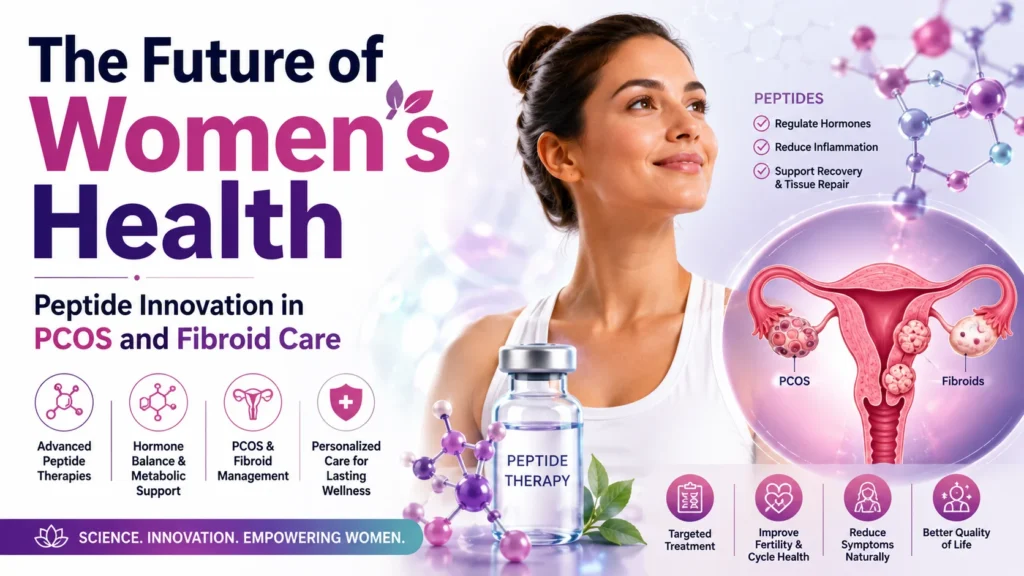

Polycystic Ovary Syndrome (PCOS) affects 9–18% of women, and uterine fibroids affect up to 70% by age 50. Both are driven by hormonal dysregulation, insulin resistance, and chronic inflammation. Peptide therapeutics — including GLP-1 receptor agonists, mitochondrial-derived peptides, and novel engineered peptides — are emerging as game-changing tools that target the root mechanisms rather than just managing symptoms. From restoring ovulation and reducing ovarian inflammation to shrinking fibroid tissue and improving metabolic health, peptide innovation offers new hope for millions of women.
🔵 The Two Giants: PCOS and Uterine Fibroids
Polycystic Ovary Syndrome (PCOS) affects 9% to 18% of women worldwide[reference:0]. It’s a metabolic and endocrine disorder characterized by insulin resistance, hyperandrogenism, and ovarian dysfunction. Women with PCOS face a 5.46× higher risk of insulin resistance and a significantly higher risk of type 2 diabetes and metabolic syndrome.
Uterine fibroids are non-cancerous tumors that develop in the uterus, affecting up to 70% of women by age 50. They cause heavy bleeding, pelvic pain, and fertility issues. Both conditions share common threads: hormonal imbalance, chronic inflammation, and insulin resistance — making them ideal targets for peptide-based therapies.
🟣 The Peptide Revolution: A New Era in Therapeutics
Peptides are short chains of amino acids that act as signaling molecules in the body. They regulate everything from hunger and metabolism to inflammation and tissue growth. Peptide therapeutics leverage these natural messengers to correct dysregulated pathways — offering a level of precision that traditional drugs often can’t match.
In the context of PCOS and fibroids, peptide innovation is moving beyond “symptom management” to disease modification. From GLP-1 receptor agonists like semaglutide and tirzepatide to novel peptides like phoenixin-14 and mitochondrial-derived peptides, the pipeline is exploding with potential[reference:1][reference:2].
🩷 How Peptides Target the Root Causes
🧬 1. Insulin Sensitivity & Metabolic Reset
GLP-1 receptor agonists enhance insulin sensitivity, reduce insulin resistance, and promote weight loss — often 10–15% with semaglutide[reference:3].
This directly addresses the metabolic core of PCOS.
🔥 2. Anti-Inflammatory Action
Peptides like humanin and engineered peptides have demonstrated potent anti-inflammatory effects in ovarian and uterine tissues[reference:4][reference:5].
Chronic inflammation is a key driver of both PCOS and fibroids.
🌱 3. Ovarian & Endometrial Restoration
Semaglutide has been shown to restore estrous cycles, correct hormone imbalances, and reduce ovarian cysts in PCOS models[reference:6].
Engineered peptides delivered via extracellular vesicles can normalize follicular development[reference:7].
🧫 4. Direct Fibroid Modulation
Peptide nanocomplexes are being developed to deliver genetic constructs directly to fibroid cells[reference:8].
GLP-1 agonists have also shown potential in lowering uterine fibrosis in animal models[reference:9].
🌿 PCOS Breakthroughs: What the Science Says
GLP-1 Receptor Agonists — Drugs like semaglutide, liraglutide, and tirzepatide are showing remarkable results in PCOS. They improve weight loss, metabolic dysfunction, and menstrual regularity[reference:10]. A recent study demonstrated that semaglutide alleviates ovarian oxidative stress and restores estrous cycles in PCOS mice[reference:11].
Novel Peptides — Phoenixin-14, a peptide found in the brain and ovary, has been shown to ameliorate ovarian morphology in PCOS rat models by enhancing granulosa cell proliferation[reference:12]. Mitochondrial-derived peptide humanin, which is downregulated in PCOS ovaries, can attenuate insulin resistance and ovarian abnormalities when supplemented exogenously[reference:13].
Engineered Peptides — Researchers are now engineering extracellular vesicles to deliver peptides like 740Y-P directly to ovarian tissue, mitigating inflammation and normalizing follicular development[reference:14].
🟠 Fibroid Breakthroughs: The Emerging Frontier
Uterine fibroids have long been treated with surgery, hormonal contraceptives, or GnRH agonists — all with significant side effects. Peptide-based approaches are offering a new path.
Peptide Nanocomplexes — Researchers are developing peptide-based delivery systems to transport genetic constructs directly into fibroid cells, offering a targeted, non-invasive approach to fibroid management[reference:15].
GLP-1 & Fibrosis — In animal models, GLP-1 receptor agonists have been shown to lower uterine fibrosis[reference:16]. This suggests that the same peptides transforming PCOS care may also have direct effects on fibroid tissue.
Extracellular Matrix Modulation — Bioengineered hydrogels incorporating collagen- and fibronectin-derived peptides are being used to model fibroid growth, paving the way for peptide-based therapies that can disrupt the fibroid microenvironment[reference:17].
✅ The Future: Integrated Peptide Care for Women
The overlap between PCOS and fibroids — insulin resistance, inflammation, hormonal imbalance — makes them ideal candidates for peptide-based therapeutics. Clinical trials are already underway. The PERIODS trial is testing tirzepatide for ovarian dysfunction in overweight women with PCOS[reference:18].
As peptide science advances, we can expect:
- Combination therapies that target multiple pathways simultaneously
- Personalized peptide regimens based on genetic and metabolic profiles
- Fewer side effects compared to traditional hormonal treatments
- Non-surgical options for fibroids that preserve fertility
The peptide revolution is not a distant dream — it’s happening right now.
❓FAQ — Your Top Questions Answered
🔥 Ready to explore the peptide revolution?
If you’re tired of treatments that only mask symptoms — and you’re ready to explore science-backed, targeted solutions for PCOS and fibroid care — you’re not alone.
👇 Discover how peptide innovation is changing the game for women’s health.
👉 Learn More About Peptide-Based SolutionsThousands of women are rewriting their health stories.
Your next chapter starts here.
📢 Disclosure: This article is based on peer-reviewed literature, including studies on GLP-1 receptor agonists, phoenixin-14, humanin, engineered peptides, and peptide nanocomplexes, as well as clinical trial data from sources like PubMed, ScienceDirect, and ClinicalTrials.gov. It is provided for educational and informational purposes only.
⚠️ Disclaimer: This content does not replace professional medical advice, diagnosis, or treatment. PCOS and fibroid management must be individualized and supervised by qualified healthcare providers (physicians, endocrinologists, or gynecologists). Any dietary, exercise, or supplement changes should be discussed with your doctor. Individual results vary. This page contains affiliate links; purchases made via these links may earn the author a commission at no extra cost to you. Our content remains objective and evidence-based.