

Table of Contents
- 1. The Silent Struggle of Kidneys
- 2. The Problem with the “Gold Standard”
- 3. Dawn of Non-Invasive Diagnosis
- 4. What Does Kidney Failure Breath Smell Like?
- 5. Can Kidney Problems Cause Bad Breath?
- 6. How to Tell if Bad Breath is from the Stomach?
- 7. Can Kidney Problems Affect Your Mouth?
- 8. The Path Forward
- 9.FAQs
- 10. Disclosure & Disclaimer
1. The Silent Struggle of Kidneys
They are the body’s silent filters. Your kidneys work 24/7, processing about 200 quarts of blood every day to sift out waste and excess fluids. Yet, they rarely complain. Chronic Kidney Disease (CKD) is often called a “silent killer” because many people don’t experience symptoms until their kidneys are significantly damaged. By then, the options become limited.
For decades, the definitive way to know what is happening inside a kidney was to cut a piece out. This procedure, known as a renal biopsy, involves inserting a needle into the back to extract tissue samples. It is invasive, carries a risk of bleeding, and is impractical for routine monitoring.
But imagine a world where a simple blood test, an advanced ultrasound, or even an AI-powered sensor analyzing your breath could diagnose kidney disease without a single incision. That future is not science fiction; it is the reality of non-invasive kidney disease diagnosis.
2. The Problem with the “Gold Standard”
To understand why non-invasive diagnosis is revolutionary, we must first appreciate the limitations of the current “gold standard”: the percutaneous renal biopsy. While it allows pathologists to score conditions like renal fibrosis (scarring), the procedure is physically and psychologically taxing for patients. It carries risks of hemorrhage and, because it samples a tiny portion of the organ, it is susceptible to sampling errors and inter-observer variability.
Nephrologist insight “I can’t tell you how many patients delay a biopsy because they are scared of the needle or the bleeding risk,” a nephrologist might say. This hesitation is dangerous because early detection is critical. Furthermore, a biopsy is a snapshot in time; it cannot be used for continuous, dynamic disease monitoring. This is where the new wave of non-invasive kidney disease diagnosis fills a crucial void.
3. The Dawn of Non-Invasive Diagnosis
The field has exploded with innovation. Researchers are developing technologies that detect the biochemical and physical changes caused by kidney disease without piercing the skin. Let’s break down the exciting advancements.
Blood & Urine Biomarkers
Extracellular vesicles, ECM markers, inflammatory factors → “liquid biopsy”Next-Gen Imaging
Shear wave elastography, functional MRI, MRE → see stiffness & oxygenAI & the “Smell”
VOCs, Raman spectroscopy, deep learning – 86% accuracy in DKDAdvanced Biomarkers: Scientists are moving beyond simply measuring creatinine or BUN. They are looking for “biomarkers”—molecules in the blood or urine that act as red flags. (Extracellular Vesicles, ECM metabolism, inflammatory factors)
Imaging: Shear wave elastography is like a “breath test” for the kidney. Sound waves measure tissue stiffness—a scarred kidney is stiffer. Functional MRI (DWI, BOLD) allows doctors to see oxygen levels and water movement. (Magnetic Resonance Elastography also provides high precision)
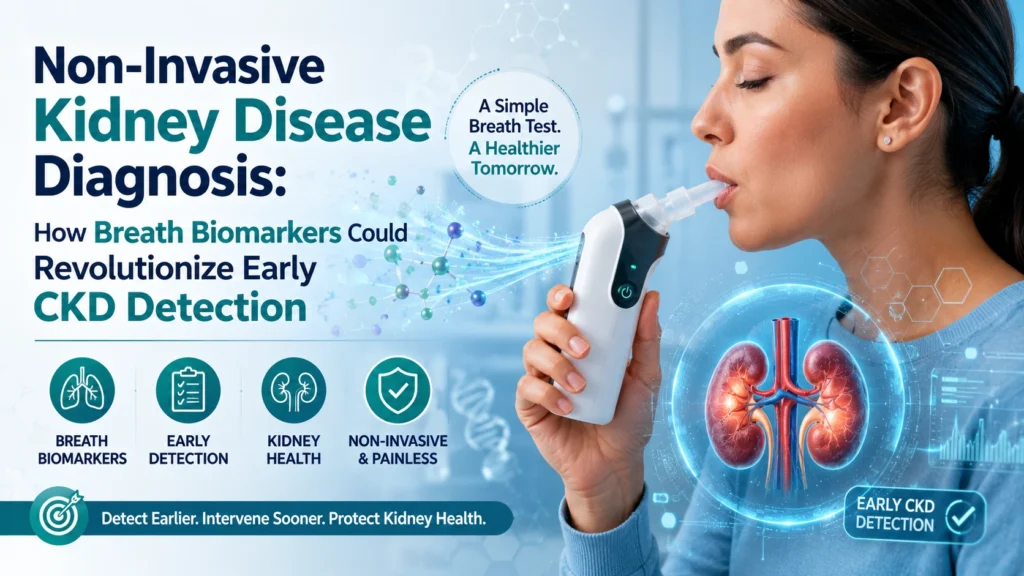
AI and VOCs: Perhaps the most futuristic frontier is the use of Artificial Intelligence and Volatile Organic Compounds (VOCs). Recent studies highlight urinary VOC profiling to diagnose Diabetic Kidney Disease with 86% accuracy using a chemiresistive biosensor and Random Forest. Raman spectroscopy combined with deep learning shows promise in distinguishing glomerular diseases.
4. What Does Kidney Failure Breath Smell Like?
Clinicians have long described a condition called “uremic breath” or “uremic fetor”. But what does it actually smell like? In medical literature, it is often described as:
- Ammoniacal – similar to urine or window cleaner.
- Fishy – a distinct fish-like odor.
- Fetid – a general, unpleasant stale smell.
5. Can Kidney Problems Cause Bad Breath?
Yes. Kidney problems can definitely cause bad breath. This connection is rooted in biochemistry. When the kidneys fail, they cannot efficiently filter out urea—a waste product of protein metabolism. This urea accumulates in the blood. In a process known as the “salivary extraction ratio,” urea from the blood leaks into the saliva. Once in the mouth, bacteria and enzymes (like urease) break down this urea into ammonia. This reaction releases that characteristic foul, ammonia-like smell on the breath.
It is important to note that “uremic odor” is a systemic, not just oral, phenomenon. Studies on patients with End-Stage Renal Disease (ESRD) show that dialysis reduces these compounds, improving the breath smell. (confirming the source is the blood)
6. How to Tell if Bad Breath is Coming from the Stomach?
While kidney issues create an “ammonia” or “fishy” breath, stomach issues usually create a different profile. If you are trying to pinpoint the source:
- Stomach (GI): Often presents as rotten eggs (sulfur) or sour acid. Usually linked to GERD, H. pylori, or gastric ulcers.
- Kidneys: Presents as ammonia or urine-like, often with a metallic or bitter taste in the mouth.
Accompanying symptoms: Stomach origin → heartburn, reflux, bloating. Kidney origin → changes in urination, fatigue, swelling in legs/ankles. If you have “ammonia breath” and swelling, the issue is likely kidney-related and requires urgent medical attention.
7. Can Kidney Problems Affect Your Mouth?
The mouth is a mirror to the body. Patients with CKD exhibit a range of oral symptoms.
| Condition | Explanation & Stats |
|---|---|
| Xerostomia (Dry Mouth) | Most common (up to 58.3% of patients). Caused by reduced salivary flow and gland fibrosis. |
| Uremic Stomatitis | Inflammation of mouth lining; mucosa may look red or white, “pasty” coating. Uremic odor in up to 36.6%. |
| Altered Taste (Dysgeusia) | Often bitter or metallic due to changes in saliva composition. |
| Bleeding & Petechiae | Due to anemia and platelet dysfunction—gums may bleed easily. |
| Pale Mucosa | Result of anemia (reduced erythropoietin). |
8. The Path Forward
The future of nephrology is bright and pain-free. The shift toward non-invasive kidney disease diagnosis is not just a convenience; it is a necessity for early detection and management. We are moving away from risky “one-time” snapshots of a biopsy toward continuous, safe monitoring. AI-driven biosensors, advanced imaging, and blood/urine biomarkers are the new frontline soldiers in the fight against renal disease.
FAQs
Disclosure: This article is for informational and educational purposes only. It does not constitute medical advice. The author and publisher are not medical professionals.
Disclaimer: The information regarding non-invasive diagnostics, biomarkers, and technologies is based on current scientific research and medical literature. However, medical science is constantly evolving. Some technologies mentioned (like specific VOC biosensors or Raman spectroscopy) are still primarily in the research phase or early adoption stages and may not be widely available. Always consult with a qualified healthcare provider for diagnosis and treatment options tailored to your specific health needs.
Written with care & science • 2026