
What Researchers Are Discovering (2024–2026)
Iodine has a single job in the human body, but it is impossible to overstate its importance. The only known function of this trace mineral is as a component of thyroid hormones—the chemical messengers that regulate metabolism in every single cell you have .
Without enough iodine, your thyroid cannot produce enough hormone. Metabolism slows. Energy plummets. Weight creeps up. And in pregnant women, the consequences extend to the developing brain of the fetus .
Here is the problem Americans do not hear enough about: iodine deficiency is making a quiet comeback.
While the introduction of iodized salt in the 1920s virtually eliminated goiter (the visible enlargement of the thyroid caused by severe deficiency), recent data suggests that iodine intake in the US has been steadily declining . The trend mirrors what researchers in the UK and Europe have already documented—where up to 70% of school-aged girls are now iodine insufficient .
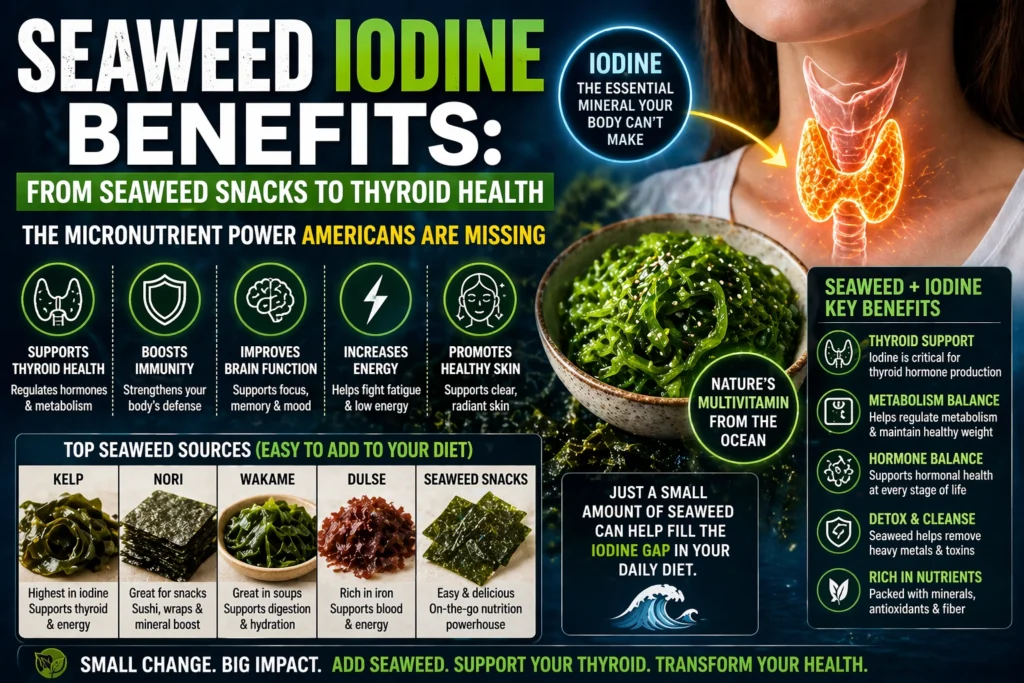
The solution is sitting on the shelves of your local grocery store, largely ignored: seaweed.
The bottom line: A small serving of certain seaweeds can provide your entire daily iodine requirement—and then some. But as with many powerful nutrients, more is not always better. The key is understanding how much you need, which seaweed to choose, and how to avoid the risks.
The Iodine-Thyroid Connection: Why This Mineral Matters
What Iodine Actually Does, seaweed iodine benefits
Your thyroid gland, a small butterfly-shaped organ at the front of your neck, is the body’s metabolic control center. It pulls iodine from your bloodstream and uses it to produce two critical hormones:
- Thyroxine (T4): The inactive storage form
- Triiodothyronine (T3): The active form that drives metabolism
Without adequate iodine, your thyroid cannot produce enough T4 and T3. The gland works overtime trying to compensate, which can lead to enlargement (goiter). Over time, the consequences become systemic .
Signs of Iodine Deficiency
Because thyroid hormones regulate metabolism throughout the body, deficiency produces a wide range of symptoms :
| Symptom Category | Specific Signs |
|---|---|
| Metabolic | Unexplained weight gain, feeling cold constantly, low body temperature |
| Energy | Fatigue, sluggishness, brain fog |
| Skin and hair | Dry, flaky skin; thinning hair; brittle nails |
| Digestive | Constipation |
| Cognitive | Poor concentration, memory issues |
| Reproductive | Menstrual irregularities, fertility problems |
Who Is at Risk?
Iodine deficiency is often framed as a problem of developing nations. But several groups in the US face elevated risk :
- People who avoid iodized salt – Many health-conscious consumers switch to sea salt, Himalayan pink salt, or kosher salt, none of which are routinely iodized
- Those who limit dairy and seafood – These are the primary dietary sources of iodine in the American diet
- Pregnant and breastfeeding women – Iodine requirements increase significantly during pregnancy and lactation (220–290 mcg/day versus 150 mcg for non-pregnant adults)
- Vegans and vegetarians – Without dairy, eggs, or seafood, plant-based eaters may struggle to meet iodine needs
A 2014 clinical study found that women who self-reported low consumption of dairy and seafood had baseline urinary iodine concentrations of just 40 mcg/L—well below the 100 mcg/L threshold for sufficiency .
Seaweed Iodine Benefits: What the Science Says
1. Effective Iodine Repletion in Deficient Individuals
A landmark study published in the British Journal of Nutrition tested a commercially available seaweed (Ascophyllum nodosum) in iodine-insufficient women. Participants consumed just 0.5 grams of seaweed daily for two weeks.
- Median urinary iodine concentration increased from 78 to 140 mcg/L (P < 0.001)
- The seaweed was palatable and acceptable to consumers as a whole food or food ingredient
- Iodine from seaweed was 33% bioavailable—slightly lower than potassium iodide supplements (59%), but still effective for repletion
The researchers concluded that “seaweed inclusion in staple foods would serve as an alternative to fortification of salt or other foods with potassium iodide” .
2. Thyroid Hormone Support (When Deficiency Is Present)
In iodine-deficient individuals, seaweed provides the raw material the thyroid needs to produce T4 and T3. This supports :
- Normal metabolic rate – Preventing the slowdown associated with hypothyroidism
- Energy regulation – Stable thyroid hormone levels help maintain consistent energy throughout the day
- Hormonal balance – Thyroid hormones influence reproductive health, body temperature regulation, and more
Important caveat: The 2025 systematic review published in Advances in Nutrition (including 72 studies) found no clear association between mild-to-moderate iodine deficiency and thyroid hormone levels in most population groups . This suggests that the thyroid has considerable adaptive capacity. However, severe deficiency—or deficiency during pregnancy—has well-documented consequences.
3. Metabolic Health and Weight Management
The connection between iodine, thyroid function, and metabolism is straightforward but often oversimplified in wellness marketing.
Here is what the evidence actually shows :
- In iodine-deficient individuals, correcting deficiency may restore normal metabolic rate, potentially leading to weight stabilization or modest loss if excess weight was related to hypothyroidism
- In iodine-sufficient individuals, additional iodine does NOT boost metabolism or cause weight loss
Seaweed has also been promoted for weight loss through other mechanisms—specifically, the fiber content (alginates) may increase feelings of fullness and modestly slow fat absorption. However, real-world weight-loss benefits are uncertain, and seaweed should be viewed as a nutrient-dense food rather than a weight loss supplement .
4. Beyond Iodine: Selenium, Zinc, and Synergistic Minerals
One of the overlooked advantages of whole seaweed versus isolated iodine supplements is the presence of cofactor minerals that support thyroid function :
| Mineral | Role in Thyroid Health |
|---|---|
| Selenium | Converts T4 (inactive) to T3 (active); protects thyroid from oxidative damage |
| Zinc | Helps regulate thyroid-stimulating hormone (TSH) production |
| Magnesium | Required for multiple enzymatic reactions in thyroid hormone synthesis |
This synergistic effect means that whole seaweed may offer advantages that isolated iodine supplements cannot match—particularly for individuals with underlying thyroid dysfunction or autoimmune thyroid conditions like Hashimoto’s thyroiditis .
5. Antioxidant and Anti-Inflammatory Properties
Brown seaweeds like bladderwrack contain unique compounds that may benefit thyroid health beyond iodine provision :
- Fucoidans – Sulfated polysaccharides with anti-inflammatory properties in lab and animal studies
- Phlorotannins – Seaweed-specific polyphenols that act as antioxidants
- Alginates – Soluble fibers that support gut health and may modulate immune function
For individuals with autoimmune thyroid conditions (Hashimoto’s, Graves’ disease), chronic inflammation affects thyroid function. The anti-inflammatory compounds in seaweed may be beneficial—but this remains an emerging area of research, and seaweed should never be used to self-treat thyroid disease .
The Risks You Need to Know (Serious, Not Scary)
This is the part that most wellness content glosses over—and it matters.
Too Much Iodine Is Dangerous
The Tolerable Upper Intake Level (UL) for iodine in adults is 1,100 mcg per day . Exceeding this regularly increases the risk of thyroid dysfunction—including both hypothyroidism (underactive) AND hyperthyroidism (overactive), depending on the individual’
1. Effective Iodine Repletion in Deficient Individuals
A landmark study published in the British Journal of Nutrition tested a commercially available seaweed (Ascophyllum nodosum) in iodine-insufficient women. Participants consumed just 0.5 grams of seaweed daily for two weeks.
The results were striking :
- Median urinary iodine concentration increased from 78 to 140 mcg/L (P < 0.001)
- The seaweed was palatable and acceptable to consumers as a whole food or food ingredient
- Iodine from seaweed was 33% bioavailable—slightly lower than potassium iodide supplements (59%), but still effective for repletion
The researchers concluded that “seaweed inclusion in staple foods would serve as an alternative to fortification of salt or other foods with potassium iodide” .
2. Thyroid Hormone Support (When Deficiency Is Present)
- Normal metabolic rate – Preventing the slowdown associated with hypothyroidism
- Energy regulation – Stable thyroid hormone levels help maintain consistent energy throughout the day
- Hormonal balance – Thyroid hormones influence reproductive health, body temperature regulation, and more
Important caveat: A 2025 systematic review published in Advances in Nutrition (including 72 studies) found no clear association between mild-to-moderate iodine deficiency and thyroid hormone levels in most population groups . This suggests that the thyroid has considerable adaptive capacity. However, severe deficiency—or deficiency during pregnancy—has well-documented consequences.
3. Metabolic Health and Weight Management
The connection between iodine, thyroid function, and metabolism is straightforward but often oversimplified in wellness marketing.
Here is what the evidence actually shows :
- In iodine-deficient individuals, correcting deficiency may restore normal metabolic rate, potentially leading to weight stabilization or modest loss if excess weight was related to hypothyroidism
- In iodine-sufficient individuals, additional iodine does NOT boost metabolism or cause weight loss
Seaweed has also been promoted for weight loss through other mechanisms—specifically, the fiber content (alginates) may increase feelings of fullness and modestly slow fat absorption. However, real-world weight-loss benefits are uncertain, and seaweed should be viewed as a nutrient-dense food rather than a weight loss supplement .
4. Beyond Iodine: Selenium, Zinc, and Synergistic Minerals
One of the overlooked advantages of whole seaweed versus isolated iodine supplements is the presence of cofactor minerals that support thyroid function :
| Mineral | Role in Thyroid Health |
|---|---|
| Selenium | Converts T4 (inactive) to T3 (active); protects thyroid from oxidative damage |
| Zinc | Helps regulate thyroid-stimulating hormone (TSH) production |
| Magnesium | Required for multiple enzymatic reactions in thyroid hormone synthesis |
This synergistic effect means that whole seaweed may offer advantages that isolated iodine supplements cannot match—particularly for individuals with underlying thyroid dysfunction or autoimmune thyroid conditions like Hashimoto’s thyroiditis .
5. Antioxidant and Anti-Inflammatory Properties
Brown seaweeds like bladderwrack contain unique compounds that may benefit thyroid health beyond iodine provision :
- Fucoidans – Sulfated polysaccharides with anti-inflammatory properties in lab and animal studies
- Phlorotannins – Seaweed-specific polyphenols that act as antioxidants
- Alginates – Soluble fibers that support gut health and may modulate immune function
For individuals with autoimmune thyroid conditions (Hashimoto’s, Graves’ disease), chronic inflammation affects thyroid function. The anti-inflammatory compounds in seaweed may be beneficial—but this remains an emerging area of research, and seaweed should never be used to self-treat thyroid disease .
The Risks You Need to Know (Serious, Not Scary)
This is the part that most wellness content glosses over—and it matters.
Too Much Iodine Is Dangerous
The Tolerable Upper Intake Level (UL) for iodine in adults is 1,100 mcg per day . Exceeding this regularly increases the risk of thyroid dysfunction—including both hypothyroidism (underactive) AND hyperthyroidism (overactive), depending on the individual’s underlying thyroid status.
Certain seaweeds, particularly kelp and bladderwrack, contain dangerously high levels of iodine. A single gram of kelp can provide 1,000–8,000+ mcg—potentially exceeding the UL in a single serving .
| Seaweed Type | Iodine per Gram | Risk Level |
|---|---|---|
| Kelp | 1,000–8,000+ mcg | High – Can exceed UL in one serving |
| Bladderwrack | Highly variable | High – Risk varies by batch |
| Wakame | 100–300 mcg | Low to moderate – Safe in typical portions |
| Nori | 15–50 mcg | Low – Very safe, even with multiple servings |
| Dulse | 50–150 mcg | Low – Generally safe |
Who Should Be Cautious
The following groups should exercise particular caution with seaweed consumption :
- People with known thyroid disease (Hashimoto’s, Graves’, goiter, thyroid nodules, or thyroid cancer)
- Those taking thyroid medication (levothyroxine, methimazole, propylthiouracil)
- Pregnant and breastfeeding women – While deficiency is dangerous, excessive iodine can also harm fetal thyroid development
- Individuals with pre-existing iodine sensitivity
Heavy Metal Contamination
Seaweeds absorb minerals from seawater—including beneficial ones like iodine, but also heavy metals like arsenic, cadmium, and lead . A 2021 study on bladderwrack (Fucus vesiculosus) found that arsenic concentrations exceeded regulatory limits for food and food supplements in 20% of samples .
What to look for on labels:
- Products that specifically state heavy metal testing
- Organic certification (reduces but does not eliminate heavy metal risk)
- Third-party testing seals (USP, NSF, or ConsumerLab)
Drug Interactions
Seaweed contains high levels of vitamin K, which can interfere with blood-thinning medications like warfarin (Coumadin). Anyone on anticoagulant therapy should speak with their doctor before adding seaweed to their diet .
What This Means for Americans in the Next 5 Years
The Shifting Landscape of Iodine Nutrition
Iodized salt has been the cornerstone of US iodine policy since the 1920s. But dietary patterns have changed dramatically :
- Processed foods – Most processed foods use non-iodized salt, and salt labeled “sea salt,” “kosher salt,” or “Himalayan salt” is rarely iodized
- Reduced dairy and seafood consumption – Particularly among younger generations and plant-based eaters
- Increased awareness of sodium intake – Public health messaging to reduce salt consumption has had the unintended consequence of reducing iodine intake
Emerging Research Directions (2024–2026)
| Research Area | Key Questions Being Investigated |
|---|---|
| Seaweed as a functional food | Can small amounts of seaweed in staple foods (bread, pasta, snacks) prevent deficiency without causing excess? |
| Bioavailability studies | How does iodine absorption from different seaweed species compare to iodized salt and supplements? |
| Heavy metal mitigation | Can processing methods (washing, boiling, fermentation) reduce heavy metal content without losing iodine? |
| Autoimmune thyroid disease | Does moderate seaweed consumption benefit or harm individuals with Hashimoto’s or Graves’? |
The 5-Year Outlook (2026–2031)
| Timeframe | Expected Development |
|---|---|
| 12-18 months | Larger clinical trials on seaweed iodine repletion in US populations |
| 2-3 years | Potential FDA guidance on seaweed labeling and heavy metal limits |
| 3-5 years | Increased availability of standardized, low-heavy-metal seaweed products in US grocery stores |
| 5 years | Possible integration of seaweed into public health iodine recommendations |
What Consumers in the US Can Already Access
Seaweed Products Available Today
| Product Type | Examples | Iodine Level | Best For |
|---|---|---|---|
| Roasted nori snacks | GimMe, SeaSnax, Annie Chun’s | Low (15–50 mcg per sheet) | Daily snacking, children, general wellness |
| Dulse flakes | Maine Coast Sea Vegetables, Sea Seasonings | Moderate (50–150 mcg per tsp) | Seasoning food instead of salt |
| Wakame (dried) | Asian grocery stores, Amazon | Moderate (100–300 mcg per serving) | Miso soup, salads |
| Kelp granules/powder | Health food stores | Very high (1,000+ mcg per serving) | Caution – Small amounts only |
| Kombu | Japanese grocery stores | Very high | Broth making (discard the kombu after cooking) |
How to Incorporate Seaweed Safely
For iodine-sufficient individuals (most Americans):
- Nori snacks: 1–2 sheets per day is safe and provides beneficial nutrients without iodine excess
- Dulse flakes: 1/4 to 1/2 teaspoon as a salt substitute
- Wakame in soup: Small handful per week
For individuals with confirmed iodine deficiency (via urinary iodine testing):
- Work with a healthcare provider to determine appropriate intake
- Consider standardized seaweed products with known iodine content
- Monitor thyroid function regularly
For individuals with thyroid disease:
- Do not self-treat with seaweed
- Consult an endocrinologist before adding any iodine-rich food
- Some thyroid conditions (e.g., Hashimoto’s) may benefit from moderate iodine; others (e.g., Graves’) may be worsened by it
What to Look for on Labels
When purchasing seaweed products in the US, look for :
- Iodine content per serving (not all products list this, but premium brands do)
- Heavy metal testing verification
- Organic certification (USDA Organic)
- Source location – Seaweed from pristine waters (e.g., Maine, Nova Scotia, Iceland) may have lower heavy metal content
What’s Coming (2026–2027)
| Product Type | Expected Availability |
|---|---|
| Standardized iodine seaweed supplements | Already available (e.g., NOW Foods, Life Extension) – choose brands with third-party testing |
| Seaweed-fortified foods | Bread, pasta, and snack bars with added seaweed (emerging in specialty markets) |
| At-home iodine testing kits | Increasingly available for urinary iodine self-assessment |
Seaweed Iodine Benefits vs. Other Iodine Sources
| Source | Iodine Content | Pros | Cons |
|---|---|---|---|
| Iodized salt | 45 mcg per 1/4 tsp | Cheap, consistent, widely available | Many consumers avoid salt; processed foods use non-iodized salt |
| Dairy (milk, yogurt) | 50–100 mcg per cup | Readily absorbed | Not suitable for vegans; declining consumption |
| Seafood (cod, shrimp, tuna) | 50–200 mcg per serving | Also provides omega-3s, protein | Expensive; not everyone eats seafood |
| Eggs | 25 mcg per egg | Widely available | Small amount per serving |
| Seaweed (nori/dulse) | 15–150 mcg per serving | Plant-based, rich in cofactor minerals | Variable iodine content; heavy metal risk with some species |
| Seaweed (kelp/bladderwrack) | 1,000–8,000+ mcg per serving | Highly concentrated | High risk of iodine excess – not recommended for regular use |
| Iodine supplements | 150–300 mcg per tablet | Consistent dosing | Lacks cofactor minerals; risk of excess if overused |
The takeaway: For most Americans, moderate consumption of low-iodine seaweeds (nori, dulse, wakame) offers the best balance of seaweed iodine benefits without the risks associated with kelp or bladderwrack .
The Bottom Line: What You Need to Know in 2026
Seaweed iodine benefits are real, significant, and under-discussed.
The science is clear: for iodine-deficient individuals, seaweed effectively repletes iodine stores, supports thyroid hormone production, and may help restore normal metabolic function . Whole seaweed offers advantages over isolated supplements, including synergistic cofactor minerals (selenium, zinc, magnesium) and anti-inflammatory compounds (fucoidans, phlorotannins) .
But here is what most wellness content will not tell you:
- Not all Americans are iodine deficient. The 2025 systematic review found that iodine deficiency remains a concern in specific populations (pregnant women, vegans, those avoiding iodized salt), but not the general population .
- More iodine is not better. The UL is 1,100 mcg per day. Kelp and bladderwrack can exceed this in a single serving, potentially causing thyroid dysfunction .
- Heavy metals are a real concern. Arsenic contamination in some seaweed products exceeds regulatory limits . Choose products with third-party testing.
- Seaweed is not a weight loss supplement. While correcting iodine deficiency may restore metabolic rate, additional iodine does not boost metabolism or cause weight loss.
What you can do right now:
- Assess your risk. Do you avoid iodized salt? Limit dairy and seafood? Eat a plant-based diet? Are you pregnant or breastfeeding? If yes, discuss iodine status with your healthcare provider.
- Choose the right seaweed. Nori, dulse, and wakame are generally safe for regular consumption. Avoid kelp and bladderwrack as daily staples.
- Read labels. Look for iodine content per serving, heavy metal testing, and organic certification.
- Do not self-treat thyroid disease. If you have Hashimoto’s, Graves’, goiter, thyroid nodules, or thyroid cancer, speak with an endocrinologist before adding seaweed to your diet.
The seaweed iodine benefits are a genuine nutritional opportunity—particularly for Americans who have quietly shifted away from iodized salt and dairy. But like all powerful nutrients, respect the dose, respect the source, and respect your individual biology.
FAQS:
What are the benefits of seaweed iodine?
Seaweed iodine benefits include supporting thyroid hormone production, maintaining normal metabolic rate, preventing goiter, and reducing the risk of iodine deficiency-related fatigue and weight gain. Whole seaweed also provides selenium, zinc, and magnesium—cofactor minerals essential for thyroid function.
How much seaweed should I eat for iodine?
For iodine maintenance: 1–2 sheets of nori daily or 1/4 teaspoon of dulse flakes. For confirmed iodine deficiency: work with a healthcare provider. Avoid kelp and bladderwrack as daily staples due to dangerously high iodine levels (1,000–8,000+ mcg per gram).
Is seaweed better than iodized salt for iodine?
It depends. Seaweed provides cofactor minerals (selenium, zinc, magnesium) that iodized salt lacks. However, iodized salt provides consistent, predictable iodine dosing (45 mcg per 1/4 tsp). Seaweed iodine content varies dramatically by species and batch. Both can be part of a healthy diet.
Can seaweed help with weight loss?
Indirectly, if you are iodine deficient. Correcting iodine deficiency may restore normal metabolic rate, potentially leading to weight stabilization. However, seaweed is not a weight loss supplement, and additional iodine does not boost metabolism in iodine-sufficient individuals.
Is seaweed safe for thyroid disease?
It depends on the condition. Individuals with Hashimoto’s may benefit from moderate iodine; those with Graves’ may be worsened by it. Do not self-treat thyroid disease with seaweed. Consult an endocrinologist.
Can you get too much iodine from seaweed?
Yes. Kelp and bladderwrack can provide 1,000–8,000+ mcg of iodine per gram—exceeding the safe upper limit (1,100 mcg per day) in a single serving. Excessive iodine can cause both hypothyroidism and hyperthyroidism, depending on individual factors.