
Modern nutrition has created a strange paradox: millions of people eat enough calories every day yet still experience exhaustion, brain fog, tingling nerves, and low stamina. One overlooked reason is what some experts call “hidden B12 hunger” — a state where the body struggles to absorb or properly use vitamin B12 even when food intake seems normal.
Unlike obvious starvation, this deficiency develops quietly. Energy slowly drops. Focus weakens. Sleep no longer feels refreshing. Many people blame stress or aging while the real issue may involve a deeper nutritional problem happening at the cellular level.
Why Vitamin B12 Matters More Than Most People Realize
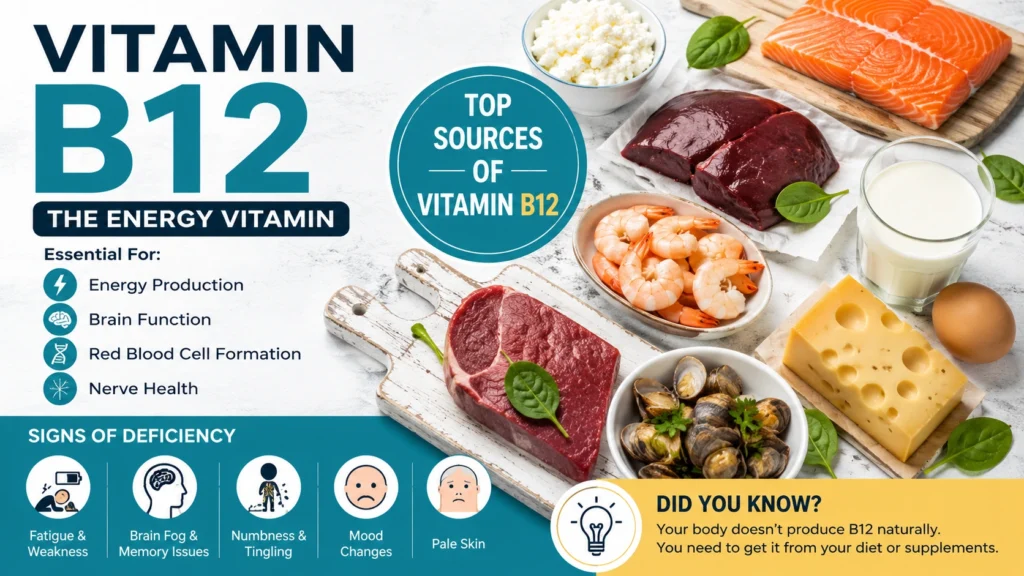
Vitamin B12 is not just another vitamin. It is essential for:
- red blood cell formation
- oxygen transport
- nerve protection
- DNA synthesis
- brain signaling
- mitochondrial energy production
Without enough usable B12, the body cannot efficiently convert food into cellular energy.
This means:
You can eat enough food and still feel biologically “underpowered.”
The Modern B12 Problem: Absorption, Not Just Intake
Many people assume deficiency only affects vegans. In reality, a growing number of adults consume B12-containing foods but still develop low levels because absorption becomes impaired.
Common hidden causes include:
- low stomach acid
- chronic gastritis
- gut inflammation
- aging-related digestive decline
- long-term antacid use
- metformin medication
- poor gut microbiome diversity
- highly processed diets
The body needs stomach acid and a protein called intrinsic factor to absorb B12 correctly. When digestion weakens, absorption may fall dramatically.
Signs of “Hidden B12 Hunger”
Symptoms are often vague at first and may be mistaken for burnout or stress.
Early Warning Signs
- constant fatigue
- low motivation
- brain fog
- dizziness
- headaches
- poor concentration
- mood changes
Nervous System Symptoms
- tingling hands or feet
- numbness
- balance problems
- muscle weakness
- memory lapses
Advanced Deficiency
- nerve damage
- walking difficulty
- cognitive decline
- severe anemia
Why Processed Diets Make the Problem Worse
Many ultra-processed foods contain calories but lack nutrient density. Even fortified foods may not compensate for poor digestion or unhealthy gut function.
High sugar intake, alcohol excess, and nutrient-poor diets can increase metabolic stress while reducing nutrient efficiency.
This creates a dangerous cycle:
- lower nutrient absorption
- lower cellular energy
- increased fatigue
- poorer dietary choices
The Gut–Brain–Energy Connection
Researchers increasingly recognize the connection between gut health and neurological function.
Poor digestion may affect:
- nutrient absorption
- inflammation levels
- neurotransmitter production
- mitochondrial activity
Vitamin B12 sits at the center of this relationship because it directly supports nerve insulation and brain signaling.
Some people with low-normal B12 levels still experience symptoms because their cells cannot efficiently utilize the vitamin — a condition sometimes described as functional B12 deficiency.
Vitamin B12 and Appetite: Understanding the “Hidden Hunger” Connection
If you’ve noticed a gnawing hunger after starting B12 supplements, you’re not imagining things. And yes, “hidden hunger” is a real medical phenomenon—though it might not mean what you think.
Let me walk you through the fascinating connection between vitamin B12, appetite changes, and the global concept of hidden hunger.
Why Does B12 Make Me So Hungry?
This is a common and often surprising experience. The short answer is that B12 plays a direct role in regulating your appetite and metabolism. When you correct a longstanding deficiency, your body essentially “wakes up” and starts functioning properly again.
Here’s what the research shows:
B12 deficiency frequently causes loss of appetite. According to a clinical study of vegans with B12 deficiency, 90.1% presented with “loss of appetite, excess fatigue, mood swings and irritability” as their most common symptoms . Loss of appetite is consistently listed as a hallmark symptom of low B12 levels .
When you supplement, your appetite returns to normal. The same study found that treatment with B12 brought about a “dramatic improvement” in 85.7% of deficient participants, with 93.5% showing “perceptible improvement in wellbeing” within three months .
Think of it this way: if B12 deficiency suppressed your appetite, then replenishing your B12 levels removes that suppression. You’re not experiencing increased hunger—you’re experiencing normal hunger returning after a period of deficiency-induced appetite loss.
A note on weight and metabolism: B12 is essential for converting food into energy. As your metabolism normalizes, your body’s energy demands become more apparent, which can feel like increased hunger. This is typically a positive sign that treatment is working.
When to be cautious: Paradoxically, very high B12 levels have been associated with certain conditions. One study on anorexia nervosa found that about 38.5% of patients displayed B12 levels above the normal range, which correlated with more severe symptoms . This is a specific clinical scenario, but it highlights that balance matters—more B12 is not automatically better.
Is Hidden Hunger a Real Thing?
Absolutely. Hidden hunger is a well-established global health concept recognized by major organizations including the United Nations, the World Health Organization (WHO), and the Food and Agriculture Organization (FAO).
The United Nations defines hidden hunger as follows:
“Food security has been understood by many as when all people have physical and economic access to sufficient, safe, and nutritious food to meet their dietary needs. However, the ability of a household to acquire sufficient food does not necessarily guarantee adequate nutrition. Thus, even in the absence of hunger, the population may suffer from the lack of essential micronutrients, often referred to as hidden hunger.”
The WHO estimates that approximately 1.7 million deaths worldwide (2.8% of all deaths) are attributed to low fruit and vegetable consumption, which is partly related to micronutrient deficiencies .
Global statistics are staggering:
- 2 billion people globally suffer from hidden hunger
- 20.3 billion (37% of the global population) have iron-deficiency anemia
- 1.99 billion (35% of the global population) are iodine deficient
- 254 million preschool children are vitamin A deficient
In India alone, the National Family Health Survey (NFHS-5) found anemia prevalence at 67.1% among children (6-59 months) and 52.2% among women (15-49 years) . As one student researcher described it, hidden hunger is “about hiding the real issue behind calories—we distribute rice and wheat, but where is the protein? Where are the legumes and vegetables?”
What Is the Concept of Hidden Hunger?
The concept of hidden hunger is elegantly simple but critically important:
Hidden hunger = micronutrient deficiency without calorie deficiency.
You can eat enough food to feel “full” and still be malnourished if that food lacks essential vitamins and minerals. As the Chinese Center for Disease Control explains:
“Energy nutrient deficiency leads to ‘visible hunger’ that ‘eating enough’ can solve. But micronutrient deficiency leads to ‘hidden hunger’ that must be solved by ‘eating well.'”
What Causes Hidden Hunger?
| Cause | Explanation |
|---|---|
| Limited dietary diversity | Reliance on staple grains (rice, wheat, corn) without fruits, vegetables, or animal products |
| Nutrient depletion in soil | Modern farming practices have reduced micronutrient content in crops |
| Food processing | Refining grains removes nutrient-rich bran and germ layers |
| Economic constraints | Nutrient-dense foods (meat, fish, fresh produce) are often more expensive |
Which Micronutrients Are Most Commonly Deficient?
The “big three” hidden hunger deficiencies are:
- Iron – leads to anemia, fatigue, impaired cognitive function
- Iodine – causes goiter, cretinism, developmental delays
- Vitamin A – causes night blindness, weakened immunity
Additional common deficiencies include zinc, calcium, folate, and of course, vitamin B12—particularly among vegans, older adults, and those with absorption disorders .
The “Double Burden” of Malnutrition
A particularly concerning trend is the coexistence of hidden hunger with obesity. People can be overweight or obese due to excess calorie consumption while simultaneously being deficient in essential micronutrients. This has been termed the “double burden of malnutrition” .
Solutions to Hidden Hunger
Public health strategies include :
| Strategy | Examples |
|---|---|
| Supplementation | Vitamin A capsules for children, iron-folic acid for pregnant women |
| Food fortification | Iodized salt, iron-fortified flour, vitamin D in milk |
| Dietary diversification | Promoting consumption of fruits, vegetables, legumes, and animal products |
| Biofortification | Breeding crops with higher nutrient content (e.g., golden rice with beta-carotene) |
Do You Feel Hungry When Your B12 Is Low?
Generally, no—in fact, the opposite is true.
The clinical evidence is clear: loss of appetite is a symptom of B12 deficiency, not increased hunger .
Symptoms of Low B12: The Complete Picture
Here are the documented symptoms of B12 deficiency :
| Category | Specific Symptoms |
|---|---|
| General | Fatigue, weakness, lethargy, feeling faint, breathlessness |
| Gastrointestinal | Loss of appetite, weight loss, constipation, altered taste |
| Neurological | Numbness and tingling in hands/feet (paresthesia), balance problems, disturbed vision |
| Cognitive/Mood | Depression, confusion, memory problems, irritability |
| Physical signs | Pale or “lemon-colored” skin, sore red tongue, mouth ulcers, tinnitus |
A Real-World Example of Severe Deficiency
A sobering case report from the Society of Hospital Medicine describes a 45-year-old man who went on a 7-month hunger strike, consuming only one meal per day. He developed severe B12 deficiency (82 pg/ml; normal is >200 pg/ml), leading to:
- Paraplegia (loss of leg function)
- Urinary and fecal incontinence
- Subacute combined degeneration of the spinal cord
- Deep vein thrombosis (blood clots)
Despite treatment, his urinary incontinence persisted. The authors concluded: “This case illustrates how delays in diagnosing vitamin B12 deficiency can result in a personal tragedy” .
Why the Confusion?
It’s easy to see why people might associate B12 with hunger. Consider:
- Weight loss is common in B12 deficiency due to appetite loss . When you start supplementing and regain your appetite, weight stabilizes or returns to normal—which feels like “increased” hunger.
- B12 is essential for metabolism. As your metabolic rate normalizes, you may notice hunger signals more acutely.
- Improved energy levels mean you’re more active, burning more calories, and needing more fuel.
But the underlying reality is consistent: B12 deficiency suppresses appetite; B12 replenishment restores normal appetite.
Summary Table: B12 and Your Appetite
If you’re experiencing increased hunger after starting B12 supplements, this is likely a sign that treatment is working—your body is returning to normal appetite regulation after a period of deficiency.
However, pay attention to your body. If the hunger feels excessive or is accompanied by other symptoms like rapid weight gain, anxiety, or heart palpitations, consult your healthcare provider. They may want to check your B12 levels to ensure you’re not overshooting the target.
And remember: hidden hunger is real. Eating enough calories does not guarantee getting enough nutrients. A balanced diet rich in diverse, whole foods is the best defense against both visible and hidden hunger.
Best Food Sources for Optimal B12 Absorption
Not all B12 foods work equally well for every person. Bioavailability matters.
Highly Bioavailable Sources
- clams
- sardines
- salmon
- eggs
- yogurt
- milk
- liver
- lean meat
These foods provide protein and co-factors that may help absorption.
Vegetarian-Friendly B12 Options
People following vegetarian or plant-based diets may need fortified foods regularly.
Helpful options include:
- fortified nutritional yeast
- fortified cereals
- fortified oat milk
- fortified soy milk
- probiotic yogurt
Strict vegans are at higher risk because natural plant foods contain very little active B12.
Nutrients That Work Together With B12
Vitamin B12 does not work alone. Several nutrients support its metabolic function.
| Nutrient | Why It Helps |
|---|---|
| Folate | Supports red blood cell formation |
| Iron | Oxygen transport |
| Magnesium | Energy metabolism |
| Vitamin B6 | Nervous system support |
| Protein | Nutrient transport |
| Probiotics | Gut health and absorption |
A balanced nutritional approach often works better than focusing on one vitamin alone.
Can You Have Normal B12 Blood Levels but Still Feel Symptoms?
Yes. Standard blood tests do not always reflect how effectively cells use vitamin B12.
Some doctors may also evaluate:
- methylmalonic acid (MMA)
- homocysteine
- complete blood count (CBC)
Functional deficiencies can sometimes appear before severe lab abnormalities develop.
How to Improve B12 Status Naturally
1. Improve Digestive Health
- reduce excessive processed foods
- support stomach acid naturally
- eat protein-rich meals
- improve gut microbiome diversity
2. Choose Nutrient-Dense Foods
Focus on whole foods with naturally high B12 content.
3. Consider Supplementation if Needed
Common forms include:
- methylcobalamin
- cyanocobalamin
Some individuals with severe deficiency may require injections.
The Bigger Picture: Energy Is More Than Calories
Modern health conversations often focus on calories, weight, or caffeine. But real biological energy depends heavily on nutrient availability at the cellular level.
Vitamin B12 deficiency reminds us that:
feeling exhausted is not always about how much you eat — sometimes it is about what your body can actually absorb and use.
Understanding hidden nutrient deficiencies early may help protect long-term brain, nerve, and metabolic health.
FAQ:
Can low B12 cause severe fatigue?
Yes. Vitamin B12 is essential for energy production and oxygen transport.
Which people are most at risk for B12 deficiency?
Older adults, vegans, vegetarians, people with digestive disorders, and long-term antacid or metformin users.
Is brain fog linked to low B12?
Low B12 may affect nerve signaling, memory, focus, and cognitive clarity.
What is the best natural source of vitamin B12?
Clams, liver, fish, eggs, dairy products, and fortified foods are among the best sources.
Can gut problems affect B12 absorption?
Yes. Stomach acid, gut inflammation, and microbiome imbalance can interfere with absorption.
FAQ: Hidden Vitamin B12 Deficiency, Fatigue, and Recovery
Can Vitamin B12 Deficiency Ruin Your Life?
Severe untreated vitamin B12 deficiency can seriously affect quality of life. Some people experience:
- extreme fatigue
- nerve pain
- tingling or numbness
- memory problems
- depression
- balance issues
- difficulty concentrating
Long-term deficiency may lead to permanent nerve damage if ignored for too long. Early diagnosis and treatment are important because many symptoms improve when B12 levels are corrected.
Can Vitamin B12 Deficiency Be a Sign of Cancer?
Sometimes low B12 can be linked to underlying medical conditions, including:
- stomach disorders
- intestinal disease
- autoimmune conditions
- rarely, certain cancers affecting digestion or absorption
Low B12 alone does not mean someone has cancer. However, unexplained deficiency—especially with weight loss, anemia, or digestive symptoms—should be medically evaluated.
What Is Pernicious Anemia?
Pernicious Anemia is an autoimmune condition where the body attacks cells that help absorb vitamin B12.
People with pernicious anemia cannot properly absorb B12 from food because they lack intrinsic factor, a protein needed for absorption.
Common symptoms include:
- severe fatigue
- pale skin
- nerve symptoms
- tongue soreness
- memory issues
Treatment often requires lifelong B12 supplementation or injections.
Unusual Symptoms of B12 Deficiency
Many people only know about fatigue, but unusual symptoms may include:
- burning feet
- electric shock sensations
- sensitivity to light
- mouth ulcers
- ringing in ears
- anxiety or panic feelings
- vision changes
- strange smells or taste changes
- muscle twitching
- balance problems
Because symptoms can mimic stress or aging, deficiency is often missed early.
Common B12 Deficiency Symptoms
Early Symptoms
- tiredness
- weakness
- dizziness
- headaches
- brain fog
Moderate Symptoms
- numbness
- tingling hands and feet
- poor memory
- mood changes
- shortness of breath
Severe Symptoms
- walking difficulty
- nerve damage
- cognitive decline
- severe anemia
What Causes Low B12?
Low vitamin B12 can happen due to:
Poor Intake
- vegan diets
- low animal-food intake
- malnutrition
Poor Absorption
- low stomach acid
- gut inflammation
- aging
- digestive disorders
Medical Causes
- pernicious anemia
- Crohn’s disease
- gastric surgery
Medication-Related Causes
- metformin
- acid reducers
- long-term antacids
Is It OK to Take 1000 mcg of B12 a Day?
In many cases, yes. Vitamin B12 is water-soluble, and high oral doses such as 1000 mcg are commonly used for deficiency treatment.
However:
- dosage depends on the cause
- some people need injections instead
- medical guidance is important for long-term use
People with severe neurological symptoms should not self-treat without evaluation.
What Foods Have Vitamin B12?
Best Natural Sources
| Food | B12 Content |
|---|---|
| Clams | Extremely high |
| Liver | Very high |
| Sardines | Excellent |
| Salmon | Excellent |
| Eggs | Moderate |
| Milk | Good source |
| Yogurt | Helpful |
| Cheese | Moderate |
| Chicken | Moderate |
Vegetarian Options
- fortified cereals
- fortified plant milk
- fortified nutritional yeast
Strict vegans usually need supplementation.
Why Am I Still Tired After Taking B12?
Several reasons are possible:
1. Recovery Takes Time
Nerves and red blood cells may need weeks or months to recover.
2. Poor Absorption
Some people cannot absorb oral B12 effectively.
3. Other Deficiencies
Low:
- iron
- folate
- vitamin D
- magnesium
can also cause fatigue.
4. Functional Deficiency
Cells may not utilize B12 efficiently even if blood levels improve.
5. Another Underlying Condition
Fatigue can also relate to:
- thyroid disease
- sleep disorders
- chronic inflammation
- depression
- anemia
Why Isn’t B12 Giving Me Energy?
Vitamin B12 is not a stimulant like caffeine. It helps restore normal cellular function over time.
If your fatigue is unrelated to deficiency, taking extra B12 may not create an “energy boost.”
Some people notice improvements only after:
- correcting multiple nutrient deficiencies
- improving sleep
- treating gut problems
- resolving anemia
What Are the 4 Stages of B12 Deficiency?
Stage 1 — Low Blood Levels
B12 stores begin falling silently.
Stage 2 — Cellular Stress
Metabolic markers like homocysteine and MMA may rise.
Stage 3 — Symptom Development
Fatigue, brain fog, numbness, and weakness appear.
Stage 4 — Neurological Damage
Long-term deficiency may cause nerve injury and cognitive problems.
Early treatment improves outcomes significantly.
What Is the Fastest Way to Fix B12 Deficiency?
The fastest approach depends on severity.
Mild Deficiency
- high-dose oral supplements
- improved diet
Moderate to Severe Deficiency
Doctors may recommend:
- B12 injections
- methylcobalamin therapy
- treating underlying absorption problems
Recovery is usually faster when the root cause is identified early.
Final Insight
Many people think exhaustion is simply stress or aging. But hidden vitamin B12 deficiency can quietly affect:
- energy
- nerves
- mood
- cognition
- metabolism
Recognizing symptoms early may help prevent long-term complications.
Disclaimer
This article is for educational purposes only and does not replace professional medical advice, diagnosis, or treatment. Consult a qualified healthcare professional for testing or persistent symptoms related to vitamin B12 deficiency.