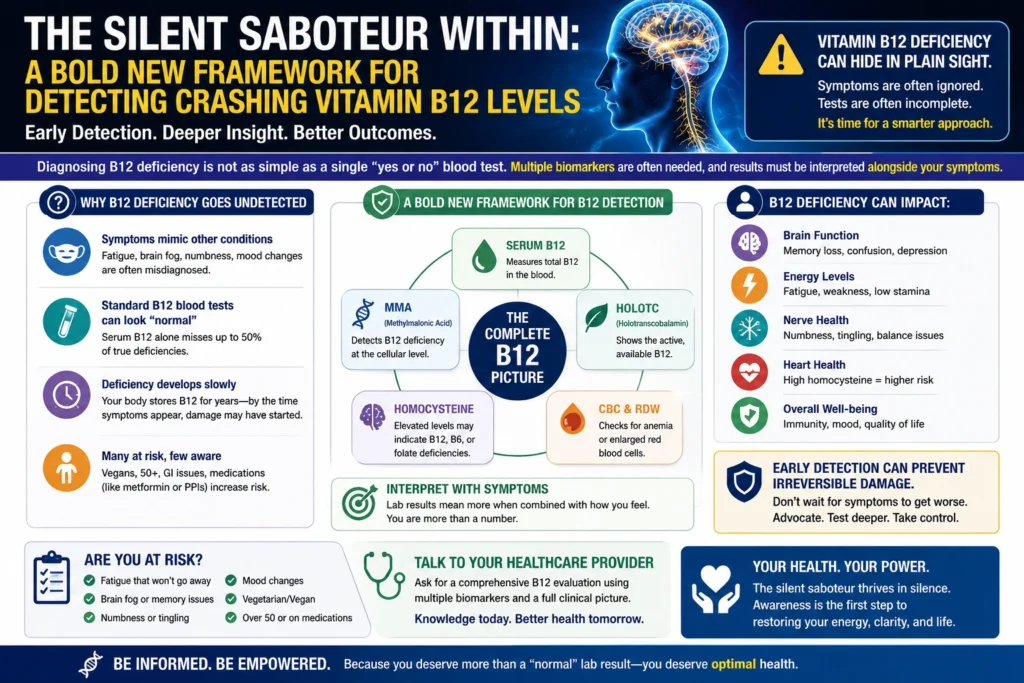

That lingering fatigue, the tingling in your hands, or the growing forgetfulness might not be “just aging.” These could be signs that your vitamin B12 levels are declining ,The Silent Saboteur Within— and catching it early is critical.
Unmask the silent thief of your vitality by mastering a ruthless diagnostic triad—scrutinizing your risk factors, demanding a complete blood count that exposes oversized red blood cells, and forcing advanced functional markers like methylmalonic acid to reveal whether your cells are quietly starving for B12 before irreversible nerve damage steals your future.
Vitamin B12 is essential for brain function, nerve health, and red blood cell production . A deficiency can develop slowly, and symptoms are often subtle at first. However, if left undiagnosed, it can lead to permanent nerve damage .
Here is exactly how medical professionals diagnose declining B12 levels — and the steps you can take to get tested.
Step 1: Recognize the Risk Factors and Warning Signs
Testing for vitamin B12 isn’t recommended for everyone. According to clinical guidelines, testing is only appropriate when there is a “reasonable clinical suspicion of deficiency” due to risk factors or symptoms .
Who Is at Risk?
Symptoms to Watch For
A 2026 review in Australian Prescriber outlines the following clinical manifestations of B12 deficiency :
Critical warning: Severe deficiency can cause subacute combined degeneration of the spinal cord — a condition that may not be fully reversible even after treatment . Early diagnosis is essential.
Step 2: The Diagnostic Testing Pathway
Diagnosing B12 deficiency is not as simple as a single “yes or no” blood test. Multiple biomarkers are often needed, and results must be interpreted alongside your symptoms .
Initial Screening (First-Line Tests)
1. Complete Blood Count (CBC)
Doctors typically start with a CBC to look for anemia. In B12 deficiency, red blood cells become abnormally large — a condition called macrocytic anemia. A blood smear may also reveal hypersegmented neutrophils (white blood cells with too many lobes), which is a classic sign .
2. Total Serum Vitamin B12
This is the most common and cost-effective test. It measures both the active and inactive forms of B12 in your blood .
| Total B12 Level | Interpretation |
|---|---|
| Less than 133 pmol/L (approx. 180 pg/mL) | Deficiency is likely |
| 133 to 258 pmol/L | Indeterminate (borderline) |
| Greater than 258 pmol/L | Deficiency is unlikely |
Important caveat: Total B12 can be falsely normal or high in some people with pernicious anemia due to antibody interference with the lab assay . Conversely, low B12 levels can occur without true tissue deficiency (e.g., in pregnancy or with oral contraceptive use) .
Confirmatory Tests (When Results Are Unclear)
Methylmalonic Acid (MMA)
MMA is a metabolic intermediate that accumulates when your body doesn’t have enough B12. It is considered a functional biomarker — it tells you what’s happening at the tissue level .
- Normal MMA essentially rules out B12 deficiency.
- Elevated MMA suggests functional B12 deficiency, though it can also be high in chronic kidney disease .
- MMA testing is often used to confirm deficiency in asymptomatic high-risk individuals with low-normal B12 levels .
Homocysteine
This is another functional biomarker. Elevated homocysteine can indicate B12 deficiency, but it is less specific — it also rises in folate deficiency, vitamin B6 deficiency, hypothyroidism, and kidney disease .
Active B12 (Holotranscobalamin)
This test measures only the biologically active fraction of B12 — the form that is actually available to your cells. It is particularly useful when total B12 results are indeterminate, or during pregnancy when total B12 naturally drops. However, it is more expensive and less widely available .
The bottom line from experts: “Laboratory results alone are insufficient to determine unequivocally which individuals need substitution. Laboratory diagnostics must be complemented by individual history and clinical symptoms” .
Step 3: Determining the Underlying Cause
Once B12 deficiency is confirmed, especially in younger patients, doctors will search for the root cause .
Common Diagnostic Follow-Ups
| Suspected Cause | Diagnostic Test |
|---|---|
| Pernicious anemia (autoimmune) | Anti-intrinsic factor antibodies, anti-parietal cell antibodies, fasting gastrin level |
| Celiac disease | Serological testing (tissue transglutaminase antibodies) |
| H. pylori infection | Stool antigen test or breath test |
| Bacterial overgrowth | Glucose or lactulose breath test |
| Gastric atrophy | Endoscopy with biopsy |
Pernicious anemia, caused by an autoimmune attack on stomach cells that produce intrinsic factor, is a particularly important diagnosis to make because it requires lifelong B12 therapy .
Step 4: At-Home Testing Options (And Their Limitations)
At-home B12 test kits are available for purchase online, typically costing between 65and90 .
How they work:
- Blood spot tests: You prick your finger, place a few drops of blood on a card, and mail it to a lab. Some measure total B12, while others measure active B12 (holotranscobalamin) .
- Urine tests: Some kits test urine for MMA levels .
Important limitations:
- At-home tests should not replace a medical evaluation, especially if you have symptoms.
- Many kits measure only one marker (e.g., total B12 or active B12), which may miss deficiency if interpreted in isolation.
- If results are abnormal, you will need to see a doctor anyway for confirmation and to determine the underlying cause.
- Online self-assessment questionnaires, while helpful for raising awareness, cannot diagnose deficiency — only a blood test can .
Medical schemes note: In some countries, B12 deficiency anemia is recognized as a condition that must be covered by insurance when it is severe or life-threatening .
Summary: The Diagnostic Process at a Glance
When Should You See a Doctor?
Do not rely solely on at-home tests or “wait and see.” Seek medical evaluation if:
- You have persistent fatigue, weakness, or shortness of breath .
- You experience tingling, numbness, or balance problems.
- You are over 65 and have noticed memory changes or confusion (B12 deficiency can mimic dementia) .
- You follow a strict vegan diet and are not taking B12 supplements.
- You have been on metformin or acid-reducing medications for more than a year .
Early diagnosis prevents permanent damage. A simple blood test could change the course of your health.
Vitamin B12 and Appetite: Understanding the “Hidden Hunger” Connection
If you’ve noticed a gnawing hunger after starting B12 supplements, you’re not imagining things. And yes, “hidden hunger” is a real medical phenomenon—though it might not mean what you think.
Let me walk you through the fascinating connection between vitamin B12, appetite changes, and the global concept of hidden hunger.
Why Does B12 Make Me So Hungry?
This is a common and often surprising experience. The short answer is that B12 plays a direct role in regulating your appetite and metabolism. When you correct a longstanding deficiency, your body essentially “wakes up” and starts functioning properly again.
Here’s what the research shows:
B12 deficiency frequently causes loss of appetite. According to a clinical study of vegans with B12 deficiency, 90.1% presented with “loss of appetite, excess fatigue, mood swings and irritability” as their most common symptoms . Loss of appetite is consistently listed as a hallmark symptom of low B12 levels .
When you supplement, your appetite returns to normal. The same study found that treatment with B12 brought about a “dramatic improvement” in 85.7% of deficient participants, with 93.5% showing “perceptible improvement in wellbeing” within three months .
Think of it this way: if B12 deficiency suppressed your appetite, then replenishing your B12 levels removes that suppression. You’re not experiencing increased hunger—you’re experiencing normal hunger returning after a period of deficiency-induced appetite loss.
A note on weight and metabolism: B12 is essential for converting food into energy. As your metabolism normalizes, your body’s energy demands become more apparent, which can feel like increased hunger. This is typically a positive sign that treatment is working.
When to be cautious: Paradoxically, very high B12 levels have been associated with certain conditions. One study on anorexia nervosa found that about 38.5% of patients displayed B12 levels above the normal range, which correlated with more severe symptoms . This is a specific clinical scenario, but it highlights that balance matters—more B12 is not automatically better.
Is Hidden Hunger a Real Thing?
Absolutely. Hidden hunger is a well-established global health concept recognized by major organizations including the United Nations, the World Health Organization (WHO), and the Food and Agriculture Organization (FAO).
The United Nations defines hidden hunger as follows:
“Food security has been understood by many as when all people have physical and economic access to sufficient, safe, and nutritious food to meet their dietary needs. However, the ability of a household to acquire sufficient food does not necessarily guarantee adequate nutrition. Thus, even in the absence of hunger, the population may suffer from the lack of essential micronutrients, often referred to as hidden hunger.”
The WHO estimates that approximately 1.7 million deaths worldwide (2.8% of all deaths) are attributed to low fruit and vegetable consumption, which is partly related to micronutrient deficiencies .
Global statistics are staggering:
- 2 billion people globally suffer from hidden hunger
- 20.3 billion (37% of the global population) have iron-deficiency anemia
- 1.99 billion (35% of the global population) are iodine deficient
- 254 million preschool children are vitamin A deficient
In India alone, the National Family Health Survey (NFHS-5) found anemia prevalence at 67.1% among children (6-59 months) and 52.2% among women (15-49 years) . As one student researcher described it, hidden hunger is “about hiding the real issue behind calories—we distribute rice and wheat, but where is the protein? Where are the legumes and vegetables?”
What Is the Concept of Hidden Hunger?
The concept of hidden hunger is elegantly simple but critically important:
Hidden hunger = micronutrient deficiency without calorie deficiency.
You can eat enough food to feel “full” and still be malnourished if that food lacks essential vitamins and minerals. As the Chinese Center for Disease Control explains:
“Energy nutrient deficiency leads to ‘visible hunger’ that ‘eating enough’ can solve. But micronutrient deficiency leads to ‘hidden hunger’ that must be solved by ‘eating well.'”
What Causes Hidden Hunger?
| Cause | Explanation |
|---|---|
| Limited dietary diversity | Reliance on staple grains (rice, wheat, corn) without fruits, vegetables, or animal products |
| Nutrient depletion in soil | Modern farming practices have reduced micronutrient content in crops |
| Food processing | Refining grains removes nutrient-rich bran and germ layers |
| Economic constraints | Nutrient-dense foods (meat, fish, fresh produce) are often more expensive |
Which Micronutrients Are Most Commonly Deficient?
The “big three” hidden hunger deficiencies are:
- Iron – leads to anemia, fatigue, impaired cognitive function
- Iodine – causes goiter, cretinism, developmental delays
- Vitamin A – causes night blindness, weakened immunity
Additional common deficiencies include zinc, calcium, folate, and of course, vitamin B12—particularly among vegans, older adults, and those with absorption disorders .
The “Double Burden” of Malnutrition
A particularly concerning trend is the coexistence of hidden hunger with obesity. People can be overweight or obese due to excess calorie consumption while simultaneously being deficient in essential micronutrients. This has been termed the “double burden of malnutrition” .
Solutions to Hidden Hunger
Public health strategies include :
| Strategy | Examples |
|---|---|
| Supplementation | Vitamin A capsules for children, iron-folic acid for pregnant women |
| Food fortification | Iodized salt, iron-fortified flour, vitamin D in milk |
| Dietary diversification | Promoting consumption of fruits, vegetables, legumes, and animal products |
| Biofortification | Breeding crops with higher nutrient content (e.g., golden rice with beta-carotene) |
Do You Feel Hungry When Your B12 Is Low?
Generally, no—in fact, the opposite is true.
The clinical evidence is clear: loss of appetite is a symptom of B12 deficiency, not increased hunger .
Symptoms of Low B12: The Complete Picture
Here are the documented symptoms of B12 deficiency :
| Category | Specific Symptoms |
|---|---|
| General | Fatigue, weakness, lethargy, feeling faint, breathlessness |
| Gastrointestinal | Loss of appetite, weight loss, constipation, altered taste |
| Neurological | Numbness and tingling in hands/feet (paresthesia), balance problems, disturbed vision |
| Cognitive/Mood | Depression, confusion, memory problems, irritability |
| Physical signs | Pale or “lemon-colored” skin, sore red tongue, mouth ulcers, tinnitus |
A Real-World Example of Severe Deficiency
A sobering case report from the Society of Hospital Medicine describes a 45-year-old man who went on a 7-month hunger strike, consuming only one meal per day. He developed severe B12 deficiency (82 pg/ml; normal is >200 pg/ml), leading to:
- Paraplegia (loss of leg function)
- Urinary and fecal incontinence
- Subacute combined degeneration of the spinal cord
- Deep vein thrombosis (blood clots)
Despite treatment, his urinary incontinence persisted. The authors concluded: “This case illustrates how delays in diagnosing vitamin B12 deficiency can result in a personal tragedy” .
Why the Confusion?
It’s easy to see why people might associate B12 with hunger. Consider:
- Weight loss is common in B12 deficiency due to appetite loss . When you start supplementing and regain your appetite, weight stabilizes or returns to normal—which feels like “increased” hunger.
- B12 is essential for metabolism. As your metabolic rate normalizes, you may notice hunger signals more acutely.
- Improved energy levels mean you’re more active, burning more calories, and needing more fuel.
But the underlying reality is consistent: B12 deficiency suppresses appetite; B12 replenishment restores normal appetite.
Summary Table: B12 and Your Appetite
The Bottom Line
If you’re experiencing increased hunger after starting B12 supplements, this is likely a sign that treatment is working—your body is returning to normal appetite regulation after a period of deficiency.
However, pay attention to your body. If the hunger feels excessive or is accompanied by other symptoms like rapid weight gain, anxiety, or heart palpitations, consult your healthcare provider. They may want to check your B12 levels to ensure you’re not overshooting the target.
And remember: hidden hunger is real. Eating enough calories does not guarantee getting enough nutrients. A balanced diet rich in diverse, whole foods is the best defense against both visible and hidden hunger.
References
- American Society of Hematology. Table 2. Severe and mild categories of B12 deficiency.
- Vikaspedia. Hidden Hunger. Government of India.
- India Today. (2026). Full plates, empty nutrients: What you need to know about India’s hidden hunger crisis.
- Journal of Clinical and Diagnostic Research. (2010). A Clinimetric Approach To The Detection And Management Of Vitamin B12 Deficiency Among A Vegan Group In Rural Coimbatore.
- Vitamin B12 deficiency signs you need to know.
- National Institutes of Health. (2014). Paradoxical increase of plasma vitamin B12 and folates with disease severity in anorexia nervosa.
- United Nations Digital Library. Tackling hidden hunger: the potential of underutilised plant species.
- Life Times (Chinese CDC). (2015). 7 ways to fight hidden hunger.
- Society of Hospital Medicine. (2021). Undiagnosed Vitamin B12 Deficiency and Its Sequelae in a Patient on a Hunger Strike.
- eMedicineHealth. (2021). What Are the Symptoms of Low Vitamin B12?