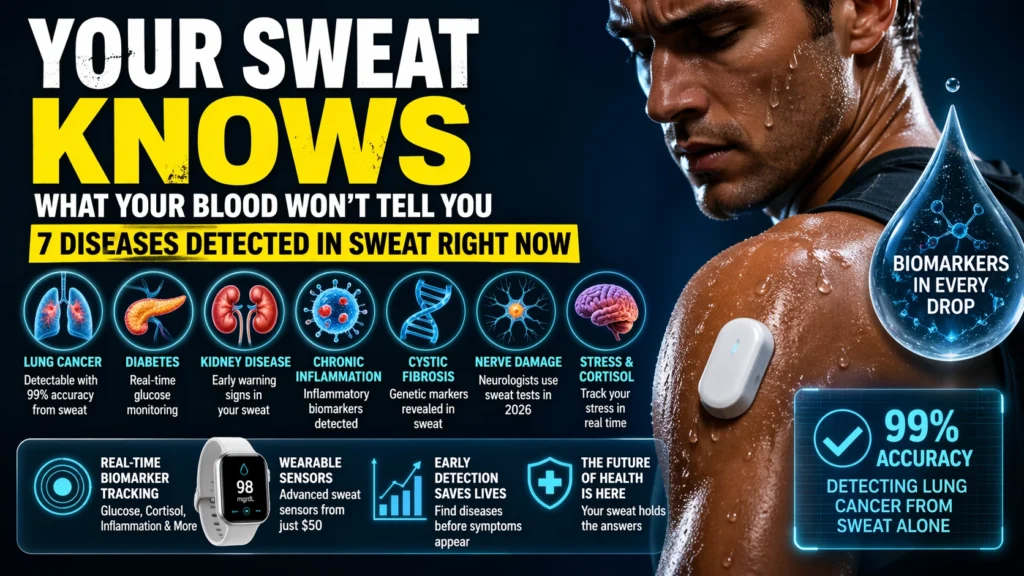

Your blood lies to you. Well, not exactly lies—but it only speaks when you draw it. By then, it might be too late. Meanwhile, your sweat has been whispering the truth about your health for hours, days, even years. Hidden inside every drop are biomarkers that can detect cystic fibrosis, diabetes, chronic inflammation, kidney disease, and even lung cancer—sometimes before symptoms appear. In 2026, neurologists are routinely ordering sweat tests to diagnose nerve damage. Wearable $50 sensors can now measure your glucose, cortisol, and inflammation in real time. And groundbreaking research published just last year achieved 99% accuracy detecting lung cancer from sweat alone. So here’s the question your primary care doctor isn’t asking yet: What is your sweat trying to tell you?
What diseases can be detected in sweat?
Sweat can detect several diseases including cystic fibrosis (via elevated chloride), diabetes (via glucose sensors), chronic inflammation (via IL-6 and CRP), kidney disease (via urea), and emerging research shows lung cancer (via aldehyde biomarkers) with up to 99% accuracy in early trials.
For decades, sweat was viewed simply as the body’s cooling mechanism—an inconvenience during exercise or stress. Today, researchers are redefining sweat as a biomarker powerhouse, capable of revealing critical information about cancer, metabolic disorders, and genetic conditions.
The field of sweat analysis has undergone a revolution. What was once collected with gauze pads and analyzed in labs can now be measured continuously using a sweat monitoring device worn on the wrist or chest. From detecting cancer biomarkers in sweat to managing diabetes with a sweat glucose sensor, this technology is bridging the gap between fitness tracking and clinical diagnostics.
This article explores the latest breakthroughs (2025–2026), the available technology, and what US consumers can access today.
Cancer Biomarkers in Sweat: A Non-Invasive Screening Revolution
One of the most exciting frontiers is the detection of cancer biomarkers in sweat. Unlike tissue biopsies or blood draws, sweat offers a completely non-invasive window into oncological health.
Lung Cancer Detection at 0.1 pM Sensitivity
A groundbreaking 2025 study published in the Chemical Engineering Journal demonstrated a wearable biosensing platform that detects lung cancer biomarkers in sweat with remarkable precision . The platform uses:
- Surface-enhanced Raman spectroscopy (SERS) with silver nanowire-hydrogel composites
- AI-powered analysis (CNN-based AlexNet algorithm)
- Ultrahigh sensitivity with a detection limit of 0.1 pM for aldehyde biomarkers
- 99% diagnostic accuracy in clinical validation
This technology represents a paradigm shift: soon, a simple skin patch could screen for lung cancer without radiation, needles, or specialized facilities .
Breast Cancer Monitoring from the Skin Surface
The European Union-funded SWEATPATCH project (2024–2026) is developing a wireless “Lab-on-a-Patch” to monitor breast cancer treatment response in real time . Rather than detecting cancer itself, this device tracks:
- Volatile organic compounds (VOCs) emitted from sweat on breast skin
- Tumor metabolic changes during chemotherapy or targeted therapy
- Treatment efficacy without repeated imaging or biopsies
The technology shifts oncology from “one-size-fits-all” monitoring to real-time, personalized assessment synchronized with tumor biology .
Extracellular Vesicles: The Next Frontier
Recent research from the University of Oulu (2025) has characterized extracellular vesicles (EVs) in sweat—tiny packages released by cells that contain proteins, lipids, and RNA . These EVs carry molecular signatures of their cell of origin, meaning tumor-derived EVs in sweat could serve as liquid biopsy targets for early cancer detection. Importantly, alginate patches can collect sufficient material without intense exercise, making the process practical for clinical use .
Sweat Sensors: Technology That Fits on Your Skin
The sweat sensor market has exploded with innovations in materials science, microfluidics, and optical detection.
Electrochemiluminescence (ECL) Chips
A 2026 study in Advanced Science introduced an all-soft, skin-conformable ECL chip for sweat metabolite monitoring . Key features include:
- Laser-patterned closed bipolar electrode array
- Microfluidic sweat collector for passive sample transport
- Deep eutectic solvent-based ionogels for signal stability
- Per-chip cost of just $0.106, making mass production viable
Taking glucose as a model analyte, the device accurately captured postprandial (after-meal) glucose changes, demonstrating its potential for diabetes management .
Optical vs. Electrochemical Sensors
A comprehensive 2025 review in Optics & Laser Technology compared detection methods for wearable sweat sensors :
| Detection Method | Advantages | Limitations |
|---|---|---|
| Colorimetric | Intuitive, visible results, low cost | Semi-quantitative, ambient light interference |
| Fluorescence | High sensitivity, real-time | Requires excitation light source |
| SERS (Raman) | Ultra-sensitive, molecular fingerprint | Complex instrumentation |
| Electrochemical | Established, quantitative | Electrode stability, calibration drift |
The review notes that optical methods are gaining traction due to their immunity to electromagnetic interference and potential for miniaturization .
Hydrogel-Based Sensors
Hydrogels—soft, water-absorbing materials—have emerged as ideal interfaces for sweat monitoring devices. A 2025 review in Intelligent Sports and Health highlights that hydrogels offer :
- Biocompatibility and skin conformability
- Tunable properties for specific biomarker capture
- Self-powering capability via motion or sweat-derived energy
- Eco-friendly options using natural polymers like cellulose and alginate
The review notes that future research will focus on multi-biomarker detection and AI integration for smarter health insights .
Sweat Monitoring Devices: From Cystic Fibrosis to Fitness
Clinical Application: Cystic Fibrosis
The most clinically validated sweat monitoring device is the CF Patch for cystic fibrosis management. A 2025 study in PNAS validated this wearable microfluidic sticker against the gold-standard pilocarpine iontophoresis method .
Key findings:
- Strong correlation between CF Patch measurements and laboratory chloridometry
- Enables remote monitoring of sweat chloride levels in people with CF
- Captures day-to-day variability that single clinic visits miss
- Assesses CFTR modulator efficacy and medication adherence
For the 40,000+ people living with CF worldwide, this technology transforms disease management from episodic clinic visits to continuous, at-home monitoring .
Consumer Wearables: Glucose, Cortisol, and Hydration
While clinical devices require FDA approval, consumer sweat monitoring device options are rapidly entering the US market:
| Device Type | Biomarker | Application | Availability |
|---|---|---|---|
| Sweat glucose sensor | Glucose | Metabolic health, diabetes | Limited; some DTC options |
| Electrolyte patch | Sodium, Chloride | Hydration, CF monitoring | Commercial (e.g., Nix, Gatorade) |
| Cortisol sensor | Cortisol | Stress, burnout | Emerging (2025–2026) |
| Lactate sensor | Lactate | Athletic performance | Research-grade |
Galvanic Skin Response (GSR) for Stress
While not a chemical sensor, galvanic skin response (GSR) devices measure sweat gland activity as a proxy for autonomic nervous system arousal . These devices range from:
- €150–499: Entry-level for teaching and simple studies
- €500–2,000: Research-ready with stable signals
- €2,000+: High-precision lab/clinical systems
GSR technology is widely used in stress research, user experience testing, and neuroscience applications .
Sweat Glucose Sensor: The Holy Grail for Diabetes?
The sweat glucose sensor has been a target for non-invasive diabetes management for years. Recent advances bring this goal closer:
The Promise
- Painless, continuous glucose monitoring without fingersticks or implanted sensors
- Real-time feedback for dietary and insulin decisions
- Integration with smartphones and wearables
The Reality
A 2026 ECL-based sweat glucose sensor demonstrated accurate postprandial glucose tracking, but several challenges remain :
- Lag time: Sweat glucose lags behind blood glucose by 10–20 minutes
- Correlation variability: Sweat-to-blood glucose ratio varies by individual, sweat rate, and collection method
- Contamination: Skin surface glucose from environmental sources can confound readings
The NIH study notes that while the technology is advancing rapidly, sweat glucose sensors are not yet FDA-approved as replacements for blood glucose monitoring in diabetes management .
Sweat Analysis: Challenges and Future Directions
A 2025 review aptly titled “Diving into sweat: advances, challenges, and future directions in wearable sweat sensing“ (paraphrased from Huang et al., 2025) identifies critical hurdles :
Current Challenges
- Sample contamination: Skin debris, sebum, and environmental pollutants
- Low analyte concentrations: Many biomarkers exist at trace levels requiring ultra-sensitive detection
- Individual variability: Sweat rate, pH, and composition vary significantly across individuals
- Evaporation effects: Collected sweat changes concentration as water evaporates
- Dynamic range: Sensors must handle both low resting levels and high exercise-induced concentrations
Future Directions (2026–2030)
- Multi-biomarker panels: Simultaneous detection of 5+ analytes per device
- AI-powered interpretation: Machine learning algorithms to distinguish signal from noise
- Closed-loop systems: Sensors that trigger drug delivery or alerts
- FDA-cleared diagnostic devices: Moving beyond wellness into clinical reimbursement
The authors emphasize that while electrochemical methods dominate current devices, optical techniques (colorimetric, fluorescent, SERS) offer compelling advantages for future generations of wearables .
Wearable Sweat Sensor Price: What US Consumers Can Expect
The wearable sweat sensor price landscape varies widely by technology and application:
| Price Tier | Typical Products | Price Range (USD) |
|---|---|---|
| Entry-level | Colorimetric patches, basic GSR | $15–50 (disposable) |
| Mid-range | Electrolyte/hydration patches | $50–200 + consumables |
| Research-grade | High-precision lab sensors | $500–2,000+ |
| Clinical | FDA-regulated diagnostic devices | Not yet commercially available |
Market research from 2026 indicates the global wearable sweat sensor market is growing steadily, with expectations to approach significant scale by 2032 .
What US consumers can already access:
- Nix Biosensors: Hydration and electrolyte monitoring for athletes
- Gatorade Gx Sweat Patch: Sodium loss analysis for training optimization
- Various GSR devices: Stress and arousal tracking (Shimmer, Plux, BIOPAC)
What’s coming (2025–2027):
- Non-invasive glucose patches (regulatory approval pending)
- Cortisol monitoring for stress management
- Multi-biomarker patches for metabolic health
Conclusion: The Future is Sweat-Powered
The evidence is clear: sweat as a biomarker is transitioning from laboratory curiosity to clinical reality. From cancer biomarkers in sweat detected at 0.1 pM concentrations to $0.10 ECL chips for glucose monitoring, the technology is advancing at an unprecedented pace .
For US consumers, the bridge between fitness and clinical diagnostics is already being built. Today’s hydration patches will become tomorrow’s multi-cancer screening tools. The sweat sensor on your wrist may soon detect inflammation, stress, and metabolic disease before symptoms appear.
The next five years will determine whether we fully embrace what our skin has been telling us all along.
What Biomarkers Are Found in Sweat?
Sweat is a complex biofluid containing a wide array of biomarkers that reflect your body’s physiological and pathological state. Research has identified over 80 distinct metabolites and more than 100 proteins in human sweat . These biomarkers fall into several major categories:
Electrolytes and Ions
Metabolites
Hormones and Stress Markers
Inflammatory and Immune Markers
Recent research has confirmed that inflammatory biomarkers in sweat correlate strongly with blood levels :
- C-reactive protein (CRP) : Detected in sweat at 1,300–4,000+ pg/mL
- Interleukin-6 (IL-6) : 3–10+ pg/mL in sweat
- Tumor Necrosis Factor-alpha (TNFα) : 4–7 pg/mL in sweat
- Histamine : Acute stress and allergic response
Proteins and Amino Acids
Advanced proteomic analysis has identified protein biomarkers in sweat including:
- Cytokines (IL-6, TNFα, IL-1β)
- Immunoglobulins (IgG, IgA antibodies) for infectious disease monitoring
- Dipeptides (Leu-Leu, Leu-Phe) as markers of heat stress
- Extracellular vesicles containing disease-specific protein signatures
Emerging Biomarkers
Recent 2025 research has identified novel sweat biomarkers for specific conditions :
- trans-3-Indoleacrylic acid – Differentiates heat stress types
- cis,cis-Muconic acid – Environmental exposure and metabolism
- Orexin A – Cognitive function and sleep regulation
What Are the 5 Essential Biomarkers in Sweat?
While dozens of biomarkers exist, clinical and research applications focus on these five essential biomarkers in sweat due to their diagnostic utility and established reference ranges:
1. Chloride (Cl−) – The Cystic Fibrosis Gold Standard
Concentration in sweat: 10–100 mM
Clinical significance: Sweat chloride testing has been the diagnostic gold standard for cystic fibrosis for decades . Elevated chloride (>60 mM) indicates CF, while intermediate levels (30–60 mM) require further investigation.
Why it’s essential: It’s the only sweat biomarker routinely used in FDA-approved clinical diagnostics. No other biofluid can replace it for CF diagnosis.
2. Glucose – The Metabolic Marker
Concentration in sweat: 10–200 μM (approximately 10–100x lower than blood glucose)
Clinical significance: Sweat glucose correlates with blood glucose, making it a target for non-invasive diabetes monitoring . However, individual variability and lag time remain challenges.
Why it’s essential: It represents the largest commercial market for sweat glucose sensors and is the focus of major wearable technology development.
3. Cortisol – The Stress Hormone
Concentration in sweat: 8–140 ng/L (0.02–0.39 nM)
Clinical significance: Cortisol in sweat reflects psychological stress, circadian rhythm disruption, and HPA axis function . Unlike blood cortisol (which fluctuates with venipuncture stress), sweat cortisol can be measured continuously.
Why it’s essential: It’s the primary stress biomarker in sweat and is already integrated into emerging wearable devices for mental health monitoring.
4. Lactate – The Performance and Perfusion Marker
Concentration in sweat: 5–60 mM (approximately 5–10x higher than blood lactate)
Clinical significance: Sweat lactate indicates muscle fatigue, anaerobic metabolism, and tissue perfusion . Elevated sweat lactate can signal inadequate oxygen delivery in shock or sepsis.
Why it’s essential: It bridges athletic performance monitoring (high consumer demand) with critical care applications (high clinical value).
5. Interleukin-6 (IL-6) – The Inflammation Sentinel
Concentration in sweat: 3–10+ pg/mL (correlates with serum levels)
Clinical significance: Sweat IL-6 reflects systemic inflammation and has been validated in cirrhosis, inflammatory bowel disease, and other chronic conditions . A 2024 study demonstrated that sweat IL-6 levels predict transplant-free survival in liver disease patients.
Why it’s essential: It’s the most clinically validated inflammation biomarker in sweat with direct correlation to serum levels and prognostic value.
Why Would a Neurologist Order a Sweat Test?
Neurologists order sweat tests to evaluate autonomic nervous system (ANS) function, specifically sudomotor (sweat gland) function. This is critical for diagnosing neuropathies affecting small nerve fibers .
The Clinical Rationale
The autonomic nervous system controls sweating through sympathetic cholinergic fibers. When these small nerve fibers are damaged, sweating becomes abnormal—either excessive, reduced, or absent .
Conditions Diagnosed with Sweat Testing
Types of Neurological Sweat Tests
1. Dynamic Sweat Test (DST) – Measures sweat production on lower legs and forearms using pilocarpine (a drug that stimulates sweating) and a weak electrical current .
2. Quantitative Sudomotor Axon Reflex Test (QSART) – Quantifies sweat output from stimulated sweat glands. The American Academy of Neurology endorses QSART for evaluating distal sympathetic polyneuropathy .
3. Thermoregulatory Sweat Test (TST) – Uses whole-body heating to assess sweat distribution patterns across the body .
4. SudoScan/Epidermal Conductance – A quick, non-invasive test measuring electrochemical skin conductance.
Why These Tests Matter
A 2021 consensus statement endorsed by the American Autonomic Society, American Academy of Neurology, and International Federation of Clinical Neurophysiology confirms that sudomotor testing provides laboratory evidence of autonomic neuropathy, even in patients without symptoms .
In clinical practice, these tests influence treatment decisions. A retrospective review found that autonomic testing (including sweat tests) led to treatment changes in many patients, with 73% reporting symptom relief following treatment guided by test results .
What Diseases Can Be Detected in Sweat?
Sweat analysis has evolved from a niche diagnostic tool to a broad platform for disease detection . Here are the conditions currently diagnosable or monitorable through sweat:
1. Cystic Fibrosis (Established Diagnostic Gold Standard)
Detection method: Sweat chloride test (pilocarpine iontophoresis)
What it measures: Elevated chloride and sodium concentrations
Diagnostic criteria:
Clinical status: FDA-approved, routine clinical use since the 1960s. This remains the only sweat-based diagnostic routinely ordered in standard medical practice.
2. Diabetes Mellitus (Emerging)
Detection method: Sweat glucose sensors (wearable, investigational)
What it measures: Sweat glucose correlates with blood glucose, though with a 10–20 minute lag
Clinical status: Available in consumer wearables for metabolic health tracking; not yet FDA-approved for diabetes management
Research status: Multiple 2025–2026 studies demonstrate accurate postprandial glucose tracking via sweat sensors .
3. Systemic Inflammation and Chronic Liver Disease (2024–2025 Validation)
Detection method: AWARE sweat sensor (investigational)
What it measures: CRP, IL-6, TNFα in passively expressed sweat
Key 2024 findings from cirrhosis patients :
- Sweat CRP, IL-6, and TNFα correlate strongly with serum levels
- Sweat IL-6 levels predict transplant-free survival
- Nocturnal inflammation patterns (nighttime peaks) are detectable only through continuous sweat monitoring
- Inpatients with decompensated cirrhosis showed significantly higher sweat cytokine levels than outpatients
Clinical status: Investigational, but validated in peer-reviewed research (npj Digital Medicine, 2024)
4. Kidney Disease / Uremia
Detection method: Sweat electrolyte and metabolite analysis
What it measures: Elevated urea, phosphate, magnesium, and calcium in sweat
Research finding: Patients with renal failure show significant increases in sweat magnesium, calcium, and phosphate levels
Clinical status: Research stage; not yet routine clinical use
5. Infectious Disease Monitoring (Antibody Detection)
Detection method: Wearable sweat patch with immunoassay
What it measures: Disease-specific IgG and IgA antibodies
- Influenza virus (H1N1, H3N2) NP and HA antigens
- Epstein-Barr Nuclear Antigen 1 (EBNA1)
- Cytokine fluctuations during infection
Clinical status: Research-stage technology from Arizona State University; detects antibodies in as little as 10μL of sweat
6. Cancer Biomarker Detection (Emerging Frontier)
Detection method: Surface-enhanced Raman spectroscopy (SERS) and proteomic analysis
What it measures:
- Lung cancer biomarkers (aldehyde compounds) at 0.1 pM sensitivity with 99% accuracy (2025 study)
- Extracellular vesicles containing tumor-derived proteins
- Volatile organic compounds (VOCs) specific to breast cancer
Clinical status: Early research (2025–2026). Not yet clinically available, but promising for future non-invasive cancer screening.
7. Electrolyte Imbalances and Dehydration
Detection method: Ion-selective electrode sensors (available in consumer wearables)
What it measures: Sweat sodium, potassium, and chloride loss during exercise
Clinical status: Commercially available in sports/hydration patches (e.g., Nix, Gatorade Gx). Not yet FDA-approved for medical diagnosis
8. Heat Stress and Exertional Illness
Detection method: Proteomic and metabolomic analysis (research)
What it measures: Novel biomarkers identified in 2025 research: trans-3-Indoleacrylic acid, Leu-Leu dipeptide, cis,cis-muconic acid
Clinical status: Research-stage; potential for future wearable devices to prevent heat stroke
9. Gout and Metabolic Disorders
Detection method: Sweat uric acid sensors
What it measures: Uric acid levels correlate with blood levels
Clinical status: Research-stage; potential for non-invasive gout management
10. Skin Diseases
Detection method: Sweat composition analysis
What it measures: Psoriatic skin shows reduced sweating and electrolyte excretion; atopic dermatitis shows altered sweat composition
Clinical status: Research-stage with dermatology applications
Summary Table: Sweat-Based Disease Detection
Conclusion
The field of sweat-based diagnostics has expanded dramatically. What was once limited to cystic fibrosis testing can now detect inflammation, stress, metabolic disorders, and even cancer signatures with remarkable accuracy .
For neurologists, sweat tests provide essential data on small fiber neuropathy and autonomic dysfunction . For researchers and early adopters, wearable sweat monitoring devices are already available for glucose, electrolyte, and cortisol tracking—bridging the gap between consumer fitness and clinical medicine.
The next five years will likely see FDA clearance for sweat-based inflammation monitors and glucose sensors, making sweat as routine a diagnostic fluid as blood .
Disclaimer: This article discusses emerging research and established clinical tests. Sweat-based diagnostics are not replacements for blood tests or medical advice without physician guidance. Always consult a healthcare provider for diagnosis and treatment decisions.