

⚡ TL;DR
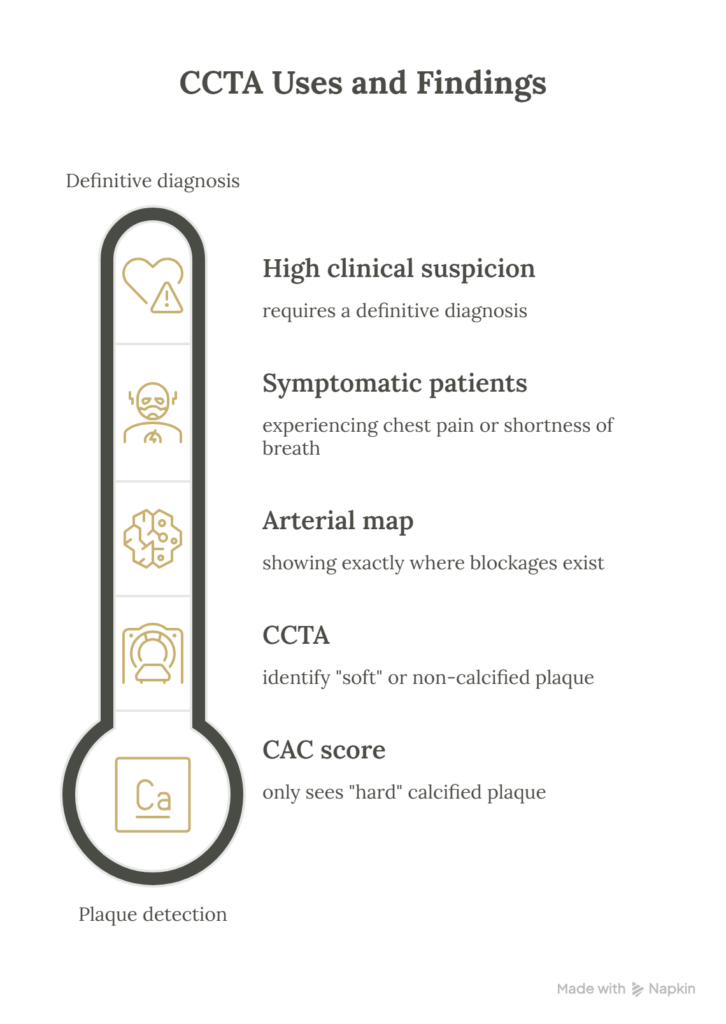
- CAC score is a fast, low-cost, low-radiation scan that measures calcified plaque. Great for risk-stratifying people with no symptoms. It can miss “hidden” soft (non-calcified) plaque.
- CT coronary angiography (CCTA) is a contrast-enhanced scan that sees inside the arteries — including non-calcified plaque and stenosis. More expensive, more radiation, but far more detailed.
- If you have symptoms or high risk: CCTA is usually worth the money.
- If you’re asymptomatic and just want a risk check: CAC is often the smarter first spend.
- Best of both worlds: CAC first, then CCTA if your score is high or symptoms exist.
Introduction
Heart disease remains the leading cause of death worldwide, and its most dangerous trick is silence. Plaque can build inside your coronary arteries for decades without a single symptom — until the day it ruptures. That’s why “hidden” artery disease is the phrase that should get your attention.
Two scans dominate the direct-to-consumer heart-scan market: the coronary artery calcium (CAC) score and CT coronary angiography (CCTA). They sound similar. They are not. One measures a proxy for plaque; the other photographs the plaque itself. Choosing the wrong one — or paying for the wrong one first — can mean wasted money or false reassurance.
This guide breaks down what each scan actually detects, what you’ll pay, who benefits most, and how to decide where your healthcare dollars go furthest.
🔔 Make this your preferred source. If you find guides like this useful, use the button below so eligible Google features can surface Best Heart Scan content when you search for heart-scan comparisons.
Google’s Preferred Sources button only renders in eligible regions/features (currently limited rollout).
What Is a CAC Score?
A coronary artery calcium score is a non-contrast CT scan of the heart. It takes about 10 minutes, requires no IV, no contrast dye, and no fasting in most cases. A radiologist’s software assigns a number — your Agatston score — based on how much calcium is present in the coronary arteries.
Typical interpretation
- 0 — no detectable calcified plaque; very low near-term risk
- 1–99 — mild calcification
- 100–399 — moderate; risk rises meaningfully
- 400+ — extensive calcification; high risk
What it’s good at: cheaply and quickly identifying people whose silent plaque burden is higher than their cholesterol panel suggests. It frequently reclassifies risk upward in people who look “fine” on paper.
What it can’t do: calcium is only part of the story. Young people and people with early, soft, non-calcified plaque — the kind most likely to rupture — can have a CAC score of zero and still be at risk. A CAC of zero is reassurance, not a guarantee.
Typical price: roughly $75–$250 in the U.S. cash market; often $99–$150 at standalone imaging centers.
What Is CT Coronary Angiography (CCTA)?
CT coronary angiography — also called coronary CTA or CCTA — is a contrast-enhanced CT scan. An IV delivers iodine contrast, and the scanner captures the coronary arteries in high resolution, allowing a radiologist to see the lumen (the inside channel) and the wall of the artery.
What it detects
- Calcified and non-calcified (soft) plaque
- Degree of stenosis (narrowing) — mild, moderate, severe
- Sometimes high-risk plaque features (positive remodeling, low-attenuation plaque, spotty calcification) that suggest vulnerability
- Occasionally, extracardiac findings (lung nodules, aortic disease)
What it costs you: more money, more radiation (though modern scanners have cut doses substantially), an IV, possible beta-blockers to slow your heart rate, and a contrast dye load that matters if your kidney function is impaired.
Typical price: roughly $300–$1,500 cash, depending on market and facility; often $500–$900 at outpatient imaging centers.
Head-to-Head: CAC Score vs. CT Angiography
| Feature | CAC Score | CT Angiography (CCTA) |
|---|---|---|
| Detects calcified plaque | ✅ Yes (quantified) | ✅ Yes |
| Detects soft/non-calcified plaque | ❌ No | ✅ Yes |
| Shows stenosis (narrowing) | ❌ No (inferred only) | ✅ Yes |
| Contrast dye / IV | ❌ None | ✅ Required |
| Radiation dose | Very low (~1 mSv) | Low–moderate (~1–5 mSv, scanner-dependent) |
| Scan time | ~10 minutes | ~15–30 minutes (plus prep) |
| Typical cash price | $75–$250 | $300–$1,500 |
| Best for | Asymptomatic risk stratification | Symptomatic evaluation; detailed plaque assessment |
| Limitation | Blind to soft plaque | Cost, contrast, heart-rate dependence, incidental findings |
The honest summary: CAC answers “how much plaque do you have?” CCTA answers “what kind of plaque, and is it blocking anything?” Those are different questions, and the right scan depends on which question you’re actually asking.
Cost Comparison: What You’ll Actually Pay
Insurance coverage is inconsistent for both. CAC is sometimes covered for certain risk profiles; CCTA is more often covered when medically indicated (symptoms, abnormal stress test) but frequently denied for pure screening. Most people shopping these scans are paying cash.
Practical cost math
- A CAC at $100–$150 is one of the highest value-per-dollar tests in preventive cardiology. If it comes back at 300, you’ve learned something that changes management.
- A CCTA at $600+ is a bigger commitment, but if you have chest pain, exertional symptoms, or a strong family history, it can replace a stress test and give your cardiologist actionable anatomy.
- Paying for CCTA when CAC would do is the most common wasted spend. Paying for CAC when you have symptoms is the most common dangerous spend.
Rule of thumb: No symptoms → CAC first. Symptoms or high suspicion → talk to a cardiologist about CCTA.
Who Should Get Which Scan?
CAC score is a reasonable spend if you:
- Are 40–75 with no cardiac symptoms
- Have borderline risk factors (borderline LDL, family history, borderline blood pressure)
- Had a “normal” physical and want objective plaque data
- Want to track plaque progression over years
- Are deciding with your doctor whether to start a statin
CT angiography is a reasonable spend if you:
- Have chest pain, exertional shortness of breath, or palpitations
- Have a strong family history of premature coronary disease
- Had an abnormal ECG or stress test
- Have a high CAC score and need to know if stenosis is present
- Need plaque characterization, not just quantification
Talk to a doctor first if you: are pregnant, have kidney disease, have a contrast allergy, or have an irregular/very fast heart rate (CCTA quality depends on a steady, slow rhythm).
The Case for Doing Both
They’re complementary, not competing. A common sensible sequence:
- CAC first as a cheap gatekeeper. Score 0 with low clinical suspicion → reasonable to defer further imaging and recheck in 5–10 years.
- Score >0, especially >100, or any symptoms → discuss CCTA to characterize plaque and rule out stenosis.
- CCTA findings then drive the real decisions: statin intensity, aspirin, further testing, lifestyle overhaul.
You rarely need both on the same day. You often need both across a decade.
How to Prepare and Where to Go
- CAC: no prep in most cases; avoid caffeine beforehand if your center asks; wear loose clothing. Results in days.
- CCTA: fasting several hours, no caffeine for 24 hours, kidney function labs often required, heart-rate control (beta-blocker may be given), IV placed at the visit. Allow 2 hours.
- Where: hospital-affiliated outpatient imaging centers and standalone cardiac imaging clinics typically beat hospital outpatient departments on cash price. Ask for the self-pay price in writing before you book, and ask what the radiologist read fee includes.
- Bring: prior lipid panels, blood pressure logs, family history, and a list of medications.
Semantic FAQs
Is a CAC score or CT angiography better for detecting hidden artery disease?
CT angiography is better at detecting hidden disease because it sees non-calcified plaque and stenosis. CAC is better at cheaply screening for total calcified plaque burden. “Better” depends on whether you’re screening or diagnosing.
Can a CAC score be zero and still have heart disease?
Yes. A zero CAC means no calcified plaque is detectable. Non-calcified, soft plaque — particularly in younger adults — can be present and dangerous without registering on a calcium score.
Does CT coronary angiography show soft plaque that a calcium score misses?
Yes. CCTA visualizes the artery lumen and wall, including non-calcified plaque, and can flag high-risk plaque features. That’s its main diagnostic advantage over CAC.
How much does a heart scan cost without insurance?
CAC typically runs $75–$250 cash; CCTA typically $300–$1,500 depending on facility and region. Always request the self-pay price and confirm whether the radiologist reading fee is included.
Is CT angiography worth the extra money over a CAC score?
If you have symptoms, a strong family history, or a high CAC score, yes — the anatomical detail can change treatment. If you’re asymptomatic and low-risk, a CAC is usually the higher-value first spend.
Which scan has more radiation?
CAC is very low dose (~1 mSv). CCTA is higher (~1–5 mSv depending on scanner and protocol) but modern scanners have reduced doses significantly. Discuss cumulative radiation with your doctor if you’ve had multiple CTs.
Can I get a CAC score and CCTA at the same appointment?
Sometimes, but it’s usually unnecessary and increases cost and contrast exposure. Most cardiologists sequence them: CAC first, CCTA only if indicated.
Does insurance cover CAC or CCTA?
Coverage varies. CCTA is more often covered when medically indicated (symptoms/abnormal testing). CAC is frequently self-pay for screening. Verify with your insurer and the facility before booking.
At what age should I get a heart scan?
Most guidelines suggest risk discussion around age 40–75 for asymptomatic adults, individualized by family history and risk factors. Earlier screening is reasonable with strong family history — discuss with a physician.
What should I do if my CAC score is high?
See a cardiologist. A high score typically prompts aggressive risk-factor management (statin therapy, blood pressure control, lifestyle changes) and sometimes further testing such as CCTA or stress imaging.
Our Recommendation
If you’re asymptomatic and paying cash: start with a CAC score. It’s the best dollar-for-dollar hidden-risk detector in preventive cardiology. If it’s elevated — or if you have symptoms — graduate to CT angiography with a cardiologist’s guidance. Don’t skip straight to the expensive scan for reassurance, and don’t stop at the cheap one if the number or your symptoms say otherwise.
💡 Shoutout — FlipMyLifeWellness
Looking for curated wellness and preventive-health resources, guides, and tools to support your heart-health journey? Check out FlipMyLifeWellness — your one-stop path for wellness-focused products and information that complement (never replace) your doctor’s advice.
Disclosure & Disclaimer
Affiliate disclosure: This article contains affiliate links, including the FlipMyLifeWellness link above. If you purchase through these links, we may earn a commission at no extra cost to you. This helps support our research and content. We only recommend resources we believe may be relevant to readers.
Medical disclaimer: This article is for informational and educational purposes only and does not constitute medical advice, diagnosis, or treatment. Heart scans involve radiation, contrast dye, and clinical interpretation that require a qualified physician. Always consult your doctor or a licensed cardiologist before scheduling any cardiac imaging, interpreting results, or making treatment decisions. Individual risk factors, symptoms, and medical history vary — what’s right for one person may not be right for another. Do not delay seeking professional medical advice because of something you read here.
Accuracy note: Prices are approximate U.S. cash-market ranges at the time of writing and vary by region and facility. Guidelines and coverage policies change; verify current details with your provider.
P.S. The most expensive heart scan is the one you didn’t need — and the most dangerous is the one you skipped because it seemed too cheap to matter. A $100 calcium score has redirected more lives than most $1,000 workups. Start smart, escalate with evidence, and loop in a cardiologist before you spend a dollar on imaging. Your arteries don’t care about branding — they care about what you do with the information. ❤️